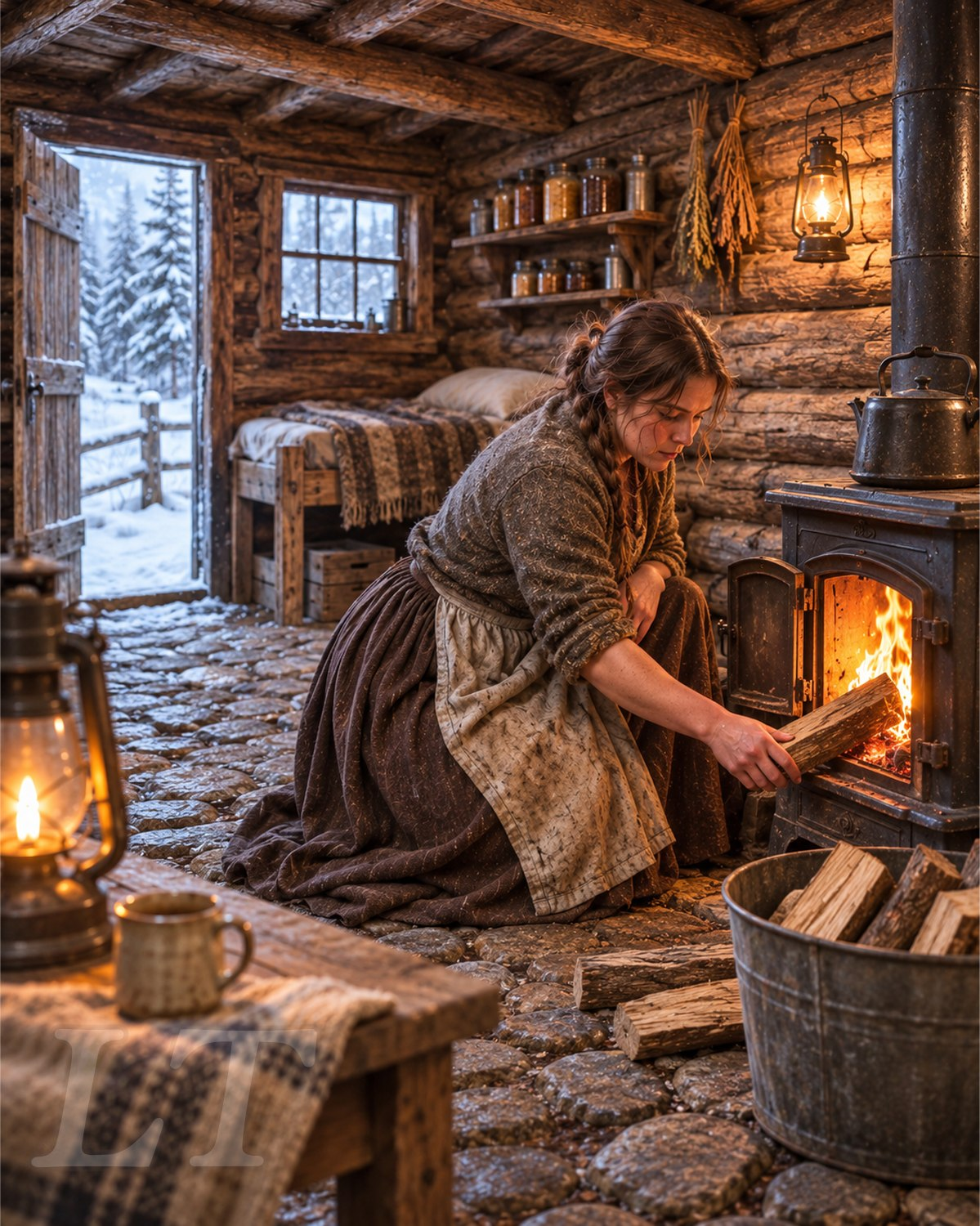
Elspeth dropped the stone when she heard her father's voice.
Not because someone had spoken.
Not because she was frightened.
But because, for one impossible second, she could almost hear him standing behind her.
"Stone has a long memory for fire, lass."
She stared at the smooth gray rock lying beside her boot.
Then she picked it up again.
Outside, the wind moved through the bare branches surrounding the cabin. Sarah slept in her basket near the hearth, and the unfinished floor waited beneath Elspeth's feet.
She turned the stone over in her hands.
It was ordinary.
No markings. No unusual shape. No precious mineral hidden inside.
Just a river stone.
Yet it carried the memory of a childhood she had left thousands of miles behind.
And suddenly, she realized that the answer to her problem might have been waiting inside her memory all along.
Twenty years earlier, in a small village in Scotland, Elspeth had been the daughter of a stonemason.
Her father, Malcolm MacLeod, was not a wealthy man. He owned no grand house, employed no workers of his own, and had never traveled farther than the neighboring counties.
But among the people who worked with stone, he possessed a reputation for understanding materials in ways other men did not.
He could examine a piece of rock and tell whether it would crack under pressure.
He could look at a wall and identify where water would eventually find its way inside.
He understood the difference between stone that merely looked strong and stone that could survive generations.
His hands were broad and permanently rough.
There were pale scars across his knuckles, and his fingernails were almost always dark with dust.
Elspeth remembered those hands more clearly than almost anything else from her childhood.
They were the hands that lifted her when she fell.
The hands that repaired her wooden toys.
The hands that held hers when she was afraid of thunder.
And the hands that taught her to pay attention to things other people overlooked.
When Elspeth was six, she had followed him to work for the first time.
The site was a lime kiln outside the village.
It was an enormous structure built from stone, with an opening where workers fed fuel into the burning chamber.
The work was dangerous.
The heat was intense, and the air carried the sharp smell of smoke and heated limestone.
Malcolm had told his daughter to stay behind a marked boundary.
She obeyed for approximately five minutes.
Then curiosity won.
She approached a large stone wall and placed her palm against it.
"Papa!"
He turned.
"What is it, lass?"
"Why is this wall warm?"
Malcolm walked over.
"Because we've been feeding the kiln all morning."
"But the fire is over there."
"Aye."
She pressed her hand against the stone again.
"It isn't burning."
Her father laughed.
"No, it isn't."
"Then why is it warm?"
Malcolm crouched beside her.
"Because stone doesn't behave like a flame, Elspeth."
She looked confused.
He picked up a small piece of limestone and placed it in her palm.
"Imagine you've been sitting beside a fire on a cold evening. Your hands become warm, don't they?"
She nodded.
"But when you walk away, they begin to cool."
"Yes."
"Stone is different. It can take in warmth and hold it. It doesn't give it back all at once."
He placed the limestone on a nearby ledge.
"Some things surrender what they receive quickly. Other things hold on."
Elspeth studied the stone.
"Like Papa?"
Malcolm laughed so loudly that one of the workers turned around.
"Perhaps."
He lifted her into his arms.
"Stone has a long memory for fire, lass. Never forget that."
She never did.
Over the following years, Malcolm continued teaching her.
He showed her how to recognize different kinds of stone.
He explained why certain stones were suitable for building foundations while others were better used for walls or decorative work.
He taught her that water was often more dangerous than wind.
"People blame the weather when their buildings fail," he once told her. "But often, the trouble began with something they could have prevented. Water got in. Nobody noticed. Winter arrived. Then the damage appeared."
Elspeth had been ten at the time.
She had not understood everything.
But she remembered the seriousness in his voice.
He also taught her about drainage.
A foundation needed a way to release water.
A structure could be strong and still fail if moisture remained trapped where it did not belong.
"Never build something merely because it looks impressive," Malcolm would say. "Build it so it can survive what people cannot see."
Those words returned to Elspeth as she stood inside her Montana cabin.
She looked at the exposed ground.
She looked at the gravel she had collected.
Then she examined the stones waiting beside the wall.
Her father's lessons were not simply about making something warm.
They were about understanding how a structure behaved.
She needed a dry base.
She needed stability.
She needed a way for moisture to escape.
And she needed to understand that storing warmth was different from producing it.
The stove would remain necessary.
But perhaps it did not have to do all the work alone.
That evening, after feeding Sarah, Elspeth opened the small wooden chest that contained the few belongings she had brought from Scotland.
Inside were several old pieces of cloth, a small brass button, two letters, and a folded sheet of paper.
She unfolded it carefully.
It was not a formal drawing.
It was a rough sketch her father had made years earlier, showing part of a stone structure and several layers beneath it.
The paper had yellowed with age.
His handwriting was difficult to read in places, but Elspeth recognized the little notes he had written beside the drawing.
Drainage.
Foundation.
Air passage.
She ran her finger along the pencil lines.
She remembered him explaining that heat could move through materials in different ways.
She remembered watching him work near the kiln.
She remembered the warmth of the stone walls after the fire had gone out.
And she remembered something else.
One evening, when she was perhaps twelve, her father had taken her to inspect a building that had recently been completed.
The owner complained that one room remained cold even when the fireplace burned for hours.
Malcolm examined the structure.
He discovered that the problem was not the fireplace.
The room had been poorly arranged.
Cold air entered through gaps near the floor, while warmth collected higher up.
The owner had spent money on more fuel, believing a larger fire would solve the problem.
Malcolm explained that adding more heat without understanding where it went was a waste.
"Heat is not a thing you can simply command to stay," he told Elspeth afterward. "You must give it somewhere useful to go."
She remembered asking whether that meant a house could be made warm without burning so much wood.
Her father had smiled.
"Not without a source of warmth, lass. But a clever builder can make better use of what the fire provides."
Now, in Montana, those words seemed more important than ever.
Elspeth folded the paper and placed it beside her charcoal sketches.
She was not going to copy the drawing exactly.
The climate was different.
The materials were different.
The cabin was smaller.
And she was working without her father's tools or experience.
But she could use what she remembered.
The following morning, she began measuring the exposed floor again.
She marked the edges of the area she intended to fill.
She checked the slope of the ground and considered where moisture might collect.
Then she moved several stones into place to see how they fitted together.
The first arrangement looked uneven.
She removed them.
The second left too many gaps.
She tried again.
By midday, she had found a pattern that allowed the stones to sit more securely.
She worked slowly, checking each section before moving to the next.
The stones varied in size.
Some were broad and flat.
Others were rounded.
She placed the flatter stones where she needed a more stable surface and used smaller pieces to fill the gaps.
It was exhausting work.
But she was no longer carrying stones simply because she believed they might help.
She had a plan.
For the first time since Tom's death, she felt something other than fear when she looked toward the coming winter.
Not certainty.
Hope.
That afternoon, Sarah woke and began making small noises.
Elspeth put down the stone she was holding and lifted her daughter.
"Your grandfather would have liked you," she whispered.
Sarah reached toward her mother's face.
Elspeth smiled faintly.
"He would have taught you everything he knew."
She kissed the baby's forehead.
"And he would have told you not to listen to people who laugh before they understand."
A sound outside interrupted her.
Someone was approaching.
Elspeth looked toward the window.
A rider had stopped near the cabin.
It was Jedediah Croft.
He had returned.
This time, he was not alone.
Another man sat beside him on horseback.
Elspeth recognized him immediately.
Silas Black.
The trapper had become the loudest voice mocking her work at the trading post.
He had once called her the river witch.
Now he was looking directly toward her open doorway.
Elspeth placed Sarah safely in her basket and walked outside.
Jedediah dismounted first.
"Mrs. MacLeod."
"Mr. Croft."
Silas remained on his horse.
"So it's true," he said.
Elspeth looked at him.
"What is?"
"You're still filling your house with rocks."
"Yes."
Silas laughed.
"Well, I suppose a person has to find something to do after losing a husband."
Jedediah gave him a warning look.
"That's enough, Silas."
But the trapper continued.
"I only came to see whether the stories were true. People say you're planning to heat the whole house with a river."
Elspeth felt her cheeks grow warm.
Not from embarrassment.
From anger.
But she kept her voice steady.
"The stones aren't replacing the stove."
Silas raised his eyebrows.
"Then what are they for?"
"They're meant to hold some of the heat the stove produces."
He laughed again.
"Stones holding heat? I've heard everything now."
Elspeth turned toward Jedediah.
"Would you like to see the drainage bed?"
The carpenter hesitated.
Then he dismounted.
He walked inside and examined the work.
For a moment, he said nothing.
He looked at the gravel.
He looked at the leveled sand.
Then he studied the narrow stone-lined passages she had begun preparing.
"Who showed you this arrangement?" he asked.
"My father."
Jedediah frowned.
"Your father?"
"He was a stonemason in Scotland."
"I know what you told me last time."
"Then you know I didn't invent these ideas without thinking."
The old carpenter crouched and examined the base.
He picked up a handful of gravel.
It was dry.
He rubbed it between his fingers and allowed it to fall.
Then he looked toward the stones.
"You've been careful with the drainage."
"I've tried to be."
"Trying isn't the same as knowing."
"I understand."
He stood.
His expression remained serious.
"Even if the stones retain warmth, you'll still need to prove that this floor can do what you believe it can."
"I know."
"How?"
Elspeth looked toward the stove.
"I'll observe it. I'll measure the temperature. I'll see how long the floor remains warm after the fire goes out."
Jedediah looked at her for several seconds.
It was not the answer he had expected.
He had imagined that she was acting on superstition.
Instead, she was talking about observation.
He opened his mouth to reply.
But Silas interrupted.
"She's measuring rocks now?"
Elspeth ignored him.
She returned to the workbench and picked up her father's old sketch.
"Would you like to see something?"
Jedediah accepted the paper.
He examined the faded lines.
His eyes moved across the notes.
For several seconds, he appeared interested despite himself.
Then he handed it back.
"That's an old drawing."
"Yes."
"From Scotland?"
"Yes."
He looked toward the floor again.
"Well, we'll see."
He walked toward the door.
Before leaving, he turned once more.
"Don't make the passages too narrow. And keep that gravel dry."
Elspeth nodded.
"I will."
It was not approval.
But it was the first time Jedediah had offered practical advice instead of simply telling her to stop.
After the men left, Elspeth returned to her measurements.
She worked until the lantern was lit.
Then she placed the drawing in the wooden chest and covered it with a piece of cloth.
She was tired.
Her hands hurt.
Her shoulders felt as though someone had placed stones across them.
But she had learned something important.
Jedediah Croft might doubt her.
Silas Black might laugh.
The valley might consider her foolish.
None of that changed what she knew.
The stones could store heat.
Her father's lesson was real.
Now she needed to make the floor work.
She carried Sarah to the basket beside the hearth and tucked the blanket around her.
Then she went back to the excavation.
A moment later, she heard another sound outside.
A wagon.
It approached slowly and stopped near the cabin.
Elspeth wiped her hands and walked to the doorway.
Martha was standing beside it.
But she was not carrying bread.
She was holding a folded piece of paper.
Her face was pale.
"Elspeth," she said quietly. "We need to talk."
Elspeth looked at the paper.
"What happened?"
Martha glanced toward the sleeping baby.
Then she lowered her voice.
"It's about Sarah."
And before Elspeth could ask another question, Martha unfolded the paper and showed her the name written at the top.
Sweetwater Valley Community Council.






Comments 0