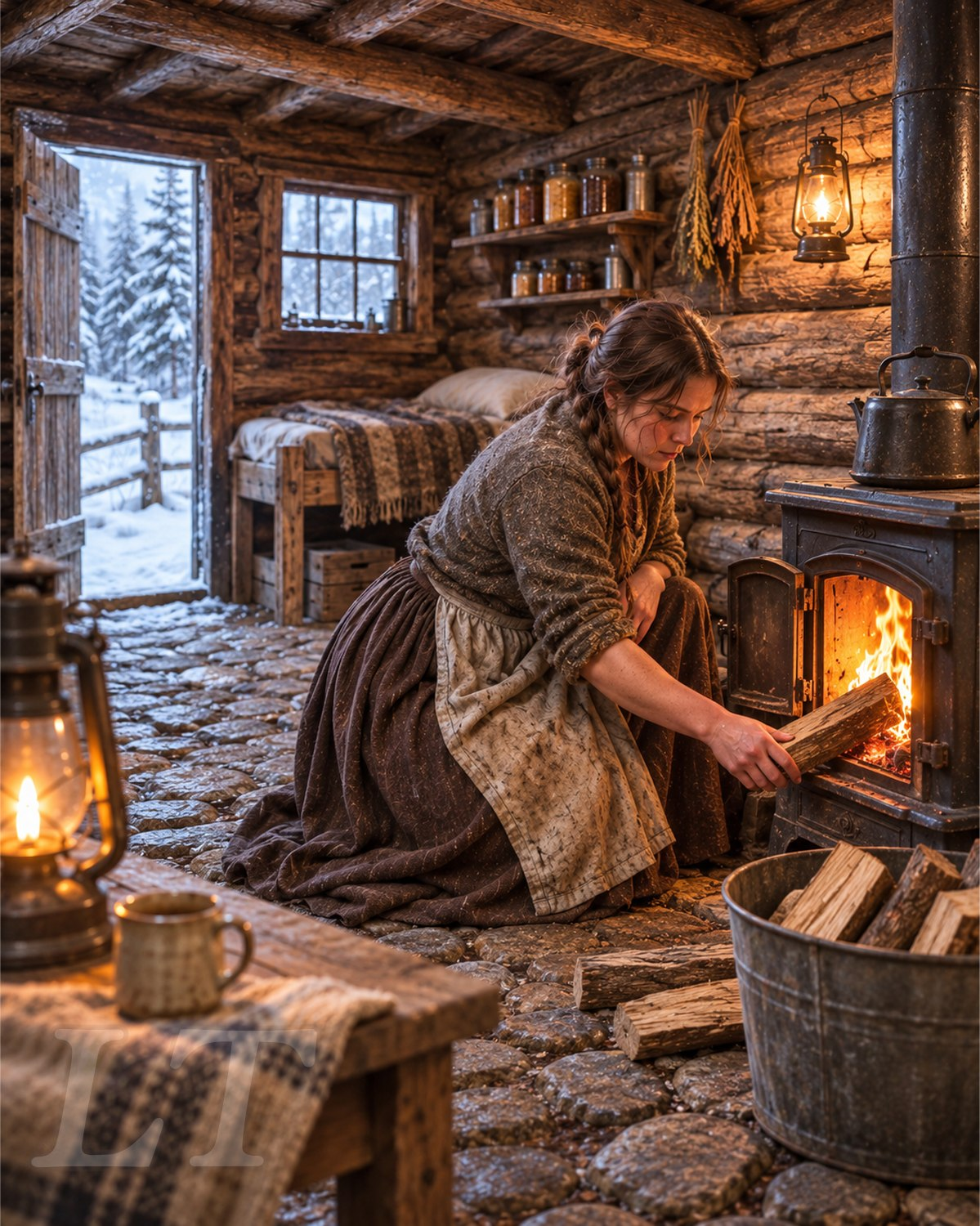
The first stone was placed just after sunrise.
Elspeth MacLeod knelt beside the unfinished floor, holding a smooth gray river stone in both hands.
For a moment, she did not move.
She thought of Tom.
She thought of the promise she had made beside his bed, when their daughter was still an infant and the future seemed impossibly cruel.
Then she thought of her father in Scotland, standing beside his great lime kilns, explaining why stone remembered fire.
She lowered the stone into its place.
"That's the one," Jedediah Croft said.
He stood beside her with a measuring tool in his hand.
"Are you certain?"
Elspeth nodded.
"Yes."
Jedediah smiled.
"Then let's finish what your father started."
Behind them, Martha carried another basket of stones. Walter Hensley was checking the drainage channel, while Andrew examined the measurements from Malcolm's original plans.
For the first time, Elspeth was not working alone.
And for the first time, the people who had once laughed at her were helping her build.
The weeks that followed changed Sweetwater Valley.
The original agreement was officially recognized by the magistrate.
The land beneath the old Colby chamber was restored to the community trust established by Malcolm MacLeod, Andrew Hensley, and Caleb Whitcomb.
The court also confirmed that the original heating design belonged to Malcolm and his surviving family.
Nathaniel Colby's confession was accepted as supporting evidence.
The false documents presented by Silas Black were withdrawn from the court record.
Silas eventually gave a complete statement.
He admitted that he had forged Tom's letter, pressured Martha into signing the guardianship declaration, and attempted to obtain the original plans.
He also revealed that his father had removed several records from the old Colby property years earlier.
Those documents had been kept in the Whitcomb residence.
The magistrate ordered them returned.
With the evidence restored, the dispute over the winter chamber was settled.
Silas was held responsible for his fraudulent actions and ordered to repay the money he had received through the improper transactions.
He also lost his position as an intermediary in the settlement's property dealings.
For several weeks, people discussed the scandal at the trading post.
Some were angry.
Others were embarrassed.
A few admitted that they had believed Silas because it was easier than questioning someone they had known for years.
Elspeth did not celebrate his humiliation.
She wanted the truth established.
She wanted the false accusations removed.
And most importantly, she wanted her daughter to grow up in a place where people understood that fear and dishonesty could destroy a family as surely as winter could destroy a poorly built home.
The court's final decision concerning Sarah arrived on a clear morning in January.
Reverend Abernathy brought the document personally.
Elspeth opened it at the kitchen table.
She read the words once.
Then again.
The guardianship petition was dismissed.
There was no legal basis for removing Sarah from her mother's care.
Martha stood beside her.
Jedediah waited near the stove.
Walter and Andrew sat quietly.
Elspeth lowered the paper.
For a moment, she could not speak.
Then she pressed it against her chest.
"She's staying with me."
Martha began crying.
"Of course she is."
Elspeth looked at her daughter.
Sarah was playing with a wooden spoon beside the hearth.
She had no idea how close she had come to losing the only home she knew.
Elspeth lifted her into her arms.
"You're staying right here, sweetheart."
And this time, nobody could threaten to take her away without cause.
The restoration of the old winter chamber began shortly afterward.
Jedediah organized the work.
Andrew supervised the original land boundaries.
Walter helped identify the damaged passages.
Elspeth brought Malcolm's drawings and Tom's calculations.
They worked slowly.
They did not attempt to recreate every feature of the original structure.
Instead, they repaired the chamber according to the safest parts of Malcolm's design.
The drainage system was rebuilt.
Damaged supports were replaced.
The stone passages were cleared and inspected.
Moisture barriers were added where necessary.
Jedediah insisted that no stone be covered until he had checked its position.
"Stone is patient," he often told the younger workers. "People are not. Don't rush something that has to last."
Elspeth smiled whenever she heard him say it.
The old carpenter had changed.
He still believed in good timber and strong joints, but he no longer dismissed unfamiliar ideas simply because they were unfamiliar.
He began asking questions about heat retention.
He studied the way different stones absorbed warmth.
He even started keeping a notebook of his own observations.
One afternoon, he approached Elspeth with a new drawing.
"I've been thinking about the Colby chamber."
She examined it.
"What have you found?"
"The original passages were wider near the stove. Malcolm may have intended to distribute the heat more evenly through the larger stone mass."
Elspeth studied the measurements.
"That would make sense."
Jedediah smiled.
"Your father was a clever man."
"He was."
"And your husband was clever enough to find his work again."
Elspeth looked down.
"Tom always wanted to understand how things worked."
Jedediah nodded.
"Then perhaps this belongs to both of them."
Elspeth folded the drawing.
"I think it does."
By February, the first community heating project was ready.
The old chamber had been repaired and inspected.
The magistrate arranged for it to remain available to families during severe weather.
No family would be charged for emergency shelter.
Firewood contributions would be voluntary, and the settlement would maintain a common supply.
The rules were written clearly.
The building would be inspected regularly.
The drainage system would remain accessible.
And anyone using the chamber would be taught how to operate the stove and maintain safe ventilation.
Elspeth insisted on that last condition.
"People must understand how the building works," she explained. "Otherwise, they may change something without knowing what it does."
Andrew agreed.
"Your father would have said the same."
The chamber opened on a cold Saturday morning.
Families arrived to see the restored stone interior.
Children ran their hands over the smooth walls.
Older men examined the foundation.
Women asked about the stove.
Jedediah demonstrated the heating passages.
Elspeth explained the drainage bed.
She did not claim that the system could solve every winter problem.
She explained its limitations.
It needed proper construction.
It required dry materials.
It needed regular inspection.
And it worked best when combined with sensible insulation and a well-maintained stove.
People listened.
Some asked difficult questions.
Elspeth answered honestly.
Then an elderly woman approached her.
"My husband used to say that stone was only useful for building walls and fireplaces."
Elspeth smiled.
"What does he say now?"
The woman laughed.
"He says he wants you to help us with our floor next summer."
Elspeth looked toward the restored chamber.
"Then tell him to bring his measuring tools."
The woman laughed again.
For the first time, the name River Witch disappeared from the settlement's conversations.
People began calling her something else.
Mrs. MacLeod.
The young widow who had found a way to make stone remember warmth.
The most important change, however, happened inside Elspeth's cabin.
By the end of February, the floor was complete.
Every stone had been positioned.
The passages had been checked.
The gravel bed remained dry.
The sand layer was level.
And the finished surface covered the entire living space.
It was not polished or elegant in the way the old oak floor had been.
It was rough in places.
Some stones were darker than others.
A few carried pale markings from the river.
But the floor was beautiful to Elspeth.
Every stone represented a journey.
A trip to the creek.
A basket carried uphill.
An evening spent measuring and adjusting.
A small piece of a promise.
The stove no longer needed to burn constantly through the night.
The stone mass absorbed warmth while the fire was burning and released it gradually afterward.
Elspeth recorded the temperatures for several weeks.
She compared the readings with those from the previous winter.
The results were encouraging.
Her cabin remained more comfortable through the coldest hours, and her firewood consumption had decreased.
The improvement was not magic.
It was the result of careful construction, dry foundations, sensible insulation, and a heating system designed to retain some of the warmth that would otherwise disappear.
But to Elspeth, it felt like something miraculous.
One evening, she sat beside Sarah on the warm stone floor.
Her daughter was old enough to crawl now.
She moved slowly across the smooth stones, touching each surface with her small fingers.
Elspeth watched her.
Then she remembered the first winter.
The frozen water bucket.
The ice on the windows.
Tom feeding the stove every two hours.
His cough.
His trembling hand.
She closed her eyes.
For a moment, grief returned.
It never disappeared completely.
But it no longer felt like a weight pressing her into the ground.
She could remember Tom without feeling that she had to stop living.
She could miss him and still laugh.
She could carry his memory while building something new.
Sarah crawled toward her.
Elspeth lifted her into her lap.
"Your father would have loved this floor."
Sarah touched her mother's cheek.
Elspeth smiled.
"He would have loved you even more."
Martha's relationship with Elspeth also began to heal.
It did not happen in a single conversation.
There were difficult days.
Some evenings, Martha apologized again for signing the declaration.
Other times, Elspeth reminded her that forgiveness did not mean pretending the betrayal had never happened.
They learned to speak honestly.
Martha admitted that Silas had frightened her with stories about the court and Sarah's safety.
She also admitted that she had allowed her own uncertainty about Elspeth's grief to influence her decisions.
"I thought you were becoming so focused on the floor that you were forgetting everything else," Martha confessed one afternoon.
Elspeth looked at her.
"I was tired. I was frightened. And sometimes I probably looked as though I had lost my mind."
Martha smiled sadly.
"But you hadn't."
"No. I was trying to keep a promise."
Martha looked toward Sarah.
"I should have trusted you."
Elspeth nodded.
"Yes."
Martha lowered her eyes.
"I cannot change what I did."
"No."
"But I can help you from now on."
Elspeth took her hand.
"Then start by helping me finish Sarah's little wool blanket."
Martha laughed through her tears.
It was not the same trust they had shared before.
It was something rebuilt.
Slower.
More honest.
And strong enough to carry them forward.
Walter and Andrew also made peace with their past.
They returned to the old family property and recovered several remaining documents.
The brothers spent days sorting through papers, tools, and old photographs.
Walter finally learned what had happened after Andrew disappeared.
Andrew had survived the attack near the creek.
He had been taken in by a family traveling west.
For several years, he had lived under another name while recovering from his injuries.
He had eventually learned that Nathaniel was still searching for him.
Rather than risk bringing danger to Walter, he had remained away.
He had intended to return when he could safely prove the truth.
But years passed.
Then illness and financial difficulties delayed him further.
He had only returned after hearing that the winter chamber had been opened and the original agreement might finally be recovered.
Walter listened without interruption.
When Andrew finished, he shook his head.
"You should have trusted me."
Andrew looked at him.
"I know."
The brothers embraced.
They agreed to spend the remainder of their lives preserving the original records.
They also arranged for Malcolm's plans to be copied and stored safely.
The documents would no longer be hidden in cupboards or forgotten beneath walls.
They would belong to the community archive, with the MacLeod family recognized as the original designers.
Andrew eventually offered to help Jedediah teach the younger carpenters how to read the plans.
Walter volunteered to oversee the inspections.
Their family had lost years to fear and misunderstanding.
Now they were using what remained of their time to repair what had been broken.
In March, a letter arrived from Scotland.
Elspeth recognized the handwriting on the envelope.
It belonged to an elderly cousin who had remained in the village where her father once worked.
She opened it carefully.
The letter explained that the old MacLeod workshop still stood.
The building had been maintained by a local family.
The great lime kiln had fallen into disrepair, but the stone hearth remained.
Beneath it, they had discovered a small compartment.
Inside were several old measuring tools and a collection of Malcolm's early drawings.
The family had also found a letter addressed to Elspeth.
Her father had written it shortly before leaving Scotland.
She read it beside the window.
My dear Elspeth,
If this letter reaches you, I hope you have continued asking questions.
Never believe that a person must know everything before beginning something worthwhile.
Good work begins with observation.
Watch how the world behaves. Notice what fails. Learn from what lasts.
And never allow someone else's certainty to make you ashamed of your curiosity.
I have always believed that one day you would use what you learned here.
If that day comes, remember that knowledge is most valuable when it helps someone other than yourself.
Your loving father,
Malcolm.
Elspeth lowered the letter.
She pressed it against her heart.
Then she looked toward the stone floor.
Her father had been gone for years.
Yet his words had traveled across an ocean and reached her at exactly the moment she needed them.
She placed the letter beside Tom's final message.
Two men.
Two promises.
One idea that had survived them both.
Spring arrived slowly in Sweetwater Valley.
The snow began retreating from the hills.
The creek moved beneath its icy surface.
Families returned to their ordinary work.
The old chamber remained open for emergencies, but its main purpose had changed.
It was no longer a forgotten building with a mysterious reputation.
It had become a community shelter.
A place where travelers could rest.
Where families could gather during dangerous weather.
Where children could learn about the importance of proper construction.
And where the story of Malcolm MacLeod's work would be remembered.
Elspeth began helping other families improve their homes.
She never promised impossible results.
She inspected foundations.
She asked about drainage.
She checked ventilation.
She explained the benefits and limitations of stone floors.
Jedediah helped with the construction.
Walter checked the heating passages.
Andrew maintained the records.
Martha organized the deliveries.
Reverend Abernathy helped arrange contributions for families who could not afford materials.
The work grew naturally.
One cabin became two.
Two became five.
And by the end of spring, several families had begun making improvements to their homes.
The settlement no longer viewed Elspeth's work as madness.
They saw it as practical knowledge.
Something worth learning.
Something worth sharing.
On the anniversary of Tom's death, Elspeth visited his grave.
She carried a small basket of river stones.
Sarah walked beside her, holding her mother's hand.
The child was nearly two years old.
She had learned to say several words.
One of her favorites was "stone."
Elspeth placed the stones near the grave.
She stood quietly.
For a long time, she said nothing.
Then she spoke.
"I kept my promise."
The wind moved gently through the grass.
"Sarah is safe. The cabin is warm. Your father's work has been found."
She looked toward her daughter.
"And people are finally learning."
Sarah bent down and picked up a small stone.
She held it toward the grave.
Elspeth smiled.
"Yes, sweetheart. That's for Papa."
The child placed it beside the others.
Elspeth knelt and kissed her daughter's forehead.
She did not cry.
Not because she no longer missed Tom.
But because she had finally learned that love could remain even when grief no longer controlled every moment.
She stood.
"Come on, Sarah. We have work to do."
That summer, the settlement organized a gathering beside the old winter chamber.
The magistrate attended.
So did Reverend Abernathy, Jedediah, Walter, Andrew, Martha, and dozens of families.
The restored building stood proudly near the creek.
Its stone foundation had been repaired.
Its drainage channels were protected.
Its heating passages had been inspected.
And a wooden sign had been placed above the entrance.
THE MACLEOD COMMUNITY WINTER CHAMBER
Beneath the name were two lines.
Designed by Malcolm MacLeod.
Preserved through the work of Thomas and Elspeth MacLeod.
Elspeth stood before the sign holding Sarah.
She looked at the names.
For a moment, she could hardly speak.
The magistrate approached.
"Mrs. MacLeod, the settlement would like you to say a few words."
Elspeth looked at the gathering.
She had never been comfortable speaking in front of large groups.
But she stepped forward.
"I did not begin this work because I believed I could change the valley," she said.
People became quiet.
"I began because I had a daughter to protect. I had very little firewood, and I remembered something my father taught me."
She paused.
"He told me that stone remembers fire."
A few people smiled.
Elspeth continued.
"For a long time, I thought I was trying to save one little cabin. But my father had been thinking about something much bigger. My husband understood that. And many people helped bring their work back to life."
She looked toward Jedediah.
Then Walter.
Then Andrew.
Finally, she looked at Martha.
"I learned that a strong home is not built by one person alone. It is built by knowledge, patience, honest work, and people who are willing to help each other."
She glanced at Sarah.
"I hope my daughter grows up knowing that the warmth inside a home is worth more than the wood used to create it."
The gathering applauded.
Jedediah wiped his eyes and pretended there was dust in them.
Walter laughed.
Martha embraced Elspeth.
And Sarah clapped her small hands because everyone else was doing the same.
Years later, people in Sweetwater Valley would still tell the story of the young widow who replaced her wooden floor with river stones.
Some remembered the winter when the valley nearly ran out of firewood.
Others remembered the day Jedediah Croft entered her cabin expecting to find a freezing mother and child and instead stepped into a room warm enough to make him forget why he had come.
But the story was never really about a clever floor.
It was about a young woman who refused to surrender to fear.
A father whose knowledge crossed an ocean.
A husband who believed in her even when he could not remain beside her.
And a community that eventually learned to recognize the value of an idea before judging the person who carried it.
Elspeth never became wealthy.
She did not seek fame.
She continued living in the small cabin with Sarah, surrounded by the people who had become her family.
She taught Sarah to measure carefully.
To ask questions.
To respect the land.
And to understand that no useful discovery was worth making if it endangered the people it was meant to protect.
Every winter, the stones beneath their feet absorbed the warmth of the stove and returned it slowly through the night.
The firewood lasted longer.
The rooms remained comfortable.
And the cabin stood strong through many more winters.
On especially cold evenings, Elspeth sometimes sat beside the hearth with Tom's letter in one hand and her father's journal in the other.
She would look across the room at Sarah, now growing into a confident young girl.
Then she would place the letters back in their wooden box.
She had kept her promise.
She had protected her daughter.
She had preserved her father's work.
And she had helped build something that would continue serving families long after her own lifetime.
One evening, Sarah asked her a question.
"Mother, why did Grandfather like stones so much?"
Elspeth smiled.
"Because he understood that some things are stronger when they learn to hold on to warmth."
Sarah considered that.
Then she touched the floor.
"Like our house?"
"Exactly like our house."
Outside, snow began falling over Sweetwater Valley.
Inside, the stove burned steadily.
The stones held their warmth.
Sarah slept peacefully.
And Elspeth MacLeod, who had once been called foolish for trusting a river full of stones, finally lived in the kind of home her father had always imagined.
A home that remembered fire.
A home that protected its people.
A home built not merely to survive the winter, but to give the next generation a warmer future.






Comments 0