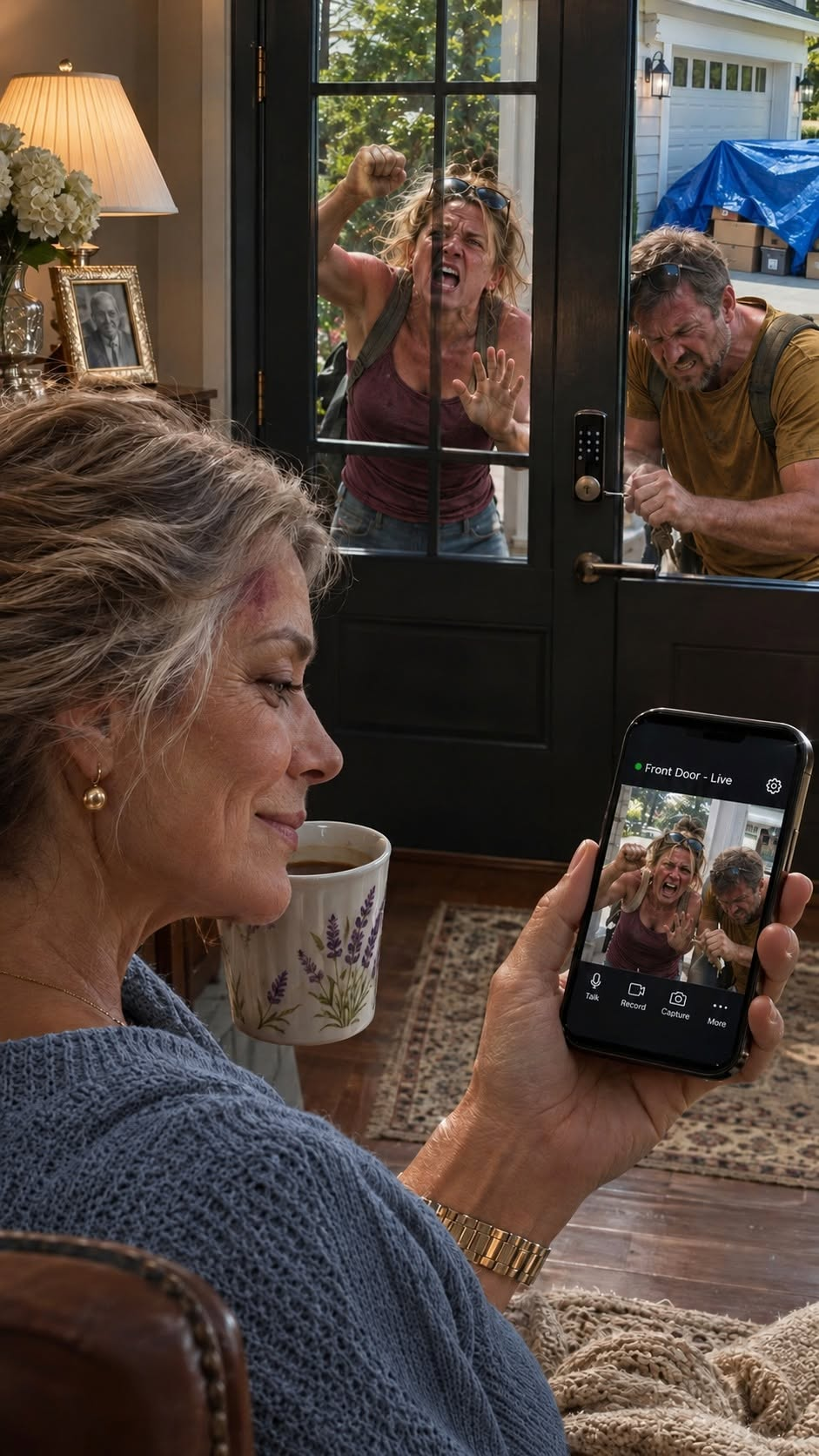
The last paragraph of Sarah's email made me put down my teacup.
Not because she had apologized.
She hadn't.
Not because she had asked whether I was recovering from the head injury she had caused.
She hadn't done that either.
It was because of one sentence.
"Mom, I already told the resort you were covering the remaining balance, so stop embarrassing us and authorize the payment before midnight."
I read it twice.
Then a third time.
My daughter had assaulted me, stolen five thousand dollars from my safe, taken my credit card, and flown to Mexico.
And somehow, in her mind, I was still responsible for making sure she enjoyed her vacation.
I scrolled back to the beginning.
The email was nearly four hundred words long.
Not one of them was "sorry."
Sarah began by complaining about the airline.
Apparently, she and Greg had attempted to upgrade their seats using my stolen credit card. When the transaction failed, they had been forced to deal with airline employees who, according to Sarah, treated them "like criminals."
I almost laughed.
The irony was extraordinary.
She then described the resort.
The oceanfront suite was beautiful.
The restaurants were expensive.
The staff had initially been attentive.
But everything had changed when the hotel attempted to process another payment.
The card had been declined.
Sarah wrote that she had spent forty-five minutes at the front desk while other guests watched.
She said the experience had been humiliating.
Humiliating.
I stared at that word.
I thought about waking up on my hardwood floor with a swollen head.
I thought about the open safe.
I thought about the doctor examining the injury my own daughter had caused.
Then I looked at Sarah's complaint again.
She was embarrassed because a hotel clerk had told her a credit card didn't work.
Apparently, that was the real tragedy.
I continued reading.
"Greg says you probably made some mistake with the bank. You need to call them immediately and tell them to release the charges."
Below that, she had added:
"And don't try telling me you can't afford it. Dad left you plenty."
My fingers tightened around the edge of the laptop.
Robert had been dead for almost four years.
During that time, Sarah had mentioned his life-insurance money more often than she had mentioned missing him.
I remembered the day we received the insurance payment.
I had been sitting at this same kitchen island, staring at the deposit confirmation.
The money had felt wrong.
It was a number on a screen representing the absence of the man I loved.
I would have given every penny back for one more ordinary Tuesday with Robert.
One more cup of coffee together.
One more argument about whether the thermostat was set too high.
One more evening listening to him complain about the baseball game.
Sarah had seen the money differently.
She had called two days after the deposit cleared.
"Mom, now that you're financially comfortable, maybe you can help us with the car."
I remembered looking at the phone in disbelief.
Robert hadn't even been gone three months.
And already, she was calculating what his death might mean for her lifestyle.
I had helped with the car.
Of course I had.
Back then, I still believed generosity could teach gratitude.
Now I knew better.
I opened a blank document and copied Sarah's email into it.
Then I saved a PDF version.
I took screenshots showing the sender, date, and subject line.
I forwarded a copy to a separate email account I used for important records.
The police officer who had taken my report had advised me to preserve anything related to the theft.
I intended to follow that advice.
Then I began writing a response.
"Sarah, I have reported the card stolen. I will not authorize any charges. You and Greg need to make your own arrangements."
I read the sentence.
It was clear.
It was reasonable.
It was also more explanation than she deserved.
I deleted it.
Instead, I typed:
"The card was reported stolen. I will not pay for your vacation."
I hovered over Send.
Then I stopped.
Sarah knew what she had done.
She knew the card wasn't hers.
She knew the money hadn't been a gift.
And she knew why I had canceled it.
A reply wouldn't provide information.
It would simply give her another opportunity to argue.
I deleted the draft.
Then I archived her email.
For the first time in my life, I allowed my daughter's demand to remain unanswered.
It felt strange.
Not frightening.
Just unfamiliar.
I had spent so many years responding to every complaint that silence felt almost like breaking a rule.
But there was no rule requiring me to participate in my own mistreatment.
I closed the laptop.
Then I looked toward the hallway.
The office door was shut.
The safe was empty.
The new locks were installed.
Yet something about Sarah's email bothered me.
She had written that the resort was expecting me to cover the remaining balance.
How had she arranged that?
I wasn't traveling with them.
I hadn't signed a hotel agreement.
I hadn't spoken to anyone in Mexico.
I hadn't authorized a single payment.
Had Sarah simply lied to the hotel?
Or had she used more of my personal information than I realized?
I opened the laptop again.
This time, I searched my inbox for the resort's name.
Nothing appeared.
I searched the airline.
There were two automated messages related to the disputed credit-card transactions.
Then I searched my full name.
A long list of ordinary emails appeared.
Insurance notices.
Bank statements.
Medical reminders.
A receipt from the garden center.
Nothing that explained Sarah's promise.
I sat back.
My head was beginning to ache.
The doctor had told me to rest, and I had already spent too much time staring at a screen.
I closed the laptop and went to the living room.
The oak coffee table was back in its usual position.
I had straightened the rug.
The mail was stacked neatly.
Anyone walking into the room would have thought nothing unusual had happened.
But I knew exactly where my head had struck the table.
I couldn't stop seeing it.
I sat on the sofa and looked at the corner.
For a moment, I heard Sarah's voice again.
"Then open the safe."
I remembered the anger in her eyes.
The sudden force against my back.
The terrible instant when I lost my balance.
I pressed my fingertips against the healing bruise near my hairline.
It was still tender.
I wondered whether Sarah had looked at me after I fell.
Had she been frightened?
Had she checked whether I was breathing?
Had Greg suggested calling for help?
Or had they simply stepped over me and gone looking for the money?
That last possibility was the one I couldn't bear.
Because it meant my daughter had seen me lying unconscious and decided that the contents of my safe were more important.
I stood and walked toward Robert's photograph.
It was the one taken on our thirty-fifth wedding anniversary.
He was wearing a navy jacket.
I was laughing at something he had said.
His arm was around my shoulders.
I picked up the frame.
"You would have known what to do," I whispered.
Then I shook my head.
No.
Robert would have been heartbroken.
He would have been furious.
But he might also have tried to fix everything.
That had been our pattern.
Sarah created the crisis.
Robert and I absorbed the consequences.
We called it keeping the family together.
Perhaps we had actually been teaching our daughter that family meant never having to take responsibility.
I returned the photograph to the table.
"I'm trying something different," I told him.
The next morning, I woke before seven.
My head felt better, although the bruised area remained sore.
I made oatmeal, watered the plants near the kitchen window, and checked my phone.
No calls.
No texts.
One new email.
Sarah again.
The subject line read:
"THIS IS GETTING RIDICULOUS."
I opened it.
"Mom, I know you're seeing these emails. Greg says you're doing this on purpose. If you don't fix the card, we're going to lose our reservation. Do you understand how much money that will cost us?"
I read the message without changing expression.
Then I noticed the final sentence.
"After everything we've done for you, this is how you repay us?"
I leaned back in my chair.
Everything they had done for me.
I tried to think of examples.
Sarah had visited twice during the first year after Robert died.
One visit had been for Thanksgiving.
The other had been to ask whether she could borrow my car.
Greg had helped carry a new washing machine into the laundry room once.
I had paid him for the delivery.
They rarely called unless they needed something.
They never asked whether I had enough groceries.
They never offered to drive me to medical appointments.
And when I was unconscious on the floor, they had left.
I couldn't imagine what debt Sarah believed I owed her.
I archived the email.
Then I made another cup of tea.
At nine-thirty, my phone rang.
The caller ID showed my son David.
I answered immediately.
"Good morning, sweetheart."
"Mom?"
Something in his voice made me straighten.
"What's wrong?"
"Have you talked to Sarah?"
I looked at the laptop.
"Not directly."
He sighed.
"She messaged me."
Of course she had.
"What did she say?"
"That she's stranded in Mexico and needs two thousand dollars."
I closed my eyes briefly.
"Did she tell you why?"
"She said there was a problem with her credit card and that you were refusing to help."
I said nothing.
"Mom, what's going on?"
David was forty-one.
He lived about two hours away with his wife, Emily, and their two daughters.
He worked long hours and rarely complained.
Unlike Sarah, he had never treated my bank account as an emergency fund.
When Robert died, David had taken time off work to help with the funeral arrangements.
He had repaired the broken gate.
He had cleaned the gutters.
He had called every evening for weeks.
He didn't always know what to say.
But he showed up.
I had considered telling him about the assault several times.
Each time, I stopped myself.
He had enough responsibilities.
I didn't want him rushing over in anger.
I didn't want my grandchildren hearing frightening stories about their aunt.
And perhaps, deep down, I still felt ashamed.
As though having a daughter who would hurt me meant I had failed as a mother.
But David was asking a direct question.
I had promised myself I would stop protecting Sarah from the truth.
So I told him.
Everything.
The demand for vacation money.
The argument.
The shove.
The coffee table.
Waking up on the floor.
The empty safe.
The stolen credit card.
The attempted account access.
The police report.
I didn't exaggerate.
I didn't speculate about what Sarah had been thinking.
I simply described what had happened.
David didn't interrupt.
When I finished, the line was silent.
"David?"
His voice sounded different when he answered.
"She knocked you down and robbed you?"
"Yes."
"Mom, are you serious?"
"Completely."
"Did you go to the hospital?"
"I had a medical evaluation. I'm following the doctor's instructions."
"Did you call the police?"
"Yes."
Another silence.
Then I heard him take a slow breath.
"I'm coming there."
"No."
"Mom—"
"David, listen to me."
"She could have killed you."
"I know."
The words surprised both of us.
I hadn't said them aloud before.
David was quiet.
I continued.
"I've changed the locks. I've canceled the card. I've spoken to the bank and the police. I'm taking care of myself."
"That doesn't mean you should be alone."
"I'm not asking you to abandon me. I'm asking you not to make a two-hour drive because you're angry."
"I'm not just angry."
His voice cracked slightly.
"I'm scared."
That nearly broke me.
I sat down.
"Oh, sweetheart."
"You're my mother. I get a message from Sarah saying she's stranded at some fancy resort, and meanwhile you've been hurt in your own house? Why didn't you tell me?"
I looked toward the window.
"Because I knew you'd worry."
"Of course I'd worry!"
"I know."
"That's what families are supposed to do."
I swallowed.
He was right.
There was a difference between protecting someone and shutting them out.
I had been so determined not to become a burden that I had forgotten people who loved me might actually want to help.
"I'm sorry I didn't call sooner," I said.
David exhaled.
"Okay. Tell me what you need."
For a moment, I couldn't answer.
Nobody had asked me that since the assault.
Not Sarah.
Not Greg.
Only the doctor, the officer, and now my son.
"I need you to stay calm," I said.
He gave a humorless laugh.
"That's a pretty big request."
"I know."
"And I need you to promise me you'll call if anything changes."
"I will."
He paused.
"Sarah isn't getting a dime from me."
"That's your decision."
"No, Mom. It's the only decision."
I could hear movement in the background.
A door opening.
Emily asking whether everything was all right.
David lowered his voice.
"Does Emily know?"
"Not yet."
"I'm going to tell her."
"That's fine."
"And Mom?"
"Yes?"
"I'm proud of you for reporting it."
I looked down at my hands.
They were folded around my teacup.
Steady.
Just as they had been when I canceled the card.
"Thank you," I whispered.
After we hung up, I sat quietly for several minutes.
I had expected David to be furious.
He was.
But beneath his anger was something Sarah had stopped showing me years ago.
Concern.
Real concern.
Not concern about money.
Not concern about appearances.
Concern about whether I was safe.
I hadn't realized how badly I needed to hear it.
That afternoon, David sent a message.
"Emily and I are here if you need anything. Please don't hesitate."
I replied that I loved them.
Then I went outside.
The garden needed attention.
Robert had planted the roses along the back fence.
I had nearly lost them the year after he died because I couldn't bear to work in the garden without him.
Eventually, I started caring for them again.
It helped.
There was something comforting about tending to a living thing that responded to patience rather than demands.
I spent an hour removing weeds and trimming dead leaves.
When my head began to ache, I stopped.
I sat on the patio with a glass of water and watched a robin hop across the grass.
For the first time in days, I wasn't thinking about Sarah.
Then my phone buzzed.
Another email.
I almost ignored it.
But the sender wasn't my daughter.
It was a customer-service address from the luxury resort in Cabo.
The subject line read:
"Payment Authorization Verification."
My stomach tightened.
I opened the message.
It was written in polite, professional language.
The resort explained that a guest had provided my name as the person responsible for settling an outstanding balance.
Before processing any further payment arrangements, the billing department wanted confirmation that I had agreed to the charges.
I read the email carefully.
Then I read it again.
There was a reservation number.
A guest name.
Sarah's name.
And a billing contact.
Mine.
I hadn't agreed to anything.
I hadn't spoken to the hotel.
I hadn't authorized my daughter to use my name.
I called the resort using the official contact number listed on its website.
After being transferred to the billing department, I explained that I had received an authorization request.
The representative asked for the reservation number.
I provided it.
She confirmed that the reservation belonged to Sarah and Greg.
Then she asked whether I was the person responsible for payment.
"No," I said.
There was a pause.
"Ma'am, the guests informed us that you had agreed to cover their outstanding charges."
"That is not correct."
"I'm sorry for the confusion."
"There is something else you need to know."
I took a breath.
"My credit card was stolen. I have already reported it to my bank and the police. I do not authorize any charges connected to this reservation."
The representative became very quiet.
Then she asked me to repeat the last part.
I did.
She told me the resort would document my statement and refer the payment issue to its billing and security teams.
I asked for written confirmation that I had disputed the authorization.
She agreed to send it.
Before ending the call, she asked one more question.
"Ma'am, are you aware that the guests requested an additional credit arrangement using your information?"
I felt a chill.
"What kind of arrangement?"
"I'm not able to discuss every detail of the reservation, but I can tell you that the request was not approved."
I gripped the phone.
"Did they submit anything with my name on it?"
The representative hesitated.
"I can document your concern and ask our security department to review the materials."
I thanked her.
Then I ended the call.
I sat at the patio table, staring at the garden.
Sarah hadn't simply told the hotel that I would pay.
She had apparently tried to arrange additional credit using my identity.
I thought about the attempted access to my retirement account.
The stolen card.
The missing cash.
The spare house key.
Each discovery had been worse than the one before it.
And still, my daughter was sending emails demanding that I rescue her.
I went inside and added the resort's message to my folder.
Then I called the officer whose contact information appeared on my police report.
I left a message explaining that I had received new information about possible unauthorized use of my identity.
I didn't know whether it would change the investigation.
But I wanted it documented.
By evening, I was exhausted.
I ate a simple dinner.
I took the medication recommended by my doctor.
I checked the doors.
Then I went upstairs.
For years, I had slept with my bedroom door open.
Robert liked being able to hear the grandfather clock downstairs.
After he died, I continued the habit.
That night, I closed the door.
Not because I was frightened of Sarah returning.
The locks had been changed.
The house was secure.
I simply wanted the comfort of knowing that I could decide which doors stayed open.
And which ones remained closed.
The next two days passed quietly.
Sarah sent more emails.
One accused me of being cruel.
Another said I was destroying her marriage.
A third claimed Greg was furious and that I would be responsible if their vacation ended in disaster.
I saved every message.
I didn't reply.
The resort confirmed that it had recorded my dispute and would not treat me as an authorized payer without proper verification.
My bank sent an update acknowledging the fraud report.
David called every evening.
Sometimes we discussed Sarah.
Mostly, we talked about ordinary things.
His daughters' school projects.
Emily's new job responsibilities.
The weather.
The tomatoes in my garden.
Those conversations reminded me that family could be something other than a constant emergency.
On the fourth afternoon after Sarah's departure, I sat at the kitchen island and opened my laptop.
There was another message waiting.
This one had no greeting.
No explanation.
Only a demand.
"FIX THIS NOW. THEY'RE THREATENING TO CHARGE US FOR EVERYTHING."
I archived it.
Then I noticed a second email from Sarah.
It had arrived seven minutes later.
The subject line was different.
"Mom, please."
I stared at those two words.
For a moment, I wondered whether she was finally ready to acknowledge what she had done.
I opened the message.
"Mom, I know you're upset. Things got out of hand at your house, but you know I didn't mean for you to fall. Greg and I are having a terrible time. We really need your help."
I read it slowly.
Things got out of hand.
I didn't mean for you to fall.
Not "I pushed you."
Not "I hurt you."
Not "I stole your money."
She had turned an assault into an unfortunate accident.
Then she had made herself the victim.
I closed the message.
I was no longer surprised.
That was the saddest part.
The following morning, David called again.
"Mom, I want to ask you something."
"Go ahead."
"Has Sarah ever done anything like this before?"
I looked at the kitchen wall.
There were photographs of both my children when they were young.
David holding a baseball trophy.
Sarah in her graduation gown.
Both smiling.
"Not physically," I said.
He was quiet.
"But she's been taking advantage of me for years."
"Why didn't you tell me?"
"Because I thought I could handle it."
"And now?"
I looked toward the new lock on the back door.
"Now I'm handling it differently."
David sighed.
"Good."
Then he hesitated.
"There's something else."
I waited.
"Sarah contacted Emily."
My stomach tightened.
"What did she say?"
"She told Emily you were having trouble with your memory."
For a moment, I couldn't speak.
David continued.
"She said you were confused about your finances and that she was worried you were making irrational decisions."
I stared at the phone.
Sarah was no longer merely asking other people for money.
She was trying to make them question my judgment.
"Did Emily believe her?"
"No."
His answer came immediately.
"She told Sarah that if she was genuinely worried about your health, she should have stayed after you were injured instead of flying to Mexico."
Despite everything, I felt a small rush of gratitude.
"Good for Emily."
"Sarah stopped replying after that."
I sat down.
David's voice softened.
"Mom, I think you need to be prepared. She's going to keep changing her story until somebody believes her."
I knew he was right.
Sarah had always been skilled at presenting herself as misunderstood.
When she was a teenager, every teacher who disciplined her was unfair.
Every friend who disagreed with her was jealous.
Every employer who criticized her was unreasonable.
Now I was becoming another villain in her story.
The difference was that this time, I had evidence.
Medical records.
A police report.
Banking alerts.
Emails.
And the truth.
After we hung up, I made another folder on my laptop.
I named it "Sarah and Greg—Incident Records."
I saved everything in chronological order.
Then I backed it up.
I wasn't planning revenge.
I wasn't interested in humiliating my daughter.
I wanted to protect myself from whatever story she might tell next.
That evening, I sat in the living room with a book.
I had barely read three pages when the landline rang.
I looked at the clock.
Almost eight.
Most people called my cellphone now.
The landline was mainly for old friends and businesses that still had the number.
I let it ring.
Once.
Twice.
Three times.
Then I stood and walked toward the phone.
The caller ID showed an international number.
Mexico.
I knew who it was before I answered.
I lifted the receiver.
"Hello?"
For a second, there was only background noise.
Voices.
A door closing.
Someone speaking Spanish.
Then Sarah's voice burst through the line.
"Mom! Finally!"
She sounded breathless.
Angry.
Almost frantic.
"Why aren't you answering? Why did you shut off our phones? Do you have any idea what's happening here?"
I pulled out a kitchen chair and sat down.
"I imagine paying for the vacation has become difficult."
"Difficult?" she shouted. "We're ruined!"
I moved the receiver slightly away from my ear.
"The hotel wants payment. The airline says there's a problem with our return tickets. The card keeps getting declined!"
I said nothing.
"Mom, are you listening?"
"Yes."
"Then do something!"
I looked down at my teacup.
My reflection appeared faintly on its dark surface.
I thought about the hardwood floor.
The pain in my head.
The open safe.
The five thousand dollars.
And the silence in my house after my daughter abandoned me.
"That's rough," I said.
Sarah stopped talking.
I continued in the same quiet voice.
"Almost like waking up on the floor after you knocked me out and stole my money."
The line went silent.
Then I heard Greg mutter something.
Sarah's breathing changed.
"Mom," she said, suddenly softer. "It was an accident."
I closed my eyes for one second.
"We just really needed this trip."
I opened them again.
"Use the cash you took."
Another pause.
Then Sarah whispered something to Greg.
He answered sharply.
I couldn't make out the words.
Finally, she spoke.
"The cash is gone."
I stared at the kitchen window.
"All five thousand dollars?"
She didn't answer immediately.
Then she said something that made me grip the receiver.
"Greg lost most of it at the casino."
For several seconds, neither of us spoke.
I had known they were irresponsible.
I hadn't realized they could spend five thousand stolen dollars so quickly.
Sarah began crying.
Not loudly.
Not convincingly.
Just enough to make her voice tremble.
"You have to help us. You're my mother."
"Yes," I replied. "And you assaulted me and robbed me."
Her crying stopped.
"You're really going to keep saying that?"
"Because it's what happened."
"You're making it sound like I attacked you!"
"You pushed me hard enough to knock me unconscious."
"I didn't know you were going to hit the table!"
"But you knew I was lying on the floor."
Silence.
I waited.
"Sarah?"
"What?"
"Did you check whether I was breathing?"
She didn't answer.
"Did you call for help?"
Nothing.
"Did you even look at me before you left?"
I heard Greg say something in the background.
Sarah's voice sharpened.
"We don't have time for this!"
There it was.
The answer I had been waiting for.
Not an apology.
Not remorse.
Just impatience that I was still talking about what she had done.
"Then I suggest you spend your time making arrangements to pay your bills," I said.
"Mom, please!"
"You have the cash you didn't spend. Use whatever is left. Speak to the hotel. Contact the airline. Make arrangements."
"We don't have enough!"
"Then you'll have to figure something out."
Her breathing became ragged.
"You're being cruel."
I looked toward Robert's photograph.
"No, Sarah. I'm refusing to let you hurt me again."
For a moment, she was silent.
Then her voice turned cold.
"If you don't help us, I'll never speak to you again."
I had heard that threat before.
When I refused to buy her a car.
When I wouldn't pay for an expensive anniversary dinner.
When I told her I couldn't babysit at the last minute.
Every time, I had panicked.
Every time, I had apologized.
Every time, I had offered something to repair the relationship.
But now, sitting in my own kitchen with my injured head slowly healing, the threat sounded different.
It sounded like the possibility of peace.
"That's your choice," I said.
Sarah inhaled sharply.
"You don't mean that."
"I do."
"Mom—"
"Goodbye, Sarah."
I ended the call.
Then I sat very still.
My hands were steady.
My breathing was normal.
But my heart hurt.
Not because I regretted what I had said.
Because I finally understood how little my daughter seemed to care about what she had done to me.
I looked at the phone.
For a moment, I thought it might ring again.
It didn't.
Instead, my cellphone lit up on the kitchen counter.
A new message had arrived.
It wasn't from Sarah.
It was from David.
I opened it.
"Mom, call me as soon as you see this. Something just happened."
Before I could respond, another message appeared.
This one contained a photograph.
I tapped it.
The image showed a printed document.
My full name appeared at the top.
Below it was a signature.
A signature that looked almost exactly like mine.
Then David's next message appeared.
"Mom, Sarah sent this to Emily. She says you signed it before they left."
I enlarged the photograph.
There was a date beneath the signature.
The same afternoon Sarah had knocked me unconscious.
And above my name, in bold letters, were four words I had never expected to see.
AUTHORIZATION FOR FINANCIAL RESPONSIBILITY.
I reached for David's number.
Before I could press Call, my phone rang.
It was the officer handling my report.
I answered.
"Hello?"
"Ma'am, this is Officer Reynolds. We need to discuss a document connected to your daughter's case."
I looked at the forged signature again.
"What document?"
He hesitated.
Then he said, "There's something you need to know about who submitted it."
I sat perfectly still.
"Who?"
A second voice spoke in the background.
Officer Reynolds covered the receiver.
I heard papers moving.
Then he returned to the line.
"Ma'am, are you alone right now?"
"Yes."
"Please stay on the phone. I'm looking at the name of the person who witnessed your signature."
I gripped the edge of the table.
"Officer, what name?"
He began to answer.
And the moment he said the first name, I realized the document might involve someone I had trusted for years...






Comments 0