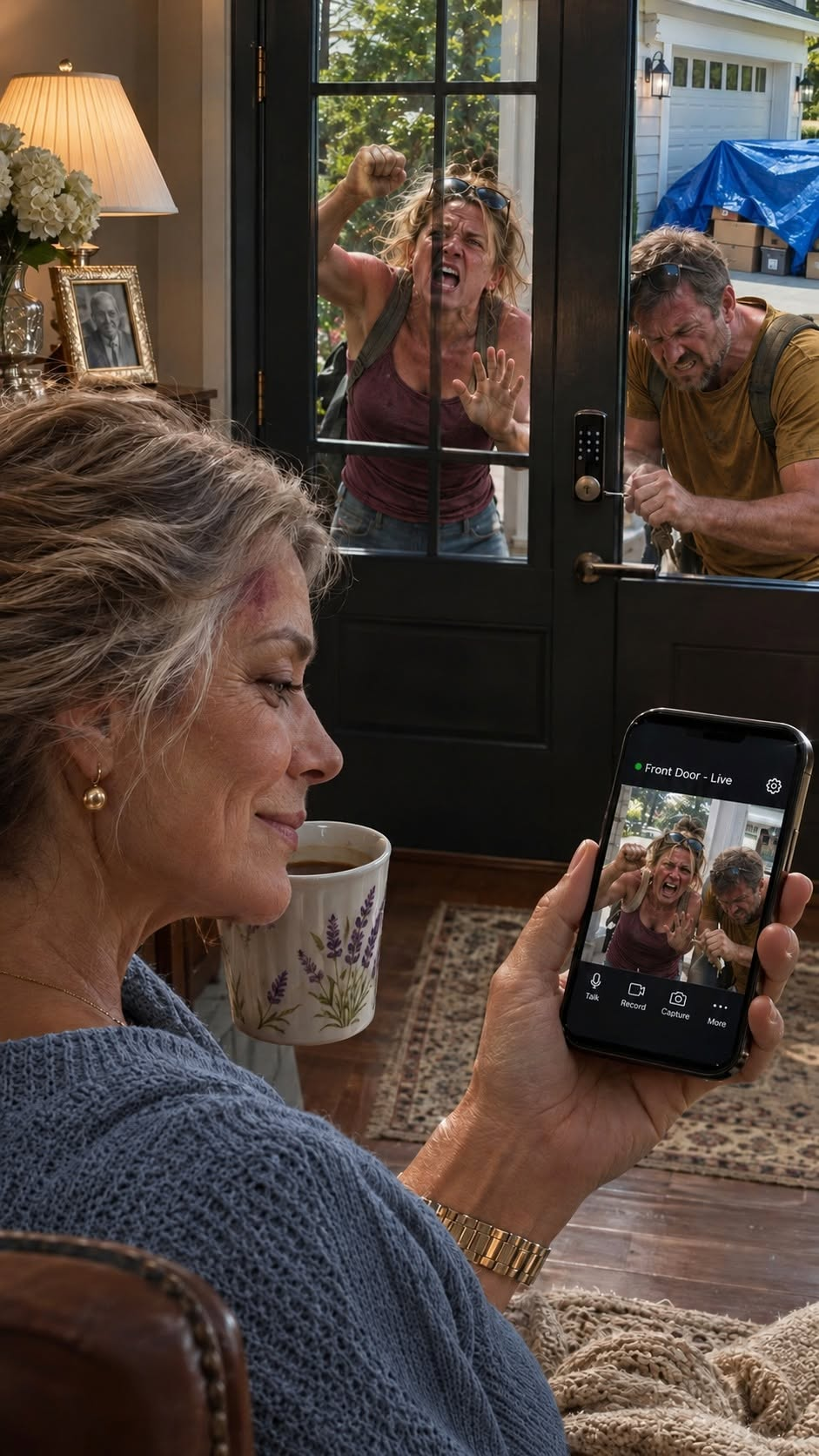
Margaret Collins stood on my front porch at 10:47 p.m., holding a large brown envelope against her chest.
I stared at the security-camera feed.
My oldest friend looked directly into the lens and whispered, "Evelyn, please. I need to tell you something before it's too late."
I didn't move.
On the phone, Linda from the attorney's office was still speaking.
"Mrs. Bennett? Are you there?"
"Yes," I answered quietly.
"Is everything all right?"
I looked at Margaret's face on the screen.
She wasn't wearing her usual cheerful expression. Her silver hair was untidy, and the cardigan she had thrown over her blouse was buttoned incorrectly.
Margaret was a woman who wouldn't walk to her mailbox without checking her appearance in the hallway mirror.
Seeing her like that frightened me more than I wanted to admit.
"Someone is at my front door," I said.
Linda paused.
"At this hour?"
"Yes."
"Are you expecting anyone?"
"No."
I watched Margaret glance over her shoulder toward the driveway.
Then she looked back at the camera.
Her lips moved.
The microphone wasn't activated, so I couldn't hear what she said.
"Mrs. Bennett," Linda continued, "I think it would be best if we discussed these documents in person tomorrow morning."
I looked at the attachment still open on my laptop.
The inquiry form.
The unfamiliar name.
The visitor log.
And the mysterious second person who had accompanied whoever came to the attorney's office.
"Linda, please tell me who signed the visitor log."
"I don't want to give you incomplete information. The records contain two different names, and we need to verify which one belongs to the person who actually attended."
"Can you at least tell me whether the visitor was my daughter?"
There was a pause.
"I can't confirm that tonight."
My stomach tightened.
"Was it Margaret Collins?"
Another pause.
"Mrs. Bennett, please come to the office tomorrow. Mr. Harrison can review everything with you."
I understood her caution.
But understanding didn't make the uncertainty easier.
"All right," I said.
"Can you come at nine-thirty?"
"Yes."
"And Mrs. Bennett?"
"Yes?"
"If you feel unsafe, please contact the police. Don't feel obligated to open your door to anyone."
I looked at Margaret again.
She had taken one step closer to the glass.
"I won't," I promised.
After ending the call, I sat on the edge of my bed.
The house was quiet except for the faint ticking of the clock downstairs.
Margaret remained on the porch.
She hadn't rung the bell again.
She was simply waiting.
I thought about calling David.
Then I looked at the time.
He would probably still be awake, but his daughters had school in the morning.
If I told him Margaret was standing outside my house, he might get into his car immediately.
I didn't want that.
Not yet.
I opened the security-camera application and pressed the microphone button.
"Margaret?"
Her head lifted.
"Evelyn!"
She stepped closer.
"Thank goodness. I was afraid you wouldn't answer."
"What are you doing here?"
She glanced behind her again.
"I need to talk to you."
"It's almost eleven."
"I know. I'm sorry."
Her voice trembled.
"Please, Evelyn. It's important."
I looked at the envelope.
"What's in your hand?"
Margaret lowered her eyes.
"Something I should have shown you months ago."
A cold feeling moved through my chest.
"What something?"
She didn't answer immediately.
Then she said, "I made a mistake."
I stared at her.
Margaret had admitted to giving Sarah a copy of my emergency contact information.
Was this about that?
Or something worse?
"What kind of mistake?"
She looked directly into the camera.
"I believed your daughter."
I felt my jaw tighten.
"About my memory?"
"About more than that."
The words settled heavily between us.
I wanted to open the door.
For twenty-six years, Margaret had been welcome in my home.
She had a favorite chair in my kitchen.
She knew where I kept the good coffee.
She had helped me through some of the worst days of my life.
But I had also trusted Sarah.
And that trust had left me unconscious on the floor.
"Margaret, I'm not opening the door tonight."
Her face crumpled.
"I understand."
I hadn't expected that.
I had expected her to insist.
To remind me how long we'd been friends.
To tell me I was being unreasonable.
Instead, she nodded.
"You're right to be careful."
I watched her wipe her cheek.
"Can you tell me what this is about?"
She looked at the envelope.
"Sarah came to see me before she left for Mexico."
My fingers tightened around the phone.
"When?"
"The morning of the day she came to your house."
I sat straighter.
"Before she pushed me?"
Margaret closed her eyes.
"Yes."
I felt a sudden rush of anger.
"Why didn't you tell me that when we spoke earlier?"
"Because I didn't understand what she'd done until you told me."
"That doesn't answer my question."
Margaret looked ashamed.
"No. It doesn't."
For a moment, neither of us spoke.
Then she lifted the envelope.
"She asked me to keep these papers for her."
"What papers?"
"Copies of documents she said you had authorized."
My heart began pounding.
"Did you sign anything?"
"No."
Her answer came quickly.
"I swear to you, Evelyn. I didn't sign anything."
I thought about the witness signature on the resort authorization.
"Your name appears on a document claiming I agreed to pay for Sarah's vacation."
Margaret went completely still.
"What?"
"Your name. Your signature. It says you witnessed me signing."
She stared into the camera.
Then she shook her head.
"No."
I said nothing.
"No, Evelyn. I never witnessed you signing anything."
"Are you certain?"
"Absolutely."
Her voice rose.
"I would remember that!"
I studied her face.
I had known Margaret long enough to recognize when she was angry, embarrassed, or trying to hide a surprise.
But I had never seen her look quite like this.
She appeared genuinely horrified.
Still, I couldn't allow myself to mistake emotion for proof.
"Then someone used your name without permission," I said.
Margaret looked down at the envelope.
"That's why you need to see these."
I hesitated.
"Leave them on the porch."
She looked up.
"What?"
"Put the envelope beside the door. I'll collect it after you leave."
For a moment, I thought she might be offended.
Instead, she nodded.
"Of course."
She bent down and placed the envelope carefully beside the flowerpot.
Then she stood.
"Evelyn, I am so sorry."
I swallowed.
"Goodnight, Margaret."
"Please call me after you read it."
I didn't promise.
She turned and walked toward her car.
I watched until she drove away.
Then I waited another five minutes.
Only when the driveway was empty did I go downstairs.
The new front-door lock felt solid beneath my hand.
I checked the camera once more.
No one outside.
I opened the door just far enough to retrieve the envelope.
Then I closed it.
Locked it.
And tested the handle.
Twice.
The envelope was heavier than I expected.
I carried it to the kitchen island.
For several seconds, I simply stared at it.
My name was written across the front in Margaret's familiar handwriting.
"Evelyn—Please Read."
I opened it carefully.
Inside were several folded papers.
A photocopy of my driver's license.
A printed email.
Two pages from a financial authorization form.
And a handwritten note.
I recognized Sarah's handwriting immediately.
The note was addressed to Margaret.
"Please keep these safe until Mom is ready to sign the final papers. She gets overwhelmed when we talk about money, and I don't want her worrying herself."
I read it twice.
Then I turned to the printed email.
It had been sent eight months earlier.
From Sarah to Margaret.
The subject line read:
"Helping Mom With Her Finances."
I sat down.
The message was written in a warm, concerned tone.
Sarah explained that I had been forgetting appointments.
That I had become confused about bank statements.
That I sometimes couldn't remember whether I had paid bills.
None of it was true.
I had never missed a mortgage payment.
I had never forgotten a utility bill.
I had never needed Sarah to manage my finances.
But the email made me sound helpless.
Worse, it made Sarah sound loving.
"Mom is very proud," she had written. "She doesn't want to admit she's getting older. I'm trying to protect her without making her feel like she's losing control."
I stared at those words.
Protect her.
My daughter had used the language of care to describe taking control of my money.
I turned the page.
There was another email.
This one was from Margaret.
"Sarah, I understand you're worried, but Evelyn seems perfectly capable to me. I don't think you should make any changes without discussing them with her directly."
I stopped.
Margaret had questioned her.
She hadn't simply accepted everything.
I kept reading.
Sarah had replied the next day.
"That's exactly the problem. Mom acts normal around other people. At home, it's different. Please don't mention this to her yet. I don't want her to feel embarrassed."
I leaned back.
There it was.
The trap.
If Margaret believed Sarah, my denials could be interpreted as proof that I was hiding my condition.
If I became angry, Sarah could say I was emotionally unstable.
If I refused financial help, she could claim I was confused.
It was a story designed to make every response work against me.
I looked at the next document.
A partially completed financial authorization request.
My name appeared in the account-holder section.
Sarah's name appeared under proposed authorized person.
The form was unsigned.
A yellow sticky note was attached to the corner.
In Margaret's handwriting, it read:
"Do not submit without Evelyn's direct approval."
I felt a wave of relief so strong that I had to close my eyes.
Margaret had not agreed to the arrangement.
At least, not according to these papers.
She had questioned it.
She had warned Sarah.
But she had still kept the documents.
And she had still failed to tell me.
I understood why she might have believed she was protecting me.
I also understood how dangerous her silence had become.
I opened the final folded page.
It was a copy of a letter Sarah had written to Margaret three weeks before the vacation.
"Margaret, I'm getting worried about Mom's spending. She keeps talking about giving money away and making changes to her accounts. Greg thinks we need to step in before she does something irresponsible."
I stared at the sentence.
Giving money away?
I had donated fifty dollars to the local animal shelter.
That was the only unusual expense I could remember.
Then I reached the final paragraph.
"Please don't tell David yet. He'll overreact, and Mom will get upset. We need to handle this quietly."
I set the paper down.
David.
Of course.
Sarah had been trying to keep him out of the situation from the beginning.
He was the one person in our family who would have questioned her story immediately.
The one person who had never depended on my money.
The one person who knew I was perfectly capable of managing my own affairs.
I looked at the documents spread across the kitchen island.
For months, Sarah had been building a picture of me as a confused old woman.
Not because she cared about my health.
Because she wanted access to my finances.
I took photographs of every page.
Then I called David.
He answered sleepily.
"Mom?"
"I'm sorry to wake you."
His voice sharpened.
"What's wrong?"
"Margaret came to my house."
"What?"
"She brought some documents."
"Is she still there?"
"No. I didn't let her inside."
"Good."
I explained what had happened.
The emails.
The financial authorization form.
The handwritten notes.
David listened quietly.
When I finished, he said, "Mom, send me everything."
"I will."
"And send it to Officer Reynolds."
"That's my plan."
He was silent for a moment.
Then he asked, "Do you believe Margaret?"
I looked at the sticky note.
Do not submit without Evelyn's direct approval.
"I believe she was manipulated," I said.
"That doesn't mean she didn't make mistakes."
"I know."
"Are you going to forgive her?"
I thought about the woman standing on my porch.
The tears in her eyes.
The envelope against her chest.
"I don't know yet."
David didn't push.
"That's fair."
Then he asked something that surprised me.
"Mom, have you considered talking to a lawyer about protecting your finances?"
"I have an appointment tomorrow."
"Good."
"I want to make sure Sarah can't use any of these documents."
"Exactly."
He paused.
"And Mom?"
"Yes?"
"I'm glad you didn't open the door."
I looked toward the hallway.
"So am I."
After we hung up, I sent the photographs to David and Officer Reynolds.
Then I placed the original papers back into the envelope.
I labeled it with the date and time Margaret had delivered it.
I saved the security-camera recording.
By the time I finished, it was almost midnight.
I should have gone to bed.
Instead, I sat at the kitchen island, looking at the documents.
The more I read, the more I realized how carefully Sarah had chosen her words.
She never directly accused me of being incapable.
She suggested concern.
She never demanded control.
She offered help.
She never said she wanted my money.
She claimed she wanted to protect it.
It was the same pattern she had used since childhood.
Make the demand sound reasonable.
Make the refusal sound cruel.
Then wait for me to surrender.
Only this time, she had gone much further.
She had involved other people.
She had used my age.
She had used my grief.
And when none of it worked, she had used violence.
I looked toward Robert's photograph.
For years, I had wondered whether I had been too hard on Sarah.
Now I wondered whether I had been too easy.
I didn't sleep much that night.
Every time I closed my eyes, I saw the signature on the resort document.
My name.
Margaret's name.
The date of the assault.
Someone had created that document while I was injured.
Or shortly afterward.
I wanted to know exactly when.
And I wanted to know who had helped.
At eight the next morning, I made coffee and dressed carefully.
I chose a cream blouse and dark trousers.
I brushed my short silver hair.
I put on the earrings Robert had given me for our thirtieth anniversary.
Then I looked in the mirror.
The bruise near my hairline was still faintly visible.
I didn't cover it.
I wasn't ashamed of what had happened.
I was ashamed that I had spent so many years pretending Sarah's behavior was normal.
At nine, I left for Mr. Harrison's office.
The drive took twenty minutes.
I had been there many times before.
Robert and I had signed our wills in that building.
We had discussed retirement plans.
We had updated our estate documents after David's first daughter was born.
I knew the receptionist.
I knew the waiting room.
I even knew which chair Robert always chose.
He liked the one near the window.
When I arrived, Linda greeted me immediately.
"Mrs. Bennett, thank you for coming."
She looked concerned.
"How are you feeling?"
"Better, thank you."
She glanced at the bruise.
Her expression softened.
"Mr. Harrison is ready for you."
I followed her down the hallway.
Mr. Harrison stood when I entered.
He was in his early sixties, with neatly combed gray hair and the calm manner of a man who had spent decades helping families through difficult decisions.
"Evelyn," he said gently. "I'm very sorry about what you've been dealing with."
I shook his hand.
"Thank you."
He gestured toward a chair.
"Please sit."
Linda placed a folder on the desk.
Mr. Harrison opened it.
"I want to begin by reassuring you of something."
I waited.
"No changes have been made to your estate documents through this office."
I released a breath I hadn't realized I was holding.
"Thank goodness."
"Your existing arrangements remain in place."
"And Sarah has no authority over my accounts?"
"Not through any document we've prepared."
I nodded.
He continued.
"However, we did receive an unusual inquiry last month."
I leaned forward.
"From whom?"
He looked at Linda.
She placed a printed visitor log in front of him.
"That's what we need to clarify."
Mr. Harrison turned the page toward me.
The first name was unfamiliar.
A woman named Patricia Wells.
I frowned.
"I don't know anyone by that name."
"That was the name used in the initial email inquiry."
He pointed to another line.
"But the person who visited our office signed in under a different name."
I looked down.
Margaret Collins.
My stomach tightened.
"Margaret?"
Mr. Harrison nodded.
"Someone used her name."
"Did you see the person?"
"No. Linda handled the initial conversation."
I turned toward her.
Linda looked uncomfortable.
"The woman said she was a longtime family friend. She asked whether we could provide general information about updating financial authorization documents."
"Did you give her anything?"
"Only publicly available information about the process. We did not release your private records."
I felt relieved.
"Did she show identification?"
"No. We didn't discuss confidential matters, so identification wasn't requested."
I looked at the visitor log again.
Margaret's name.
But the handwriting didn't resemble hers.
Not even slightly.
Margaret wrote in rounded, careful letters.
The signature on the log was sharp and hurried.
I pointed to it.
"That's not her handwriting."
Mr. Harrison nodded.
"We suspected there might be a problem."
"Was the visitor alone?"
Linda shook her head.
"No."
I remembered the phone call.
The second person.
"Who was with her?"
Linda opened another page.
"The visitor was accompanied by a man."
My pulse quickened.
"Greg?"
"We can't confirm that."
"Did he give a name?"
"He signed the visitor log."
She turned the page.
I looked at the signature.
It was difficult to read.
But the first name was clear.
Gregory.
I sat back.
Greg's full name was Gregory Bennett.
Sarah's husband.
The man who had stood in my living room while she demanded money.
The man who had watched me lie unconscious.
The man who had helped take my cash.
I stared at the signature.
"That looks like his name."
Mr. Harrison spoke carefully.
"We cannot establish identity from handwriting alone. But the timing is concerning."
I nodded.
"Did they ask about my life-insurance money?"
Linda looked at her notes.
"The woman asked whether a beneficiary could be changed without the account holder appearing in person."
I felt cold.
"What did you tell her?"
"That any changes would depend on the specific account and applicable requirements, and that we couldn't assist with your private affairs without proper authorization."
I looked at Mr. Harrison.
"Did they ask about my house?"
He hesitated.
Then nodded.
"They asked generally about transferring property into a family trust."
I stared at him.
My house.
Robert's house.
The home we had spent decades paying for.
Sarah hadn't been satisfied with the five thousand dollars.
She had been asking questions about everything.
I felt anger rising.
Not the explosive kind.
Something quieter.
Heavier.
I looked down at my hands.
They were steady.
"Mr. Harrison," I said, "I want to make sure no one can use my name to make decisions without my permission."
He nodded.
"That's exactly what we're going to review."
For the next hour, we went through my estate documents.
He explained the importance of confirming authorized contacts, protecting personal information, and monitoring for fraudulent requests.
We discussed whether additional safeguards were appropriate.
He recommended contacting the relevant financial institutions directly to verify that no unauthorized changes had been made.
He also suggested placing a fraud alert with the credit bureaus and reviewing my credit reports.
I wrote everything down.
I wasn't going to rely on memory alone.
Not because Sarah was right about my age.
Because careful records mattered.
When we finished, Mr. Harrison closed the folder.
"Evelyn, I want you to understand something."
I looked at him.
"Someone asking questions about your finances doesn't automatically mean they have legal authority to act."
"I understand."
"But the combination of these inquiries and the theft you've reported deserves serious attention."
I nodded.
"That's why I'm here."
He gave me a small, approving smile.
"Good."
Before leaving, I asked Linda whether the office had security cameras.
She nodded.
"Yes."
"Would there be footage from the day those visitors came?"
"Possibly. We would need to check our retention system."
Mr. Harrison said he would preserve any available records and coordinate appropriately with the investigating officer.
I thanked them both.
Then I returned to my car.
I sat behind the steering wheel for several minutes before starting the engine.
I felt exhausted.
But also strangely clear.
Sarah had spent months trying to make me appear incapable.
Yet every professional I had spoken to had treated me as exactly what I was.
An adult woman managing her own affairs.
A victim reporting a crime.
A homeowner protecting her property.
A mother setting boundaries.
Nothing more.
Nothing less.
When I arrived home, the driveway was empty.
The blue tarp beside the garage fluttered slightly in the breeze.
Underneath it were several boxes of Sarah's belongings.
I had arranged for the heavier items to be moved and stored safely until proper collection arrangements could be made.
I wasn't going to destroy anything.
I wasn't going to give Sarah another reason to claim I had mistreated her.
I simply wanted her belongings removed from my living space.
I parked the car and walked toward the front door.
The new lock clicked smoothly.
Inside, the house smelled faintly of coffee and lemon furniture polish.
I set my handbag on the console table.
Then I noticed the answering machine blinking.
One new message.
I pressed Play.
Margaret's voice filled the hallway.
"Evelyn, it's me. I know you probably don't want to talk to me right now. I understand. But I remembered something after I left last night."
I stood still.
Her voice trembled.
"When Sarah came to my house, Greg waited in the car. I didn't think anything of it at the time."
A pause.
"After she left, I found something on my kitchen table. I thought it was junk mail, so I put it in a drawer."
Another pause.
"Evelyn, I looked at it this morning. It's a receipt."
My heart began beating faster.
"A receipt from a printing service. It has your name on it."
I gripped the edge of the console table.
Margaret continued.
"And there's something else. The date is the same day Sarah came to your house."
The message ended.
I stared at the machine.
A printing service.
A receipt.
My name.
The day of the assault.
I reached for my phone and called Margaret.
She answered immediately.
"Evelyn?"
"Margaret, tell me about the receipt."
"Oh, thank goodness you called."
"What does it say?"
She rustled papers.
"It lists document printing and copying. Several pages."
"Does it say what documents?"
"No. But there's an order number."
I thought about the forged signature.
The resort authorization.
The financial forms.
"Can you send me a photograph?"
"Of course."
"And Margaret?"
"Yes?"
"Please don't throw anything away."
"I won't."
Her voice broke.
"Evelyn, I swear I didn't know what Sarah was doing."
I closed my eyes.
"I know you say that."
"I should have told you she was asking questions. I should have come to you directly."
"Yes," I said quietly. "You should have."
She began crying.
I didn't rush to comfort her.
Not because I wanted to hurt her.
Because I needed her to understand that an apology didn't erase the consequences of silence.
"I'll send the photograph," she whispered.
"Thank you."
After we hung up, I stood by the kitchen window.
My phone buzzed.
The image arrived.
I opened it.
The receipt was from a local print-and-copy shop.
The date matched the day Sarah assaulted me.
The order had been placed at 2:18 p.m.
I stared at the time.
I remembered looking at the clock shortly before Sarah and Greg arrived.
It had been just after one.
The argument had lasted perhaps twenty minutes.
I had lost consciousness sometime after that.
When I woke up, the sunlight had shifted across the floor.
I had no way of knowing exactly how long I had been unconscious.
But the receipt raised a disturbing possibility.
Someone had been printing documents while I lay injured in my home.
I enlarged the image.
There was a customer name.
Gregory Bennett.
And beneath it, a description of the order.
"Authorization packet—six pages."
I felt a wave of nausea.
I saved the photograph.
Then I called Officer Reynolds.
He wasn't available.
I left a message.
Afterward, I sat at the kitchen island and opened my laptop.
I searched for the printing service.
It was only fifteen minutes from my house.
I considered driving there.
Then I stopped.
I wasn't an investigator.
I didn't need to confront employees or demand information they might not be allowed to provide.
I could preserve the receipt and let the police follow up.
I had learned something important over the past week.
Protecting myself didn't mean doing everything alone.
Sometimes it meant knowing when to ask the right people for help.
I closed the laptop.
Then I noticed a new email.
From Sarah.
The subject line read:
"YOU'VE GONE TOO FAR."
I stared at it.
I had canceled my stolen card.
Protected my accounts.
Changed my locks.
Reported the assault.
And refused to pay for a luxury vacation.
Apparently, that was going too far.
I opened the message.
It was short.
"Mom, Greg and I know you've been talking to people about us. You're making us look terrible. If you keep this up, don't expect us to be nice when we get home."
I read it twice.
Then I saved it.
I forwarded it to Officer Reynolds.
And I did not reply.
An hour later, David called.
"Mom, I just got a message from Sarah."
I sighed.
"What now?"
"She says they're trying to arrange a flight home."
"Good."
"She also says you're trying to ruin their lives."
I looked at the email on my screen.
"She's confusing consequences with revenge."
David was quiet.
Then he said, "Mom, I think you need to be prepared for them to show up."
"I am."
"Do you have the camera notifications turned on?"
"Yes."
"And the new locks?"
"All working."
"Promise me you won't open the door."
I looked toward the entrance.
"I promise."
He exhaled.
"Okay."
Then he added, "Emily and I are coming this weekend, whether you like it or not."
I smiled faintly.
"Bring the girls."
"We will."
After we hung up, I made tea.
I sat in the living room and watched the afternoon sunlight move across the floor.
For a while, everything was quiet.
Then my phone rang.
Unknown number.
I almost ignored it.
But something made me answer.
"Hello?"
A man's voice spoke.
"Is this Evelyn Bennett?"
"Yes."
"My name is Daniel Price. I'm calling from the print-and-copy shop on Westfield Avenue."
I sat straighter.
"How can I help you?"
There was a pause.
"Ma'am, I believe someone used your name for a document order here last week."
My heart began pounding.
"Why are you calling me?"
"Because we received a request to reprint the same documents, and something about it didn't seem right."
I gripped the phone.
"What kind of documents?"
He hesitated.
"I'm not sure I should discuss the contents over the phone."
"Then why did you call?"
Another pause.
"Because the person who placed the new order gave us your home address for delivery."
I looked toward the front door.
"My address?"
"Yes, ma'am."
"When is the delivery supposed to happen?"
He didn't answer immediately.
Then he said, "That's the problem."
I stood slowly.
"What problem?"
"The courier already left."
I stared at the hallway.
"How long ago?"
"About twenty minutes."
I looked at the clock.
Then my phone vibrated.
A security-camera notification appeared.
Motion detected—Front Door.
I opened the live feed.
A delivery van was parked in my driveway.
A man in a dark jacket stood on the porch holding a large white envelope.
He looked down at the address.
Then he glanced toward the camera.
I pressed the microphone button.
"Can I help you?"
The man looked up.
"Delivery for Evelyn Bennett."
"Who sent it?"
He checked the label.
Then he frowned.
"That's strange."
My stomach tightened.
"What is?"
He turned the envelope over.
"Ma'am, the sender's name is the same as the recipient's."
I stared at the screen.
My name.
My address.
A package I had never ordered.
Then the courier lifted the envelope toward the camera.
A bright red stamp covered the lower corner.
CONFIDENTIAL—SIGNATURE REQUIRED.
I looked at the phone.
"Please leave it there. I won't sign for anything I didn't request."
The courier hesitated.
Then he checked his handheld device.
"Ma'am, I need to tell you something."
"What?"
He looked back at the envelope.
"This isn't the first delivery attempt."
I felt my pulse quicken.
"What do you mean?"
He turned the package slightly.
A second label was visible beneath the first.
An older label.
Partially covered.
I leaned closer to the screen.
The courier peeled back the corner.
And underneath my name was another recipient.
A name I recognized immediately.
The courier looked up.
"Ma'am, do you know someone named Sarah Bennett?"
I didn't answer.
Because just as he spoke, a second vehicle pulled into my driveway.
The courier turned toward it.
The driver's door opened.
Someone stepped out.
And the person was carrying a key to my house.






Comments 0