"Margaret."
Officer Reynolds said the name slowly.
For a moment, I thought I had misunderstood him.
"Margaret who?" I asked.
"Margaret Collins. Does that name mean anything to you?"
I gripped the edge of the kitchen table.
It meant more than he could possibly imagine.
Margaret Collins had been my closest friend for twenty-six years.
She had brought casseroles to my house when Robert was dying. She had sat beside me at his funeral. She had helped me sort through his clothes when I couldn't bear to open his closet.
And now her name appeared on a document claiming I had agreed to finance my daughter's vacation.
"Mrs. Bennett?" Officer Reynolds asked.
I realized I hadn't answered.
"Yes," I whispered. "I know her."
"How well?"
"She's my best friend."
The words sounded strange coming out of my mouth.
Best friend.
I had used those words for Margaret so many times that they had become automatic.
She was the person I called when the washing machine broke.
The person who knew which flowers Robert had planted.
The person who still brought me a homemade birthday cake every year.
And apparently, according to the document Officer Reynolds was examining, she had witnessed me signing away financial responsibility for Sarah and Greg's luxury vacation.
Except I hadn't signed anything.
And Margaret hadn't been at my house that afternoon.
At least, not while I was conscious.
"Officer," I said carefully, "there has to be a mistake."
"That's what we're trying to determine."
"Margaret would never sign something like that without speaking to me."
He didn't respond immediately.
Then he asked, "When was the last time you saw her?"
I thought back.
"Last Thursday. She came over for coffee."
"Before the incident involving your daughter?"
"Yes."
"Did you discuss your finances?"
I closed my eyes.
We had.
Not in detail.
But enough.
Margaret had asked whether I was still keeping emergency cash in the house.
I remembered laughing and telling her Robert's old habits were difficult to break.
She had smiled and said, "That man never trusted banks completely."
At the time, it had seemed like an ordinary conversation between old friends.
Now I wondered why she had asked.
"Mrs. Bennett?"
I opened my eyes.
"Yes. We talked about money briefly."
"Did she know where your safe was located?"
My throat tightened.
"She knew I had one."
"Did she know how to open it?"
"No."
I answered too quickly.
Because the truth was more complicated.
Years earlier, Robert had shown Margaret where we kept important documents.
She had been the person we trusted to help if something happened while we were traveling.
But the safe had been replaced since then.
And I had changed the combination after Robert died.
Margaret shouldn't have known the current code.
Neither should Sarah.
Yet somehow, my daughter had opened it.
I stared at the kitchen wall.
A terrible thought began forming.
"Officer, why are you asking about Margaret?"
"We've received a copy of the authorization document. It contains what appears to be your signature, a witness signature, and identifying information."
"What kind of identifying information?"
"Your full legal name, home address, and partial account details."
I felt cold.
"Where did it come from?"
"That is part of the investigation. We need to establish who prepared it and whether anyone actually witnessed you signing it."
I looked at the photograph David had sent.
The signature resembled mine.
Not perfectly.
The first letter was too large.
The final stroke curved upward when mine usually curved down.
But someone who didn't know my handwriting might have accepted it.
"Officer, I did not sign that document."
"I understand."
"And Margaret did not witness me signing it."
"That's important information."
I took a breath.
"Have you spoken to her?"
"Not yet."
"Then please don't assume she was involved. Someone could have written her name without permission."
"That's one possibility."
His voice remained calm.
Professional.
He wasn't trying to frighten me.
He was gathering facts.
But the possibility of Margaret's involvement frightened me more than anything Sarah had done since leaving for Mexico.
I could accept that my daughter had become someone I barely recognized.
I had been watching that change for years.
But Margaret?
Margaret had been part of my life before Sarah married Greg.
Before David had children.
Before Robert got sick.
If she had betrayed me, I wasn't sure what that would mean.
Officer Reynolds asked me to forward the photograph and preserve the original message from David.
I agreed.
He explained that the document would need to be examined and that a witness name alone didn't establish who had actually signed it.
I appreciated his caution.
I needed facts.
Not another reason to panic.
Before ending the call, he asked whether I had noticed anyone unfamiliar near my home.
"No."
"Any missing documents?"
"I haven't checked everything."
"Please don't disturb anything you believe may be relevant. Make a note of what you find, and let us know."
I promised I would.
Then the call ended.
I sat at the kitchen table with the receiver in my hand.
For several minutes, I didn't move.
The house was silent.
The grandfather clock struck nine.
I looked toward Robert's photograph.
"Margaret?" I whispered.
It seemed impossible.
Then again, six days earlier, I would have said it was impossible for Sarah to push me into a coffee table and leave me unconscious.
I had learned how dangerous that word could be.
Impossible.
Sometimes it simply meant I hadn't wanted to see what was happening.
I called David.
He answered on the second ring.
"Mom?"
"Where did you get that photograph?"
"Emily sent it to me. Sarah emailed it to her."
"Why?"
David sighed.
"She said it proves you agreed to pay for the vacation."
I stared at the phone.
"Did she explain why she sent it to Emily instead of me?"
"She said you weren't thinking clearly and that someone in the family needed to intervene."
There it was again.
The same accusation.
Confusion.
Memory problems.
Irrational decisions.
Sarah wasn't merely demanding money anymore.
She was trying to convince other people that I couldn't be trusted to make decisions about my own finances.
"David, did she say anything about Margaret Collins?"
"Margaret? Your friend Margaret?"
"Yes."
"No. Why?"
I told him about the witness signature.
He was quiet for several seconds.
Then he said, "Mom, are you sure?"
"I'm sure that's the name Officer Reynolds read to me."
"That doesn't mean Margaret signed it."
"I know."
"Sarah could have copied her signature."
"I know that too."
But knowing it was possible didn't make me feel better.
David asked me to send him the police report number and the resort's authorization email.
I hesitated.
"Why?"
"Because I want everything organized in case you need help."
"I already have a folder."
"Then send me copies. Not because I think you can't handle this. Because you shouldn't have to carry all of it alone."
I looked down at my hands.
There was something about hearing those words from my son that made my throat tighten.
For years, I had believed being independent meant never needing anyone.
Robert had been my partner for nearly four decades.
After he died, I had tried to prove I could manage everything myself.
The bills.
The house.
The repairs.
The grief.
And now this.
But David wasn't asking to take over.
He was offering to stand beside me.
"All right," I said.
He sounded relieved.
"Good."
Then he added, "And Mom?"
"Yes?"
"Please don't call Margaret yet."
I looked toward the window.
"Why not?"
"Because if she had nothing to do with it, you don't want to accuse her. And if she did, you don't want to warn her before the police have a chance to investigate."
I hated how sensible that sounded.
"You're right."
"I know you want answers."
"I do."
"Then let the evidence lead."
After we hung up, I opened my laptop.
I forwarded the documents David requested.
Then I began reviewing my own records.
Not because I expected to discover some elaborate conspiracy.
Because I needed to understand what information Sarah might have taken from my office.
The home office had always been Robert's favorite room.
He had built the bookshelves himself.
They weren't perfect.
One shelf leaned slightly to the left, and the bottom cabinet door never closed without a little push.
But I loved them.
After he died, I left most of the room exactly as it had been.
His desk.
His old reading lamp.
The framed photograph of our family at the beach.
The wooden box where he kept spare pens.
I entered the room slowly.
The drawers had been closed since the police visit.
The rug was back over the safe.
But I still remembered finding everything disturbed.
I sat in Robert's chair.
For a moment, I could almost smell his aftershave.
Then I opened the top drawer.
Bank statements.
Insurance paperwork.
Old tax documents.
A folder containing the deed to the house.
I checked each one.
Nothing obvious was missing.
Then I opened the second drawer.
Inside was a small blue folder labeled "Emergency Contacts."
Robert had made it years ago.
It contained phone numbers, insurance information, and instructions in case either of us became seriously ill.
I opened it.
The first page listed David.
The second listed Sarah.
The third listed Margaret.
I stared at the names.
Under Margaret's information was a handwritten note in Robert's familiar block letters.
"Trusted friend. Contact if children unavailable."
I ran my fingers over the words.
Robert had trusted Margaret completely.
So had I.
I turned the page.
There was an old photocopy of my driver's license.
A copy of Robert's.
A list of account institutions.
And a document I had forgotten existed.
A sample of my signature.
Years earlier, when Robert and I were preparing estate paperwork, our attorney had asked us to keep certain records together.
I remembered signing the page.
I remembered Robert teasing me because my signature was nearly impossible to read.
I looked at it now.
Then I looked at the photograph David had sent.
My stomach dropped.
The forged signature was almost identical to the old sample.
Not just similar.
The same unusual curve in the first letter.
The same long line beneath my last name.
Even the small break in the middle appeared in the same place.
I enlarged both images on my laptop.
Side by side.
The resemblance was too close to ignore.
Someone hadn't simply tried to imitate my handwriting.
Someone appeared to have copied an existing signature.
I sat back.
The blue folder had been inside the desk drawer when Sarah and Greg searched my office.
They could have found it.
They could have photographed the page.
They could have used it to create the authorization.
That explanation made sense.
It also meant Margaret might have had nothing to do with the document.
Her name and signature sample could have been taken from the same folder.
I felt a small wave of relief.
Then I turned another page.
And stopped.
There was a handwritten note attached to the back of the folder.
It was dated eight months earlier.
I recognized Margaret's handwriting.
"Updated emergency contact information for Evelyn. Sarah requested a copy."
I stared at the note.
Evelyn.
My name.
Sarah had requested a copy of the emergency information eight months ago.
Why?
I couldn't remember authorizing that.
I searched my memory.
Eight months earlier, I had been recovering from a bad case of bronchitis.
Margaret had brought soup.
Sarah had called twice.
She had asked whether my doctor thought I should stop driving.
I remembered being irritated by the question.
I had been sick, not incapable.
Then Sarah had suggested that someone should help organize my important documents.
I had told her everything was already organized.
Had she contacted Margaret afterward?
Had Margaret given her the folder?
I looked at the note again.
It didn't say a copy had been provided.
Only that Sarah had requested one.
I photographed the note and sent it to Officer Reynolds with a brief explanation.
Then I closed the folder.
I needed to stop before my imagination turned every ordinary memory into evidence of betrayal.
That was the problem with discovering someone you loved had deceived you.
Suddenly, every conversation seemed suspicious.
Every kindness could be reinterpreted.
Every forgotten detail became a possible warning.
I didn't want to live that way.
But I couldn't ignore what was in front of me either.
At noon, Margaret called.
I stared at her name on the screen.
For twenty-six years, I had answered her calls without hesitation.
Now my thumb hovered over the button.
David had told me not to contact her.
But she was calling me.
I answered.
"Hello, Margaret."
"Evelyn, honey! How are you feeling?"
Her voice was warm.
Familiar.
Exactly as it had always been.
"I'm doing all right."
"You sound tired."
"I haven't been sleeping very well."
"Oh, sweetheart. I was thinking about you this morning."
I closed my eyes.
She had no idea how much I had been thinking about her.
"That's kind of you."
"Listen, I made chicken soup. I thought I'd bring some over."
My heart tightened.
Margaret had brought chicken soup to my house more times than I could count.
When Robert had chemotherapy.
When I broke my wrist.
When I had the flu.
It was one of the ways she showed love.
Under ordinary circumstances, I would have told her to come right over.
Instead, I said, "Not today, Margaret."
There was a pause.
"Oh?"
"I'm resting."
"Of course. I understand."
Another pause.
Then she asked, "Have you heard from Sarah?"
I opened my eyes.
"Why?"
"Well, she called me a few days ago."
My pulse quickened.
"What did she say?"
Margaret sighed.
"She sounded upset. She said you two had a disagreement."
I waited.
"She said you were being unusually stubborn about something."
I looked at the blue folder on the desk.
"Did she tell you what?"
"Money, I think."
"Did she mention that she pushed me into a table?"
Silence.
Then Margaret gasped.
"What?"
I didn't repeat myself.
"Evelyn, what are you talking about?"
"Sarah pushed me. I hit my head and lost consciousness. She and Greg took money from my safe and my credit card."
For several seconds, Margaret said nothing.
Then I heard a chair scrape against the floor.
"Oh, my God."
Her voice had changed completely.
"Evelyn, are you hurt?"
"I've been examined by a doctor. I'm recovering."
"Why didn't you call me?"
I looked down.
Because your name is on a document I never signed.
Because I don't know who to trust.
Because my daughter has made me question things I never questioned before.
But I couldn't say any of that.
Not yet.
"I needed time," I answered.
Margaret began crying.
Not loudly.
Just a small, broken sound.
"Oh, Evelyn. I'm so sorry."
I felt tears rise in my own eyes.
I wanted to believe her.
More than anything, I wanted to believe her.
"Margaret," I said, "did Sarah ever ask you for copies of my emergency documents?"
The crying stopped.
There was a long pause.
Then she said, "Why are you asking?"
My stomach tightened.
"Please just answer."
"She did ask."
"When?"
"Months ago."
"Did you give them to her?"
Margaret hesitated.
"Evelyn, she told me you were worried about forgetting things."
I stared at the wall.
"What?"
"She said you had been having trouble keeping track of paperwork. She said she wanted to help."
I felt something inside me go very still.
"Did you believe her?"
"She sounded genuinely concerned."
"Margaret."
My voice was firmer now.
"Did you give her my documents?"
Another silence.
Then she whispered, "I gave her a copy of the emergency contact sheet."
I closed my eyes.
"Anything else?"
"No. Nothing else."
"Are you sure?"
"Yes."
I wanted to ask about the authorization.
The signature.
The witness line.
But I remembered David's warning.
And Officer Reynolds's questions.
I wasn't going to accuse her without evidence.
"Thank you for telling me," I said.
Margaret sounded frightened.
"Evelyn, what's going on?"
"I can't explain everything right now."
"Please. You're scaring me."
I looked at Robert's photograph.
"I know how that feels."
She began to say something else.
I gently interrupted.
"I need to rest, Margaret."
"Of course."
"Goodbye."
I ended the call.
Then I sat in silence.
Margaret had given Sarah information.
Not because she wanted to hurt me.
At least, I hoped not.
She had believed my daughter's story.
Sarah had told her I was becoming forgetful.
She had presented herself as a concerned daughter trying to help an aging mother.
And Margaret had trusted her.
I thought about how easily that lie could spread.
One person heard that I was confused.
Another heard that I couldn't manage my money.
Someone else heard that I had forgotten authorizing a payment.
Eventually, Sarah wouldn't need proof.
She would have a story everyone already believed.
I felt sick.
Not from my head injury.
From the realization that my daughter had been preparing that story long before the vacation.
Eight months.
She had started asking questions eight months ago.
I opened my laptop and searched my email history.
I typed Sarah's name and the word "memory."
Several messages appeared.
Most were ordinary.
Then I found one from six months earlier.
"Mom, have you thought about putting me on your accounts in case something happens?"
I remembered answering that I already had estate arrangements in place.
Sarah had replied:
"David lives too far away. It makes more sense for me to handle things."
At the time, I had dismissed it.
Now I read it differently.
I searched again.
Another email.
Four months earlier.
"Mom, Greg says you should really consider adding me as an authorized user on your main credit card. Just for emergencies."
I had said no.
Another message.
Two months earlier.
"Mom, you should let me have a spare key. What if you fall and nobody can get inside?"
I stared at that sentence.
What if you fall.
My daughter had used the possibility of an accident to justify access to my home.
Then she had caused the very injury she claimed to fear.
I saved the messages.
My hands were no longer completely steady.
I made myself stop.
I walked into the kitchen and filled a glass with water.
Then I stood by the window until my breathing slowed.
I couldn't change the past.
I couldn't undo the years of excuses.
But I could decide what happened next.
That afternoon, Officer Reynolds returned my call.
I told him about Margaret's admission that she had provided Sarah with an emergency contact sheet.
I also explained the signature sample in the blue folder.
He listened carefully.
Then he said, "That may help explain how the document was created."
"Does that mean Margaret isn't involved?"
"We can't make that determination yet."
I swallowed.
"She sounded genuinely shocked when I told her about the assault."
"That may be significant, but we still need to verify the information."
He asked whether I could provide copies of the older emails showing Sarah's requests for financial access.
I said yes.
Then he asked something unexpected.
"Mrs. Bennett, has anyone ever suggested that you sign a power of attorney?"
I frowned.
"Robert and I discussed estate planning years ago."
"Did you sign anything giving Sarah authority over your finances?"
"No."
"Are you certain?"
"Absolutely."
He paused.
"All right. Please let us know if you discover any additional documents."
After the call, I sat at my desk.
Power of attorney.
The phrase bothered me.
Sarah had repeatedly asked for access to my accounts.
She had told Margaret I was forgetful.
She had created or submitted a document claiming I had agreed to pay her expenses.
What else might she have tried?
I opened the file cabinet beside Robert's desk.
Inside were folders labeled by year.
Tax records.
Insurance policies.
Property documents.
Estate planning.
I pulled out the estate folder.
The original documents were there.
My will.
Robert's old will.
The attorney's contact information.
And a durable power of attorney I had signed years earlier naming Robert as my agent.
After his death, I had met with our attorney to update my estate plan.
David was named as my financial agent if I became unable to manage my affairs, subject to the document's terms.
Sarah was not.
I checked the date.
Everything appeared correct.
I felt relieved.
Then I noticed a small envelope tucked behind the folder.
It wasn't part of the original file.
The paper was newer.
On the front, someone had written:
"Evelyn—Updated Copies."
I didn't recognize the handwriting.
I opened the envelope.
Inside was a single photocopied page.
At the top were the words:
"Financial Authorization Request."
My name appeared beneath them.
So did Sarah's.
I read the document slowly.
It wasn't a completed power of attorney.
It appeared to be an unfinished request for information about granting someone access to financial accounts.
Several sections were blank.
But one section had been filled in.
The proposed authorized person.
Sarah Bennett.
I stared at the page.
There was no signature.
No date.
No indication that I had approved anything.
Still, I had never seen it before.
I photographed it.
Then I called the attorney whose name appeared on my estate documents.
His office was closed for the afternoon.
I left a message asking for an appointment.
I wanted an independent professional to review my documents and confirm that no unauthorized changes had been made.
Then I returned everything to the folder.
By evening, I was emotionally exhausted.
I made a simple dinner.
I ate half of it.
Then I sat in the living room with the television on low.
I wasn't really watching.
My mind kept returning to Margaret.
Had she been careless?
Had Sarah manipulated her?
Or was there something she hadn't told me?
I hated doubting her.
But I hated even more that Sarah had made doubt necessary.
At seven-thirty, my phone rang.
David.
I answered.
"Hi, sweetheart."
"Mom, Emily wants to come visit this weekend."
"That would be lovely."
"And the girls want to bring you something."
I smiled for the first time that day.
"What kind of something?"
"They won't tell me. Apparently, it's classified information."
I laughed softly.
The sound surprised me.
David chuckled.
"There she is."
"What?"
"My mom."
My throat tightened.
We talked for a while.
About the girls.
About school.
About whether the weather would be nice enough for a picnic.
Then David asked whether Sarah had contacted me again.
I told him about the phone call from Mexico.
He listened without interrupting.
When I mentioned that Greg had lost most of the stolen cash at a casino, David made a sound of disbelief.
"Five thousand dollars?"
"Most of it, apparently."
"And now they want you to pay for the rest of the trip?"
"Yes."
He was quiet.
Then he said, "Mom, I don't think Sarah understands that you mean no this time."
"I think she's beginning to."
"Be careful when they come home."
I looked toward the hallway.
The new locks.
The new keys.
The security camera above the front door.
"I will."
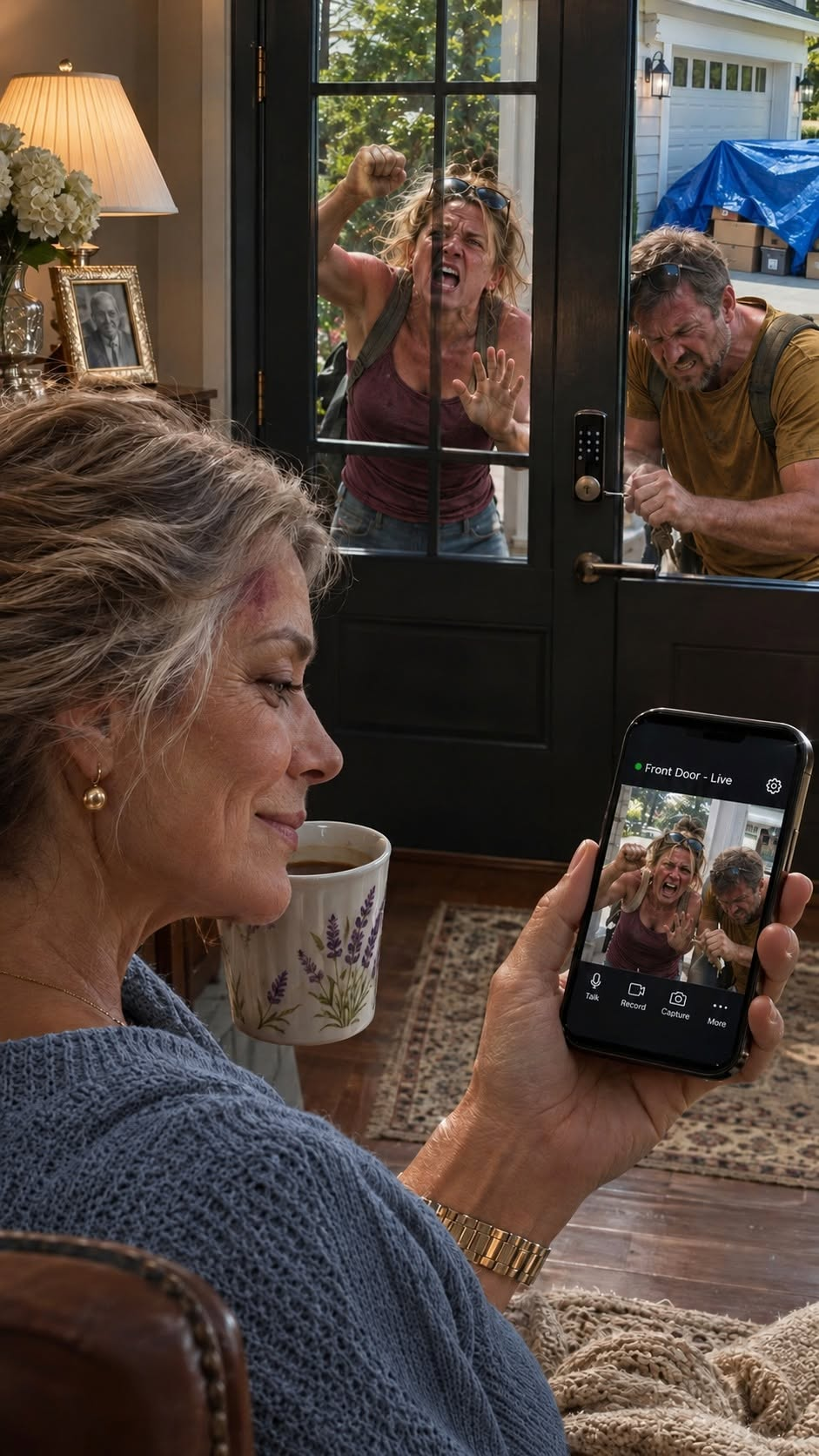
After we hung up, I checked the camera system.
Robert had installed it after a series of package thefts in the neighborhood.
The application showed the front porch, driveway, and garage entrance.
Everything was quiet.
I adjusted the notification settings so I would receive an alert if someone approached the front door.
Then I tested the microphone.
A small indicator appeared.
"Front Door—Live."
I had always thought of the camera as a convenience.
Now it felt like another layer of protection.
I set the phone down.
For the first time all day, I felt ready to sleep.
I went upstairs.
Changed into my nightclothes.
Washed my face.
Then I looked at myself in the bathroom mirror.
The bruise near my hairline had begun to fade.
My face looked tired.
But my eyes were clear.
Sarah had told people I was confused.
She had tried to make my age into a weakness.
She had treated my kindness as permission to take whatever she wanted.
And now she was discovering that I could still make decisions.
Very clear decisions.
I turned off the bathroom light.
Just as I reached my bedroom, my cellphone vibrated.
An email notification.
I almost ignored it.
Then I saw the sender.
The law office that had prepared Robert's estate documents.
I stopped.
The subject line read:
"Urgent: Verification of Recent Inquiry."
I opened the email.
It was from the attorney's assistant.
She apologized for contacting me so late but explained that my voicemail had prompted a review of the office's recent correspondence.
Then I read the next sentence.
"Mrs. Bennett, our records show that someone contacted this office last month claiming to be acting on your behalf."
I sat on the edge of the bed.
The email continued.
"The caller requested information regarding changes to your financial authorization documents."
My pulse quickened.
I read the final paragraph.
The office had not made any changes.
But it had preserved the request.
And the assistant wanted to confirm whether I had authorized the person who contacted them.
I reached for my glasses.
There was an attachment.
A copy of the inquiry form.
I opened it.
My name appeared at the top.
My address.
My date of birth.
And beneath the heading "Person Requesting Information," there was a name.
Not Sarah.
Not Greg.
Not Margaret.
I stared at it.
I knew that name.
I had known it for years.
But the person listed on the form had never once asked me for permission to discuss my finances.
My phone began ringing.
The attorney's office.
I answered immediately.
"Mrs. Bennett?" a woman asked.
"Yes."
"This is Linda from Mr. Harrison's office. I'm sorry to call so late, but I thought you should know something before tomorrow."
I gripped the phone.
"What is it?"
She lowered her voice.
"The person who submitted that inquiry came into our office in person."
I looked at the name on the screen.
"Are you certain?"
"Yes. We have a visitor record."
My heart began pounding.
"Linda, who was it?"
There was a pause.
Then she said, "Mrs. Bennett, the name on the form isn't the name the visitor used when they arrived."
I stood slowly.
"What name did they use?"
I heard papers moving.
A keyboard clicking.
Then Linda spoke again.
"I've found the original visitor log."
She stopped.
"Oh, my goodness."
"Linda?"
Her breathing changed.
"Mrs. Bennett, there's something else written beside the signature."
I held the phone tighter.
"What?"
She didn't answer immediately.
Then she whispered, "It says the visitor brought a second person."
I stared into the dark hallway.
"Who?"
Linda took a sharp breath.
And just as she began reading the second name, I heard a notification from my front-door security camera.
Someone had stepped onto my porch.
At 10:47 p.m.
I opened the live feed.
A figure stood beneath the porch light.
The person was holding a large envelope.
Then the figure slowly raised a hand toward the camera.
And I recognized the face.






Comments 0