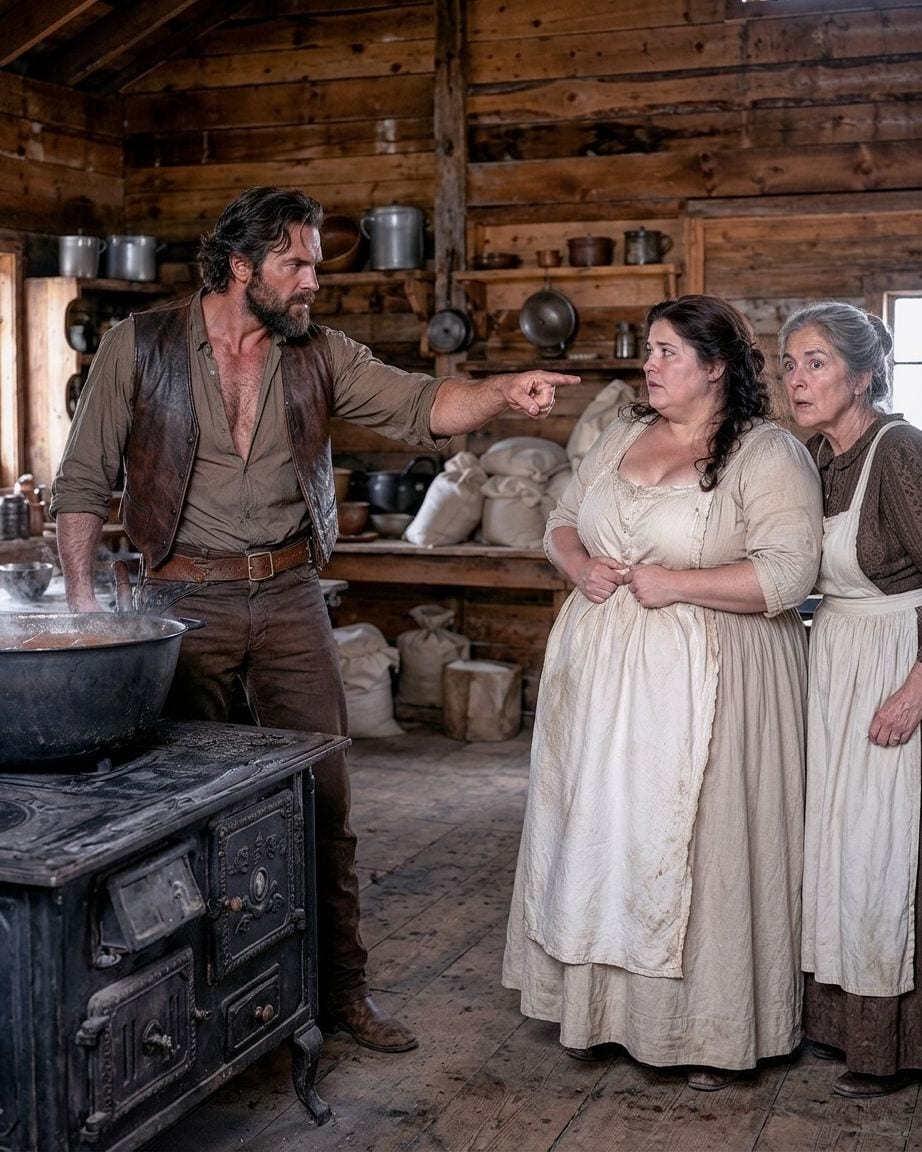
"Why were you standing beside Charles Whitaker in Denver?"
Beatrice Caldwell held the photograph with both hands.
Samuel Hayes stopped in the kitchen doorway.
For the first time since she had arrived at Ironwood Ranch, the powerful cattleman looked genuinely shaken.
His eyes moved from the photograph to the small wooden box on the table.
Then to the silver thimble lying beside it.
"Where did that come from?"
Beatrice took a step backward.
"Answer my question."
Martha Whitcomb stood beside the stove, watching them both.
Samuel entered the kitchen slowly.
"Beatrice."
"No."
Her voice trembled, but she did not lower her eyes.
"Please don't say my name like that. Not until you tell me the truth."
Samuel stopped.
She lifted the photograph.
"Charles Whitaker disappeared from Denver. You told me that yourself. You said your attorney was trying to find him."
"That's true."
"Then why do you have a photograph with him?"
Samuel looked at the image again.
The photograph showed two men outside a brick office building.
One was Charles Whitaker.
The other was Samuel Hayes.
There was no mistaking the scar along his jaw.
Samuel exhaled slowly.
"Because I knew him."
Beatrice felt her stomach tighten.
"How well?"
"Well enough to know he was afraid of something."
"Afraid of what?"
Samuel did not answer immediately.
That hesitation frightened her more than anything he could have said.
Martha stepped forward.
"Samuel, perhaps you should sit down."
He shook his head.
"No. She deserves an explanation."
Beatrice stared at him.
"Then give me one."
Samuel pulled out a chair.
But he did not sit.
Instead, he placed one hand on the table and looked directly at her.
"I met Charles Whitaker six years ago, before Eleanor died."
Beatrice's expression changed.
"Your wife?"
Samuel nodded.
"Whitaker was working as an accountant for several cattle brokers. He had a reputation for finding missing money."
"And Harlan?"
"Riggs was one of the men whose accounts he examined."
Beatrice lowered the photograph slightly.
Samuel continued.
"Whitaker came to me because he believed somebody was stealing cattle and selling them under false ownership papers."
"Who?"
"At the time, he wouldn't say."
Beatrice swallowed.
"Did you suspect Harlan?"
"Yes."
"Then why didn't you tell me?"
Samuel's jaw tightened.
"Because I didn't know whether Whitaker was still alive, and because I didn't want to accuse anyone without proof."
Beatrice stared at him.
"Or because you thought I couldn't be trusted."
Samuel's expression softened.
"That's not what I thought."
"But you kept it from me."
"Yes."
The admission hung between them.
Martha looked down.
Samuel continued quietly.
"And I was wrong to do that."
Beatrice blinked.
She had not expected an apology.
Harlan Riggs had never admitted wrongdoing without turning the blame back on her.
Samuel did not offer excuses.
He simply stood there and accepted what he had done.
"Why did Whitaker come to you?" she asked.
Samuel looked toward the window.
"Because I was one of the ranchers losing cattle."
Six years earlier, Ironwood Ranch had nearly collapsed.
A severe winter had killed hundreds of animals.
The following spring brought sickness among the surviving herd.
Then cattle began disappearing from the northern pastures.
At first, Samuel blamed rustlers.
He hired more men.
Increased patrols.
Repaired fences.
But the losses continued.
Then Charles Whitaker arrived with a leather satchel full of documents.
He claimed that cattle stolen from Wyoming ranches were being sold through legitimate markets using altered brands and forged ownership records.
Samuel listened.
He examined the evidence.
And for the first time, he began to understand why the thefts had continued despite his precautions.
The men responsible were not ordinary thieves.
They had money.
Connections.
And access to the very officials who were supposed to stop them.
"Whitaker told me he needed time," Samuel explained.
"He was collecting evidence against several men. Riggs was one of them."
Beatrice looked at the photograph.
"Where was this taken?"
"Outside Whitaker's office in Denver."
"When?"
"About six months before Eleanor died."
She looked up.
"What happened to the investigation?"
Samuel's expression darkened.
"Whitaker disappeared for a while. Then he sent word that he had found something important."
"Did he tell you what?"
"No."
Samuel paused.
"Before I could meet him again, Eleanor became ill."
Martha closed her eyes.
Beatrice noticed.
Samuel's voice changed.
"The investigation stopped mattering."
He looked away.
"Everything stopped mattering."
For several seconds, nobody spoke.
Then Beatrice asked gently, "What happened to her?"
Samuel stared at the floor.
"She died."
"I know that. I meant—"
"I know what you meant."
His voice was not angry.
Only tired.
He pulled out the chair and sat.
For the first time, Beatrice saw how much weight he carried beneath his hard exterior.
"Eleanor had been sick for months," he said. "The doctors called it a fever that settled in her lungs. Some days she improved. Other days she could barely breathe."
Martha quietly wiped her eyes.
Samuel continued.
"I kept thinking there would be time."
Beatrice listened.
"Time for another doctor. Time for a better medicine. Time to take her somewhere warmer."
He swallowed.
"Then one morning, there wasn't."
The kitchen seemed to grow smaller around them.
Samuel looked at his hands.
"I was out checking the southern herd when she died."
Beatrice's heart tightened.
"Samuel..."
He shook his head.
"She asked for me. Martha sent a rider. But I didn't get back in time."
Martha stepped forward.
"Samuel, you couldn't have known."
He gave a faint, humorless smile.
"That's what everyone told me."
"Because it's true."
Samuel looked toward the window.
"Truth doesn't always make a thing easier to live with."
Beatrice understood that better than she wanted to.
For five years, Samuel Hayes had lived as though grief were a debt he could repay through labor.
He rose before sunrise.
Worked until darkness.
Ate alone whenever possible.
And refused every invitation that might remind him of the life he had lost.
He stopped attending church socials.
Stopped visiting neighbors.
Stopped celebrating birthdays.
When Martha decorated the dining hall for Christmas, he allowed the men to enjoy themselves but remained in his study.
He kept Eleanor's belongings in a locked cedar chest.
Her dresses.
Her letters.
A pair of dancing shoes she had worn the night they first met.
He could not bear to give them away.
But he could not bear to look at them either.
Beatrice listened as Martha described those years.
Samuel remained silent.
Then Martha said something that made him look up.
"Eleanor wouldn't have wanted you to punish yourself forever."
Samuel's expression hardened.
"Martha."
"No. You've heard me say it before, and you'll hear it again."
She folded her arms.
"That woman loved you. She didn't marry you so you'd spend the rest of your life acting like happiness was a betrayal."
Samuel looked away.
Beatrice felt suddenly uncomfortable.
She had not meant to enter such private territory.
"I should go," she whispered.
Samuel looked back.
"No."
She stopped.
He stood.
"There's something I need to show you."
Samuel led Beatrice down the hallway to his study.
Martha remained in the kitchen.
The room was quiet when they entered.
Samuel crossed to a locked cabinet and removed a small brass key from his pocket.
He opened the cabinet.
Inside were several leather-bound account books, a wooden box, and a stack of old correspondence.
He took out a narrow envelope.
The paper had yellowed with age.
"Whitaker sent this to me shortly before Eleanor died."
Beatrice approached.
Samuel handed her the letter.
She unfolded it carefully.
The handwriting was neat and precise.
Mr. Hayes,
I have confirmed that the missing cattle are part of a much larger operation. The records involve transactions across several territories, including payments made through private accounts in Denver.
I believe certain men are using false debts to gain control of property they could not otherwise purchase.
Do not trust any official who insists the matter is merely a dispute over ownership.
I will contact you when I have enough evidence to proceed.
Charles Whitaker.
Beatrice read the letter twice.
Then she looked up.
"False debts."
Samuel nodded.
"That's what caught my attention."
She thought of the ledger.
Her father's name.
Ten thousand dollars.
A payment recorded after his death.
"Harlan claimed my father owed money," she whispered.
Samuel's eyes sharpened.
"What?"
Beatrice lowered the letter.
"After we married, Harlan told me he had paid my father's creditors. He said the debt was one reason I should be grateful."
Samuel remained still.
"How much?"
She swallowed.
"Ten thousand dollars."
The room fell silent.
Samuel reached for the ledger.
He unfolded it beside Whitaker's letter.
The same amount appeared next to Thomas Caldwell's name.
Beatrice stared at the figure.
"My father's shop was struggling, but he never owed that much."
Samuel examined the dates.
"Did Riggs ever show you proof?"
"No."
"Did he ever explain who the creditors were?"
She shook her head.
"He said those matters were beyond my understanding."
Samuel's jaw tightened.
Beatrice looked at him.
"Do you think he invented the debt?"
"I think we need to find out."
She stared at the ledger.
A terrible possibility began taking shape.
Perhaps Harlan had not rescued her from financial ruin.
Perhaps he had helped create it.
The thought made her feel sick.
Samuel noticed.
"Sit down."
"I'm all right."
"Beatrice."
She looked up.
His voice softened.
"Please."
She sat.
Samuel poured water into a glass and handed it to her.
She accepted it with trembling fingers.
For several minutes, neither spoke.
Then Beatrice asked a question she had been afraid to ask since arriving at Ironwood Ranch.
"Why are you helping me?"
Samuel looked surprised.
"Because you need help."
"That's not enough."
He frowned.
"Why not?"
"Because people don't risk everything for strangers."
Samuel leaned against the desk.
"Sometimes they do."
Beatrice shook her head.
"Not in my experience."
His expression changed.
She continued quietly.
"Harlan was kind when he wanted something. He brought gifts when he needed forgiveness. He offered help when he wanted control."
She looked down.
"I don't know how to understand kindness that doesn't come with a price."
Samuel was silent for a long moment.
Then he said, "There isn't a price."
Beatrice's eyes filled.
"I want to believe that."
"You can take your time."
She looked up.
He continued.
"You don't owe me affection. You don't owe me gratitude. You don't owe me anything beyond the work we agreed upon."
A tear slipped down her cheek.
Samuel looked uncomfortable.
He was better with cattle than tears.
Better with fences than feelings.
But he did not turn away.
Instead, he pulled out the chair opposite her.
And sat.
Over the following days, something subtle changed between them.
Samuel still worked long hours.
Beatrice still rose before dawn to prepare meals.
The ranch continued its ordinary routines.
But Samuel began returning to the house earlier.
Sometimes he appeared in the kitchen while Beatrice was kneading bread.
Sometimes he lingered after supper.
Sometimes he asked questions about recipes he had never previously cared to understand.
One afternoon, Beatrice found him standing beside the stove, staring at a tray of biscuits.
"Something wrong?" she asked.
Samuel shook his head.
"Just wondering how you make them rise like that."
She smiled.
"Would you like to learn?"
He looked startled.
"Me?"
"Unless you're afraid of flour."
Samuel raised an eyebrow.
"I've faced stampeding cattle."
"Then biscuits should be easy."
He rolled up his sleeves.
Beatrice handed him a bowl.
"Start by mixing the flour and salt."
Samuel obeyed.
Awkwardly.
Within minutes, flour covered his hands.
Then his vest.
Then the table.
Beatrice tried not to laugh.
Samuel looked down at the mess.
"I believe the flour's winning."
She burst into laughter.
The sound filled the kitchen.
Samuel looked at her.
And smiled.
A genuine smile.
Warm enough to transform his entire face.
For one brief moment, he forgot the grief that had followed him for five years.
He forgot the dangerous men searching for Beatrice.
He forgot the debts, the cattle, the threatening letters.
He simply stood in his kitchen, covered in flour, listening to a woman laugh.
And something inside him began to wake.
Martha noticed immediately.
She noticed the way Samuel's eyes followed Beatrice when she moved through the room.
The way his voice softened when he spoke to her.
The way Beatrice smiled whenever she heard his boots in the hallway.
But Martha said nothing.
Not yet.
She had lived long enough to know that wounded hearts could not be hurried.
One evening, she found Samuel standing alone on the porch.
He watched the kitchen window.
Inside, Beatrice was singing softly while washing dishes.
Martha approached.
"She's got a lovely voice."
Samuel nodded.
"Yes."
"Eleanor used to sing in that kitchen."
Samuel's expression tightened.
Martha continued gently.
"Different songs, of course."
He said nothing.
She rested one hand on the porch railing.
"Samuel, loving someone new doesn't mean you loved Eleanor any less."
He turned sharply.
"Martha."
She looked at him.
"What?"
"Nobody said anything about love."
Martha smiled.
"Of course not."
He frowned.
She walked away before he could answer.
Samuel remained on the porch.
He looked toward the kitchen window again.
Beatrice was laughing at something Luke had said.
Her face glowed in the lamplight.
Samuel felt an unfamiliar ache in his chest.
Not grief.
Not exactly.
Something more dangerous.
Hope.
That night, Beatrice found a small package outside her bedroom door.
Her heart jumped.
For a moment, she feared another message from Harlan.
But there was no black ribbon.
No red wax seal.
Only plain brown paper tied with string.
She carried it inside.
Untied the knot.
And opened it.
Inside lay a new apron.
Soft blue cotton.
Carefully stitched.
Large enough to fit comfortably without pulling at the waist.
Beatrice stared at it.
Beneath the apron was a small note.
For the woman who has made this house feel like a home again.
There was no signature.
But she recognized the handwriting.
Samuel.
Beatrice pressed the apron against her chest.
For several moments, she could not move.
Harlan had bought her expensive dresses.
Silk.
Lace.
Jewelry.
But every gift had been chosen to make her appear more acceptable to others.
This was different.
Samuel had noticed what she needed.
Something practical.
Something comfortable.
Something made for her as she was.
Beatrice sat on the bed.
And cried.
Not because she was frightened.
But because, for the first time in years, someone had given her a gift without asking her to become someone else.
The following morning, Samuel found her wearing the apron.
He stopped in the kitchen doorway.
Beatrice looked up.
"Good morning, Mr. Hayes."
His eyes moved to the blue fabric.
"Morning."
She smiled.
"Thank you."
Samuel cleared his throat.
"For what?"
She raised an eyebrow.
"The apron."
He looked toward the stove.
"Martha said you needed one."
"Martha didn't choose it."
Samuel said nothing.
Beatrice stepped closer.
"It's beautiful."
He looked at her.
"I'm glad it fits."
"It fits perfectly."
Their eyes met.
For a moment, the kitchen seemed strangely quiet.
Then Samuel said softly, "You deserve things that fit, Beatrice."
Her smile faded.
Not from sadness.
From the unexpected tenderness in his voice.
Before she could answer, Martha entered carrying a basket of eggs.
She stopped.
Looked at Samuel.
Looked at Beatrice.
Then smiled to herself.
"Well," she said, "I see breakfast is going to be interesting."
Samuel cleared his throat again.
"I should check the horses."
He turned and left.
Beatrice watched him go.
Martha placed the eggs on the table.
"That man hasn't been this nervous around a woman in twenty years."
Beatrice blushed.
"Martha!"
The older woman laughed.
But the peace did not last.
Late that afternoon, Samuel received a telegram from Jonathan Mercer.
The attorney had discovered that Charles Whitaker had recently been seen near the Colorado-Wyoming border.
More troubling, Whitaker had reportedly been traveling with a man connected to Harlan Riggs.
Samuel read the message twice.
Then called Luke into his study.
"I want two men ready to ride at first light."
Luke nodded.
"Where are we going?"
"South."
"Looking for Whitaker?"
Samuel folded the telegram.
"Yes."
Luke hesitated.
"Boss, if Riggs is involved, this could get ugly."
Samuel looked toward the kitchen.
Through the open doorway, he could hear Beatrice humming.
His expression hardened.
"It's already ugly."
That evening, Samuel found Beatrice sitting on the back porch.
She wore the blue apron.
Her dark hair was pinned loosely at the back of her head.
A warm breeze moved through the grass.
Samuel sat beside her.
For a while, neither spoke.
Then Beatrice asked, "Are you leaving tomorrow?"
Samuel looked surprised.
"Who told you?"
"Luke mentioned horses being prepared."
Samuel nodded.
"I need to find someone."
"Charles Whitaker?"
"Yes."
She looked toward the distant hills.
"Please be careful."
Samuel studied her.
"I will."
She hesitated.
Then whispered, "I don't want anything to happen to you."
The words settled between them.
Samuel looked at her.
Something moved in his expression.
Something vulnerable.
Something he had spent five years hiding.
"Beatrice..."
She turned toward him.
For a moment, he seemed about to say something important.
Then footsteps sounded behind them.
Martha appeared in the doorway.
"Samuel?"
He stood.
"What is it?"
"There's a man at the front gate."
Samuel frowned.
"At this hour?"
Martha nodded.
"He says he has information about Charles Whitaker."
Samuel's expression changed.
Beatrice rose slowly.
"Who is he?"
Martha looked pale.
"I don't know. But he asked for you both."
Samuel stepped toward the house.
Beatrice followed.
They crossed the hallway together.
At the front door, Luke stood with his hand resting near his revolver.
Outside, a stranger waited beneath the porch lantern.
His coat was torn.
His face was bruised.
And one arm hung uselessly at his side.
Samuel opened the door.
The stranger looked at him.
Then at Beatrice.
His eyes widened.
"Mrs. Riggs?"
Beatrice froze.
She recognized his face.
The man who had been lying in blood on Harlan's study floor.
He was alive.
He took one stumbling step forward.
"Thank God," he whispered. "I found you."
Samuel reached out to steady him.
The stranger gripped his arm.
"Listen carefully. Whitaker isn't the man you need to find."
Samuel frowned.
"What?"
The stranger looked toward the darkness behind him.
His face twisted with terror.
Then he whispered, "The man who ordered everything... the man who destroyed your wife's life..."
Samuel went completely still.
The stranger leaned closer.
And began to speak the name.






Comments 0