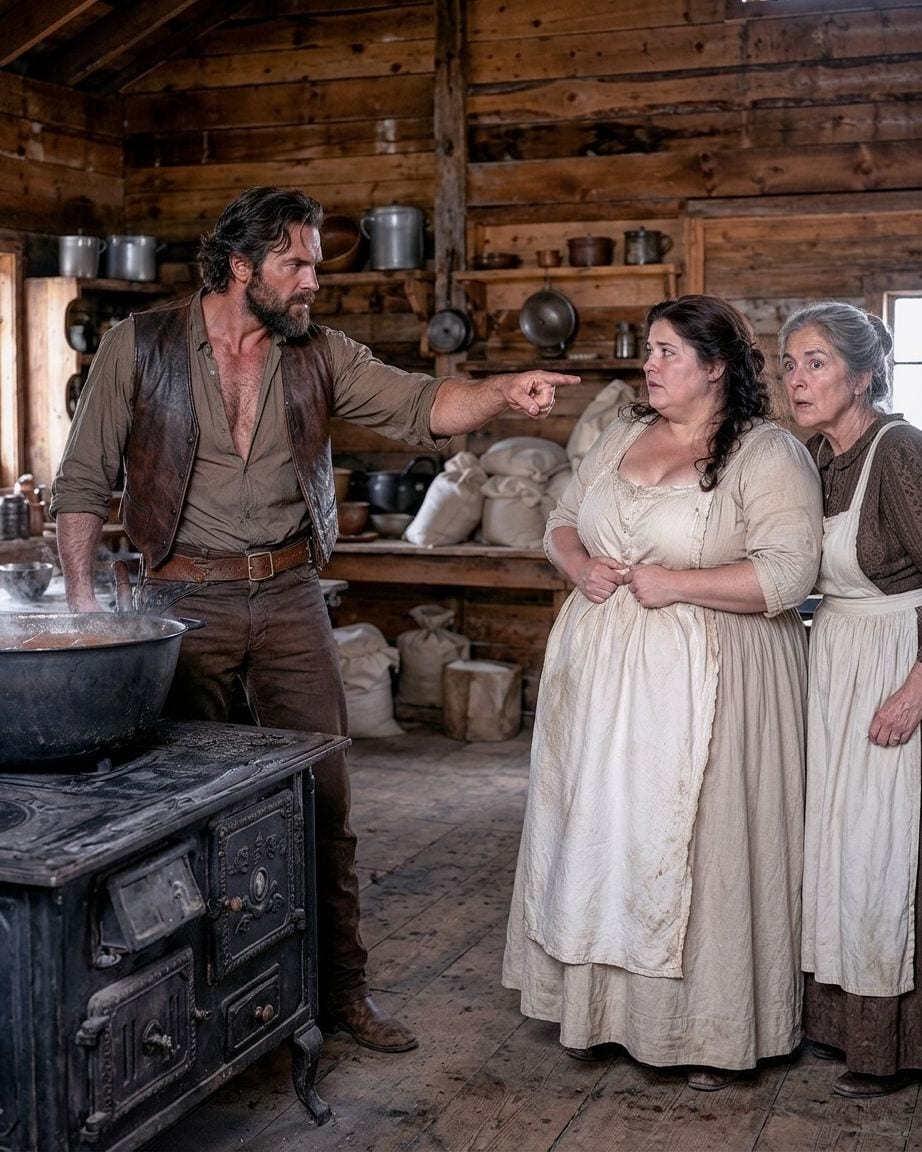
"He's calling me stolen property!" Beatrice cried, crushing the legal notice against her chest.
Luke Bennett reached for the document, but Martha caught his wrist.
"Don't touch it."
The kitchen fell silent.
Thirty men had eaten breakfast beneath that roof. They had laughed, argued, and praised Beatrice's biscuits. Now the woman who had fed them stood trembling beside the stove, staring at a document that claimed she belonged to another human being.
Martha took the paper from her hands.
"This isn't a lawful claim," she said firmly.
Beatrice shook her head.
"You don't know Harlan."
"I know enough."
"He owns judges. He owns policemen. He owns men who will swear to anything if he pays them."
Luke's expression darkened.
"Well, he doesn't own us."
Beatrice looked at him.
The young cowboy stood with his hat in his hands, his usually cheerful face set in an unfamiliar expression.
"You don't understand," she whispered. "He doesn't have to own you. He only has to make you afraid."
Luke glanced toward the other ranch hands gathering in the doorway.
Then he said something Beatrice had never expected to hear.
"Miss Bea, you're not the only person in this house who's tired of being afraid."
For a moment, nobody moved.
Then Martha folded the notice and placed it on the table.
"Luke, saddle the fastest horse in the stable."
"Yes, ma'am."
"Find Samuel. Tell him what's happened."
Luke was already moving when Beatrice caught his sleeve.
"Wait."
He turned.
"Please don't let Mr. Hayes do anything foolish because of me."
Luke studied her.
Then he smiled sadly.
"Ma'am, the boss has been doing things his own way since before I was born. I doubt either of us can stop him now."
He disappeared through the doorway.
Beatrice watched him go.
Her heart was pounding.
The document remained on the table.
She could not stop looking at it.
The property in question is the woman herself.
Harlan had finally written down what he had believed throughout their marriage.
He had never considered her a wife.
Only a possession.
By late afternoon, the news had spread through Ironwood Ranch.
Some men were furious.
Others were confused.
A few became uneasy when they learned Harlan Riggs was threatening legal action against their employer.
Beatrice heard their conversations while carrying a tray of fresh bread toward the dining hall.
"Riggs has money enough to buy half the territory."
"Doesn't mean he's right."
"Right doesn't always matter when a rich man wants something."
"What if Hayes loses the ranch over this?"
The final question stopped Beatrice outside the doorway.
She recognized the speaker.
Frank Miller.
A broad-shouldered cattle hand who had worked for Samuel nearly ten years.
He was not cruel.
But he was practical.
And practicality, Beatrice had learned, could become a frightening thing when someone else's safety was at stake.
She stepped into the dining hall.
The men fell silent.
Frank looked uncomfortable.
"Miss Bea."
She set down the tray.
"There's bread if anyone wants some."
Nobody moved.
Beatrice looked around the room.
She saw familiar faces.
Men she had fed.
Men whose injuries she had cleaned.
Men whose birthdays she had remembered even when they had forgotten them themselves.
"I know you're worried," she said quietly.
Frank lowered his eyes.
Beatrice continued.
"I never intended to bring trouble here."
Luke's younger brother, Peter, shifted in his chair.
"Nobody said you did."
She gave him a grateful smile.
"But I heard what was said. And you're right to be concerned."
Frank stood.
"Miss Caldwell, I didn't mean—"
"It's all right."
She looked toward the windows.
Beyond them stretched thousands of acres of grassland, cattle, fences, and hard-earned livelihood.
"Mr. Hayes built this place with years of work. You all helped him. I won't be the reason it's taken away."
Frank frowned.
"What are you saying?"
Beatrice swallowed.
"I'm saying that if leaving would protect this ranch, then perhaps I should—"
"No."
The voice came from the doorway.
Martha stood there holding a wooden spoon.
She looked furious.
"Don't you dare finish that sentence."
Beatrice stared at her.
"Martha—"
"Not another word."
The older woman marched into the room.
"Every time somebody threatens you, your first thought is to disappear. Well, I've had enough of it."
Beatrice felt her cheeks burn.
"I only want to help."
"Then help by staying where you belong."
The words struck Beatrice harder than Martha intended.
Where you belong.
She had spent years searching for such a place.
Now she was being told she had found one.
And she did not know how to believe it.
Martha turned toward the ranch hands.
"As for the rest of you, anybody worried about his supper disappearing can start learning to cook for himself."
A few men chuckled.
Martha pointed her spoon at Frank.
"And you, Frank Miller, can begin by peeling potatoes."
Frank blinked.
"Me?"
"Unless you've suddenly forgotten how hands work."
The room erupted in laughter.
Even Beatrice smiled.
Frank sighed dramatically.
"Yes, ma'am."
Martha nodded.
"Good. Now everybody eat before the bread gets cold."
Samuel returned shortly before sunset.
His horse was covered in dust.
Luke rode beside him.
Neither man looked pleased.
Beatrice stood near the kitchen window when she saw them enter the courtyard.
Her stomach tightened.
Samuel dismounted and handed his reins to a stable boy.
He carried a leather satchel beneath one arm.
His expression was grim.
Beatrice stepped into the hallway as he entered the house.
"Mr. Hayes."
He stopped.
"Beatrice."
"I'm sorry."
Samuel closed his eyes briefly.
"What are you apologizing for now?"
"The letter."
"I've seen it."
"Then you know—"
"I know Harlan Riggs has hired a lawyer willing to put nonsense on expensive paper."
Beatrice stared at him.
Samuel removed his hat.
"Where's Martha?"
"In the kitchen."
"Good. Ask her to bring coffee to my study."
He started past her.
Beatrice caught his sleeve.
The gesture surprised them both.
She released him immediately.
"Please."
Samuel turned.
"What is it?"
"I don't want you to lose your ranch."
He studied her.
"Neither do I."
"Then perhaps I should leave."
His expression hardened.
"Who told you that?"
"Nobody."
"Beatrice."
She looked down.
"I heard the men talking."
Samuel was silent for a moment.
Then he set his satchel on the hallway table.
"Come with me."
She hesitated.
"Where?"
"The study."
He opened the door and waited.
Beatrice followed.
Samuel's study smelled of leather, tobacco, and old paper.
A large desk stood beneath the window.
Maps of Wyoming covered one wall.
A rifle rested above the fireplace.
Beatrice remained near the doorway while Samuel opened his satchel.
He removed several documents.
"Sit down."
She obeyed.
Samuel placed the threatening notice beside the papers he had brought from Cheyenne.
"I spoke with an attorney named Jonathan Mercer."
Beatrice looked up.
"Can he help?"
"He thinks so."
Samuel tapped the notice.
"Riggs is trying to frighten us. This paper isn't a court judgment. It's a lawyer's demand dressed up to look official."
Beatrice swallowed.
"But he can still cause trouble."
"Yes."
Samuel did not pretend otherwise.
"He can file complaints. He can pay witnesses. He can send men who enjoy making threats."
He paused.
"But he cannot legally own you."
Beatrice stared at the desk.
Samuel's voice softened.
"Whatever Harlan Riggs told you, marriage doesn't turn a woman into livestock."
Tears gathered in her eyes.
"He said the law gave him the right to decide where I lived."
Samuel leaned forward.
"The law may give husbands advantages it shouldn't. That doesn't make every claim they invent enforceable."
She looked up.
"Then why would he send this?"
"Because he knows you're frightened."
Beatrice's hands tightened.
Samuel continued.
"Mercer believes the real danger is the criminal accusation. If Riggs can persuade the authorities that you're a fugitive, he'll try to force you back to Denver."
She looked toward the window.
"And then?"
Samuel did not answer immediately.
He did not need to.
Beatrice understood.
Harlan had already shown what happened when she disobeyed him.
Samuel reached for another document.
"There's something else."
He unfolded a copy of the ledger she had stolen.
"Mercer recognized one of these names."
Beatrice leaned forward.
"Which one?"
"Charles Whitaker."
Her breath caught.
The name struck a memory.
A man with silver hair.
A dark suit.
A nervous expression.
One of Harlan's business associates.
She had seen him at dinner several times.
"He was at the house that night," she whispered.
Samuel looked sharply at her.
"The night you heard the gunshot?"
She nodded.
"Yes."
"Was he the injured man?"
Beatrice closed her eyes.
She remembered the blood.
The broken glass.
The body beside the desk.
Then she shook her head.
"No."
Samuel frowned.
"Are you certain?"
"Yes. The injured man was younger."
"Did you know his name?"
She hesitated.
"No."
Samuel studied her.
"Then why did Whitaker's name frighten you?"
Beatrice opened her eyes.
"Because I remembered something."
She leaned forward.
"The man on the floor spoke before he lost consciousness."
Samuel went still.
"What did he say?"
Beatrice's voice trembled.
"He said something about books."
"Books?"
"Yes. Then he whispered a name."
Samuel waited.
She swallowed.
"Whitaker."
The room fell silent.
Samuel looked down at the ledger.
Then back at Beatrice.
"Are you sure?"
She nodded.
"I couldn't remember it before. But last night, it came back to me."
Samuel stood and crossed to the window.
For several seconds, he said nothing.
Then he turned.
"Charles Whitaker disappeared from Denver two weeks ago."
Beatrice felt the blood drain from her face.
"Disappeared?"
"Mercer heard rumors that he'd left town suddenly."
"Why?"
"Nobody knows."
Samuel looked at the ledger again.
"But I intend to find out."
That evening, Beatrice returned to the kitchen with her thoughts in turmoil.
Martha was preparing supper.
The older woman glanced up.
"Well?"
Beatrice tied on her apron.
"Mr. Hayes says the letter isn't a proper legal judgment."
Martha nodded.
"I could have told him that."
"He also says the marshal may come back."
Martha's expression darkened.
"Then we'll be ready."
Beatrice began chopping onions.
For several minutes, they worked in silence.
Then Martha spoke.
"Samuel told me you offered to leave."
Beatrice stopped.
"I didn't mean—"
"Yes, you did."
The older woman set down her knife.
"Beatrice, I want you to listen carefully."
Beatrice looked up.
"You've been here a little more than a week. In that time, you've done more than cook meals."
She gestured toward the dining hall.
"Those men used to eat like strangers sharing a trough. Now they sit together. They talk. They laugh."
Beatrice shook her head.
"That's not because of me."
"It is."
Martha continued.
"Peter Walsh hasn't received a letter from home in months. You noticed he was lonely and asked him to help make bread."
Beatrice smiled faintly.
"He reminds me of my younger cousin."
"And Frank Miller?"
"What about him?"
"He used to complain about everything. Yesterday, he carried wood into the kitchen without being asked."
Beatrice laughed softly.
Martha stepped closer.
"Kindness changes people, child. Sometimes slowly. Sometimes when they least expect it."
Beatrice looked down at the onions.
Her eyes filled.
"I've never had people care whether I stayed."
Martha touched her shoulder.
"Then it's time you got used to it."
The following morning, Beatrice discovered just how much the ranch had changed.
When she entered the kitchen before sunrise, someone had already brought in fresh firewood.
The water barrels were full.
A basket of wildflowers stood on the counter.
Beside it lay a folded note.
She opened it.
The handwriting was clumsy.
For Miss Bea.
Thank you for remembering my birthday.
Peter.
Beatrice pressed the paper against her chest.
She had baked Peter a small cake two days earlier.
Nothing elaborate.
Just flour, sugar, dried apples, and a little cinnamon.
He had looked so surprised that she nearly cried.
Now he had brought her flowers.
She placed them in a jar beside the window.
Then she began breakfast.
By seven o'clock, the dining hall was filled with the smell of bacon, biscuits, and fresh coffee.
The men arrived laughing.
Luke carried a basket of eggs.
Frank brought a sack of potatoes.
Peter appeared with a small wooden shelf he had built for the kitchen.
"I thought you might need somewhere to keep your spices," he said shyly.
Beatrice stared at it.
"It's beautiful."
Peter blushed.
"Just scraps from the workshop."
She smiled.
"That doesn't make it any less beautiful."
He grinned.
For the first time in years, Beatrice felt that her work mattered beyond the meals she prepared.
She was becoming part of something.
Not because she had married the right man.
Not because she possessed money.
Not because she looked the way society expected.
But because she was herself.
And the people around her were beginning to see her.
Three days later, a sudden accident tested that fragile happiness.
A young ranch hand named Daniel Price was thrown from his horse near the eastern pasture.
The animal had stepped into a hidden hole.
Daniel struck the ground hard.
By the time the men carried him into the bunkhouse, his face was pale and his breathing shallow.
Samuel sent Luke for the doctor.
But Cheyenne was miles away.
Beatrice arrived carrying clean cloths and hot water.
Martha followed with bandages.
Daniel groaned.
His right leg was twisted beneath him.
Frank looked helpless.
"What do we do?"
Beatrice knelt beside the injured man.
She had helped her father treat cuts and broken bones in the butcher shop.
She was no physician.
But she knew how to keep someone calm.
"Daniel, look at me."
His eyes fluttered.
"Miss Bea?"
"That's right."
"It hurts."
"I know."
She took his hand.
"You're going to breathe slowly with me."
He tried.
She kept her voice steady.
"Good. Again."
Samuel stood nearby, watching.
Beatrice examined the leg without moving it unnecessarily.
She instructed the men to support Daniel carefully and keep him warm.
Then she prepared a cool cloth for his forehead.
For nearly two hours, she remained beside him.
She talked about ordinary things.
His favorite meals.
The horse he loved.
The apple pie she promised to bake when he recovered.
When the doctor finally arrived, Daniel was still conscious.
The physician examined him and confirmed that the leg was broken but the injury appeared manageable.
He praised the careful way the men had supported him.
Then he looked at Beatrice.
"You kept him calm?"
She nodded.
"I tried."
"That helped more than you know."
Beatrice lowered her eyes.
"Thank you."
Samuel watched her from the doorway.
Something unfamiliar moved through his chest.
Respect.
Admiration.
And something warmer that he had not allowed himself to feel in years.
That evening, Samuel found Beatrice sitting alone on the back porch.
She held a cup of tea.
Her shoulders sagged with exhaustion.
He stepped beside her.
"Mind if I sit?"
She looked surprised.
"Of course not."
Samuel lowered himself onto the bench.
For a while, they watched the sun disappear behind the hills.
Then he spoke.
"Daniel's going to recover."
Beatrice nodded.
"I'm glad."
"You did well today."
She shook her head.
"I only stayed with him."
"Sometimes that's the hardest thing."
She looked toward him.
Samuel's expression was thoughtful.
"Eleanor used to say people remembered who stayed when things got difficult."
Beatrice lowered her eyes.
"She sounds like a wonderful woman."
"She was."
Silence settled between them.
Then Samuel asked, "Did your husband ever tell you that you were good at anything?"
Beatrice gave a sad smile.
"He told me I was good at embarrassing him."
Samuel's jaw tightened.
She continued.
"He said I was too large, too emotional, too foolish. He told me nobody would ever want me if he left."
Samuel turned toward her.
"Beatrice."
She looked up.
"That man was a fool."
Her eyes widened.
Samuel held her gaze.
"And a cruel one."
Tears gathered.
She looked away quickly.
Samuel did not reach for her.
He did not demand that she stop crying.
He simply remained beside her.
For several minutes, neither spoke.
Then Beatrice whispered, "Thank you for letting me stay."
Samuel looked toward the distant pasture.
"Thank you for giving this place something it's been missing."
She turned toward him.
"What?"
He hesitated.
Then said quietly, "A reason to come home before supper."
Beatrice's heart skipped.
Samuel seemed surprised by his own words.
He stood.
"Good night, Miss Caldwell."
"Good night, Mr. Hayes."
He walked toward the house.
Beatrice watched him go.
For the first time since her marriage, she allowed herself to imagine that affection might not always lead to pain.
But happiness at Ironwood Ranch was never allowed to remain undisturbed for long.
The following afternoon, Martha entered the kitchen carrying a small wooden box.
"Someone left this at the back door."
Beatrice looked up from the bread dough.
"Who?"
"I didn't see."
The box was plain.
No address.
No name.
Only a thin black ribbon tied around the lid.
Beatrice's stomach tightened.
She recognized the ribbon.
Harlan used identical ribbons to bind private correspondence.
"Don't open it," she whispered.
Martha stopped.
"Beatrice?"
The younger woman stepped backward.
"Please."
But the box had already shifted in Martha's hands.
Something inside rattled.
A small metallic sound.
Beatrice stared at it.
She knew that sound.
She had heard it many times in Denver.
Harlan kept a collection of personal items taken from people who had displeased him.
A pocket watch.
A wedding ring.
A broken cuff link.
Objects he displayed like trophies.
Martha placed the box on the table.
Beatrice approached slowly.
Her hands trembled as she untied the ribbon.
She lifted the lid.
Inside lay a silver thimble.
Her father's thimble.
The one she had packed when she fled Denver.
The one she believed had been lost with her traveling bag.
Beatrice gasped.
Beneath it was a folded note.
She picked it up.
The message was written in Harlan's unmistakable hand.
You left something behind, my dear.
I thought you might like to have it back.
The next thing I return will not fit inside a box.
Beatrice stared at the words.
Then she noticed something beneath the note.
A small photograph.
She lifted it carefully.
It showed a man standing outside a Denver office.
His face was familiar.
Beatrice recognized him immediately.
Charles Whitaker.
But he was not alone.
Beside him stood another man.
Tall.
Broad-shouldered.
Wearing a dark leather vest.
Beatrice's breath caught.
She brought the photograph closer to the window.
The second man's face was partly hidden by the brim of his hat.
But the scar along his jaw was unmistakable.
Beatrice looked toward the doorway.
Samuel Hayes had just entered the kitchen.
He stopped when he saw the photograph in her hand.
His expression changed.
"Beatrice," he said quietly, "where did you get that?"
She stared at him.
Then at the photograph.
Then back at him.
Her voice was barely audible.
"Samuel... why were you standing beside Charles Whitaker in Denver?"






Comments 0