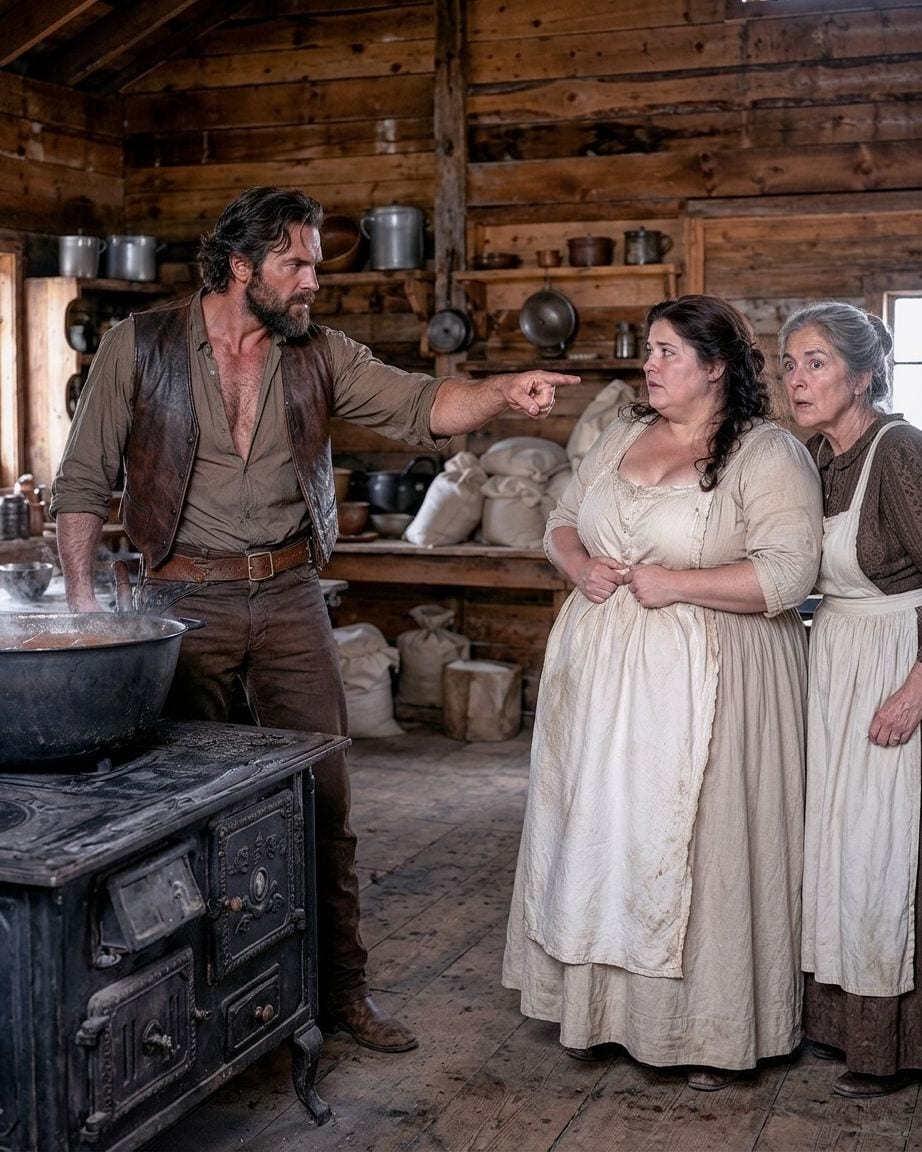
Harlan Riggs stood in the doorway of Eleanor Hayes's bedroom with a revolver pointed directly at Beatrice's heart.
"Nobody move."
His voice was quiet.
That was how Beatrice knew he was dangerous.
Samuel Hayes stood beside the open floorboards, his own revolver halfway out of its holster. Sheriff Kincaid was behind him. Jonathan Mercer stood near the window, his face pale beneath the lantern light.
On the floor lay the body of Dr. Arthur Bellamy.
And in the doorway stood the man responsible for so much suffering.
Harlan smiled at his wife.
"Hello, Beatrice."
She felt the old terror rise inside her.
For years, that voice had been enough to silence her.
Now she looked directly into his eyes.
"You shouldn't be here."
Harlan laughed.
"Darling, you really must stop telling me where I belong."
Samuel shifted.
Harlan immediately raised the revolver.
"Not another inch, Hayes."
Samuel stopped.
"Let her go."
"She's my wife."
"She's a person," Samuel answered. "Something you never understood."
Harlan's expression hardened.
"You're remarkably brave for a man standing so close to a corpse."
Kincaid stepped forward.
"Riggs, you're under arrest."
Harlan glanced at him.
"Am I?"
"You escaped lawful custody."
"An unfortunate misunderstanding."
"You've also threatened a woman with a firearm."
Harlan smiled.
"Then perhaps you'd better arrest me."
He pressed the revolver closer to Beatrice.
"After she comes with me."
Beatrice did not move.
"No."
Harlan stared.
"What did you say?"
"I said no."
His smile vanished.
"Beatrice."
She knew that tone.
The warning.
The promise of punishment.
But something had changed.
She had crossed the Wyoming wilderness with nothing.
She had survived hunger, cold, and humiliation.
She had found work, friendship, and a place where people knew her name without using it as a weapon.
She would not surrender those things now.
"I'm not going anywhere with you."
Harlan's face twisted.
"You ungrateful—"
"Enough."
Her voice rang through the room.
Even Samuel looked surprised.
Beatrice stepped forward.
"You took my father's business. You forged my signature. You accused me of murder. You sent men to frighten people who had shown me kindness."
Her hands trembled.
But she kept speaking.
"You told me nobody would ever love me."
Harlan's eyes narrowed.
"And I was right."
Beatrice shook her head.
"No."
She glanced toward Samuel.
Then back at Harlan.
"You were wrong about everything."
For one moment, Harlan looked uncertain.
Then rage overtook him.
He seized her wrist.
Samuel moved.
The revolver discharged.
The shot struck the wooden doorframe.
Beatrice cried out.
Samuel slammed into Harlan, driving him away from her.
The two men crashed against the wall.
Harlan swung the revolver toward Samuel's head.
Samuel caught his wrist.
They struggled.
A second shot shattered the bedroom mirror.
Kincaid shouted.
"Drop the gun!"
Harlan twisted free.
Then struck Samuel across the face.
Samuel staggered.
Beatrice saw the revolver rising again.
And she remembered her father's voice.
Never use strength when balance will do.
She seized the heavy iron poker beside the fireplace.
Then struck Harlan's wrist.
The revolver fell.
Samuel lunged.
He drove Harlan against the floorboards and pinned his arms behind his back.
Kincaid rushed forward.
Within seconds, iron handcuffs closed around Harlan's wrists.
The room fell silent.
Harlan struggled.
"Get off me!"
Samuel stood.
Blood ran from a cut above his eyebrow.
He looked down at the man who had terrorized Beatrice for years.
"It's over."
Harlan laughed bitterly.
"You think this ends anything?"
Beatrice stepped closer.
For the first time, she looked at her husband without lowering her eyes.
"It ends your hold over me."
They took Harlan downstairs under guard.
Martha Whitcomb stood in the hallway with Clara Bellamy beside her.
When she saw Beatrice, Martha hurried forward.
"Child!"
Beatrice fell into her arms.
The older woman held her tightly.
"Are you hurt?"
"No."
Martha looked toward Samuel.
"And you?"
Samuel touched his bleeding forehead.
"Nothing serious."
Martha's eyes narrowed.
"You men have a remarkable talent for deciding what constitutes serious."
Despite everything, Beatrice laughed.
It was a shaky sound.
But it was real.
Across the hallway, Harlan watched them.
His expression darkened.
"You think these people care about you, Beatrice?"
Martha turned.
"Oh, be quiet."
Harlan stared.
Martha folded her arms.
"I have listened to enough of your nonsense to last three lifetimes."
Kincaid almost smiled.
Then he pushed Harlan toward the front door.
Outside, Luke and Frank waited with their rifles.
This time, the prisoner would not be transferred on the authority of one of Halbrook's friends.
Federal investigator Edward Foster had already arranged for two independent officers to escort him directly into federal custody.
Kincaid handed Harlan over personally.
Before the wagon departed, Harlan turned toward Beatrice.
His face was pale.
"You're still my wife."
Beatrice looked at him steadily.
"Only until the law catches up with the truth."
The wagon rolled away.
She watched until it disappeared beyond the gate.
Then she turned toward the house.
Samuel was waiting.
The discovery beneath Eleanor's bedroom floor brought the final pieces of the conspiracy into the light.
Dr. Arthur Bellamy had been dead only a short time.
The physician's body had been hidden beneath the loose boards while Samuel and the others were occupied with the confrontation at the gate.
The evidence showed that Bellamy had been forced to return to Ironwood under threat to Clara's life. He had been made to carry a sealed package into Eleanor's old room, where a concealed intruder killed him after he refused to reveal where his surviving medical records were hidden.
Harlan's confession had been written to lure Samuel upstairs.
The threat concerning Charles Whitaker was another attempt to control the people investigating him.
But Harlan had made one mistake.
He had underestimated Clara.
When she learned what had happened to her father, she wept for hours.
Beatrice remained beside her.
Martha brought tea.
Samuel quietly arranged for the doctor's burial.
And when Clara was finally ready to speak, she remembered the brass key her father had given her.
Ask the woman who knew the butcher.
Beatrice examined the key again.
Then she thought of her father's scale.
The hollow weight.
The old shop records.
And the small brass token bearing the emblem of the Western Commercial Trust.
She turned to Jonathan Mercer.
"I think I know what this opens."
Two days later, they returned to the storage depot outside Cheyenne.
The old butcher's scale still stood beneath its canvas covering.
Beatrice knelt beside the wooden base.
Her father's carved letter C remained visible beneath the frame.
She ran her fingers along the wood.
Then noticed a small brass plate.
It had been painted over.
She carefully scraped away the paint.
Beneath it was a keyhole.
Mercer leaned closer.
"Well, I'll be."
Beatrice inserted Clara's key.
It turned.
A narrow drawer slid from the wooden base.
Inside lay a sealed packet.
The envelope was addressed in Thomas Caldwell's handwriting.
For my daughter, should the truth ever be needed.
Beatrice's eyes filled.
Samuel stood beside her.
"Take your time."
She opened the packet.
Inside were original bank receipts, signed statements, and a letter from Charles Whitaker.
The documents explained the scheme in devastating detail.
Silas Vane had arranged fraudulent loans against legitimate businesses and ranches.
Harlan Riggs had used those loans to seize property and move stolen cattle through false sales.
Richard Halbrook had protected the operation through corrupt officials.
Emmett Dalton had intimidated witnesses and pursued anyone who threatened to expose them.
Thomas Caldwell had discovered the fraud when a false debt appeared against his butcher shop.
He had refused to cooperate.
His business had been ruined in retaliation.
Charles Whitaker had helped him investigate.
And Eleanor Hayes, after learning that stolen Ironwood cattle were passing through the same accounts, had secretly supplied information.
Beatrice turned the final page.
There was a letter from her father.
My dearest Beatrice,
If you are reading this, I fear I was unable to finish what I began.
I wanted to leave you a business. A comfortable home. A future without fear.
Instead, I leave you the truth.
Please understand that nothing they took from me was worth more than you.
I have never been ashamed of you.
I have only ever been proud.
Your loving father.
Beatrice covered her mouth.
For years, she had believed her father died defeated.
Now she knew he had spent his final strength protecting the evidence that could expose the men who destroyed him.
Samuel gently placed his hand against her back.
She leaned into him.
And cried.
The records from the scale were taken to the federal investigators.
They were compared with the duplicate accounts maintained by the Western Commercial Trust.
The signatures matched.
The transfer numbers matched.
The dates matched.
No one could plausibly dismiss them as inventions.
Richard Halbrook's authorization of fraudulent payments was established through original bank records.
Emmett Dalton's involvement was confirmed by receipts, witness testimony, and the weapons recovered during his attacks.
Silas Vane's financial arrangements were traced through several states.
And Harlan Riggs's name appeared again and again.
The evidence also revealed what had happened to Eleanor.
She had discovered that Ironwood's stolen cattle were being sold through companies connected to Vane.
She had written to Whitaker and Thomas Caldwell.
When the conspirators learned she intended to tell Samuel, they arranged for Dr. Bellamy's treatment to be interfered with.
Bellamy's surviving notes, hidden with the bank records, showed that medicine ordered for Eleanor had been deliberately substituted and necessary treatment withheld.
The evidence could not prove that proper care would certainly have saved her.
But it established that the men involved had knowingly placed her life in greater danger to silence her.
Samuel read the findings alone.
Then he went to Eleanor's grave.
Beatrice watched from a distance.
She did not interrupt.
He stood beneath the cottonwoods for a long time.
Finally, he knelt and placed a small bunch of wildflowers beside the stone.
"I'm sorry," he whispered.
The wind moved through the grass.
Samuel closed his eyes.
"I should have listened when you tried to tell me something was wrong."
His voice broke.
Then he shook his head.
"No. That isn't fair to either of us."
He touched the gravestone.
"You loved this ranch. You loved the people here. You were trying to protect us."
He swallowed.
"I wish I'd known."
For a while, he remained silent.
Then he spoke again.
"There's someone I want you to know about."
He looked toward the house.
"Her name is Beatrice."
A faint smile touched his face.
"She makes the best stew I've ever tasted."
His eyes filled.
"And somehow, she brought this place back to life."
He rested his hand on the stone.
"I'll always love you, Eleanor."
Then he stood.
"But I think I'm ready to live again."
Charles Whitaker was found alive three days later.
The discovery came after federal officers followed a payment recorded in Harlan's private accounts to an abandoned mining property near the Colorado border.
Whitaker had been held there under guard.
He was weak, bruised, and badly malnourished.
But he was alive.
When Samuel visited him after his rescue, Whitaker struggled to sit upright.
"Hayes."
Samuel approached.
"Don't move."
Whitaker gave a tired smile.
"You always were difficult to impress."
Samuel pulled up a chair.
"I've been told."
Whitaker's expression became serious.
"Eleanor..."
Samuel nodded.
"I know."
Whitaker closed his eyes.
"I tried to warn her."
"I know."
"I should have done more."
Samuel looked at him for a long moment.
Then shook his head.
"The men responsible made their choices. We don't have to carry their guilt for them."
Whitaker's eyes filled.
Samuel continued.
"You kept the truth alive."
The older man nodded slowly.
"And Thomas Caldwell?"
Samuel hesitated.
Then answered.
"His daughter finished what he started."
Whitaker smiled through his tears.
"Then he would have been proud."
The trials began the following spring.
Harlan Riggs faced charges arising from fraud, bribery, conspiracy, unlawful imprisonment, and his role in the violence committed to protect the scheme.
Silas Vane's financial records became central evidence.
Richard Halbrook's official position did not protect him.
Emmett Dalton's badge was taken away.
Gideon Shaw was captured after Peter Walsh identified the man he had seen at the upstairs window.
Shaw admitted firing the shot that wounded Peter.
He also testified that Harlan had paid him to terrorize the ranch.
The case was long.
The testimony was painful.
But the evidence was overwhelming.
Harlan was convicted.
The other principal conspirators were convicted on the charges proved against them.
The fraudulent debts were invalidated.
Property taken through the scheme became subject to restitution proceedings.
And the murder accusation against Beatrice was formally dismissed.
When the court clerk read the order clearing her name, Beatrice sat very still.
She had imagined feeling triumphant.
Instead, she felt exhausted.
Samuel sat beside her.
His hand rested near hers.
She reached for it.
He held on.
Outside the courthouse, Jonathan Mercer approached.
"There's another matter."
Beatrice looked up.
"What?"
Mercer smiled.
"Your marriage."
Her heart began pounding.
He continued.
"The court has granted your petition for divorce."
Beatrice stared at him.
For a moment, she could not speak.
Then she whispered, "I'm free?"
Mercer nodded.
"Legally and completely."
She looked toward Samuel.
His eyes were shining.
Beatrice began to cry.
But this time, her tears were not born of fear.
By summer, Ironwood Ranch had changed.
Not in its fields or fences.
The cattle still wandered across the hills.
The horses still needed feeding.
The wind still swept across the Wyoming plains.
But the house was filled with laughter again.
Peter Walsh recovered from his wound and returned to work, although Martha insisted on treating him like an invalid long after the doctor declared him healthy.
Daniel Price's broken leg had healed.
Daniel Mercer, reunited with his brother Jonathan, began helping investigators organize the recovered financial records.
Clara Bellamy found a home with relatives and later began training as a nurse, determined to honor the good her father had tried to do before fear and corruption overtook him.
Charles Whitaker regained his strength.
Sheriff Kincaid remained a frequent visitor.
And Martha continued to rule the kitchen with absolute authority.
One afternoon, Beatrice stood beside the stove, stirring a large pot of venison stew.
Samuel entered quietly.
He watched her for a moment.
Then cleared his throat.
"Excuse me, ma'am."
Beatrice looked up.
"Yes, Mr. Hayes?"
He folded his arms.
"I demand to know who made this stew."
She stared at him.
Then laughed.
The sound filled the kitchen.
"Why, sir, I believe that would be me."
Samuel stepped closer.
"Then I have a complaint."
Beatrice raised an eyebrow.
"Do you?"
"Yes."
"What's wrong with it?"
He smiled.
"It appears to have ruined my life."
She laughed again.
"How unfortunate."
"Before you arrived, I was perfectly content being miserable."
"That sounds dreadful."
"It was."
Samuel reached for her hand.
"Then you came along and made everyone start smiling."
Beatrice's expression softened.
Samuel looked into her eyes.
"And now I find I can't imagine this place without you."
Her breath caught.
He stepped closer.
"Beatrice, there's something I've wanted to ask you."
She smiled faintly.
"I remember."
Samuel reached into his coat.
Then lowered himself onto one knee.
Beatrice covered her mouth.
In his hand was a small velvet box.
Inside lay a simple gold ring.
Not enormous.
Not extravagant.
But beautiful.
Samuel looked up at her.
"I know you spent years being told that marriage meant obedience."
His voice trembled.
"I want you to know that isn't what I'm offering."
Beatrice's eyes filled.
Samuel continued.
"I don't want someone to own. I don't want someone to command."
He swallowed.
"I want a partner."
A tear slipped down her cheek.
"I want someone who will argue with me when I'm wrong. Someone who will laugh with me when the days are good and stand beside me when they're difficult."
He smiled.
"And someone who will keep making that stew."
Beatrice laughed through her tears.
Samuel's expression became tender.
"I love you, Beatrice Caldwell."
Her heart seemed to stop.
He continued.
"I love your courage. Your kindness. Your stubbornness. The way you see people others overlook."
His voice broke.
"And I would be honored if you'd let me spend the rest of my life making sure you never have to face the world alone again."
He held up the ring.
"Will you marry me?"
Beatrice stared at him.
For years, she had believed herself unworthy of love.
Too plain.
Too large.
Too old.
Too damaged by everything she had survived.
But Samuel was looking at her as though she were the most precious thing in the world.
She knelt beside him.
Took his face between her hands.
And kissed him.
It was a gentle kiss.
Warm.
Unhurried.
Full of everything they had been afraid to say.
When they parted, Samuel looked dazed.
"Was that a yes?"
Beatrice laughed.
"Yes, Samuel Hayes."
She kissed him again.
"Yes."
From the doorway came a loud sniff.
They turned.
Martha stood holding a dish towel.
Peter and Luke were behind her.
Frank leaned against the wall.
All three ranch hands were grinning.
Martha wiped her eyes.
"Well, it's about time."
They married beneath the cottonwoods in early autumn.
The ceremony was small.
The sky was clear.
The grass had begun turning gold.
Samuel wore his best dark suit.
Beatrice wore a soft blue dress that Martha had helped her sew.
It fit her beautifully.
There were no cruel remarks.
No demands that she change herself.
No whispers about what she ought to hide.
When she walked toward Samuel, he looked at her with such open happiness that she nearly forgot the words she had practiced.
Jonathan Mercer stood beside Samuel.
Martha carried the flowers.
Peter, fully recovered, had built a small wooden arch decorated with wildflowers.
Luke and Frank stood with the other ranch hands.
Clara Bellamy attended with her relatives.
Charles Whitaker watched from the front row.
And Sheriff Kincaid, who had faced gunmen without flinching, wiped his eyes when Beatrice reached the altar.
The minister spoke of love.
Of trust.
Of promises freely made.
When Samuel took Beatrice's hands, his voice was steady.
"I promise to respect you."
Her eyes filled.
"To listen to you."
He smiled.
"Even when you're telling me I've done something foolish."
A ripple of laughter passed through the gathering.
Beatrice smiled through her tears.
Samuel continued.
"To stand beside you in sorrow and joy."
He squeezed her hands.
"And to make this house a home worthy of the love you've brought into it."
When Beatrice spoke, her voice trembled.
"I promise to love you honestly."
She looked into his eyes.
"To share the work and the laughter."
She swallowed.
"To tell you when I'm frightened instead of hiding."
Samuel's expression softened.
"And to remember that neither of us has to carry the past alone."
The minister smiled.
Then pronounced them husband and wife.
Samuel kissed her.
The ranch hands cheered.
Martha cried openly.
And Beatrice Caldwell Hayes laughed with a happiness she had once believed belonged only to other women.
But Samuel had one more surprise.
A week after the wedding, he asked Beatrice to accompany him into Cheyenne.
She climbed into the wagon beside him.
"Where are we going?"
Samuel smiled.
"You'll see."
She narrowed her eyes.
"Samuel."
He laughed.
"Trust me."
They traveled through the town until they reached a quiet street lined with shops.
Samuel stopped before a small brick building.
Its windows were large.
Sunlight poured through them.
Flower boxes stood beneath the glass.
A painted wooden sign hung above the door.
Beatrice stared.
The sign read:
BEATRICE'S TABLE
She turned toward Samuel.
"What is this?"
He climbed down.
Then offered his hand.
"Come inside."
She followed him through the doorway.
The room smelled of fresh wood and paint.
Small tables stood beside the windows.
There was a spacious kitchen.
A brick oven.
Shelves for spices.
And a counter where customers could sit and watch bread being prepared.
Beatrice stared in disbelief.
Samuel stood beside her.
"You once told me about a dream."
Her eyes filled.
"A restaurant."
He nodded.
"With big windows."
She looked toward the sunlight.
"Fresh flowers."
He smiled.
"And enough food for people who can't afford to pay."
Beatrice covered her mouth.
Samuel took her hand.
"I purchased the building."
She stared at him.
"Samuel..."
"But I haven't given it to you."
Her expression changed.
He smiled gently.
"I've arranged for it to be transferred into your name, using the money recovered from the fraudulent debts against your father's estate."
Beatrice blinked.
"My money?"
"Your inheritance. What can be restored of it."
He nodded toward the papers on the counter.
"The business will belong to you. You'll decide how to run it."
She looked around the room.
For a long moment, she could not speak.
Then she whispered, "You remembered."
Samuel's expression softened.
"Every word."
Beatrice began to cry.
He drew her into his arms.
She held him tightly.
"Thank you."
Samuel kissed her forehead.
"You don't have to thank me."
She looked up.
"Yes, I do."
He smiled.
"Then thank me by letting me wash dishes occasionally."
She laughed.
"Only occasionally?"
He pretended to consider.
"Perhaps twice a week."
She kissed him.
"Three times."
Samuel sighed.
"Marriage is a dangerous business."
Beatrice's Table opened the following spring.
The first morning, a line formed outside the door.
Ranch hands came from neighboring properties.
Families arrived from town.
Travelers stopped for breakfast.
Martha supervised the kitchen.
Peter delivered fresh flowers.
Luke helped carry supplies.
Frank insisted he was only there to inspect the coffee, then stayed for three hours.
Samuel worked beside Beatrice, washing dishes and carrying plates with the same seriousness he brought to managing cattle.
Above the counter hung a small framed photograph.
Thomas Caldwell.
Beside it rested his silver thimble.
And beneath the photograph, Beatrice had placed a handwritten sign.
No one leaves hungry.
Some customers paid full price.
Others paid what they could.
A few could pay nothing at all.
Beatrice served them anyway.
One rainy afternoon, a woman entered carrying a small child.
Her clothes were worn.
Her shoes were muddy.
She stood uncertainly near the doorway.
Beatrice recognized the look immediately.
Hunger.
Exhaustion.
Shame.
The woman glanced at the menu.
Then lowered her eyes.
"I'm sorry," she whispered. "I don't think I have enough money."
Beatrice approached.
"What's your name?"
"Anna."
"And this little one?"
"Rose."
Beatrice smiled at the child.
"Hello, Rose."
The little girl hid behind her mother's skirt.
Beatrice knelt.
"Do you like bread?"
Rose nodded.
"With butter?"
Another nod.
Beatrice stood.
"Then you've come to the right place."
Anna's eyes filled.
"But I can't—"
"You can sit."
Beatrice guided them toward a table beside the window.
"That's all I ask."
A few minutes later, she returned with two bowls of hot stew, fresh bread, and a small dish of butter.
Anna stared at the food.
Then began to cry.
Beatrice gently touched her shoulder.
"Eat while it's warm."
The woman looked up.
"Why are you doing this?"
Beatrice thought of a cold day in Wyoming.
A crowded kitchen.
A pot of venison stew.
And a rancher who had demanded to meet the woman who cooked it.
She smiled.
"Because someone once gave me a chance when I had nothing."
Years later, Beatrice would still remember that first bowl of stew at Ironwood Ranch.
She would remember the fear she felt when Samuel Hayes entered the kitchen.
The way she expected anger.
The way she prepared herself to be dismissed.
Instead, he had looked at her with curiosity.
Then kindness.
Then, slowly, love.
Their life was not without difficult days.
The winters remained harsh.
The ranch demanded constant work.
The restaurant sometimes struggled through quiet months.
There were disagreements.
Worries.
Moments when old memories returned unexpectedly.
But there was also laughter.
And trust.
And the comfort of knowing that neither of them had to face hardship alone.
Samuel never asked Beatrice to become smaller.
Beatrice never asked Samuel to forget Eleanor.
They honored the people they had lost while building something new together.
Every spring, they placed flowers on Eleanor's grave.
Every autumn, Beatrice visited her father's resting place and told him about the restaurant.
She told him about the people she had fed.
The families she had helped.
The life she had made.
And she always ended with the same words.
"You were right, Papa. The truth mattered."
One evening, long after the restaurant had closed, Beatrice stood beside the kitchen window at Ironwood Ranch.
The sun was setting over the hills.
Golden light stretched across the pasture.
Samuel entered carrying two cups of tea.
He handed her one.
Then stood beside her.
"Beautiful evening."
She nodded.
"Yes."
He slipped an arm around her waist.
She leaned against him.
For a while, they watched the horses grazing beneath the cottonwoods.
Then Samuel smiled.
"Do you remember the first thing I ever said to you?"
Beatrice laughed.
"Oh, I remember."
He raised an eyebrow.
"Was I frightening?"
"Terrifying."
Samuel looked offended.
"I was perfectly polite."
"You demanded to know who made your stew."
"I was impressed."
"You looked as though you were preparing to arrest someone."
He laughed.
"Well, it was unusually good stew."
Beatrice shook her head.
Samuel kissed her temple.
Then his expression softened.
"I've often wondered something."
She looked up.
"What?"
"What would have happened if you hadn't come to Ironwood that day?"
Beatrice considered the question.
For a moment, she remembered the lonely road.
The cold.
The hunger.
The terrible uncertainty of having nowhere to go.
Then she looked around the warm kitchen.
At the polished table.
The shelves of spices.
The flowers beside the window.
The man standing beside her.
She smiled.
"I don't know."
Samuel nodded.
"Neither do I."
She turned toward him.
"But I'm glad I did."
He brushed a loose strand of hair from her cheek.
"So am I."
Beatrice rested her hand against his chest.
Once, she had believed that home was a place someone could take away.
A house controlled by another person.
A door that could be locked against her.
A life she had to earn by being obedient.
Now she knew better.
Home was the sound of Martha laughing in the kitchen.
The sight of Peter bringing flowers from the pasture.
The warmth of bread rising in the oven.
The knowledge that hungry strangers would find a welcome at her table.
And the gentle strength of Samuel's arms around her.
She looked into his eyes.
"I love you."
Samuel smiled.
"I love you too."
He kissed her softly.
Outside, the last sunlight disappeared beyond the Wyoming hills.
Inside, the kitchen remained warm.
Tomorrow there would be bread to bake.
People to feed.
Work to do.
And a life to share.
Beatrice set down her tea and took Samuel's hand.
Together, they walked toward the dining room, where Martha was calling everyone to supper.
For the woman who had once arrived with nothing, there was now a place at the table.
A place in the world.
And a home that was truly hers.






Comments 0