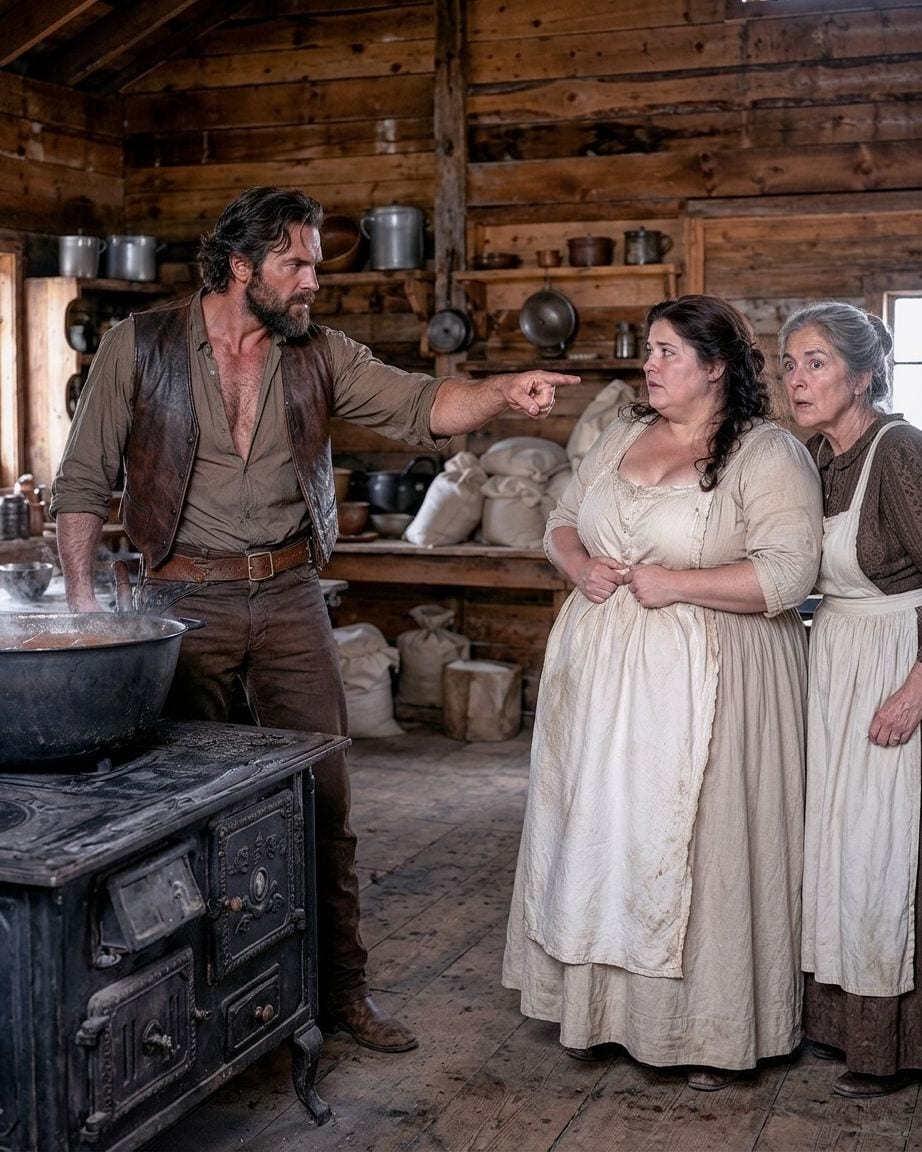
"Who made this stew?" Samuel Hayes shouted, slamming his spoon onto the dining table.
The powerful rancher stood over a steaming bowl, his weathered hand gripping a silver spoon with a small engraved letter H on its handle.
Beside the engraving was a fresh scratch, deep enough to catch the afternoon light.
Samuel stared at the mark.
Then he looked toward the kitchen.
For the first time in five years, the most feared man at Ironwood Ranch was afraid of what he might find.
Thirty ranch hands stopped eating.
A chair scraped against the wooden floor.
Someone near the far end of the table coughed nervously, then thought better of making another sound.
Samuel Hayes was not a man who raised his voice without reason.
At forty-two, he owned more cattle than most men in Laramie County had ever counted. His property stretched across thousands of acres of Wyoming grassland, and his reputation traveled farther than his herds.
Men respected him.
Some feared him.
Almost nobody understood him.
And now the entire dining hall watched as their employer stared at a bowl of venison stew as though it contained a secret.
"Mr. Hayes?"
Martha Whitcomb, the ranch's elderly housekeeper, stepped forward with a dish towel twisted between her fingers.
Samuel turned toward her.
"Did you make this?"
Martha hesitated.
She had worked for Samuel for five years. She had seen him return from cattle drives with broken ribs, bloody knuckles, and exhaustion so severe he could barely climb the porch steps.
She had seen him bury his wife.
She had seen him sit alone at Christmas dinner while thirty hired men celebrated in the next room.
But she had never seen him look quite like this.
"Well, sir," she began, "I helped with supper."
"That isn't what I asked."
His voice was quiet now.
Somehow, that frightened her more.
Martha glanced toward the swinging kitchen doors.
Samuel followed her eyes.
"There's someone else back there."
It was not a question.
Martha swallowed.
"She's only a woman who needed a little help."
Samuel straightened.
"A woman?"
"Yes, sir."
"Who?"
Martha's fingers tightened around the towel.
"Her name is Beatrice Caldwell."
The name meant nothing to him.
But the stew did.
Samuel looked down at the bowl again.
The meat was tender enough to separate beneath his spoon. The gravy was dark, rich, and fragrant with wild onions and thyme.
It was the kind of meal that demanded patience.
Care.
Something more than the simple desire to fill a hungry stomach.
For five years, Martha had served him respectable food. Beans, biscuits, salt pork, roasted beef, and whatever vegetables survived the Wyoming seasons.
He had never complained.
Food was fuel.
That was all.
Until tonight.
Samuel lifted the spoon again, tasted the stew, and closed his eyes for half a second.
A memory moved through him.
A kitchen in St. Louis.
His mother standing beside a black iron stove.
A wooden spoon tapping the edge of a pot.
And a voice he had not heard since he was seventeen.
Good food doesn't just feed a man, Samuel. Sometimes it reminds him he's still human.
He opened his eyes.
"Bring her here."
Martha did not move.
Samuel's expression hardened.
"Martha."
"Please, Mr. Hayes. She's had a terrible time of it."
"Then bring her here before I go looking myself."
Behind the kitchen doors, Beatrice Caldwell heard every word.
She stood beside three enormous flour barrels, pressing one trembling hand against her mouth.
Her other hand clutched the front of her apron.
She was thirty-six years old, with a full, heavy figure, round cheeks, dark brown eyes, and thick hair that had once been carefully arranged every morning.
Now loose strands stuck to her damp forehead.
Her cream-colored dress was stained with flour, and the hem had been repaired so many times that the original stitching was almost impossible to recognize.
Three days earlier, she had owned a respectable traveling bag, two good dresses, and enough money to begin a new life.
Now she owned almost nothing.
And the man who had given her temporary shelter was demanding to see her.
Beatrice looked toward the small kitchen window.
Too narrow.
She glanced at the rear storage door.
Blocked by sacks of grain.
There was nowhere to run.
Not that she could have run far.
Her feet were blistered.
Her ankles still ached from walking through miles of unforgiving country.
And beneath the left sleeve of her dress, a dark bruise reminded her exactly why she had fled Denver.
"Beatrice?"
Martha appeared in the doorway.
Her face was pale.
"Come along, child."
Beatrice shook her head.
"I can't."
"He's asking for you."
"Then tell him I left."
Martha looked at her sadly.
"He'll know you're lying."
Beatrice's eyes filled with tears.
"I didn't steal anything."
Martha frowned.
"Nobody said you did."
"I know. I just—"
She stopped.
Her breathing had become uneven.
Martha stepped closer.
"Listen to me. Whatever trouble you're running from, Samuel Hayes isn't the man who caused it."
Beatrice looked toward the dining hall.
"Men like him don't need to cause trouble, Martha. They only need to decide you're not worth helping."
The older woman had no answer.
Because she understood.
Beatrice had learned that lesson long before she reached Wyoming.
She had learned it in drawing rooms where women whispered about her size.
In shops where dressmakers sighed when she entered.
At dinner tables where men made jokes about how much food she must consume.
And finally, in the home of Harlan Riggs, where every kindness had eventually revealed its price.
She had spent years trying to make herself smaller.
Not physically.
That had never worked.
She made her voice smaller.
Her needs smaller.
Her hopes smaller.
She apologized before asking questions.
She laughed at insults before anyone could accuse her of being sensitive.
She learned to stand near walls, avoid crowded rooms, and pretend she did not notice the way strangers stared.
But hunger had never made her ashamed.
Cooking was different.
Cooking was the one thing she knew she could do well.
Her father had taught her that.
Before his butcher shop failed, before illness took him, before Beatrice discovered how quickly a woman could become vulnerable without money or family, he had shown her how to turn ordinary ingredients into something extraordinary.
"Every piece of meat has a purpose, Bea," he used to say. "You just need patience enough to find it."
She had remembered those words while preparing the evening meal.
The venison had been tough.
The onions were nearly spoiled.
The vegetables were shriveled.
Martha had apologized for the ingredients.
Beatrice had smiled for the first time in days.
"Let me try."
Three hours later, thirty hungry ranch hands were eating the finest supper they had tasted in years.
And now she was about to lose the only roof she had found.
"Please," Beatrice whispered. "Tell him I'll leave at sunrise."
Before Martha could answer, the kitchen doors swung open.
Samuel Hayes stepped inside.
He filled the doorway.
Broad shoulders.
Dark leather vest.
Dusty brown shirt.
A thick beard framing a hard, handsome face.
His boots struck the wooden floor with deliberate weight.
Beatrice backed away.
Her shoulders collided with a flour barrel.
Samuel stopped.
For several seconds, neither spoke.
He had expected an experienced cook.
Perhaps a traveling widow.
Perhaps some sharp-tongued woman who had wandered onto his property looking for employment.
He had not expected this frightened stranger.
Beatrice's hands were trembling.
Her cheeks were flushed from the stove's heat.
Her dress was worn, but the fabric had once been expensive.
And there was something else.
A look in her eyes that Samuel recognized immediately.
He had seen it in injured horses.
In men who had survived terrible accidents.
In people who had learned that danger sometimes wore an ordinary face.
Fear.
Not the nervousness of someone caught doing wrong.
The deeper fear of someone who expected punishment simply for existing.
Samuel glanced at Martha.
"Leave us."
Beatrice stiffened.
"No!"
The word escaped before she could stop it.
Samuel looked back at her.
She swallowed.
"Please, sir. Let her stay."
Something shifted in his expression.
After a moment, he nodded.
"Martha can stay."
Beatrice released a breath she had not realized she was holding.
Samuel stepped toward the stove.
He lifted the lid of the enormous iron pot.
Steam curled upward.
"You made this?"
"Yes, sir."
"All of it?"
"Martha helped prepare the vegetables."
"I'm asking about the stew."
Beatrice lowered her eyes.
"Yes, Mr. Hayes."
Samuel replaced the lid.
"Where did you learn to cook venison like that?"
She hesitated.
"My father."
"Was he a cook?"
"A butcher."
"Where?"
"St. Louis."
Samuel nodded slowly.
"That's a long way from Wyoming."
"Yes, sir."
"How did you get here?"
Beatrice's fingers tightened around her apron.
"The stagecoach broke down."
"And?"
"I walked."
Samuel studied her.
"From where?"
She named a lonely stretch of road beyond Cheyenne.
His eyes narrowed.
"That's nearly three days on foot."
Beatrice said nothing.
"Alone?"
"Yes."
Martha looked down.
Samuel glanced at the woman's blistered hands.
Then at her dusty shoes.
Then at the bruise partly visible beneath her sleeve.
"Why?"
The question was simple.
The answer was not.
Beatrice felt her throat tighten.
She could have invented a story.
A dead husband.
A lost inheritance.
A relative waiting in another town.
But she was too tired to lie.
And something about Samuel's steady gaze made dishonesty feel useless.
"I needed to get away."
"From what?"
Her eyes flickered toward the window.
"Someone."
Samuel noticed.
He had spent enough years dealing with thieves, cattle rustlers, and dishonest traders to recognize when a person was withholding information.
But he also knew there were times when pressing too hard only made frightened people retreat further.
"Does this someone know where you are?"
"I hope not."
"Is he your husband?"
Beatrice went very still.
Samuel noticed that too.
She looked at the floor.
"I don't want to cause trouble."
"That's not an answer."
"No, sir."
"Then give me one."
Martha shifted uncomfortably.
"Samuel—"
He raised one hand.
Not threateningly.
Simply asking for patience.
Beatrice drew a slow breath.
"There was a man in Denver. Harlan Riggs."
Samuel's expression changed almost imperceptibly.
He knew the name.
Anyone involved in Wyoming cattle knew Harlan Riggs.
The broker had money, political connections, and a reputation for making inconvenient problems disappear.
Samuel had never trusted him.
But he did not reveal that.
"What about him?"
Beatrice shook her head.
"I can't tell you."
"Can't?"
"Not yet."
Samuel watched her for a long moment.
Then he surprised her.
"All right."
Beatrice blinked.
"All right?"
"You don't have to tell me tonight."
She stared at him.
She had expected anger.
Suspicion.
A demand for explanations.
Instead, he walked toward the wooden table and pulled out a chair.
"Sit down."
Beatrice did not move.
Samuel glanced at her.
"That's a chair, Miss Caldwell. Not a trap."
Martha made a small sound that might have been a laugh.
Beatrice hesitated before lowering herself into the seat.
Her knees ached.
Her entire body seemed to sag with exhaustion.
Samuel noticed how carefully she moved.
"Have you eaten?"
She nodded automatically.
Martha folded her arms.
"No, she hasn't."
Beatrice looked up sharply.
"Martha!"
"Don't Martha me. You've been cooking for everybody but yourself."
Samuel reached for a clean bowl.
He ladled stew into it and placed it before Beatrice.
"Eat."
She stared at the bowl.
"I couldn't."
"Why not?"
"It's your food."
Samuel looked at the enormous pot.
"There's enough to feed half of Cheyenne."
Martha chuckled.
Beatrice almost smiled.
Almost.
Then her eyes filled again.
Samuel frowned.
"What's wrong?"
She shook her head.
"Nothing."
"You're crying."
"I'm sorry."
"For what?"
The question startled her.
She searched for an answer.
For being hungry.
For being large.
For arriving without permission.
For needing help.
For taking up space in a kitchen that did not belong to her.
But none of those explanations seemed safe to say aloud.
So she whispered, "I don't know."
Samuel pulled out the chair opposite her.
He sat.
For a moment, the formidable ranch owner looked less like a man who commanded thousands of acres and more like someone who understood what it meant to be alone.
"Miss Caldwell," he said, "where are you staying?"
Beatrice looked down at her hands.
"Martha let me rest in the storeroom."
"Before that?"
"Nowhere."
"Where are your belongings?"
"I lost them."
"Your money?"
"Gone."
"Family?"
Her expression crumpled.
"My father died. There's no one else."
Samuel leaned back.
"Then where do you intend to go tomorrow?"
She tried to answer.
Nothing came.
Outside, a horse whinnied.
The stove crackled.
Martha stood perfectly still beside the preparation table.
Finally, Beatrice whispered the truth.
"I don't know, Mr. Hayes."
Samuel waited.
She swallowed.
"I don't have a home."
The words seemed to drain the last of her strength.
She had been holding herself together for days.
Through hunger.
Through thirst.
Through the terror of hearing hoofbeats behind her on empty roads.
Through the humiliation of begging an elderly stranger for water.
But saying those five words aloud broke something inside her.
"I have nowhere left to go."
Samuel did not speak.
Beatrice forced herself to look at him.
She expected pity.
Or disgust.
Instead, she found him studying her with an expression she could not understand.
At last, he stood.
Martha straightened.
"Samuel?"
He looked toward the kitchen shelves.
Then the stove.
Then the woman sitting before him.
"Martha, how many men are we feeding these days?"
"Thirty, sometimes thirty-five."
"And how many hours are you spending in this kitchen?"
"More than these old bones appreciate."
Samuel nodded.
"Thought so."
He turned toward Beatrice.
"Can you bake bread?"
She blinked.
"Yes."
"Biscuits?"
"Of course."
"Can you manage breakfast for thirty men before sunrise?"
"I've cooked for large groups before."
"Can you keep accounts?"
"My father taught me bookkeeping."
"Can you work hard?"
For the first time, something like pride entered her voice.
"Yes, Mr. Hayes. I can."
Samuel folded his arms.
"Good."
Martha stared at him.
Beatrice waited for the catch.
There was always a catch.
Samuel glanced toward the dining hall, where thirty men were still waiting to discover why their employer had abandoned supper.
Then he looked back at the frightened woman.
"Martha needs help. I need a cook. You need work."
Beatrice's heart seemed to stop.
"Sir?"
"Room, board, and ten dollars a month."
She stared at him.
He continued.
"You'll have your own room. You'll answer to Martha about the kitchen, and you'll answer to me about the quality of the food."
Beatrice could barely breathe.
"You're offering me a job?"
"I'm offering you honest work."
"But you don't know me."
Samuel's expression remained steady.
"I know what you can do with a miserable cut of venison."
Martha covered her mouth.
Beatrice looked between them.
"Mr. Hayes, I don't understand."
"You don't have to understand everything tonight."
He placed one large hand on the back of the chair.
"You just have to decide whether you want to stay."
For several seconds, Beatrice could not speak.
She had spent so long expecting cruelty that kindness felt almost dangerous.
Then she nodded.
Once.
Twice.
"Yes," she whispered. "Yes, sir. I want to stay."
Martha's eyes shone.
Samuel gave a brief nod.
"Then it's settled."
He turned toward the dining hall.
But before he reached the door, Beatrice stood.
"Mr. Hayes?"
He looked back.
"Thank you."
The words were barely audible.
Samuel regarded her quietly.
Then he said something she would remember for the rest of her life.
"Don't thank me for giving you a chance to earn your place, Miss Caldwell. Just show me what you can do."
He disappeared through the swinging doors.
Martha let out a long breath.
"Well, I'll be."
Beatrice sank back into the chair.
Her hands were shaking again.
But this time, it was not entirely from fear.
Martha stepped beside her and rested one weathered hand on her shoulder.
"Eat your supper, child."
Beatrice picked up the spoon.
She took one small bite.
The stew tasted exactly as she had intended.
Rich.
Warm.
Comforting.
For the first time in three days, she allowed herself to believe she might survive.
Then something struck the kitchen window.
A sharp tap.
Beatrice froze.
Martha turned.
Another tap came.
Not from a bird.
Not from the wind.
Someone was outside.
Beatrice slowly lowered her spoon.
Through the dusty glass, she saw the shadow of a man standing beside the building.
He lifted one hand.
Pressed something against the window.
A folded piece of paper.
Beatrice recognized the handwriting on its outer edge.
Her blood turned cold.
She knew that handwriting.
She had seen it on contracts.
On threatening letters.
On documents she had been forced to sign.
The paper shifted against the glass.
And beneath the name Beatrice Caldwell, someone had written three words in black ink.
I FOUND YOU.






Comments 0