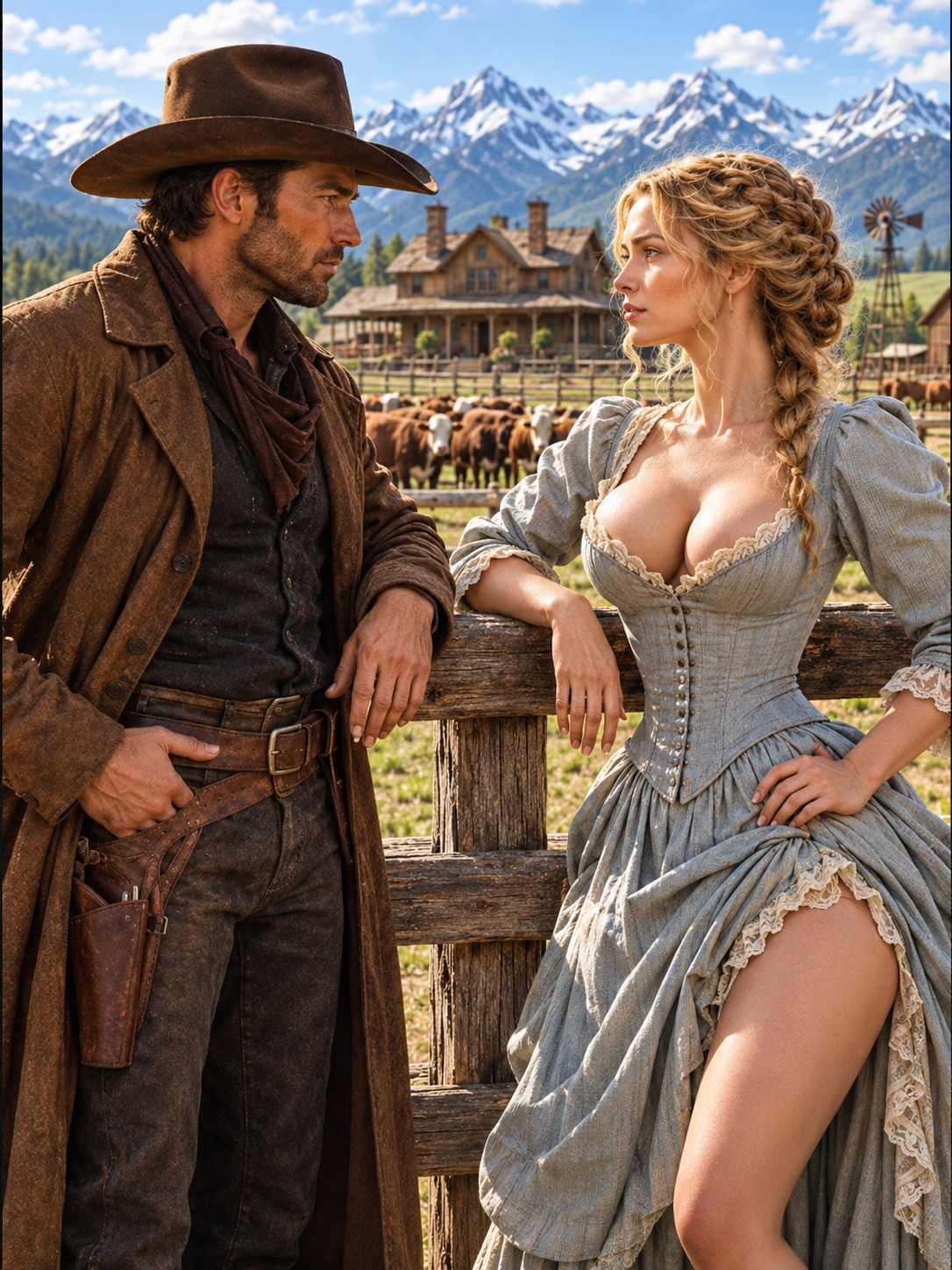
Eleanor placed the old envelope beside my father's letter.
"Where did you get that?" I asked.
She looked down at the handwriting.
"My father's private correspondence. I found it in his study before I left Boston."
I picked up the envelope.
The paper was thick, yellowed around the edges, and marked with a faded Boston postmark. My father's name wasn't written anywhere on it. Instead, the front bore the name of Reginald Whitmore, Eleanor's father.
"Why would you bring this to Montana?"
"I didn't know what it meant when I found it."
She paused.
"But I recognized the handwriting."
I looked at the two pieces of paper.
The letters were unmistakably similar. The same narrow capital letters. The same unusual way of crossing the letter T. Even the final strokes of certain words curled slightly upward.
My father had written the letter in my hand.
And whoever had written the envelope had written to Eleanor's father.
"Open it," I said.
Eleanor hesitated.
"Are you certain?"
"It's addressed to your father. But if my father's letter concerns the same matter, I think we're entitled to know."
She carefully opened the envelope.
Inside was a folded sheet of paper.
The ink had faded, but most of the writing remained readable.
Eleanor unfolded it and placed it beneath the lamp.
I leaned closer.
The letter was dated October 1861.
It was written by my father, Thomas Hale, and addressed to Reginald Whitmore.
I recognized his signature immediately.
My father had been dead for seventeen years, but I could still remember watching him sign documents at the farmhouse table when I was a boy.
Eleanor began reading.
"Mr. Whitmore, I am writing to confirm that the amount we discussed represents a temporary loan against the eastern pasture, with repayment expected upon the sale of the autumn cattle."
She stopped.
I continued reading silently.
The letter mentioned a principal amount of eight hundred dollars.
I frowned.
"Eight hundred?"
Eleanor nodded.
"That's what it says."
I walked to the cabinet and retrieved the copy of the legal claim sent from Helena.
The document listed the original loan as eight hundred dollars.
That part matched.
But the interest calculation was another matter.
According to the claim, my father had agreed to a specific interest arrangement that had continued accumulating for more than two decades.
The old letter contained no mention of that arrangement.
"Where's the rest?" I asked.
Eleanor examined the sheet.
"There isn't anything else."
"Does your father have the original?"
"I don't know."
I looked at her.
"Surely he knows about this letter."
She lowered her eyes.
"My father kept hundreds of business documents. He rarely discussed the contents with me."
"Did he know you found it?"
"No."
"Why didn't you mention it before?"
She looked directly at me.
"Because I didn't understand its significance. I thought it was an ordinary business letter between two men who had known each other."
I studied her face.
She wasn't hiding anything deliberately.
At least, I had no reason to believe she was.
But the discovery raised more questions than it answered.
Why had my father written about a temporary loan?
Why did the Whitmore family now claim the debt had grown into something that threatened the eastern third of my ranch?
And why had my father left a warning about someone changing the original amount?
I picked up the envelope again.
There was something written inside the flap.
A small number.
1861.
Beneath it were two initials.
R.W.
I turned the paper toward Eleanor.
"Did your father write this?"
She examined the initials.
"I don't think so."
"Why?"
"His handwriting was different."
She took a pencil from the table and wrote her father's name on a spare sheet.
The difference was obvious.
Reginald's handwriting was rounded and elegant.
The writing inside the envelope was narrow and hurried.
It looked much more like my father's.
I felt a chill move across my shoulders.
"Your father kept a letter written by mine for more than twenty years."
"Apparently."
"And someone has been investigating the same debt."
Eleanor nodded.
"Which is why I think we should find the original agreement."
I looked toward the hallway.
My father's old office was at the rear of the farmhouse.
I rarely entered it.
The room contained his desk, a few shelves, and several boxes of documents I had never bothered to sort.
I had kept the room locked since his death.
Not because it contained anything particularly valuable.
But because it was the last place in the house that still felt like his.
"Come with me," I said.
Eleanor followed.
I took the key from my pocket and opened the door.
The hinges made a low groan.
Dust floated through the light coming from the narrow window.
The desk stood against the far wall.
My father's old chair remained behind it.
Several books were stacked on the shelves.
I walked toward the desk.
"Most of these papers haven't been touched in years."
Eleanor looked around carefully.
"May I?"
I nodded.
She began examining the shelves.
I opened the top drawer.
Inside were old receipts, a broken fountain pen, several folded maps, and a small collection of letters.
I recognized some of them.
Others meant nothing to me.
I searched through the papers until I found a worn leather folder.
It contained property documents from the years before I inherited Iron Ridge.
Eleanor joined me.
She examined the folder.
"These are land records."
"Yes."
She turned several pages.
Then she stopped.
"Carson."
I looked up.
"What?"
She pointed to a document dated 1861.
It was a handwritten agreement between my father and Reginald Whitmore.
The paper was badly worn.
Two signatures appeared at the bottom.
Thomas Hale.
Reginald Whitmore.
My heart began beating faster.
"That's it," I said.
Eleanor moved closer.
We read the document together.
It described a loan of eight hundred dollars.
The eastern pasture was listed as security.
The agreement also specified a repayment date.
One year.
Not twenty-two years.
One year.
I read that sentence twice.
Then a third time.
"That's not what the lawyers told me."
Eleanor continued examining the page.
"There's another section."
A paragraph near the bottom described what would happen if repayment was delayed.
The language was complicated, but one sentence was clear.
The land could only be claimed after a formal notice of default had been delivered to the borrower.
My father had been dead for seventeen years.
I looked at Eleanor.
"Did your father ever send such a notice?"
She shook her head.
"I have no idea."
I felt anger rising.
"How can the family claim the land if no notice was ever issued?"
"We need to examine the later correspondence."
She turned the page.
There was a second document attached to the agreement.
It was a calculation of the outstanding balance.
The amount listed was considerably higher than the original loan.
I leaned closer.
Someone had written several figures in the margin.
One of them had been crossed out.
Another had been added above it.
Eleanor took the paper toward the window.
"The ink is different."
"Different?"
"Look at the original amount. The handwriting is similar to your father's. But these later calculations appear to have been added by someone else."
I examined the figures.
She was right.
The original writing was faded brown.
The newer calculations were darker.
Somebody had added numbers to the document after it had been signed.
"Can you tell when?"
"Not without a closer examination."
I stared at the page.
My father had warned me.
If the Whitmores ever come for the eastern water, ask who changed the original amount.
He hadn't written those words without reason.
He had known something was wrong.
Perhaps he had known long before I inherited the ranch.
I sat down in his chair.
For a moment, I couldn't speak.
Eleanor placed the documents on the desk.
"Carson, I think we should make copies of everything before we contact anyone."
"Why?"
"Because if someone has altered the original agreement, we need to preserve the evidence."
I looked at her.
"You think my father's signature was forged?"
"I don't know."
She spoke carefully.
"But I think the later figures deserve investigation."
I rubbed my forehead.
I had spent years believing that the Whitmore family held a legitimate claim against my land.
The marriage had seemed like the only way to prevent the loss of the eastern pasture.
Now I was beginning to wonder whether the entire arrangement rested on a document that had been altered.
"Does your father know about this?" I asked.
Eleanor was silent.
"I don't know what he knows."
"Would he have arranged this marriage if the claim wasn't valid?"
She looked at the old agreement.
"Possibly."
"Why?"
She took a breath.
"My father has always believed that business decisions should be made according to what benefits the family."
I studied her face.
"Even if the decision harms someone else?"
She didn't answer immediately.
"Especially when he believes the other person has no choice."
There was no anger in her voice.
Only disappointment.
I began to understand that Eleanor might have spent much of her life dealing with the same man who had arranged my marriage.
A man who viewed people as pieces on a board.
I looked at the agreement again.
"Your father gave me one choice. Marry you or lose the ranch."
"And he gave me one choice. Marry you or remain dependent on him."
I turned toward her.
"You didn't want this marriage either?"
She gave a faint shake of her head.
"I didn't know you. I didn't know Montana. I didn't even know what kind of man you were."
I looked away.
"Neither did I."
For several seconds, the room was quiet.
Then Eleanor spoke.
"But I don't regret coming here."
I turned back.
She seemed surprised by her own words.
"Why?"
"Because I finally have something useful to do."
I looked at the documents.
"You've already done more for this ranch in two days than I expected."
"Then imagine what we might accomplish if we stop treating this marriage as a debt arrangement."
I didn't know what to say.
The idea of working with someone else had always seemed unnecessary.
But Eleanor wasn't asking to replace me.
She was asking to stand beside me.
And I was beginning to understand the difference.
We spent another hour sorting the papers.
Eleanor found two additional letters from my father.
Both were addressed to Reginald Whitmore.
One was dated 1862.
The other was dated 1863.
The first requested confirmation that the original loan had been repaid.
The second referred to a disagreement concerning the eastern water rights.
Neither letter contained a reply.
I looked at the dates.
"Why would my father continue writing if he had received no response?"
"Perhaps he was trying to resolve the matter."
"Or perhaps someone was refusing to answer."
Eleanor carefully folded the letters.
"We should find out whether these were ever delivered."
I nodded.
"Tomorrow, I'll send a message to the Helena attorney."
"Not yet."
I looked at her.
"Why not?"
"Because we don't know whether he has seen the original agreement."
I frowned.
"He's the man handling the claim."
"Exactly."
She paused.
"If he represents the Whitmore family, we should not assume that he has your interests in mind."
That was fair.
I had been dealing with the same attorney since receiving the first notice.
He had seemed professional enough.
But I was beginning to understand that professionalism and loyalty were not necessarily the same thing.
I closed the folder.
"Let's make copies first."
Eleanor nodded.
We carried the documents into the dining room.
May was preparing tea.
She noticed the papers immediately.
"Found something?"
"Perhaps," I said.
Eleanor placed the old agreement on the table.
May examined the faded handwriting.
"That looks like Mr. Thomas's writing."
I looked at her.
"You recognize it?"
"Of course. He used to write notes for the kitchen."
She leaned closer.
"Though I haven't seen his handwriting in years."
Eleanor smiled faintly.
"Do you remember anyone visiting him about these papers?"
May thought.
"Not particularly."
Then she hesitated.
"Actually, there was one gentleman."
I looked up.
"When?"
"Before Mr. Thomas died."
I felt my stomach tighten.
"Who?"
May frowned as she searched her memory.
"He came during the winter. Your father was very upset afterward."
"Did he give a name?"
"No. But I remember his watch."
Eleanor looked at me.
May continued.
"It was gold, with a little engraving on the cover."
I stopped moving.
The description sounded familiar.
The man who had visited the ranch recently and asked about the old land documents had worn a gold pocket watch.
"Did he look like the man who came last month?" I asked.
May shook her head.
"No. The first gentleman was older. Much older."
"Did you hear what they discussed?"
"No, sir. But I remember Mr. Thomas telling him he wouldn't sign another paper."
Eleanor's face became serious.
"Another paper?"
May nodded.
"He said something like, 'I won't put my name to a lie.'"
The words settled over the table.
I looked at the old agreement.
My father had refused to sign something.
Something connected to the debt.
Something that might explain why the eastern pasture was now under threat.
I wanted to ask May more questions, but she had already returned to the kitchen.
Eleanor examined the documents again.
"Carson, we need to know who that man was."
"I agree."
"And whether he was connected to the Whitmore family."
I nodded.
But before I could answer, a loud knock came from the front door.
Three sharp strikes.
Hank entered the dining room a moment later.
"Carson, there's a visitor."
"Who?"
"Man from town. Says he's a representative of the Whitmore estate."
Eleanor stood immediately.
"Did he give his name?"
Hank hesitated.
"Yes, ma'am."
He looked toward me.
"Mr. Edward Whitmore."
Eleanor went completely still.
I turned toward her.
"Do you know him?"
She slowly shook her head.
"He's my father's younger brother."
I looked toward the front door.
"Why would your uncle come here?"
Eleanor's eyes moved to the old loan agreement.
Then to the envelope bearing her father's name.
"I don't know."
Hank appeared uncomfortable.
"There's something else, boss."
"What?"
"He says he's here to collect a document your father promised him before he died."
I felt my hands tighten.
"What document?"
Hank swallowed.
"He says it's the original deed to the eastern water rights."
Eleanor looked at me.
I looked at the locked drawer where I had placed the original land papers.
Then came another knock.
This time, the voice from the other side of the door was unmistakable.
"Carson Hale! I know you have something that belongs to my family."
And when Eleanor heard the next words, she reached for my arm.
"Open the door, nephew. Your father and I have unfinished business."






Comments 0