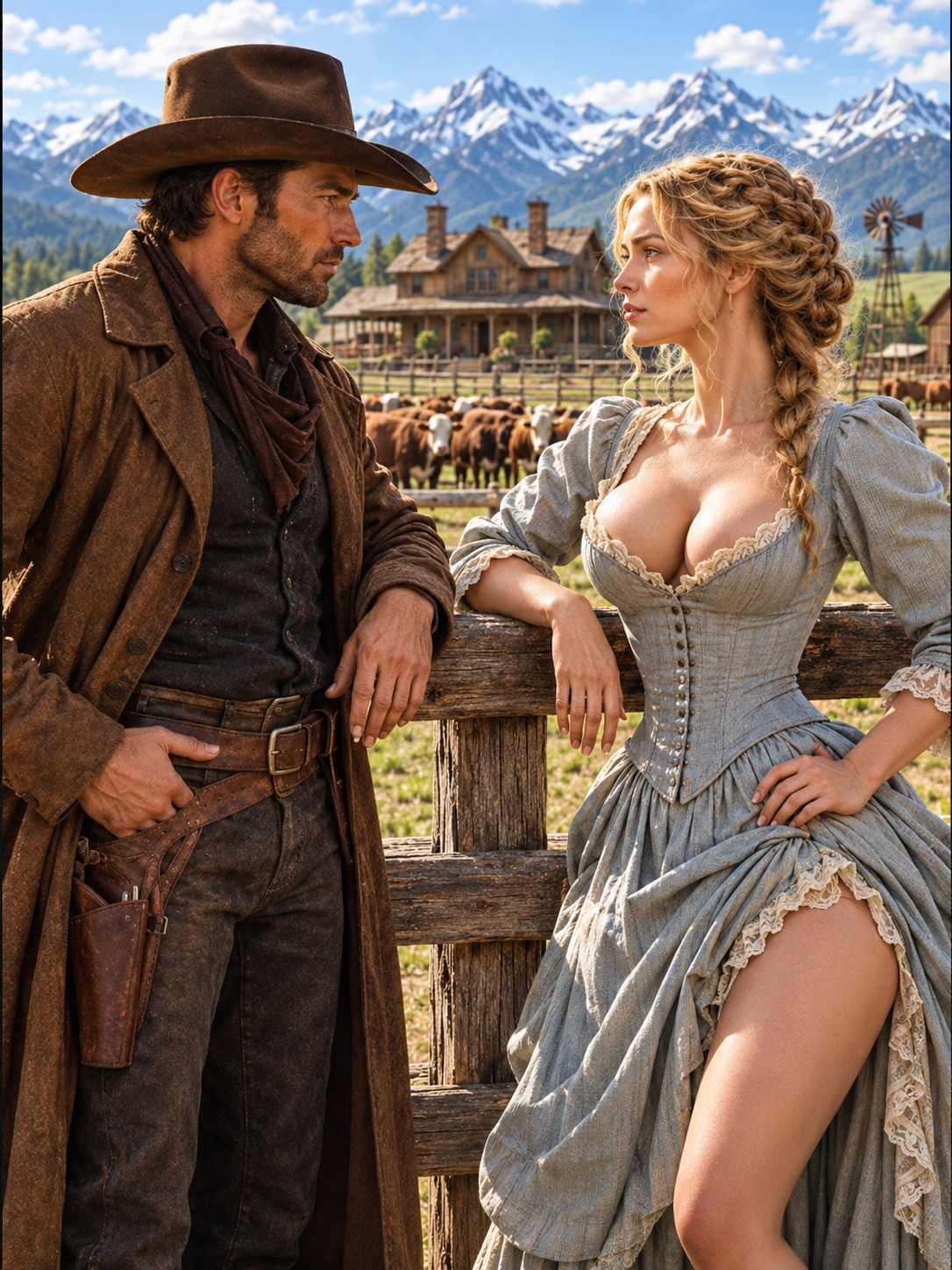
Arthur Bell stood in the courthouse doorway holding a folded document.
"Your father didn't lose the eastern water rights, Carson. He was cheated out of them."
I stared at the man who had disappeared from Iron Ridge seventeen years earlier.
He looked older than I remembered. His dark hair had thinned considerably, and deep lines surrounded his mouth. He wore a brown traveling coat, a clean white shirt, and a narrow black tie. His face had lost the confidence I remembered from the brief period when he worked for me.
But his eyes were unmistakable.
Arthur Bell.
The man who had once handled my father's old business records.
The man who had left Iron Ridge without collecting his final wages.
The man whose signature appeared beside a missing land document in the courthouse register.
And now he was standing in front of me, claiming he knew something about my father's death.
I stepped toward him.
"What did you just say?"
Arthur glanced at Eleanor.
"I think we should speak somewhere private."
"No," I answered. "You've had seventeen years to find me. You're going to explain yourself right here."
Several people in the courthouse turned toward us.
Arthur lowered his voice.
"Your father signed an agreement that transferred the eastern water rights to the Whitmore family. But he never received the payment recorded in the document."
I felt my stomach tighten.
"What payment?"
"Three thousand dollars."
I looked at Eleanor.
She had gone completely still.
"Three thousand?" I repeated.
Arthur nodded.
"That was the amount written in the transfer agreement."
I shook my head.
"The original loan was eight hundred dollars."
"Yes."
"And the eastern water rights were only supposed to serve as security until the debt was repaid."
Arthur looked at me.
"That was the original arrangement."
I stepped closer.
"Then explain the three thousand dollars."
He glanced at the folded paper in his hand.
"Your father believed he was signing a temporary extension. Reginald Whitmore's representatives presented him with another document, claiming it would give him additional time to repay the loan."
"You're saying he didn't know what he signed?"
"I'm saying the document he was shown was not the document eventually recorded."
Eleanor spoke.
"Who prepared the replacement?"
Arthur hesitated.
"Charles Whitcomb."
The name immediately caught my attention.
The attorney who had sent the legal notice threatening to take my ranch.
The man whose representative had recently visited the courthouse.
I looked at Arthur.
"Why would a Boston attorney be involved in a land transaction in Montana?"
"Because the Whitmore family had business interests throughout the territory."
"That's not an answer."
Arthur looked toward the courthouse windows.
"Because they wanted the water."
I felt my jaw tighten.
The eastern pasture contained the most dependable spring on Iron Ridge.
Without it, the cattle would eventually have nowhere reliable to drink during the dry months.
The western creek sometimes dried to a narrow stream.
The northern pond froze early.
The eastern spring had kept the ranch alive through droughts that had destroyed neighboring operations.
If someone controlled that water, they controlled the future of Iron Ridge.
"Why didn't you tell me this seventeen years ago?" I demanded.
Arthur lowered his eyes.
"Because I was afraid."
"Afraid of what?"
"Reginald Whitmore."
Eleanor stepped closer.
"My father?"
Arthur looked at her.
"Yes, Mrs. Hale."
She seemed to struggle with the words.
"Are you certain?"
"I saw the correspondence myself."
"My father told me the ranch belonged to a family that had failed to honor its obligations."
Arthur gave a tired smile.
"That's what he wanted people to believe."
I felt anger rising.
"Then why did you leave?"
Arthur looked at me.
"Because I made a mistake."
"What mistake?"
"I helped prepare the documents."
The admission landed heavily.
For a moment, I couldn't speak.
Arthur continued.
"I was twenty-four years old. I had recently started working as a clerk for the Whitmore family's attorney. They paid me well, and I believed I was helping organize a legitimate transaction."
"Then?"
"Then I discovered the original agreement and the replacement deed didn't match."
I stared at him.
"What did you do?"
"I asked questions."
"And?"
"Mr. Whitcomb told me to mind my work."
Arthur unfolded the document.
"I made a copy of the original agreement before it was removed from the courthouse archive. I thought it might be useful if anyone ever challenged the transaction."
I looked at the paper.
"Is that what you're holding?"
He nodded.
"Not exactly. This is a copy of the original transfer record, along with a handwritten statement I prepared at the time."
Eleanor stepped closer.
"Why did you come here now?"
Arthur looked at her.
"Because I heard you had married Carson Hale."
She frowned.
"How did you hear that?"
"News travels. Especially when the Whitmore family arranges a marriage that saves a valuable property claim."
His eyes returned to me.
"When I heard about the wedding, I realized the family intended to use the old agreement again."
I felt a cold sensation move down my back.
"Use it how?"
"By convincing you that marriage was the only way to keep the ranch."
Eleanor looked at the floor.
I glanced at her.
For the first time, I wondered whether she had been brought into this arrangement for reasons beyond her father's convenience.
Arthur continued.
"Your father spent years trying to challenge the transaction. He sent letters to Boston. He contacted attorneys. He even traveled to Helena to request a review of the land records."
"Why didn't he win?"
"Because the original deed disappeared."
I looked toward the register.
Arthur's signature was still visible.
He followed my gaze.
"That was me."
"Why did you sign for its removal?"
"Mr. Whitcomb told me the document needed to be examined by the family's attorney. I believed it would be returned."
"And it wasn't."
"No."
I felt my hands tighten.
"Did you steal it?"
Arthur shook his head.
"I didn't steal it. But I helped it disappear."
The distinction meant very little to me.
"You had one job, Arthur. You were supposed to keep the records accurate."
"I know."
"You knew my father."
"I did."
"You knew what that land meant to him."
Arthur lowered his head.
"I know."
I wanted to strike him.
Instead, I took a breath.
"What happened after you left?"
He looked at Eleanor.
"Your father arranged for me to be transferred to another office. I refused. I told him I would speak to the authorities."
"And he threatened you?"
"Not directly. He told me that a young man without money, family connections, or a respectable employer would find it difficult to convince anyone that a wealthy businessman had committed fraud."
Eleanor's face hardened.
"That sounds like my father."
Arthur nodded.
"He offered me money to remain silent. I refused. Then I received a letter warning me that if I continued, I could be charged with participating in the document fraud myself."
I stared at him.
"So you ran."
"Yes."
"And left my father to deal with everything alone."
Arthur looked at me.
"Yes."
His honesty surprised me.
He didn't attempt to excuse himself.
He didn't ask for sympathy.
He simply accepted the accusation.
Eleanor extended her hand.
"May I see the document?"
Arthur handed it to her.
She examined the paper carefully.
The writing was faded, but the date was visible.
October 1861.
She compared it with the letter she had brought from Boston.
I watched her eyes move across the page.
"Carson."
"What?"
"Look at this paragraph."
She pointed to a section near the bottom.
It described the payment my father was supposed to receive in exchange for the temporary transfer of the eastern water rights.
The amount was eight hundred dollars.
Not three thousand.
There was also a sentence specifying that the arrangement would expire once the original loan was repaid.
Eleanor examined the signature.
"This appears to be consistent with the original agreement."
Arthur nodded.
"It is."
"How can we prove the copy is authentic?"
"Because I witnessed the original being prepared."
She looked up.
"Would you testify?"
Arthur hesitated.
Then he nodded.
"Yes."
I leaned against the desk.
For the first time in years, the possibility of saving the eastern pasture seemed real.
But I didn't want to celebrate prematurely.
"Where is the original document?"
Arthur's expression changed.
"That's the problem."
"What problem?"
"It wasn't destroyed."
I stared at him.
"Then where is it?"
He looked toward the courthouse door.
"I believe Reginald Whitmore still has it."
Eleanor's eyes narrowed.
"My father?"
Arthur nodded.
"He kept the original in a private archive in Boston."
"How do you know?"
"Because I saw it again seventeen years ago."
I stepped closer.
"When?"
"After your father died."
My stomach tightened.
"What?"
Arthur looked at me.
"Shortly after Thomas Hale passed away, Mr. Whitcomb summoned me to Boston. He wanted me to help prepare the final claim against Iron Ridge."
I felt the room tilt slightly.
"You're telling me you saw the original agreement after my father died?"
"Yes."
"And you said nothing?"
"I was afraid."
I looked away.
For several seconds, I couldn't speak.
My father had died believing the eastern water rights were under threat.
I had inherited that fear.
I had spent fifteen years working to keep the ranch alive.
And all this time, someone might have possessed the document that could have cleared the entire dispute.
Eleanor broke the silence.
"Did you see anything else?"
Arthur looked at her.
"Yes."
"What?"
He hesitated.
"A second document."
"What kind?"
"A payment record."
I frowned.
"Payment to whom?"
"Your father."
I felt my heart begin to beat faster.
"You're saying he received the three thousand dollars?"
"No."
Arthur shook his head.
"That's the strange part. The payment record stated that the money had been delivered to Thomas Hale, but the signature acknowledging receipt was not his."
I stared at him.
"Whose signature was it?"
Arthur looked down at the paper.
"I couldn't identify it at the time."
Eleanor studied the document.
"Can you identify it now?"
Arthur nodded slowly.
"I believe I can."
He turned the paper toward us.
A name had been written beneath the signature.
Not Thomas Hale.
Not Reginald Whitmore.
It was the name of the man who had handled my father's financial affairs after the original loan.
The man who had disappeared shortly before my father died.
And the same man whose handwriting appeared on several altered ranch invoices.
"Arthur," I whispered. "Who was it?"
He looked directly at me.
"Samuel Pike."
I felt as though someone had struck me in the chest.
Samuel Pike.
The harness supplier.
The man who had arrived at my ranch with Tom Barker two days earlier.
The man who had charged me for equipment I never received.
The man who had been asking questions about my purchasing records.
I looked at Eleanor.
She was already reaching for her notebook.
"How could Pike have been involved in a transaction in 1861?" she asked.
Arthur shook his head.
"He wasn't. Not then."
I frowned.
"What are you talking about?"
"The signature on the payment record wasn't written by Samuel Pike himself. It was signed by someone authorized to act on his behalf."
"Who?"
Arthur hesitated.
Then he gave us the answer.
"His father."
I stared at him.
Samuel Pike's father had died long before I took over the ranch.
I remembered hearing the name once.
Old Samuel Pike had been a bookkeeper who worked for several businesses in Helena.
But I had never connected him to the Whitmore family.
"Why would his father receive money intended for mine?"
Arthur looked toward Eleanor.
"Because he was the man who handled the original payment."
I felt anger rising again.
"Then where did the money go?"
"I don't know."
"Who does?"
Arthur folded the paper.
"Reginald Whitmore."
Eleanor looked as though she had been struck.
"My father knew?"
Arthur nodded.
"Your father signed the instructions authorizing the payment."
She stepped back.
For several seconds, she said nothing.
Then she spoke quietly.
"You're telling me my father knew Thomas Hale never received the money, yet continued pursuing the land?"
Arthur didn't answer.
He didn't need to.
I looked at Eleanor.
She seemed to be fighting something inside herself.
I wanted to comfort her.
But I couldn't forget that her family had spent decades threatening everything I owned.
"Does your father still have the payment records?" I asked.
Arthur nodded.
"Almost certainly."
"Then we'll go to Boston."
Eleanor turned toward me.
"Carson—"
"We'll find the original agreement. We'll find the payment record. And we'll make your father explain what happened."
Arthur shook his head.
"There's something else you need to know."
I turned back.
"What?"
"The document isn't the only thing Reginald kept."
He opened his leather case and removed a second envelope.
This one was sealed.
The handwriting on the front was my father's.
Thomas Hale.
I recognized it immediately.
Arthur placed it on the desk.
"I found this among the papers your father left behind when he died."
I stared at the envelope.
"Where?"
"In the old office at Iron Ridge."
"Then why didn't you give it to me?"
"Because I was never able to return to the ranch."
He pushed the envelope toward me.
"I kept it all these years."
I picked it up.
My father's name was written on the back, followed by a date.
January 1863.
Eleanor moved beside me.
"Is it addressed to anyone?"
I turned it over.
There was one line.
To be opened only if the Whitmores return for the eastern water.
My hands began to tremble.
The date was twenty years before my father died.
He had known the Whitmores might return.
He had prepared something for that possibility.
I carefully broke the seal.
Inside was a single folded sheet.
The first line was written in my father's familiar hand.
If you are reading this, then the Whitmore family has come for the land again.
I continued.
The letter described a meeting that had taken place in Helena.
It mentioned the missing payment.
It mentioned a second signature.
And it mentioned a witness who had agreed to help my father prove the fraud.
I reached the bottom of the page.
There, beneath the final paragraph, was a name.
I read it once.
Then again.
My face went cold.
Because the witness my father had trusted was not Arthur Bell.
It wasn't an attorney.
It wasn't a rancher.
It was someone still working at Iron Ridge.
Someone who had been standing beside me for eleven years.
I looked up at Eleanor.
Then I whispered the name.
"Hank Briggs."
Arthur nodded slowly.
"Your father believed Hank was the only man who knew where the original payment had gone."
Before I could ask another question, the courthouse bell rang.
A man hurried through the entrance.
His face was pale.
He looked directly at me.
"Mr. Hale! You need to get back to Iron Ridge immediately!"
I stood.
"What happened?"
The man swallowed.
"There's been an accident at the ranch."
Eleanor grabbed her coat.
"Is everyone safe?"
The messenger shook his head.
Then he looked at me.
"The eastern fence has collapsed, and nearly two hundred cattle are heading straight toward the water..."






Comments 0