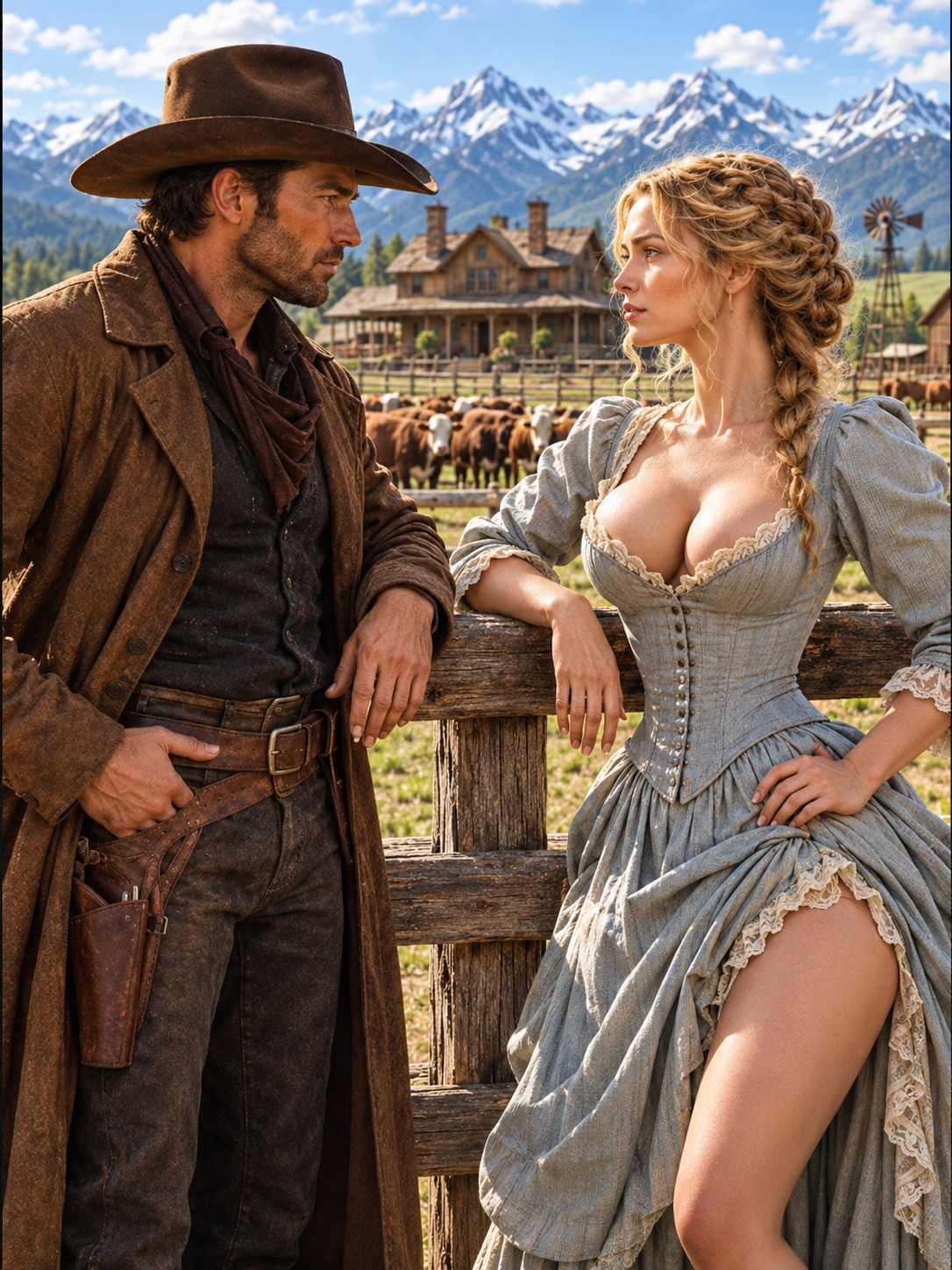
Eleanor Whitmore stepped down from the wagon and pointed toward my fence.
"That post won't survive another Montana winter."
I stared at the fourth fence post beside the entrance to Iron Ridge Ranch.
The soil beneath it had washed away, leaving a narrow gap around its base.
My new wife had noticed something I had ignored for weeks.
And I suddenly wondered what else she might see.
My name is Carson Hale. I was forty-five years old when Eleanor arrived at my ranch in August of 1883. I had spent fifteen years building Iron Ridge from a struggling piece of inherited land into a working cattle operation with nearly a thousand head of livestock.
I knew how to mend fences, break horses, treat sick cattle, and survive winters that could freeze a man's breath before it reached the ground.
I also knew how to recognize trouble.
Unfortunately, I had never expected trouble to arrive wearing an elegant gray traveling coat and carrying a single leather suitcase.
Three weeks earlier, I had become Eleanor Whitmore's husband without ever seeing her face.
It wasn't a love story.
It was a business arrangement made by two families, one old debt, and a piece of land that mattered more to me than anything else in the world.
My father had borrowed money from the Whitmore family in 1861. By the time the lawyers finally brought the matter to my attention, decades of accumulated interest had turned that old loan into a claim against the eastern third of Iron Ridge.
That land contained our most dependable water source.
Losing it would eventually mean losing the ranch.
The Whitmores offered one alternative.
I could marry their daughter, Eleanor, and the family would release its claim.
I had read the proposal several times before signing.
There was no affection in it. No promise of happiness. No suggestion that either of us would find anything resembling companionship.
It was simply the price of keeping my land.
And I had paid it.
When word reached Millhaven, the nearest town, people found the arrangement hilarious.
A Boston heiress was coming to live on a cattle ranch.
The jokes started before she had even boarded the train.
"Give her a month," a man at the general store had told me. "She'll be begging for the first train back east."
Another had laughed.
"That girl won't last a week around your cattle, Carson."
I hadn't answered.
Truthfully, I wasn't sure she would.
I had imagined trunks full of dresses, expensive furniture, servants, and endless complaints about the lack of proper conveniences.
I had imagined a woman who would look at our muddy yard and wonder why anyone would choose to live there.
What I hadn't imagined was the woman who stepped out of Hank Briggs's wagon around noon that Thursday.
Hank had worked for me for eleven years.
He was dependable, practical, and generally uninterested in anything that didn't involve cattle or horses.
I had sent him to the station because I couldn't bring myself to meet my bride.
That morning, I had inspected two fences that didn't need inspecting and counted the same cattle twice.
When I heard the wagon approaching, I turned toward the entrance.
Hank pulled the reins.
Beside him sat a young woman with copper-red hair arranged in an elaborate braided style beneath a modest traveling hat.
Her gray coat was clean despite the dusty journey.
She held a small leather suitcase on her lap.
That was all she had brought.
I remember looking at the suitcase and then at her.
"Mrs. Hale," I said.
She looked at me.
"Mr. Hale?"
"Carson."
She hesitated.
"Eleanor."
There was no trembling in her voice.
No nervous smile.
No attempt to look impressed by the property.
She climbed down from the wagon without waiting for Hank to help her.
I noticed her boots were practical, though considerably finer than anything worn by the women in Millhaven.
She stood in the yard and studied the farmhouse.
Then the barn.
Then the pasture.
Finally, her attention settled on the eastern fence.
"Your fourth fence post is sinking," she said.
I followed her gaze.
"What?"
"The one beside the entrance."
I looked at the post.
It was leaning slightly toward the pasture.
I'd noticed the problem earlier that summer. A heavy rain had washed away some of the earth around its base.
I had intended to repair it when I had more time.
There were always other things demanding attention.
"It isn't urgent," I told her.
Eleanor walked closer.
She crouched slightly and examined the ground.
"The drainage is washing the soil away from underneath it. When the ground freezes, the post will shift further. You should reinforce it before winter."
I stared at her.
She spoke as though she had been inspecting fences all her life.
"How did you notice that from the wagon?"
She stood.
"The angle of the post. And the exposed roots."
For a moment, neither of us said anything.
Then she picked up her suitcase.
"Would someone show me my room? I'd like to wash before supper."
I nodded toward the farmhouse.
"Hank can help you."
Hank took her suitcase.
Eleanor started toward the porch, but stopped after only a few steps.
"Mr. Hale?"
"Yes?"
"I'd also like to examine the ranch's financial records."
I thought I had misunderstood.
"The what?"
"Your account books. Purchasing contracts, livestock expenses, bank correspondence, and supplier invoices."
I folded my arms.
"Why would you need those?"
"Because I would like to understand the financial condition of the property I've just married into."
Something about the way she said it irritated me.
"I've managed this ranch for fifteen years."
"I'm sure you have."
"Then you should understand that I know what I'm doing."
Eleanor studied my face.
She didn't look offended.
That somehow made the exchange more uncomfortable.
"Mr. Hale, I traveled two thousand miles to marry a stranger because my father decided it was financially convenient. You married me because the alternative was losing your land."
I said nothing.
"Neither of us chose this arrangement," she continued. "But now we're here. I don't intend to spend the rest of my life sitting in a bedroom pretending to be useless."
Her voice remained quiet.
"If I'm going to live here, I intend to contribute."
I had expected complaints about the house.
I had expected questions about the nearest town, the quality of the food, and whether we had proper servants.
I hadn't expected a request to examine my purchasing contracts.
"Your father told you to do this?"
"No."
"Then why?"
"Because I would like to know what I've married into."
She looked toward the pasture.
"Besides, a ranch can lose money in more ways than it can lose cattle."
I had no immediate answer.
Finally, I told Hank to show her the east bedroom.
She thanked him and followed him inside.
I remained in the yard.
For several minutes, I looked at the fence post.
Then I looked at the farmhouse.
I couldn't decide whether Eleanor was unusually observant or simply determined to make her presence known.
That evening, I placed five years of financial ledgers on the dining room table.
I told myself I was doing it to satisfy her curiosity.
Nothing more.
The house was quiet when I returned from checking the cattle.
May, our cook, was preparing beef stew and cornbread.
She had worked at Iron Ridge for six years and possessed a practical understanding of household matters that I had never questioned.
She seemed curious about Eleanor.
"She hasn't complained once," May told me.
"About what?"
"The room. The water. The food. Nothing."
I grunted.
"That's good."
"She asked me where you kept the old account books."
I stopped.
"She did?"
"Yes, sir."
I looked toward the dining room.
Eleanor was standing beside the table, examining the ledgers.
Her traveling coat had been replaced by a simple dark-blue Victorian dress. Her copper-red hair was neatly secured behind her head.
She had removed her gloves.
A sheet of paper and a pencil lay beside the open book.
She glanced up when I entered.
"Thank you for bringing these."
"May said you asked for them."
"I did."
"Do you understand what's written in them?"
She looked at the ledger.
Then at me.
"Yes, Mr. Hale."
I pulled out a chair.
"Well, I suppose you'll find them rather dull."
"I doubt that."
She returned to her calculations.
I watched her for a moment.
There was something unusual about the way she approached the figures.
She didn't simply turn pages.
She compared entries.
She checked dates.
She wrote down amounts and returned to previous sections.
She seemed to be looking for something specific.
I sat across from her.
"How long have you been interested in bookkeeping?"
"Since I was a child."
"Your father taught you?"
"Not exactly."
She paused.
"My father discussed business constantly. At dinner, during visits, whenever he entertained other businessmen. I was expected to sit quietly and listen."
"That sounds useful."
"It was useful. Just not in the way he intended."
I looked at the open ledger.
"What do you mean?"
She turned another page.
"He never imagined I might actually learn anything."
There was a bitterness in that sentence I hadn't expected.
I wanted to ask more, but she was already examining another column of figures.
For a while, I listened to the sound of pages turning.
The ranch had its usual evening noises.
A horse moved in the stable.
Wind rattled a loose shutter.
Somewhere outside, cattle called to one another across the pasture.
Inside, my new wife was studying five years of accounts.
I couldn't understand why she was so interested.
At last, I stood.
"Don't stay up too late. Those books aren't going anywhere."
She looked up.
"I won't."
I headed toward my office.
Behind me, I heard her turn another page.
Then another.
I had almost reached the hallway when she spoke.
"Mr. Hale?"
I turned.
"Yes?"
She held up a handwritten invoice.
"Who is Tom Barker?"
"He's our hay supplier."
"How long has he supplied the ranch?"
"Twelve years."
She nodded slowly.
"Then I think we need to discuss him."
Something in her expression made me stop.
"What about him?"
Eleanor placed the invoice beside the open ledger.
"I believe he's been charging you for hay you never received."
I stared at the paper.
Outside, the ranch bell rang once as Hank returned from the lower pasture.
I looked at my wife's calculations.
Then I looked at her face.
For the first time that day, Eleanor Whitmore didn't look like a stranger who had arrived to take her place in my house.
She looked like someone who had just discovered a problem I hadn't known existed.
And she wasn't finished.






Comments 0