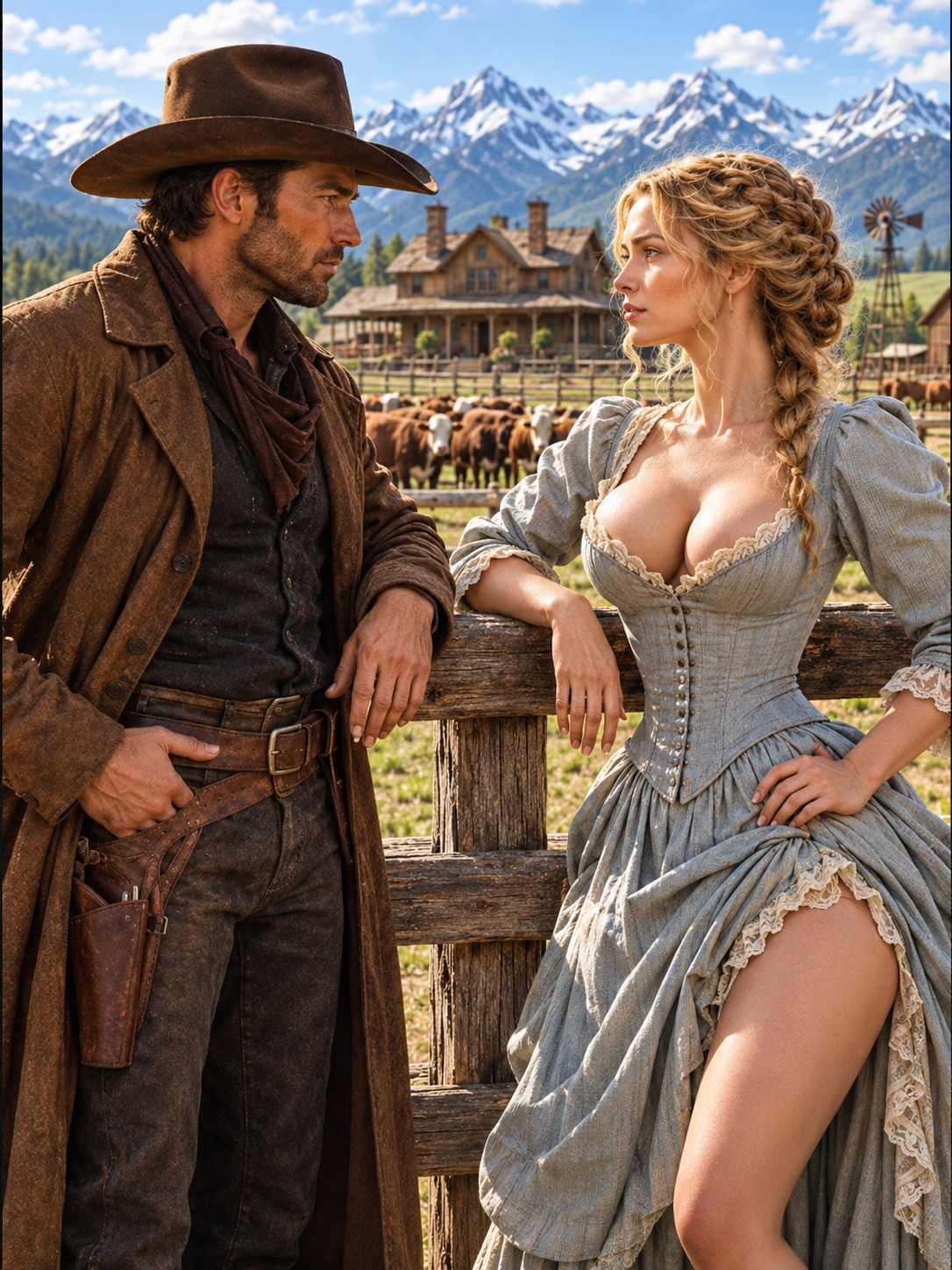
Hank Briggs stood inside my father's office with his hand resting against the locked door.
Nobody spoke.
The blue ledger lay open on the desk.
Beside it sat the original deed to Iron Ridge Ranch.
And beneath the final payment entry was Hank's signature.
I looked at the man who had worked beside me for eleven years.
"There's one thing Thomas never told you about the five thousand dollars."
I folded my arms.
"Then tell me."
Hank removed his hat.
His expression was tired, almost defeated.
"Your father didn't steal that money. And neither did I."
I pointed toward the ledger.
"Your signature says otherwise."
"I know what it says."
"Then explain it."
Hank looked toward Catherine.
She stood beside Eleanor, holding the old photograph of Thomas Hale.
"Thomas gave me that money," Hank continued. "But it wasn't payment for helping Reginald Whitmore. It was payment for protecting something your father believed was more important than the ranch."
"What?"
"Your future."
I stared at him.
Hank took a breath.
"After Thomas discovered that Reginald had arranged the fraudulent deed, he realized the Whitmores wouldn't stop until they controlled the eastern spring. He knew the ranch might eventually pass to you, and he was afraid you'd inherit the same danger."
Edward leaned forward.
"What did he do?"
"He arranged for five thousand dollars to be placed in a private account. The money was supposed to be used to defend Iron Ridge if Reginald ever returned."
I looked at the ledger again.
"Why was it placed in my father's name?"
"Because Thomas wanted the money protected from the Whitmore family. The account was opened under his name, but I was authorized to manage it."
I shook my head.
"Then why didn't you tell me?"
Hank looked directly at me.
"Because the money was gone."
My stomach tightened.
"What do you mean?"
"Reginald found the account. He used the money to pay Charles Whitcomb and several other people involved in the original fraud."
Edward closed his eyes.
"That explains the missing balance."
Hank nodded.
"Thomas discovered what happened shortly before he died. He knew the money couldn't be recovered easily, so he concentrated on preserving the evidence."
I looked at the signature.
"Then why did your name appear beside the payment?"
"Because I authorized the original transfer to Thomas's account. I didn't know Reginald had taken control of it until it was too late."
I studied him.
"Why didn't you tell me when we found the first notebook?"
Hank lowered his eyes.
"Because I was ashamed."
The answer surprised me.
He continued.
"I thought I had failed Thomas. I promised him I'd protect the ranch, and I couldn't even protect the money he'd saved for you."
For a long moment, I said nothing.
Then I looked toward Eleanor.
She stepped beside me.
"Carson, we have the original records now. We can verify everything."
I nodded.
Hank had kept too many secrets.
But the documents showed that his signature had authorized the original transfer, not the theft.
The final page of the ledger contained another entry.
It recorded the date Reginald had withdrawn the money.
And beside it was a notation in my father's handwriting.
Unauthorized transfer. Evidence retained.
I looked at Hank.
"Did you know about this entry?"
He nodded.
"Yes."
"Then you should have told me."
"I should have."
He placed his hat on the desk.
"If you want me to leave Iron Ridge, I'll understand."
I looked at him.
For eleven years, Hank had worked through every hardship the ranch had faced.
He had also allowed me to believe that I was fighting the Whitmores without knowing how deeply my own family had been involved.
I couldn't pretend that hadn't hurt.
But I also couldn't ignore everything he had done.
"You're not leaving today," I finally said.
Hank looked up.
"Carson?"
"You're going to help us finish this. After that, we'll decide what comes next."
He nodded slowly.
"Thank you."
I closed the ledger.
For the first time, all the pieces were finally together.
And this time, nobody would be allowed to hide them.
The legal battle lasted several months.
Arthur Bell returned to Millhaven after learning that Catherine was safe.
He brought the original courthouse records he had managed to preserve.
Margaret Pike provided her father's diary.
Edward Whitmore submitted his signed statement confirming the repayment of the original loan.
Catherine testified about the arrangement she had witnessed in 1863.
And Eleanor presented the financial records she had spent weeks organizing.
The evidence was overwhelming.
The original debt had been repaid.
The replacement deed had been fraudulently prepared.
The twenty-thousand-dollar transaction had been concealed through several private accounts.
The eastern water claim had no legitimate legal foundation.
Reginald Whitmore was forced to answer questions before the authorities.
Charles Whitcomb faced charges connected to the altered documents.
Samuel Pike eventually admitted his role in the fraudulent supplier arrangements and agreed to repay the money he had taken from Iron Ridge.
He also provided additional records connecting Reginald to the scheme.
Henry Caldwell's bank records confirmed the unauthorized transfer of the five thousand dollars.
For the first time in decades, the Whitmore family's influence could no longer protect everyone involved.
The county restored the original land records.
The eastern third of Iron Ridge was legally recognized as part of my property.
The water rights were confirmed.
And the claim that had threatened to destroy the ranch was finally dismissed.
I remember the morning Arthur delivered the final notice.
He stood in my office holding a thick envelope.
"Mr. Hale, I believe you'll want to read this."
I opened it.
The decision was brief.
The Whitmore claim had been rejected.
The original deed remained valid.
And Iron Ridge belonged entirely to the Hale family.
I read the final paragraph twice.
Then I looked at Eleanor.
She was standing beside the window.
For a moment, neither of us spoke.
Then she smiled.
Not the small, restrained smile she had worn when she first arrived.
This time, it reached her eyes.
"Is it over?" she asked.
I nodded.
"It's over."
She crossed the room.
I took her hands.
"We did it."
She shook her head.
"We did it together."
I pulled her into my arms.
Outside, the cattle were moving across the eastern pasture.
The spring continued flowing.
And for the first time in years, I knew nobody could take those things away from us.
Reginald Whitmore never returned to Iron Ridge.
He lost control of several business interests after the financial investigation exposed the unauthorized payments.
The family fortune was no longer enough to protect his reputation.
Edward testified against him.
It was not an easy decision.
He had spent most of his life trying to maintain some relationship with his brother.
But eventually, he understood that loyalty could not mean defending dishonesty.
When the proceedings ended, Edward visited Iron Ridge.
He stood beside the eastern spring with me.
For several minutes, we watched the water moving over the stones.
Then he spoke.
"Thomas would have been proud."
I nodded.
"I wish he could have seen this."
Edward looked toward the ranch house.
"He would have liked Eleanor."
I smiled.
"Everyone does."
He laughed.
Then he became serious.
"There's something I owe you."
"What?"
"An apology."
I looked at him.
"For what?"
"For the years I spent knowing the truth without doing enough to correct it."
I considered his words.
"You helped us expose everything."
"Too late."
"Perhaps. But you still helped."
He nodded.
Before leaving, he gave me a small envelope.
Inside was a letter written by Thomas Hale.
It was dated shortly before his death.
I recognized the handwriting immediately.
The letter was addressed to me.
Carson,
If you are reading this, then I hope you have found the truth about the eastern spring.
I made mistakes. I trusted people who didn't deserve it, and I kept secrets because I believed silence would protect you.
I don't know what kind of man you'll become, but I hope you never confuse stubbornness with strength.
Protect the land, but remember that land is not the only thing worth protecting.
One day, someone may come into your life who sees possibilities where you see only problems. Don't make the mistake of dismissing that person simply because they come from a different world.
Listen to her.
And if you are fortunate enough to find someone who stands beside you when everything seems lost, don't let pride keep you from telling her how much she means to you.
Your father,
Thomas Hale.
I folded the letter.
For a long time, I stood beside the spring.
Then I looked toward the farmhouse.
Eleanor was standing on the porch.
She raised her hand.
I smiled.
My father had been right about one thing.
I had found someone who saw possibilities where I saw problems.
And I wasn't going to make the mistake of letting her go.
The following spring, Iron Ridge began to recover.
The damaged fence had been rebuilt.
The drainage channel was reinforced.
We repaired the western holding field and replaced several aging water troughs.
Eleanor insisted on reviewing every supplier contract before signing it.
The ranch's financial records were reorganized.
We negotiated new prices for hay, veterinary services, and equipment.
Within six months, our operating expenses had fallen considerably.
The savings allowed us to repair the barn roof and hire two additional ranch hands.
Eleanor also established a proper account system.
Every purchase was recorded.
Every invoice was checked.
Every payment required documentation.
The men occasionally complained about the extra paperwork.
But none complained when their wages arrived on time.
Hank became more comfortable with the new system.
He still preferred working with cattle to studying numbers, but he learned to keep accurate records.
One afternoon, I found him sitting at the dining table with a stack of invoices.
He looked up as I entered.
"Mrs. Hale says this supplier's prices are too high."
I examined the paper.
"Is she right?"
Hank sighed.
"Probably."
I laughed.
"Then change suppliers."
He shook his head.
"She already found another one."
I sat across from him.
"You know, when Eleanor first arrived, you thought she'd last a month."
Hank grinned.
"I never said that."
"You laughed with the others in town."
He looked embarrassed.
"All right. I might have."
"Well?"
He closed the ledger.
"Seems I was wrong."
I nodded.
"Very wrong."
He laughed.
"She saved the ranch, Carson."
I looked toward the kitchen.
"Yes, she did."
But Eleanor had done more than save the ranch.
She had helped turn it into something stronger than it had been when I inherited it.
And she had done it without trying to become someone else.
She remained practical, determined, and occasionally stubborn.
Especially when I disagreed with her calculations.
Catherine stayed at Iron Ridge.
At first, she lived in the east bedroom.
Later, we repaired the old stone cottage near the spring.
She asked that the rooms be kept simple.
A small bedroom.
A writing desk.
A comfortable chair beside the window.
She spent many mornings sitting there, watching the water flow.
Eleanor visited her every day.
Sometimes they talked for hours.
Sometimes they simply sat together.
Their relationship wasn't perfect.
Seventeen years of separation couldn't be repaired in a few conversations.
There were painful questions.
There were apologies.
There were memories Eleanor had carried alone for most of her life.
But gradually, they began building something new.
One evening, I found them in the garden.
Catherine was teaching Eleanor how to arrange flowers in a glass vase.
They were laughing.
I stopped near the doorway.
Eleanor looked up.
"Carson, come here."
I approached.
She held out a small photograph.
It showed Catherine and Thomas standing beside the spring in 1863.
On the back were the same words we had found years earlier.
To the two people who refused to let fear decide what was right.
Catherine looked at me.
"Your father was a good man."
I nodded.
"He tried to be."
"He made mistakes, but he never stopped trying to protect what mattered."
She paused.
"That's something you inherited."
I smiled.
"I hope I inherited more than his stubbornness."
Catherine laughed.
"Unfortunately, you did."
Eleanor joined her.
I shook my head.
It was good to hear laughter in the house.
For too long, the sound of this place had been work, worry, and arguments over money.
Now there was something else.
A family.
That summer, Eleanor and I finally held a proper wedding celebration.
Our original marriage had been arranged through attorneys.
There had been no ceremony together.
No vows.
No guests.
No moment when either of us had stood beside the other willingly.
We decided to change that.
The ceremony took place beneath the cottonwood trees near the eastern spring.
The ranch hands attended.
May prepared a large supper.
Margaret Pike came with her husband.
Arthur Bell traveled from Helena.
Edward stood beside Catherine.
Hank served as my best man.
Eleanor wore a beautiful ivory dress with delicate lace sleeves.
Her dark auburn hair fell in soft waves around her shoulders.
She carried a small bouquet of wildflowers.
When she approached, I felt something I hadn't expected.
Nervousness.
I had faced angry cattle, financial ruin, and men threatening to take my land.
Yet standing before Eleanor made my hands shake.
She noticed.
"Are you nervous?" she whispered.
"Terribly."
She smiled.
"Good. I thought I was the only one."
The minister began speaking.
I barely heard the first few sentences.
I was watching my wife.
When it was time for our vows, I took both her hands.
"Eleanor, when you first arrived at Iron Ridge, I thought I was losing the last piece of control I had over my life."
A few people laughed softly.
I continued.
"I believed you were a stranger who had been sent to take something from me. I was wrong."
Her eyes began to shine.
"You came here with almost nothing. One suitcase, a determined mind, and more courage than I knew how to recognize."
I paused.
"You saved this ranch. But more importantly, you helped me understand that a man doesn't have to carry every burden alone."
I looked into her eyes.
"I promise to listen to you, to respect you, and to stand beside you. Not because a contract says I must, but because I choose to."
Eleanor squeezed my hands.
When it was her turn, she smiled.
"Carson, I came to Montana believing I was being sent to a place where I would never belong."
She glanced toward the ranch.
"I thought I would spend my life being tolerated by a man who had never wanted me."
I shook my head.
She continued.
"Instead, I found someone who gave me the chance to become more than the daughter my father expected me to be."
Her voice softened.
"You never promised me an easy life. But you gave me something better. A place where my thoughts mattered, where my work had meaning, and where I could be loved without having to surrender who I was."
She looked at me.
"I choose you, Carson Hale. Not because our families arranged it. Not because our names appear on the same document. But because I love the man standing in front of me."
I kissed her.
The men cheered.
May cried.
Hank clapped so loudly that the horses near the barn began moving.
Catherine held Edward's arm.
For the first time in many years, the Whitmore and Hale families stood together without a legal dispute between them.
Two years later, Iron Ridge was thriving.
The herd had grown.
The barns had been repaired.
The eastern pasture produced more hay than we had managed in years.
Eleanor had introduced a better purchasing system and negotiated long-term contracts with several regional suppliers.
She also established a small scholarship fund for young people in Millhaven who wanted to study agriculture, accounting, or veterinary medicine.
The town that had once laughed at the idea of a Boston heiress living on a Montana ranch now regularly asked her for advice.
She never reminded anyone of their earlier comments.
She didn't need to.
Her work spoke for itself.
One autumn evening, I found her sitting on the porch with a ledger.
The sun was setting beyond the western hills.
She closed the book as I approached.
"Everything balanced?" I asked.
"Almost."
"Almost?"
She smiled.
"There's one expense you haven't explained."
I sat beside her.
"What expense?"
She pointed to a line.
"Three new horses."
I shrugged.
"They were necessary."
"Three?"
"One was for Hank."
"And the other two?"
"Insurance."
She laughed.
"Insurance?"
"In case one gets tired."
She shook her head.
"You're impossible."
I took her hand.
"Yet you married me."
"Twice, technically."
I laughed.
Then I looked across the pasture.
The cattle were grazing near the eastern spring.
The water moved through the channel.
The fence stood firm.
The land was safe.
After a while, Eleanor leaned against my shoulder.
"Do you ever think about how close we came to losing everything?"
"Sometimes."
"Do you regret the marriage?"
I turned toward her.
"Not for a single day."
She smiled.
"Neither do I."
I looked at the farmhouse.
The windows glowed warmly.
Catherine was inside preparing tea with May.
Edward had promised to visit for Christmas.
Hank was checking the horses before nightfall.
The ranch was alive.
And so was the family my father had spent his final years trying to protect.
I thought about the day Eleanor had arrived.
Her single suitcase.
Her gray traveling coat.
The first fence post she had noticed sinking into the ground.
I had mistaken her attention to detail for curiosity.
I had mistaken her confidence for arrogance.
And I had mistaken her determination to examine my financial records for an insult.
She had seen the problems before I did.
She had seen the possibilities before I did.
And when everything fell apart, she had never once walked away.
I leaned over and kissed her forehead.
"Thank you."
She looked up.
"For what?"
"For choosing to stay."
She closed the ledger and rested her head against my shoulder.
"I think I found exactly where I was supposed to be."
The evening breeze moved gently across the pasture.
Somewhere near the barn, Hank called to one of the horses.
The kitchen door opened, and Catherine invited us inside.
Eleanor stood and offered me her hand.
I took it.
Together, we walked into the farmhouse.
Iron Ridge had survived the debt, the deception, the stolen documents, and the men who believed they could purchase everything that mattered.
But the greatest thing we had gained was never written in a ledger or recorded on a deed.
It was the family we had chosen to become.
And as I looked at Eleanor standing beside me, I finally understood what my father had meant in his last letter.
The land was worth protecting.
But the people who loved it were worth even more.
For the first time in my life, I wasn't fighting to keep Iron Ridge.
I was simply living there.
And I couldn't imagine a happier place to call home.






Comments 0