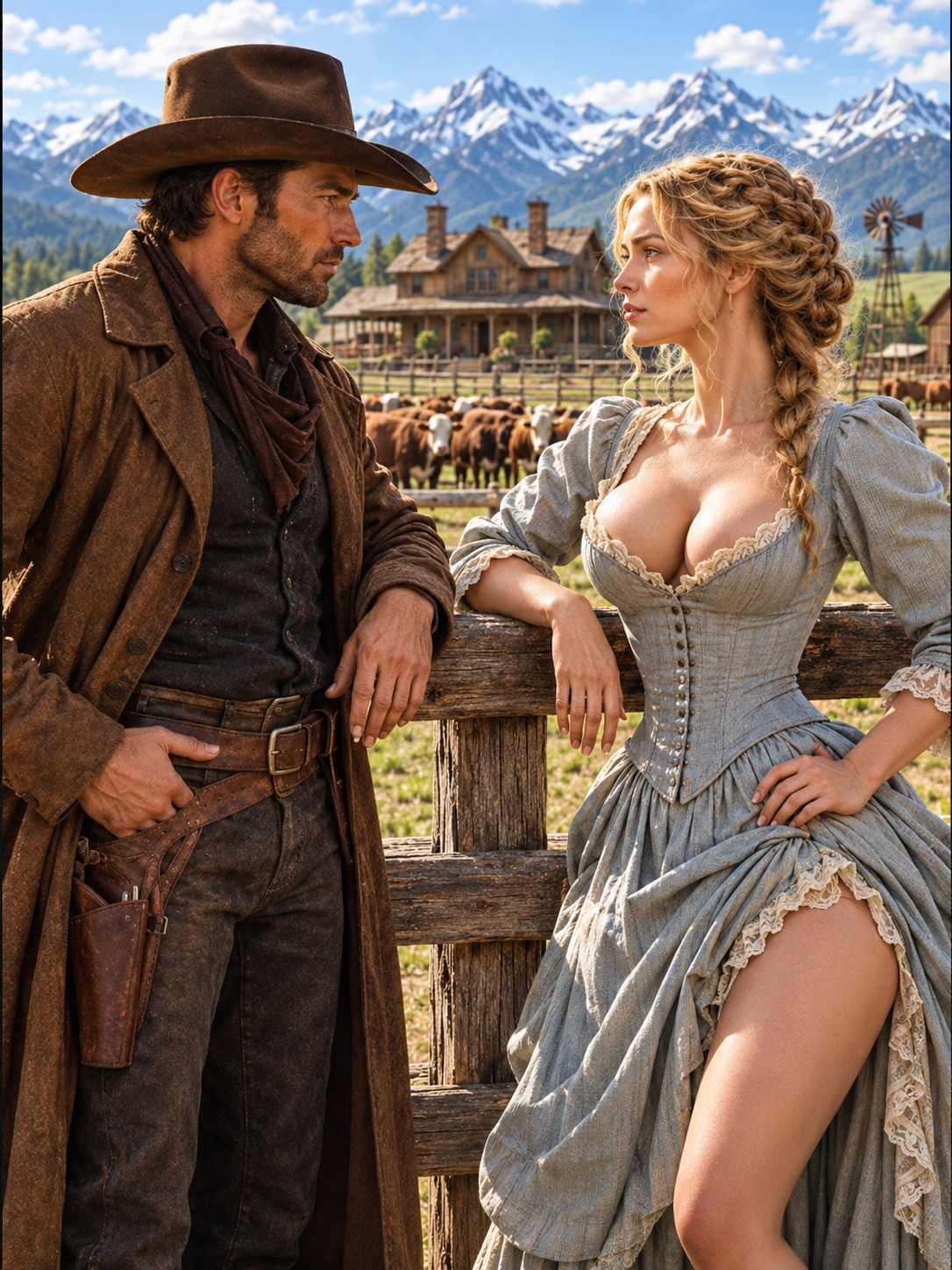
I read Hank Briggs's name three times.
Each time, the words seemed more difficult to believe.
Hank Briggs — Payment due after the eastern spring is secured.
For eleven years, Hank had been the most dependable man on Iron Ridge. He had worked beside me through blizzards, droughts, cattle disease, and financial disasters. He had never asked for more than his wages, never complained about the hours, and never once given me a reason to question his loyalty.
He had been there when I inherited the ranch.
He had been there when I buried my father.
And now his name appeared in a notebook hidden inside a shed where someone had apparently planned the destruction of our eastern fence.
I slowly turned toward him.
"Hank."
He stared at the notebook.
His face had gone pale.
"Carson, I can explain."
I felt my stomach tighten.
"Then start explaining."
He removed his hat.
"I've never seen that notebook before."
Eleanor stood beside the workbench, holding the photograph.
"Your name is written beside a payment amount."
"I can read, Mrs. Hale."
"Then you understand why we're asking."
Hank looked at me.
"Boss, I've worked for you eleven years."
"I know."
"You know what kind of man I am."
I looked at the notebook again.
"Until tonight, I thought I did."
His expression changed.
For a moment, I saw something in his eyes that I couldn't identify.
It might have been anger.
It might have been fear.
Or perhaps both.
"I never took money from the Whitmores," he said.
Eleanor placed the photograph on the workbench.
"Then why is your name here?"
"I don't know."
"Have you ever met Reginald Whitmore?"
Hank hesitated.
It was barely a second.
But I noticed.
"Once," he finally answered.
"When?"
"Years ago."
I stepped closer.
"Why didn't you tell me?"
"Because it wasn't important."
"Apparently, it was important enough for someone to write your name beside a payment."
Hank rubbed his forehead.
"Carson, listen. A man came to the ranch about six months after your father died. He said he was looking into the old land dispute."
"Who?"
"I don't remember his name."
"Was it Edward Whitmore?"
"No."
"Charles Whitcomb?"
Hank shook his head.
"He said he worked for the Whitmore family."
I felt anger rising.
"What did he want?"
"He asked about the eastern spring. Wanted to know how much water it produced during the summer. He asked whether the lower pasture could be accessed from the county road."
I looked toward Eleanor.
She was listening carefully.
"What did you tell him?" I asked.
"Nothing he couldn't see for himself."
"Did he offer you money?"
Hank looked down.
"No."
The answer came too quickly.
I stepped closer.
"Don't lie to me."
His jaw tightened.
"I said he didn't offer me money."
Eleanor interrupted.
"Did he threaten you?"
Hank turned toward her.
"No, ma'am."
"Then why did you hesitate?"
Hank looked at the notebook.
"Because I remember something else."
I waited.
He swallowed.
"The man asked whether you intended to keep the ranch."
I frowned.
"What did you say?"
"I told him you had no intention of selling."
"And?"
"He said that was unfortunate."
The shed became silent.
I looked at the old photograph again.
The man standing beside the spring was wearing a dark coat.
His face was difficult to see.
But the shape of his shoulders seemed familiar.
"Do you recognize this man?" I asked.
Hank examined it.
His eyes narrowed.
Then he shook his head.
"No."
Eleanor picked up the notebook.
"There's something else."
She turned several pages.
Most contained names, amounts, and dates.
Some entries referred to payments for transportation.
Others mentioned legal expenses.
But several were connected to the eastern water supply.
One entry was particularly troubling.
Lower drainage — inspection completed.
Another read:
Fence supports — replacement postponed.
And beneath it:
Spring access — final arrangements pending.
Eleanor looked at me.
"This appears to be a record of preparations."
"For what?"
"Taking control of the eastern water."
I looked toward the open door.
Outside, the ranch was dark.
Somewhere in the distance, cattle moved inside the holding field.
I thought about the fence.
The damaged drainage channel.
The man who had visited the courthouse.
And my father's warning.
Someone had been working toward this for years.
Perhaps decades.
"Who has access to this shed?" Eleanor asked.
Hank answered.
"Nobody regularly."
"Who has a key?"
"I used to."
"Used to?"
He nodded.
"The lock broke last winter. I never replaced it."
I looked at him.
"Why?"
"Because we stopped storing anything valuable here."
Eleanor examined the door.
"Then whoever came here didn't need a key."
She pointed toward the ground.
Fresh footprints were visible in the dust.
There were at least two sets.
One belonged to a large boot.
The other was narrower.
I crouched beside them.
"How recent?"
Hank examined the marks.
"Today, most likely."
"Before the fence collapsed?"
"Could be."
Eleanor moved toward the workbench.
She lifted the small wooden box and examined its underside.
Then she noticed something attached to the bottom.
A narrow piece of folded paper.
She carefully removed it.
The paper contained a list of dates.
The final entry was tomorrow morning.
Beside it were three words.
Remove remaining supports.
I felt my pulse quicken.
"They were planning to finish the job."
Eleanor nodded.
"Which means someone may return tonight."
Hank moved toward the door.
"Then I'll stay here and wait for him."
"No," Eleanor said.
He turned.
"Why not?"
"Because if someone is planning to come back, they may already know the shed has been discovered."
I looked at her.
She was right.
We needed to secure the evidence and return to the farmhouse.
I took the notebook, the photograph, and the folded paper.
Hank carried the wooden box.
Eleanor held the lantern.
We left the shed together.
As we approached the farmhouse, I noticed a light in my office.
I stopped.
"Did you leave that lamp burning?"
Eleanor shook her head.
"No."
Hank looked toward the window.
"I didn't."
I felt a chill.
The office door had been locked before we left.
I was certain of it.
I had checked it myself.
"Stay behind me," I told Eleanor.
We crossed the porch.
I reached for the handle.
The door opened.
The room appeared undisturbed at first.
My father's desk remained against the wall.
The books were still on the shelves.
But the top drawer stood open.
I hurried toward it.
The key was missing.
So was the folder containing the original loan agreement.
I looked toward the desk.
Several papers had been scattered across the floor.
Someone had searched the room.
Eleanor entered behind me.
"What's missing?"
"The original land documents."
She moved toward the desk.
Then she noticed something lying beneath the chair.
A small envelope.
It had not been there when we left.
I picked it up.
My name was written across the front.
Carson Hale.
The handwriting was unfamiliar.
I opened it.
Inside was a short message.
Stop asking questions about 1861.
Beneath it was another sentence.
Your wife cannot protect you from what comes next.
I looked at Eleanor.
She read the message without changing her expression.
Then she folded the paper.
"Someone knows what we've found."
I nodded.
"Apparently."
She looked toward the open drawer.
"Carson, did you leave any other documents in this room?"
"Yes."
"Which ones?"
I searched through the remaining papers.
Then I stopped.
There had been a small envelope containing my father's private correspondence.
It included the letters he had written to Reginald Whitmore.
And one letter addressed to me.
The letter Arthur had found.
The one explaining that the eastern water claim might be fraudulent.
It was gone.
I felt my anger become something colder.
"Whoever came here knew exactly what to take."
Eleanor examined the desk.
"Then we need to find out who knew those documents were here."
I turned toward Hank.
He stood near the doorway.
His expression was difficult to read.
"Did anyone know we were searching these records?"
He shook his head.
"Not that I know of."
"Did you tell anyone about the courthouse?"
"No."
"Did you tell anyone we were coming back?"
"No."
Eleanor looked at him.
"Did you tell anyone about the fence?"
Hank hesitated.
"Only the ranch hands."
I frowned.
"Which ones?"
"Caleb, Joseph, and Martin."
"Did any of them know about the documents?"
"No."
I wanted to believe him.
But the notebook had made that difficult.
"Where are they now?"
"Caleb and Joseph are at the holding field. Martin went to town for supplies."
I looked at Eleanor.
"Let's secure the remaining papers."
We spent the next hour moving the important documents into a locked cabinet in the dining room.
Eleanor organized everything into separate groups.
The original loan agreement.
My father's correspondence.
The notebook from the shed.
Arthur's statement.
The photographs.
The financial ledgers.
She made a written inventory of every document.
I watched her work.
She was precise and methodical.
Even after the emergency, she had not lost her concentration.
I found myself wondering how many people had underestimated her before she came to Montana.
Probably more than I could count.
"Carson?"
I looked up.
Eleanor was holding the letter my father had written to me.
It was the one we had found among the courthouse papers.
She had been examining it under the lamp.
"What is it?"
"Look at the date."
I leaned closer.
January 1863.
That was what I remembered.
But Eleanor pointed to the bottom corner.
There was another date.
Written faintly beneath the first.
November 1883.
I frowned.
"That's impossible."
"Why?"
"Because my father died in 1868."
Eleanor turned the paper toward me.
"The original letter may be old, but someone added this date later."
I examined the writing.
It was a different ink.
The numbers were written in a smaller hand.
Someone had added a note five months ago.
Why?
I looked at Eleanor.
"Could this have been done by the person who searched the office?"
"Possibly."
She turned the paper over.
There was another small mark.
A set of initials.
C.W.
I stared.
"Charles Whitcomb."
Eleanor nodded.
"That's what I was thinking."
I sat down.
The attorney who had handled the Whitmore claim had apparently been examining my father's private papers.
But why would he have added a date?
And why had the letter been hidden?
Eleanor continued examining the document.
Then she noticed something unusual.
A thin section of the paper had been folded inward.
She carefully opened it.
There was a second message written beneath the fold.
Only one sentence.
The money was never meant for Thomas Hale.
I stared at the words.
"Then who received it?"
Eleanor looked at the payment record.
"Samuel Pike's father."
I nodded.
"But why?"
She was silent.
Then she looked toward the window.
"Perhaps because he was the person who arranged the original loan."
I frowned.
"Are you saying the Pike family and the Whitmores worked together?"
"I think that's possible."
I thought about Samuel Pike.
His rising prices.
His missing equipment.
His invoices.
His father's connection to the original payment.
Suddenly, the financial irregularities no longer seemed like separate problems.
They might have been part of the same arrangement.
I stood.
"We need to find Arthur."
Eleanor nodded.
"He may know more about the Pike family."
"And we need to speak with your father."
She looked down.
"Yes."
I hesitated.
"Would he tell us the truth?"
She gave a small, humorless smile.
"My father has spent his entire life deciding which truths other people are allowed to hear."
"Then we'll have to make him answer."
She looked at me.
For a moment, something softened in her expression.
"Carson, I need to tell you something."
"What?"
"When my father arranged this marriage, he told me the Hale family had been dishonest about the original debt."
I felt my shoulders stiffen.
"Why didn't you tell me?"
"Because I believed him."
I looked at her.
"Did you?"
She shook her head.
"Not entirely. But I had no reason to believe otherwise."
She walked toward the window.
"My father said your family had refused to honor a legitimate agreement. He told me the marriage would prevent an unnecessary dispute and allow both families to move forward."
"And you agreed?"
"I agreed because I wanted to get away from him."
Her voice became quieter.
"He had already decided what my life would look like. The marriage was simply another arrangement he expected me to accept."
I understood more than I wanted to.
We had both entered the marriage believing we had no choice.
But now I was beginning to wonder whether the people who had arranged it had deliberately kept us ignorant of the truth.
"Do you think your father knew about the forged payment?"
Eleanor turned.
"I think he knew something was wrong."
"That's not the same as knowing."
"No. But it is enough to make me question everything he told me."
I stepped closer.
"Whatever happens, I won't blame you for what your father did."
She looked at me.
I continued.
"You didn't create this debt. You didn't take the money. And you didn't cut that fence."
Her eyes softened.
"Thank you."
For the first time, I realized that the marriage had begun to change.
Not because we had suddenly fallen in love.
But because we were beginning to trust each other.
And trust was something neither of us had expected to find.
The following morning, I sent Hank to inspect the eastern pasture with Caleb.
Eleanor and I remained at the farmhouse.
We needed to contact Arthur.
I sent a message to the courthouse asking Mr. Jenkins to locate him.
But the reply came sooner than expected.
Arthur had left town.
No one knew where he had gone.
I felt uneasy.
He had promised to testify.
He had given us evidence.
And now he had disappeared again.
Eleanor read the message.
"He may be afraid."
"Of Whitmore?"
"Or of someone else."
I looked at the notebook.
The name Hank Briggs was still visible.
I hadn't spoken to Hank about it again.
Part of me wanted to believe that someone had written his name deliberately to frame him.
But another part remembered his hesitation.
I decided to speak with him when he returned.
Before I could do that, a carriage appeared on the road.
It was black, expensive, and unfamiliar.
The driver stopped near the porch.
A woman stepped down.
She was perhaps in her late forties, dressed in a dark blue traveling gown, with a small hat and a silver brooch at her collar.
She carried a leather handbag.
I approached.
"Can I help you?"
She looked at me.
"Carson Hale?"
"Yes."
"My name is Margaret Pike."
The name caught my attention.
"Are you related to Samuel Pike?"
She nodded.
"I'm his sister."
I glanced toward Eleanor.
Margaret looked past me into the farmhouse.
"I need to speak with you and Mrs. Hale."
"About what?"
She hesitated.
Then she lowered her voice.
"About my father's involvement in the Whitmore loan."
I felt my pulse quicken.
"How much do you know?"
Margaret looked toward the road.
"More than Samuel realizes."
Eleanor stepped onto the porch.
"Please come inside."
Margaret followed us into the dining room.
She placed her handbag on the table and removed a folded photograph.
It showed an older man standing beside a desk.
A gold pocket watch was visible on his waistcoat.
I recognized the watch immediately.
"Is that your father?"
Margaret nodded.
"His name was Joseph Pike."
I looked at the photograph.
"Was he the man who handled the original payment to Thomas Hale?"
Margaret's expression changed.
"Yes."
Eleanor leaned forward.
"Then you know where the money went?"
Margaret looked at both of us.
For a moment, she seemed uncertain whether she should continue.
Then she opened her handbag again.
This time, she removed a small leather diary.
"My father kept this hidden for nearly twenty years. After he died, I found it among his personal belongings."
She placed it on the table.
I opened the cover.
Several pages contained business records.
Then I found an entry dated November 1861.
The handwriting was unmistakable.
Joseph Pike had recorded a payment of eight hundred dollars.
But the recipient's name wasn't Thomas Hale.
It was Reginald Whitmore.
I looked up.
Eleanor had gone completely pale.
"That doesn't make sense," she whispered.
Margaret shook her head.
"There's more."
She turned to the final page.
A note had been written in darker ink.
It contained a date.
And a sentence that changed everything.
The eight hundred dollars were returned to Mr. Whitmore after the eastern spring was secured.
I stared at the words.
The original loan might never have been intended to help my father at all.
It might have been a way to obtain control of the water.
But before I could ask Margaret another question, she reached into her handbag and removed one final document.
It was a signed statement.
And the name at the bottom was not Joseph Pike's.
It belonged to someone still living.
Someone who had been present when the original money was transferred.
Margaret pushed it toward me.
"Your father wasn't the only person who tried to stop them, Mr. Hale."
I looked at the signature.
My breath caught.
It was Reginald Whitmore's own brother, Edward.






Comments 0