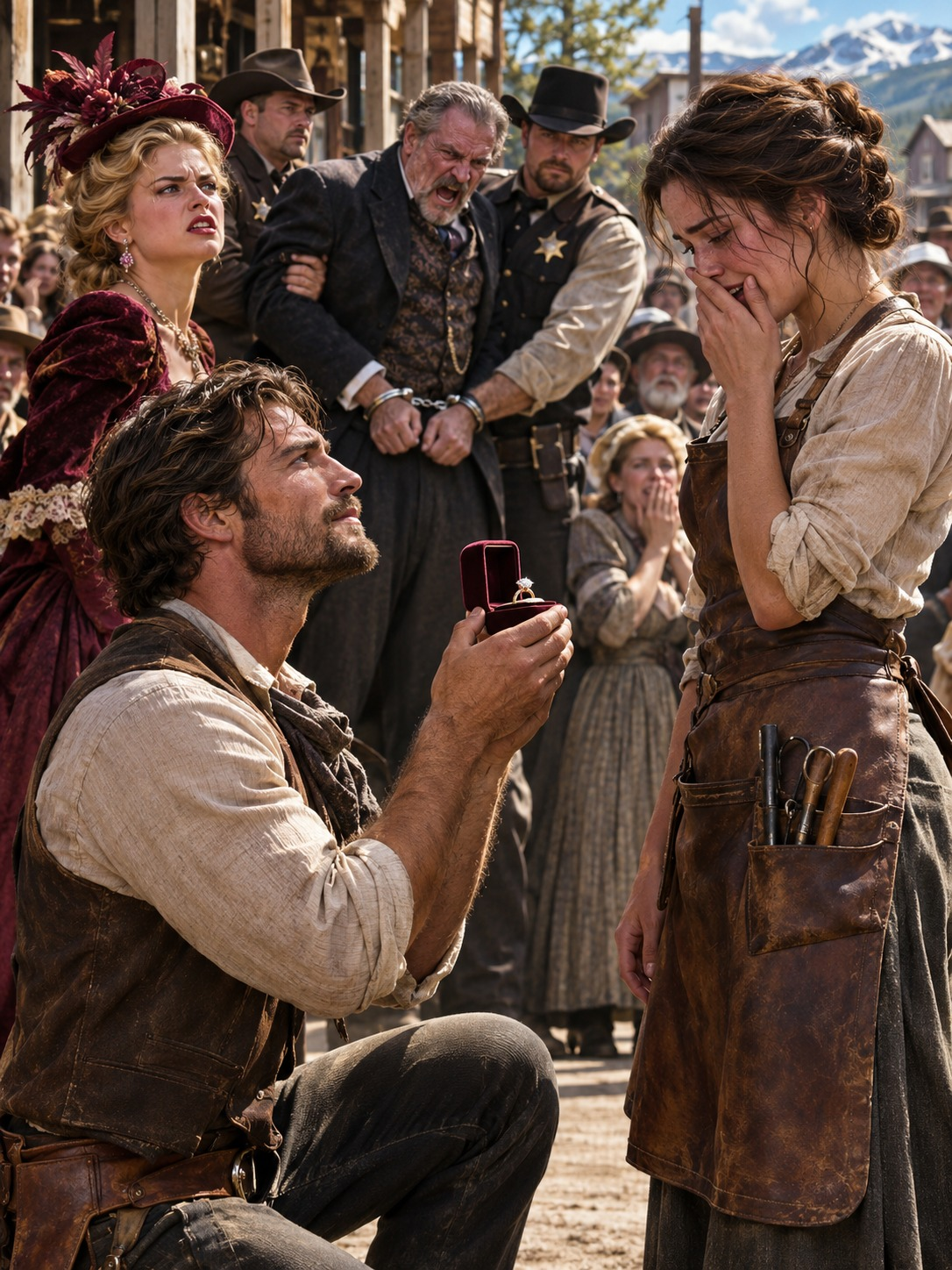
"Ellie."
The voice came from the darkness at the top of the staircase.
Eleanor Whitmore tightened her grip on the leatherworking hammer.
"Come down where I can see you."
A floorboard creaked.
Then a man stepped into the weak light spilling upward from the workshop.
He was older than she remembered.
Much older.
His hair had turned almost entirely gray, and deep lines surrounded his eyes. His coat was worn, his boots were covered in road dust, and a faded scar crossed the back of his right hand.
But Eleanor recognized him.
She recognized the shape of his face.
The narrow nose.
The familiar gray-green eyes.
And the voice that had once told her bedtime stories before disappearing from her life.
Her fingers loosened around the hammer.
"No."
The man stopped.
"Eleanor."
She shook her head.
"No. You don't get to call me that."
His expression tightened.
"I know I have no right to ask you to listen."
"Then don't."
She stepped backward.
The hammer remained in her hand.
"Get out of my house."
The man lowered his eyes.
"I came because you're in danger."
Eleanor laughed once.
It was a sharp, humorless sound.
"That's interesting. You left when I was six years old, and now you suddenly care whether I'm safe?"
He flinched.
"I never stopped caring."
"Don't."
"Eleanor—"
"Don't you dare stand in my mother's home and tell me you cared."
The man fell silent.
For twenty-one years, Eleanor had imagined what she might say if she ever saw her father again.
She had imagined anger.
She had imagined demanding answers.
She had even imagined forgiving him.
But she had never imagined finding him standing inside her home in the middle of the night.
"How did you get in?" she demanded.
"The upstairs window."
"That's locked."
"The latch is loose."
Eleanor stared at him.
He looked ashamed.
"I didn't want to frighten you."
"You climbed through my bedroom window."
"I know."
"You broke into my home."
"I know."
"Then you did a remarkable job of not frightening me."
He accepted the rebuke without argument.
For several seconds, neither spoke.
Then Eleanor placed the hammer on the workbench.
Not because she trusted him.
Because she refused to let him see her hands shaking.
"What do you want?"
The man took one cautious step down.
"My name is Thomas Whitmore."
"I know your name."
"I'm your father."
Eleanor looked directly into his eyes.
"No. You're the man who left my mother to raise me alone."
Thomas lowered his head.
"I deserve that."
"You deserve worse."
He nodded.
"Probably."
The quiet agreement unsettled her more than an argument would have.
She had expected excuses.
Perhaps anger.
Perhaps a story about how her mother had driven him away.
Instead, he stood before her like a man who had spent decades carrying something too heavy to put down.
But Eleanor was not interested in his suffering.
She wanted the truth.
"Why are you here?"
Thomas glanced toward the front window.
"Because Vance Marsh knows you're getting close."
"Close to what?"
"The records."
Eleanor felt her stomach tighten.
She glanced toward the folded note on her workbench.
Your mother wasn't the only Whitmore who knew the truth.
She picked it up.
"Did you leave this?"
Thomas nodded.
"Yes."
"And you entered my home afterward?"
"I needed to make sure you received it."
"You could have knocked."
"I thought someone was watching the shop."
"Someone is always watching this shop lately."
Thomas looked toward the street again.
"Then we don't have much time."
Eleanor folded her arms.
"You have exactly five minutes."
He took a breath.
"Your mother discovered that Marsh was stealing land through fraudulent loans."
"I know."
Thomas looked surprised.
"You know?"
"I know about the altered accounts. I know about Jonathan Carter. I know Samuel Briggs witnessed the payment."
Thomas's expression changed at the mention of Samuel.
"Samuel's still alive?"
"Yes."
"Good."
"Why?"
Thomas hesitated.
"Because he knows what happened the night I left Red Hollow."
Eleanor went still.
She had not expected those words.
"What happened?"
Thomas looked at her.
"I didn't leave because I stopped loving you."
Her jaw tightened.
"Then why?"
"Because Marsh threatened to have your mother arrested."
Eleanor stared at him.
Thomas continued.
"He claimed she'd stolen money from the bank. Said he had documents proving it."
"My mother never stole anything."
"I know."
"Then why would you believe him?"
"I didn't. But he had the sheriff in his pocket, and he knew how to make false records look real."
Eleanor felt a cold pressure settle in her chest.
"What did he want?"
Thomas swallowed.
"He wanted me to disappear."
"Why?"
"Because I had seen him change the accounts."
The workshop became silent.
Thomas looked toward the photograph of Margaret Whitmore hanging beside the shelves.
"I was working temporary jobs at the bank back then. Repairing locks, moving cabinets, doing whatever work they needed. One evening, I saw Marsh and another man altering the loan books."
"Who was the other man?"
Thomas hesitated.
"I never learned his name."
Eleanor watched him carefully.
"You're lying."
He looked back at her.
"No."
"You hesitated."
"Because I'm trying to remember a face I haven't seen in twenty years."
She said nothing.
Thomas continued.
"I confronted Marsh. I was foolish enough to think he'd admit what he'd done."
"And?"
"He offered me money."
"How much?"
"Enough to leave Wyoming."
Eleanor felt sick.
"Did you take it?"
Thomas closed his eyes.
"No."
"Then why did you leave?"
"Because he threatened you."
The words struck her harder than she expected.
Thomas's voice grew rough.
"He said if I stayed, he'd make sure your mother lost the shop. He said you'd grow up in a county poorhouse. He knew exactly what frightened me."
Eleanor looked away.
She wanted to believe him.
That was what frightened her.
For twenty-one years, she had protected herself with a simple explanation.
Her father had left because he did not want her.
Now he was offering a different story.
A story that made him less cruel.
But not innocent.
"You could have written," she said.
"I did."
She turned sharply.
"What?"
"I sent letters."
"To whom?"
"To you. To Margaret."
"We never received them."
Thomas looked down.
"I know that now."
Eleanor stared at him.
"How?"
"Because the man I paid to deliver them worked for Marsh."
She felt her anger returning.
"And you never came back to check?"
Thomas's eyes filled with regret.
"I should have."
"Yes."
"I was ashamed."
"That didn't stop my mother from working sixteen hours a day."
"I know."
"No, you don't."
Her voice rose for the first time.
"You don't know what it was like when the roof leaked and she couldn't afford repairs. You don't know how she worked with a fever because customers were waiting. You don't know how she cried when she thought I was asleep."
Thomas stood motionless.
Eleanor's throat tightened.
"And you weren't there when she died."
He lowered his head.
A tear slipped down his cheek.
"I know."
She turned away.
For several seconds, the only sound was the ticking clock above the counter.
Then Thomas spoke quietly.
"I'm not asking you to forgive me."
"Good."
"I'm asking you to protect yourself."
Eleanor wiped her eyes before turning back.
"From Marsh?"
"From anyone who wants those records."
She studied him.
"Why now?"
Thomas reached into his coat.
Eleanor stiffened.
He stopped.
"May I?"
She nodded cautiously.
He removed a small envelope.
Inside was a faded photograph.
He placed it on the workbench.
Eleanor looked down.
The photograph showed Margaret Whitmore standing beside Jonathan Carter and Samuel Briggs.
All three stood outside the bank.
In Margaret's hands was a leather folder.
Eleanor leaned closer.
There was a fourth person in the photograph.
A man standing partly behind Jonathan Carter.
His face was turned away.
"Who is that?"
Thomas's expression darkened.
"That's the man Marsh was protecting."
Eleanor looked up.
"Who?"
Thomas opened his mouth.
Then a horse snorted outside.
He stopped speaking.
His eyes moved toward the window.
Eleanor turned.
A lantern glowed briefly beyond the glass.
Then disappeared.
Thomas stepped backward.
"Someone followed me."
Eleanor reached for the hammer again.
"Who?"
"I don't know."
He moved toward the staircase.
"Where are you going?"
"Out the way I came."
"You're not leaving until you tell me who that man is."
Thomas looked at her.
For a moment, she saw the father she barely remembered.
A frightened man.
A man who had spent too many years running.
Then he said quietly, "Ask Samuel about the photograph. He'll know."
He disappeared upstairs.
Eleanor stood frozen.
A moment later, she heard the bedroom window open.
Then close.
Her father was gone.
Again.
By sunrise, the rumor had spread through Red Hollow.
Eleanor Whitmore had been seen entertaining a strange man in her workshop after midnight.
The story began with a woman who lived across the street.
She claimed to have seen a gray-haired stranger climbing down from Eleanor's upstairs window.
By breakfast, the stranger had become a secret lover.
By noon, he had become a criminal.
By afternoon, several townspeople were whispering that Eleanor had been using William Carter's attention to hide an improper relationship with another man.
Virginia Marsh heard the story while drinking tea with two wealthy women.
She nearly smiled into her cup.
"How unfortunate," she said.
Mrs. Caroline Hensley leaned closer.
"Do you believe it?"
Virginia lowered her eyes.
"I would hate to think badly of anyone."
The other woman nodded sympathetically.
"Of course."
Virginia continued.
"But Eleanor has always been rather unconventional."
Mrs. Hensley sighed.
"Working in that shop with men coming and going."
"Exactly."
"And William Carter has been spending so much time there."
Virginia shook her head.
"William has a generous heart. Sometimes generous men are taken advantage of."
The women exchanged looks.
Virginia placed her cup on its saucer.
"I only hope he discovers the truth before he makes a terrible mistake."
She spoke softly.
With apparent concern.
But inside, she felt a rush of satisfaction.
For days, Eleanor had refused to be intimidated.
She had stood up to Vance.
She had challenged the bank.
She had accepted William's friendship without embarrassment.
Now Virginia finally had something that could damage her.
Not a financial accusation.
Not a disputed document.
A scandal.
And in Red Hollow, scandal could destroy a woman's reputation faster than any court judgment.
William Carter heard the rumor from a ranch hand.
He was inspecting a shipment of feed when young Peter Dawson approached him.
"Mr. Carter?"
"Yes?"
"There's something folks are saying in town."
William continued examining the sacks.
"Folks say a great many things."
"This is about Miss Whitmore."
William stopped.
"What about her?"
Peter looked uncomfortable.
"Somebody says she had a man staying upstairs last night."
William turned slowly.
"Who says?"
"Mrs. Hensley heard it from Mrs. Dalton."
"And Mrs. Dalton?"
"She says she saw him."
William considered that.
"Did anyone speak to Eleanor?"
Peter shook his head.
"Not that I know of."
"Then nobody knows anything."
The young ranch hand nodded.
"Yes, sir."
William returned to his work.
But his thoughts were no longer on feed prices.
He remembered Eleanor's expression the previous evening.
Her determination.
Her fear.
The way she had insisted on sending the documents to Cheyenne despite the danger.
He also remembered that someone had been watching her shop.
If a stranger had entered her home, he needed to know whether she was safe.
He handed the inventory sheet to Peter.
"Finish checking these."
"Where are you going?"
"Town."
Eleanor was repairing a saddle when William arrived.
She looked up.
"You're becoming my most frequent visitor."
He removed his hat.
"I've been told."
She studied his face.
"Something's wrong."
"Have you heard what people are saying?"
Eleanor's expression changed.
"About the man?"
William nodded.
She sighed.
"Of course."
"Are you all right?"
She looked at him sharply.
"That's your question?"
"What should it be?"
She stared at him.
For a moment, she had expected him to demand an explanation.
To ask whether the rumors were true.
To look at her with suspicion.
Instead, he wanted to know whether she was safe.
Eleanor set down her needle.
"I'm angry."
William nodded.
"That seems reasonable."
"Someone saw a man near my window, and now half the town thinks I'm entertaining criminals."
"Was someone there?"
She hesitated.
Then answered.
"Yes."
William's expression grew serious.
"Did he hurt you?"
"No."
"Did he threaten you?"
"No."
"Then what happened?"
Eleanor looked toward her mother's photograph.
She had not yet decided whether she could trust the man who claimed to be her father.
But she trusted William enough to tell him the truth.
"I think I met my father last night."
William went still.
"Your father?"
"Thomas Whitmore."
"I thought he left when you were a child."
"He did."
"Why did he come back?"
Eleanor looked down.
"He says Vance Marsh forced him to leave."
William frowned.
"Forced him?"
"Threatened my mother. Threatened me."
William's expression darkened.
"Did he explain why?"
"He claims he witnessed Marsh altering bank records."
For several seconds, William said nothing.
Then he asked, "Do you believe him?"
Eleanor looked toward the window.
"I don't know."
William waited.
She continued.
"I spent twenty-one years believing he abandoned us because he didn't care. Now he wants me to believe he was protecting us."
"Both things could contain some truth."
Eleanor looked at him.
"What do you mean?"
"He may have been threatened. He may also have made choices he regrets."
She considered that.
William continued.
"You don't have to decide what he deserves today."
Eleanor felt some of the tension leave her shoulders.
"Thank you."
"For what?"
"For not telling me what to think."
He smiled faintly.
"I've learned that doesn't work very well with you."
She almost laughed.
Then her expression grew serious.
"There's something else."
She retrieved the photograph from beneath the counter.
William examined it.
His face changed when he recognized his father.
"Where did you get this?"
"My father brought it."
William studied the image.
"That's Samuel."
"Yes."
"And my father."
"Yes."
He looked at the fourth figure.
"Who's that?"
"I don't know."
William leaned closer.
The man stood partly behind Jonathan Carter.
His face was turned away.
But his right hand rested on the edge of the leather folder.
William noticed something.
A ring.
Large.
Dark.
With an unusual square setting.
He frowned.
"I've seen that ring before."
Eleanor's heart quickened.
"Where?"
William hesitated.
"I'm not certain."
"Think."
He studied the photograph again.
Then his expression hardened.
"At Marsh's bank."
Eleanor stared at him.
"Vance?"
"No."
"Then who?"
William looked up.
"Someone who used to visit my father."
That afternoon, Eleanor and William rode to Carter Ranch.
Samuel Briggs was working near the stables when they arrived.
He looked surprised.
"Back so soon?"
William dismounted.
"We need to show you something."
Samuel wiped his hands on a cloth.
"What?"
Eleanor handed him the photograph.
The older foreman's expression changed immediately.
He stared at the image.
Then slowly lowered himself onto a wooden bench.
"Where did you find this?"
"My father brought it."
Samuel looked up sharply.
"Thomas?"
Eleanor nodded.
"He's back."
Samuel closed his eyes.
"Lord help us."
William stepped closer.
"Samuel, who is the fourth man?"
The foreman studied the photograph.
For a long moment, he said nothing.
Then he looked toward the stable entrance.
"Not here."
William frowned.
"Why?"
"Because some things are better discussed where nobody can overhear."
They entered the old tack room.
Samuel closed the door.
He placed the photograph on a wooden table.
Then he pointed to the fourth figure.
"His name was Nathaniel Vale."
Eleanor repeated it.
"Nathaniel Vale."
William frowned.
"I remember that name."
Samuel nodded.
"He worked as a financial examiner for several banks across the territory."
"Was he involved with Marsh?"
"Yes."
"How?"
Samuel took a breath.
"Vale helped Marsh make fraudulent accounts appear legitimate."
Eleanor felt her stomach tighten.
"Then why was he standing with my mother and Jonathan Carter?"
Samuel looked at her.
"Because he wanted to confess."
The room became silent.
William leaned forward.
"Confess what?"
"That Marsh had been using false debts to seize property."
Eleanor stared at the photograph.
"Did he?"
Samuel nodded.
"He gave your mother a list of altered accounts."
"Where is it?"
Samuel looked away.
"We never found the original."
William's expression hardened.
"What happened to Vale?"
Samuel hesitated.
"Disappeared."
Eleanor felt a chill.
"When?"
"Three days after that photograph was taken."
William stared at him.
"And nobody investigated?"
"Marsh said Vale had left Wyoming."
"Did you believe him?"
Samuel's silence answered.
Eleanor looked down at the photograph.
The fourth man.
The dark ring.
The leather folder.
A missing financial examiner.
Her mother had not simply uncovered a dishonest banker.
She had stumbled into something much larger.
"Samuel," she said quietly, "did my mother know what happened to Vale?"
The older man looked at her.
"I think she suspected."
"What did she suspect?"
Samuel's face tightened.
"That he never left Red Hollow."
Virginia Marsh was not satisfied with the gossip.
By evening, she had visited three prominent families and arranged for a private gathering at her father's home.
She called it a charitable planning meeting.
In reality, it was an opportunity to turn influential townspeople against Eleanor.
Mrs. Hensley attended.
So did the mayor's wife.
The owner of the general store.
Two wealthy ranchers' wives.
And Harold Finch's wife, whose husband edited the Gazette.
Virginia welcomed them with tea and expensive pastries.
She spoke about the importance of protecting Red Hollow's reputation.
She mentioned the dangers of dishonest business practices.
She expressed concern about young women who sought wealthy husbands through questionable means.
She never mentioned Eleanor's name directly.
She didn't need to.
Everyone understood.
Mrs. Finch leaned forward.
"Do you believe William Carter intends to marry her?"
Virginia smiled sadly.
"I sincerely hope not."
"Why?"
"Because William deserves a woman who understands the responsibilities of his position."
Mrs. Hensley nodded.
"Someone from a respectable family."
"Exactly."
Virginia lowered her voice.
"And there are things about Eleanor's family that have never been properly explained."
The women leaned closer.
Virginia continued.
"Her father abandoned them. Her mother had financial troubles. Now Eleanor herself is facing questions about the property."
Mrs. Finch frowned.
"Are you suggesting dishonesty?"
Virginia lifted her hands.
"I would never make such an accusation."
Then she paused.
"But I do believe people should be cautious."
By the time the gathering ended, the women had enough material to fuel gossip for weeks.
Virginia watched their carriages depart.
She felt triumphant.
But when she entered her father's office, she found Vance standing beside the fireplace.
His expression was furious.
"What have you done?"
Virginia stopped.
"Excuse me?"
"Those women. That gathering. The newspaper."
She folded her arms.
"I've done what you should have done weeks ago."
Vance stepped closer.
"You're drawing attention to the Whitmore matter."
"Good."
"No. Not good."
Virginia frowned.
"Why?"
"Because every time you mention Eleanor, people start asking questions about the bank."
She stared at him.
"Then answer them."
Vance laughed bitterly.
"You have no idea what you're playing with."
Virginia's expression hardened.
"I'm trying to protect our family."
"Then stop talking."
She stepped backward.
For the first time, she saw genuine fear in her father's eyes.
Not anger.
Fear.
"Father," she whispered, "what exactly happened to Margaret Whitmore?"
Vance went still.
The room became silent.
Then he spoke quietly.
"Never ask me that again."
The following morning, Eleanor discovered that three customers had canceled their orders.
One was a rancher who had used her services for years.
Another was a merchant who regularly brought damaged harnesses.
The third was a woman who had ordered a leather travel bag.
All three gave vague explanations.
Financial difficulties.
Changed plans.
Unexpected expenses.
Eleanor understood.
The rumors were working.
By noon, a supplier from Cheyenne sent word that future deliveries would require payment in advance.
Her bank account remained restricted.
Her savings were shrinking.
And the workshop depended on a steady flow of customers.
She sat at her workbench, staring at the canceled orders.
For the first time, she understood how Vance Marsh intended to defeat her.
Not through one dramatic confrontation.
Through a hundred small pressures.
A frozen account.
A delayed payment.
A canceled order.
A whispered accusation.
Each one manageable alone.
Together, they could destroy her business.
Eleanor closed the order book.
Then she stood.
She would not surrender.
But she needed a plan.
She retrieved the copies of her mother's documents.
She examined Jonathan Carter's notebook.
She reviewed the dates.
The account numbers.
The names.
Then she noticed something she had overlooked.
Several fraudulent transfers had been made to accounts associated with properties near the freight road.
The same road that passed her workshop.
The same road Vance Marsh wanted to control.
Eleanor took out a pencil.
She began drawing a simple map.
The bank.
The freight depot.
The surrounding properties.
The road.
Then she marked the parcels Marsh had acquired.
One by one, a pattern emerged.
The properties formed a narrow corridor.
A route leading directly toward the proposed railroad expansion.
Eleanor stared at the map.
Her workshop stood in the middle.
Without her land, the corridor was incomplete.
Suddenly, Vance's desperation made sense.
He did not simply want her property.
He needed it.
And he needed it before someone else understood its value.
William arrived that afternoon carrying a small package.
Eleanor looked up.
"If that's another saddle, I'm charging you double."
He smiled.
"No saddle."
"Then what?"
"Something you might find useful."
He placed the package on the counter.
Eleanor studied it.
"William."
"Before you object, open it."
She untied the string.
Inside was a small leather-bound notebook.
And a pencil.
Eleanor looked at him.
"What's this?"
"A record book."
"I have record books."
"I know."
"Then why bring another?"
William hesitated.
"Because I noticed yours was nearly full."
Eleanor looked down at the notebook.
It was simple.
Practical.
No expensive decoration.
No attempt to impress her.
She ran her fingers over the cover.
"How much did it cost?"
William laughed.
"Less than a saddle repair."
"William."
"One dollar."
She reached for her cash box.
He gently raised a hand.
"Eleanor."
She stopped.
"It's a gift."
"I don't accept expensive gifts."
"It isn't expensive."
"That's not the point."
"I know."
She studied him.
He continued.
"I saw it and thought of you. That's all."
Eleanor looked at the notebook again.
For years, people had given her things because they pitied her.
Old clothes.
Leftover food.
Broken tools they no longer wanted.
William had given her something because he had noticed what she needed.
Not charity.
Attention.
She swallowed.
"Thank you."
He smiled.
"You're welcome."
She placed the notebook beside her mother's records.
Then she showed him the map.
William studied it.
His expression changed.
"Where did you get these property transfers?"
"From your father's notebook."
He leaned closer.
Eleanor pointed to the marked parcels.
"Look."
William followed the line.
The properties formed a route from the freight depot toward the eastern road.
He frowned.
"Marsh has been buying land along the proposed expansion."
"Yes."
"And your shop sits directly in the middle."
"Exactly."
William looked at her.
"Then this isn't just about an old debt."
"No."
Eleanor tapped the map.
"He needs my land to complete whatever agreement he's making."
William studied the drawing.
"Do you know who he's working with?"
"Not yet."
He looked toward the window.
"Then we find out."
Eleanor nodded.
But before either could speak again, a wagon stopped outside.
A man in a dark suit climbed down.
He carried a leather briefcase.
William recognized him.
"Henry Caldwell."
Eleanor turned.
"The attorney?"
William nodded.
"I sent him a message yesterday."
Eleanor stared at him.
"You asked him to come?"
"I asked whether he could review the documents."
"William—"
"He agreed to meet with you. His fee is his own business."
She hesitated.
Then nodded.
"All right."
Henry Caldwell entered moments later.
He was a lean man in his late forties, with silver spectacles and a calm, observant expression.
"Miss Whitmore."
"Mr. Caldwell."
William introduced them.
The attorney placed his briefcase on the counter.
"I've received copies of several documents concerning your mother's loan."
Eleanor looked surprised.
"The mail coach?"
Caldwell nodded.
"They arrived sooner than expected."
She felt relief.
The evidence had reached Cheyenne.
Despite Rourke's attempt to stop it.
Caldwell opened his briefcase.
"I've reviewed the material."
Eleanor leaned forward.
"And?"
The attorney looked at her.
"Miss Whitmore, I believe you have grounds to challenge the bank's claim."
Her heart lifted.
"Then I can keep my property?"
"Possibly. But there is a complication."
William's expression hardened.
"What complication?"
Caldwell removed a document.
"The bank has filed an additional petition."
Eleanor stared at it.
"What kind?"
"A request to reassess the property and collect alleged outstanding fees."
She felt anger rise.
"More fees?"
"Yes."
William looked at the attorney.
"Can they do that?"
"Not without proper justification."
Caldwell paused.
"But the petition includes something unusual."
Eleanor frowned.
"What?"
The attorney turned the paper toward her.
"A claim that the original deed may have been improperly transferred to your mother."
Eleanor stared at him.
"That's impossible."
Caldwell looked serious.
"Then we'll need to prove it."
She looked toward her mother's photograph.
The workshop.
The land.
Everything Margaret had sacrificed to protect.
Vance Marsh was now attacking the very foundation of her ownership.
Not merely the loan.
The deed itself.
That evening, Virginia received a note from Caleb Rourke.
It contained only one sentence.
The lawyer has arrived.
Virginia carried the message to her father.
Vance read it.
His face darkened.
"Caldwell."
Virginia folded her arms.
"Who is he?"
"An attorney from Cheyenne."
"Is he dangerous?"
Vance looked at her.
"Very."
"Then stop him."
The banker stared at the note.
For several seconds, he said nothing.
Then he reached for a sheet of paper.
He began writing.
Virginia watched.
"What are you doing?"
"Making arrangements."
"For what?"
Vance looked up.
"To remind Eleanor Whitmore that every choice has consequences."
At the workshop, Henry Caldwell finished reviewing the documents shortly after sunset.
He placed the papers back into his briefcase.
"Miss Whitmore, I recommend that you preserve every original record and keep detailed notes of all contact with the bank."
"I've already started."
"Good."
"Can you represent me?"
Caldwell studied her.
"Yes."
Eleanor hesitated.
"How much?"
He gave her a straightforward estimate.
It was more than she could comfortably afford.
But not impossible if she spread the payments over time.
She considered the amount.
Then nodded.
"I'll find a way."
Caldwell smiled faintly.
"I believe you will."
William said nothing.
He understood that Eleanor needed to make this decision herself.
The attorney stood.
"I'll prepare the necessary filings."
Eleanor walked him to the door.
"Thank you."
Caldwell paused.
"One more thing."
She looked at him.
"Be careful."
Eleanor frowned.
"Why?"
"Because men who manipulate records often become desperate when someone begins examining them."
She nodded.
"I understand."
After Caldwell left, William remained beside the workbench.
Eleanor looked at him.
"You're worried."
"Yes."
"About the bank?"
"About you."
She looked away.
"William."
He stepped closer.
"I know you can take care of yourself."
"Then trust me."
"I do."
She looked back at him.
"Good."
For a moment, they stood in silence.
Then William spoke quietly.
"Saturday dinner is still on, isn't it?"
Eleanor blinked.
Despite everything, he remembered.
She felt a small warmth in her chest.
"Yes."
He smiled.
"Six o'clock?"
"Six."
"No flowers."
She almost laughed.
"No flowers."
William tipped his hat.
"Good night, Eleanor."
"Good night."
He left.
Eleanor watched him walk toward his horse.
Then she returned to the workbench.
The new notebook lay beside her mother's documents.
She opened it.
On the first page, she wrote:
Every dollar accounted for.
Every threat recorded.
Every lie answered with proof.
She closed the notebook.
Then she heard a soft sound outside.
A carriage stopping.
Eleanor looked toward the window.
A dark green carriage stood beneath the streetlamp.
The door opened.
Virginia Marsh stepped down.
She was not alone.
Beside her stood a man Eleanor had never seen before.
Tall.
Thin.
Wearing a dark suit.
A square black ring gleamed on his right hand.
Eleanor's breath caught.
She recognized the ring.
The same ring worn by the fourth man in the old photograph.
Nathaniel Vale.
The financial examiner who had supposedly disappeared years ago.
Virginia looked toward the workshop.
Then she smiled.
The man beside her slowly raised his head.
His face came into the light.
Eleanor reached for the photograph.
She held it beside the window.
The face matched.
The ring matched.
The man who had vanished from Red Hollow more than twenty years earlier was standing outside her door.
And Virginia Marsh was bringing him directly toward her.
Three sharp knocks struck the glass.
Then the stranger spoke.
"Miss Whitmore, I believe your mother left something that belongs to me."
Eleanor did not move.
The man reached into his coat.
He withdrew a sealed envelope.
Across the front, in Margaret Whitmore's handwriting, were the words:
To the person responsible for my death.
Then he turned the envelope over.
And Eleanor saw that it had already been opened.






Comments 0