The second gunshot shattered the silence.
Eleanor Whitmore felt William Carter's arm tighten around her.
"Stay behind me."
Smoke drifted through the open doorway of the sheriff's office.
Somewhere beyond it, a man groaned.
Samuel Briggs stood in the front room, his revolver trembling in his hand.
"Don't believe Blackstone!" he shouted. "The man who killed your mother is standing right beside you!"
Eleanor's blood turned cold.
She looked at William.
For one terrible second, neither of them moved.
Then Samuel shouted again.
"Not William! The other one!"
Inspector Benjamin Holt stepped backward.
His hand moved toward his coat.
Samuel raised his revolver.
"Don't touch it!"
Sheriff Reed appeared in the doorway.
"Samuel! Lower that gun!"
"Look at Holt's hand!"
Reed turned.
The inspector had already drawn a small pistol.
He pointed it directly at Eleanor.
"Nobody moves."
The room became deathly silent.
William pushed Eleanor farther behind him.
Holt's expression changed.
The respectable investigator from Cheyenne was gone.
In his place stood a frightened, desperate man.
"Step away from her, Carter."
William did not move.
Holt cocked the pistol.
"I said step away."
Eleanor felt William's fingers tighten around hers.
Then she spoke.
"Inspector Holt."
His eyes flicked toward her.
"Don't."
"You came here to investigate my mother's death."
"Be quiet."
"But you already knew who killed her."
His face hardened.
"I warned you."
Behind them, Augustus Blackstone began laughing.
It was a low, unpleasant sound.
"Benjamin," he said, "you always did have terrible timing."
Holt turned his head.
"Shut your mouth."
And in that instant, Samuel fired.
The bullet struck Holt's pistol.
The weapon flew from his hand and crashed against the wall.
William lunged.
He caught Holt around the shoulders and drove him backward into the desk.
The inspector struggled wildly.
A chair overturned.
Papers scattered.
Sheriff Reed rushed forward.
Within seconds, Holt was pinned to the floor.
Samuel stood motionless, smoke curling from his revolver.
Eleanor could hear her own breathing.
William looked up.
"Eleanor?"
She nodded.
"I'm all right."
Only then did he release Holt.
The sheriff snapped handcuffs around the inspector's wrists.
Holt twisted his head toward Blackstone.
"You promised!"
Blackstone's smile disappeared.
"Be careful, Benjamin."
Holt laughed bitterly.
"Careful? After everything I've done for you?"
The financier went pale.
Eleanor stepped closer.
"What did you do?"
Holt stared at her.
Then looked toward the sheriff.
For several seconds, he said nothing.
Finally, he whispered, "I should have left that family alone."
The truth emerged slowly.
Not through one dramatic confession, but through the accumulation of documents, testimony, and the desperate attempts of guilty men to blame one another.
Benjamin Holt had not been an innocent investigator.
Twelve years earlier, he had worked as a private financial examiner for Augustus Blackstone before entering territorial service.
He had helped Blackstone conceal fraudulent transfers through Marsh County Bank.
When Margaret Whitmore discovered discrepancies in the accounts, Holt was sent to determine how much she knew.
At first, Blackstone wanted her frightened into silence.
Then he learned she possessed copies of the transactions.
And the mineral survey.
And the names of the men who had helped him steal property throughout Wyoming Territory.
Margaret refused to surrender the evidence.
So Blackstone ordered Vance Marsh to arrange her death.
Holt had delivered the instructions.
Edwin Mercer had administered the poison.
And Vance had provided the money.
Eleanor listened without moving.
Her mother had not died because of an unfortunate illness.
She had been murdered because she refused to allow powerful men to steal from ordinary families.
The knowledge was almost unbearable.
But there was more.
Jonathan Carter had discovered the conspiracy.
He had begun collecting evidence with Margaret.
When Blackstone learned of his involvement, Holt arranged for a different poison to be introduced into Jonathan's medicine.
The wealthy rancher died within days.
Two deaths.
Two families shattered.
And twelve years of silence.
William stood beside Eleanor as Sheriff Reed recorded the statement.
His face was pale.
"My father trusted you," he said to Holt.
The inspector looked away.
William stepped closer.
"He trusted you enough to let you examine his financial records."
Holt said nothing.
"And you used that trust to kill him."
The inspector lowered his head.
William's hands trembled.
Eleanor reached for one.
He held on tightly.
Neither spoke.
There were no words large enough for what they had lost.
Samuel Briggs sat across from Eleanor in the sheriff's office as dawn approached.
His revolver had been surrendered.
The wounded deputy was being treated by Doctor Hayes. The first shot had come from Holt when Samuel entered the building and demanded to see Eleanor. The deputy had suffered a grazing wound while trying to stop him.
Samuel had fired the second shot into the ceiling to force Holt's attention away from the injured man.
His final shot had disarmed the inspector.
Now the old foreman looked exhausted.
Eleanor placed the payment record on the table.
"Blackstone said you took money."
Samuel nodded.
"I did."
William stared at him.
"Samuel."
The foreman closed his eyes.
"I should have told you years ago."
Eleanor waited.
Samuel looked at her.
"Blackstone offered me five thousand dollars to tell him where your mother had hidden the records."
Her stomach tightened.
"And you accepted?"
"I took the money."
William stepped backward.
Samuel continued quickly.
"But I never told him where the records were."
Eleanor studied him.
"Then why take it?"
"Because Jonathan was already dead. Margaret was dying. And I knew Blackstone wouldn't stop until he believed he'd bought everyone who mattered."
Samuel swallowed.
"I took the money to make him believe I'd betrayed them."
William looked at him.
"What did you do with it?"
Samuel's eyes filled with tears.
"I used part of it to pay for Margaret's medicine. The rest went into the trust your father established for Eleanor."
Eleanor stared.
"The trust?"
Samuel nodded.
"Every dollar was recorded. I kept the money separate from my own accounts."
He looked ashamed.
"But I never told anyone where it came from. I was afraid Blackstone would discover I'd deceived him."
Eleanor thought of the years she had struggled.
The unpaid bills.
The leaking roof.
The nights she had gone hungry rather than borrow money.
"You could have told me."
Samuel lowered his eyes.
"I know."
"You could have let me decide what to do with it."
"I know."
Her voice trembled.
"People keep saying they protected me by keeping secrets."
Samuel looked at her.
"And I was wrong."
Eleanor stared at him.
The admission mattered.
Not because it erased the years.
But because he was finally treating her as someone entitled to the truth.
Samuel continued.
"There's something else."
He reached into his coat.
Then stopped when the sheriff glanced toward him.
Reed nodded.
"Slowly."
Samuel withdrew a small notebook.
It was worn, with cracked leather around the edges.
"Jonathan asked me to keep this safe."
William took it.
Inside were dates.
Payments.
Names.
And notes concerning Blackstone's dealings.
On the final page was a sentence written in Jonathan Carter's handwriting.
If anything happens to Margaret or me, Samuel must protect the evidence until it can be placed before an honest court.
William read it silently.
Then closed the notebook.
He looked at Samuel.
"You were trying to honor my father's wishes."
Samuel nodded.
"But I made mistakes."
"Yes," William said quietly. "You did."
The foreman's shoulders sagged.
William continued.
"And now we know the truth."
Samuel looked up.
For the first time that morning, a small measure of relief crossed his face.
By noon, Red Hollow had learned that Benjamin Holt had been arrested.
The news stunned the town.
People who had already been shaken by Vance Marsh's arrest now discovered that a territorial investigator had helped conceal the crimes.
Harold Finch published another special edition.
This time, he printed the names of the men accused of participating in the conspiracy.
He also printed a statement from Sheriff Reed explaining that the investigation had uncovered evidence connecting the deaths of Margaret Whitmore and Jonathan Carter to the fraudulent land transactions.
Eleanor read the article at her workbench.
She did not smile.
She did not feel victorious.
She felt tired.
Terribly tired.
Mrs. Porter entered carrying a basket.
"Dear?"
Eleanor looked up.
"Yes?"
The older woman set down the basket.
"I brought lunch."
Eleanor nodded.
"Thank you."
Mrs. Porter studied her.
"You haven't eaten."
"I'm not hungry."
"That wasn't the question."
Eleanor almost laughed.
Then her face crumpled.
Mrs. Porter crossed the room and wrapped her arms around her.
Eleanor began crying.
Not quietly.
Not politely.
She cried with the grief of a daughter who had spent twelve years believing her mother died from illness.
She cried for the woman who had taught her to sew leather.
For the evenings spent listening to stories beside the stove.
For the hands that had braided her hair.
For the voice she could barely remember.
Mrs. Porter held her.
And let her cry.
When Eleanor finally stepped back, the older woman brushed a tear from her cheek.
"Your mother loved you more than anything."
Eleanor nodded.
"I know."
"She would have wanted you to live."
Eleanor looked toward the photograph on the wall.
For years, she had believed honoring Margaret meant never surrendering the workshop.
Now she understood that her mother had wanted more for her.
Not wealth.
Not status.
A life that belonged to her.
And the freedom to choose it.
The legal proceedings took months.
There were hearings in Red Hollow.
Depositions in Cheyenne.
Financial examinations that filled entire rooms with ledgers and correspondence.
Nathaniel Vale testified under oath.
Daniel Price provided the original bank ledger and explained how Vance Marsh had reversed Margaret's payment.
Henry Caldwell presented the trust agreement, the mineral survey, and the documents recovered from Jonathan Carter's study.
Samuel Briggs testified about the money he had accepted and produced the records proving how it had been used.
Virginia Marsh appeared before the investigators.
She told them everything she knew.
Including the rumors she had helped spread.
Including the conversations she had overheard.
Including her father's attempts to pressure Eleanor into selling her land.
Her testimony did not erase her cruelty.
But it helped establish the truth.
Thomas Whitmore also returned.
This time, he did not disappear through an upstairs window.
He walked into the courthouse in daylight.
He testified about the threats Vance Marsh had made against Margaret and Eleanor.
He admitted that he had abandoned his family because he was afraid.
He admitted that he should have returned.
And when he finished, he asked to speak with his daughter.
Eleanor met him in the courthouse corridor.
He stood before her with his hat in his hands.
"Ellie."
She looked at him.
For a moment, she saw the father she had once waited for.
The man whose footsteps she had imagined hearing outside the workshop.
The man whose absence had shaped so much of her childhood.
Thomas swallowed.
"I don't expect you to forgive me."
Eleanor nodded.
"Good."
His eyes filled.
She continued.
"You were frightened. I understand that now."
He lowered his head.
"But Mother was frightened too."
Thomas closed his eyes.
"And she stayed."
The words struck him harder than any accusation.
He began crying.
Eleanor waited.
Then she spoke gently.
"I don't know what kind of relationship we can have."
He nodded.
"I understand."
"But if you want to be part of my life, you cannot disappear when things become difficult."
Thomas looked up.
"I won't."
Eleanor studied him.
She could not know whether he would keep that promise.
Trust would have to be rebuilt through actions.
But she was willing to give him the opportunity.
"Then we can begin there."
Thomas nodded through his tears.
"Thank you."
The trial concluded the following spring.
Vance Marsh was convicted of fraud, conspiracy, and involvement in the murder of Margaret Whitmore.
Augustus Blackstone was convicted of directing the conspiracy and financing the crimes.
Benjamin Holt was convicted of participating in the killings and obstructing the investigation.
Their sentences ensured that none would return to power in Red Hollow.
The court also ordered an extensive review of the fraudulent property transfers.
Families who had lost land through falsified debts were given the opportunity to recover their property or receive compensation from the seized assets.
Marsh County Bank was placed under receivership.
Its remaining legitimate accounts were transferred to a new institution under independent supervision.
The original $480 debt against Margaret Whitmore was formally declared paid in full.
The fraudulent foreclosure petition was dismissed.
And Eleanor Whitmore's title to her land was confirmed.
When Henry Caldwell delivered the final documents, Eleanor stared at them for a long time.
Then she looked up.
"It's over?"
The attorney smiled.
"The foreclosure dispute is over. Your title is secure."
She swallowed.
"And the mineral rights?"
"Yours."
Eleanor looked down.
For years, the land had been described as nearly worthless.
Now she possessed property that might contain valuable silver deposits.
Caldwell leaned forward.
"Several companies may approach you about mineral leases."
She nodded.
"I expected that."
"I recommend you take your time."
Eleanor smiled.
"Mr. Caldwell, I have become very good at refusing offers."
He laughed.
"Yes, Miss Whitmore. You certainly have."
William Carter arrived that afternoon carrying a small wooden box.
Eleanor looked up from her workbench.
"What's that?"
"A wedding present."
She raised an eyebrow.
"We aren't married yet."
"I know."
"Then you're early."
William smiled.
"I've been accused of worse."
He placed the box on the table.
Eleanor opened it.
Inside was a set of finely crafted leatherworking tools.
A new awl.
Several stitching needles.
A polished edge tool.
And a beautifully balanced cutting knife.
She stared.
"William."
He looked suddenly uncertain.
"Do you like them?"
Eleanor lifted the awl.
The handle fit her hand perfectly.
She turned it beneath the light.
"These are wonderful."
William smiled.
"I had them made in Cheyenne."
She looked at him.
"Why?"
"Because your old tools are wearing out."
Eleanor laughed.
"That isn't what I meant."
He stepped closer.
"I know."
She looked into his eyes.
William continued.
"I don't want to give you something that asks you to become a different woman."
Her throat tightened.
"I want to give you something that helps you keep being the woman I fell in love with."
Eleanor set down the tool.
Then wrapped her arms around him.
He held her close.
For several moments, neither spoke.
Finally, she whispered, "I love you."
William kissed her hair.
"I love you too."
Their wedding took place on a warm Saturday in June.
The ceremony was held in the garden beside Carter Ranch.
Wildflowers lined the path.
White ribbons fluttered from the wooden chairs.
Mrs. Porter had baked the cake herself.
Clara Bennett helped arrange the flowers.
Samuel Briggs stood beside William, looking prouder than he had in years.
Thomas Whitmore attended quietly.
He had spent the preceding months repairing the neglected fence behind Eleanor's workshop and helping her replace the damaged upstairs window.
He never asked for praise.
He simply came when he promised.
Eleanor had begun allowing him into her life.
Slowly.
Carefully.
On her own terms.
Virginia Marsh also attended.
She had left her father's grand house after its sale and begun working in a small dressmaking establishment.
She had discovered that earning her own money was harder than spending someone else's.
And far more satisfying.
When Eleanor saw her standing near the garden gate, she approached.
"Virginia."
The younger woman smiled nervously.
"Eleanor."
"I'm glad you came."
Virginia's eyes filled.
"Thank you for inviting me."
Eleanor nodded.
They were not close friends.
Perhaps they never would be.
But the bitterness between them no longer controlled their lives.
That was enough.
When the music began, Eleanor stepped into the garden.
She wore a simple ivory dress.
Her copper-red hair was pinned loosely beneath a small lace veil.
Around her neck hung her mother's silver locket.
She had polished it herself.
Inside was a tiny photograph of Margaret Whitmore.
As Eleanor walked toward William, she felt the weight of the locket against her heart.
Her mother could not stand beside her.
But her love had brought Eleanor to this day.
William waited beneath an arch of white roses.
When he saw her, his expression changed.
He looked as though he had forgotten how to breathe.
Eleanor smiled.
"You're staring."
He laughed softly.
"I know."
"Is something wrong?"
He shook his head.
"No."
His eyes shone.
"Everything is right."
The ceremony began.
The minister spoke of love.
Of patience.
Of faithfulness.
Then he asked William to make his vows.
William took Eleanor's hands.
"Eleanor, I promise to love you."
His voice was steady.
"I promise to stand beside you when life is easy and when it is difficult."
He smiled faintly.
"I promise to listen when you disagree with me."
A few guests laughed.
"And I promise never to mistake my wealth for wisdom."
Eleanor's eyes filled.
William continued.
"I will never ask you to surrender the work you love, the land your mother left you, or the independence that makes you who you are."
His voice softened.
"I want to build a life with you. Not a life that belongs to me alone."
Eleanor squeezed his hands.
Then it was her turn.
"William, I promise to love you."
She smiled through her tears.
"I promise to trust you enough to ask for help when I need it."
Mrs. Porter dabbed her eyes.
Eleanor continued.
"I promise to remember that independence does not mean facing every hardship alone."
William's expression softened.
"And I promise to stand beside you as your equal."
She looked directly into his eyes.
"Not because you are the richest rancher in Wyoming."
A ripple of laughter moved through the garden.
"But because you are the kindest man I have ever known."
William's eyes filled.
The minister smiled.
"Then, by the authority vested in me, I pronounce you husband and wife."
William leaned forward.
Eleanor met him halfway.
And they kissed beneath the summer sky.
The garden erupted in applause.
Marriage did not end Eleanor's work.
It gave her a new kind of freedom.
She continued running the leather shop.
William never asked her to close it.
Instead, they worked together to expand it.
Eleanor hired two apprentices.
One was a young woman named Lucy who had been told that leatherworking was no occupation for a lady.
Eleanor handed her a needle on her first morning.
"People will tell you all sorts of things you cannot do."
Lucy looked nervous.
"What should I say?"
Eleanor smiled.
"Ask them to watch."
Within a year, the workshop had become one of the busiest businesses in Red Hollow.
Ranchers traveled from neighboring counties to purchase Eleanor's saddles.
Freight companies ordered harnesses.
Families brought boots and belts for repair.
And young women who had once believed their choices were limited began asking whether Eleanor might teach them.
She always made time.
The mineral rights remained in Eleanor's name.
After careful consideration, she negotiated a limited exploration agreement with an independent company.
Henry Caldwell reviewed every page.
William offered advice when she requested it.
But the final decision belonged to Eleanor.
The agreement provided fair compensation, required protection of the workshop and surrounding property, and prohibited any mining activity without further approval.
The initial surveys confirmed a modest silver deposit.
It was valuable.
But Eleanor did not abandon her business.
Instead, she used part of the income to establish a fund for families harmed by the fraudulent bank foreclosures.
The fund helped people repair homes.
Purchase tools.
Replace livestock.
And restart businesses.
She named it the Margaret Whitmore Fund.
At the dedication ceremony, Eleanor stood before a small gathering outside the town hall.
Harold Finch waited with his notebook.
Mrs. Porter stood beside Clara.
Samuel and Thomas watched from the front row.
William stood quietly at the back.
Eleanor looked at the crowd.
"My mother believed that honest work deserved honest treatment."
She paused.
"She believed that a person's worth could not be measured by the size of a bank account."
Several people nodded.
Eleanor continued.
"For years, people told me that our land was worthless."
She smiled faintly.
"They were wrong."
The crowd grew quiet.
"But not because silver was found beneath it."
She looked toward the distant workshop.
"It was valuable because it was our home."
Her voice softened.
"Because my mother worked there. Because she raised me there. Because she taught me that no one has the right to take what another person has honestly earned."
She looked back at the crowd.
"This fund is for the families who were told they had no choice."
Her eyes filled.
"I want them to know they do."
When she finished, the applause was warm and sincere.
But the moment Eleanor remembered most came afterward.
A little girl approached with her mother.
The child held a worn leather belt.
"Mrs. Carter?"
Eleanor knelt.
"Yes?"
"My mama says you make the best things in Wyoming."
Eleanor smiled.
"Your mama is very kind."
The little girl held out the belt.
"Can you fix this?"
Eleanor examined it.
The leather was cracked.
The buckle was loose.
But it could be repaired.
"Of course."
The child smiled.
"How much?"
Eleanor looked toward the girl's mother.
The woman seemed embarrassed.
"We can pay next week."
Eleanor shook her head.
"Bring it to the workshop tomorrow."
The woman swallowed.
"Are you sure?"
Eleanor smiled.
"Yes."
The little girl looked delighted.
Then she leaned forward and whispered, "I want to learn how to make things too."
Eleanor's heart warmed.
"Then come early."
Years later, people in Red Hollow still told the story of the night Augustus Blackstone arrived.
They remembered the carriages.
The armed guards.
The accusations.
The arrests.
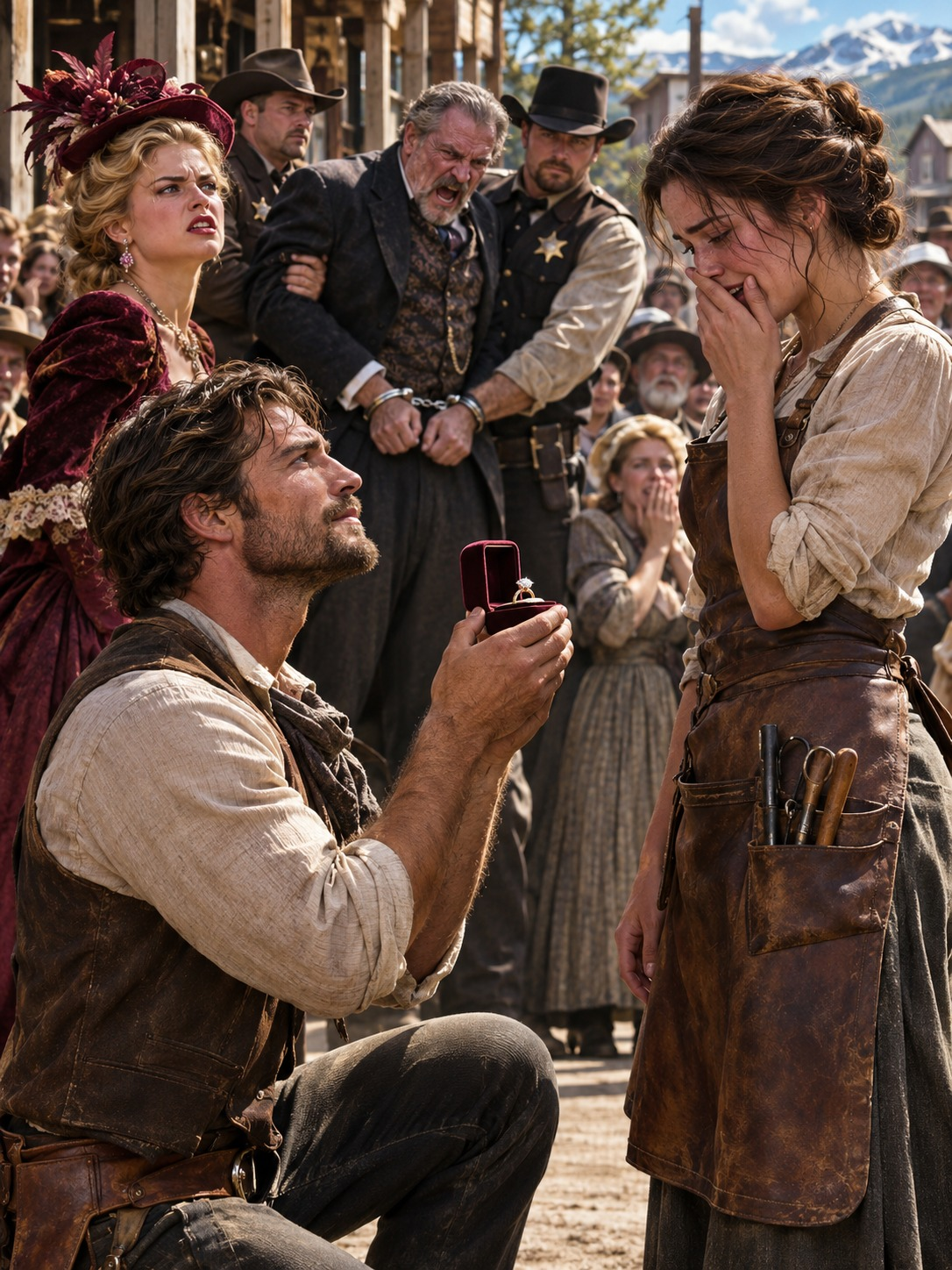
They remembered the wealthy rancher who had knelt before the woman everyone had once dismissed.
But the story changed as the years passed.
People stopped telling it as though William Carter had rescued Eleanor Whitmore.
Instead, they spoke of a woman who had refused to surrender.
A woman who had challenged a powerful banker.
Who had uncovered the truth about her mother's death.
Who had forced a town to confront its own cruelty.
And who had accepted love without giving up herself.
One autumn evening, Eleanor stood inside the workshop after the apprentices had gone home.
The room smelled of leather and cedar.
A new saddle rested on the workbench.
Sunlight spilled across the floor.
She was finishing a row of stitches when William entered.
"Still working?"
She looked up.
"Almost finished."
He smiled.
"You said that an hour ago."
"And I was almost finished an hour ago."
William laughed.
He crossed the room and kissed her cheek.
"Mrs. Carter."
She raised an eyebrow.
"Mr. Carter."
"Your husband has been waiting for supper."
"Then your husband should have learned to cook."
He laughed again.
"Fair enough."
Eleanor set down her needle.
William looked toward the photograph on the wall.
Margaret Whitmore smiled from its old wooden frame.
Beside it hung another photograph.
Jonathan Carter.
And beneath them, a smaller picture showed Eleanor and William on their wedding day.
William studied the photographs.
"Do you think they'd be happy?"
Eleanor followed his gaze.
She considered the question.
Then nodded.
"Yes."
William slipped an arm around her waist.
"Good."
Eleanor rested her head against his shoulder.
For a moment, they stood quietly.
Then she looked around the workshop.
The tools.
The shelves.
The repaired roof.
The new windows.
The apprentices' workbenches.
Everything her mother had left behind had been preserved.
But Eleanor had built something new upon it.
Something stronger.
Something that belonged to the future.
William kissed her forehead.
"Ready to go home?"
Eleanor smiled.
She looked at him.
Then at the workshop.
"This is home too."
William nodded.
"I know."
She reached for her coat.
He held it open.
She slipped her arms into the sleeves.
Then turned toward him.
"William?"
"Yes?"
"Do you remember the first day you came here?"
He smiled.
"How could I forget?"
"You brought me that terrible saddle."
"It wasn't terrible."
Eleanor laughed.
"The stitching was crooked."
"Only slightly."
"The leather was poorly treated."
"That seems harsh."
"And the price you offered was ridiculous."
William grinned.
"You refused half of it."
"Because the work wasn't worth that much."
He stepped closer.
"And yet I kept coming back."
Eleanor smiled.
"Yes, you did."
William took her hand.
"Best decision I ever made."
She looked at the ring on her finger.
Then at the man who had placed it there.
For years, she had believed that loving someone might mean losing part of herself.
But William had never asked her to become smaller.
He had never demanded that she choose between marriage and independence.
He had simply loved her.
And allowed her to love him freely.
Eleanor rose onto her toes and kissed him.
When she stepped back, William was smiling.
"What was that for?"
She laughed softly.
"For coming back."
He brushed a strand of copper-red hair from her face.
"I'll always come back."
Together, they turned out the lamps.
Eleanor locked the workshop door.
Then she placed the key in her pocket.
It was the same key she had carried for years.
The key to her mother's business.
The key to the life she had fought to protect.
William offered his arm.
Eleanor took it.
And they walked together beneath the golden autumn sky.
Not as a wealthy man and a woman the town had once called worthless.
Not as a rescuer and someone who needed saving.
But as two people who had chosen each other.
Freely.
Completely.
And without surrendering who they were.






Comments 0