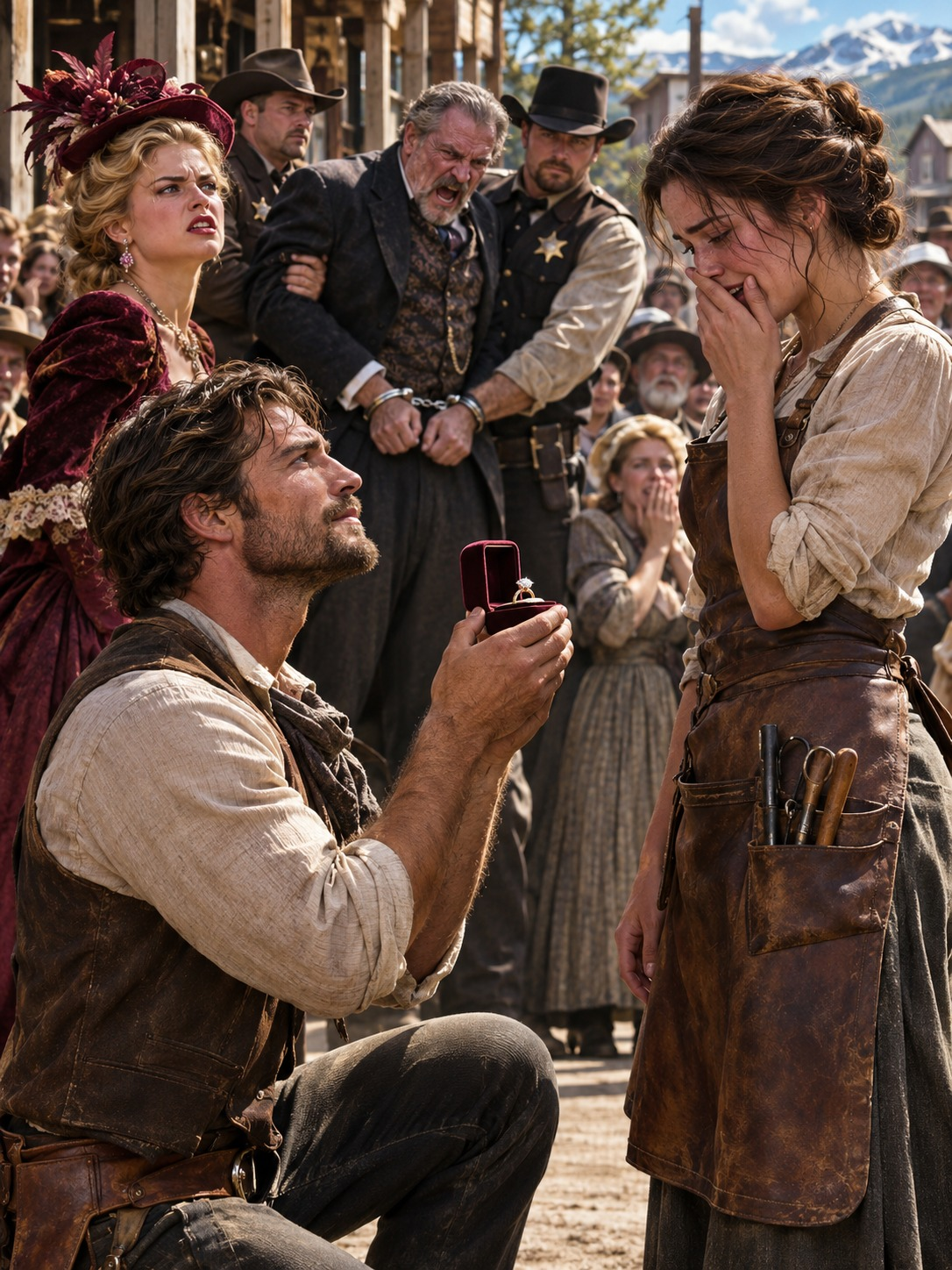
The key scraped against the lock.
Eleanor Whitmore stood frozen beside her workbench.
Someone outside was trying to open the door to the only home she had ever known.
"Who gave you a key to my shop?" she demanded.
The turning stopped.
Sheriff Thomas Reed answered from the other side.
"Miss Whitmore, I suggest you open this door before matters become unpleasant."
William Carter moved toward the entrance.
"Thomas, put that key away."
Silence followed.
Then the sheriff spoke again.
"William? Is that you?"
"Yes. And if you're carrying a court order, you can show it through the window before you touch another lock."
Eleanor glanced at William.
His voice was calm, but something in his expression had changed.
The warmth she had seen earlier that afternoon was gone.
In its place was the hard authority of a man accustomed to handling dangerous situations without raising his voice.
Outside, the sheriff muttered something.
A second man answered.
Eleanor recognized that voice immediately.
Vance Marsh.
Her stomach tightened.
Of course.
The banker had not been satisfied with threatening her.
He had brought the law to her doorstep.
William looked at her.
"Don't open it yet."
Eleanor lifted her chin.
"This is my property."
"I know."
"Then I decide who enters."
William stepped aside.
"You're right."
She walked toward the window.
Through the glass, she saw Sheriff Reed standing beneath the wooden awning, holding a folded document.
Beside him stood Vance Marsh.
Two deputies waited near the street.
And behind them, watching from a polished carriage, sat Virginia Marsh.
Eleanor felt a sudden, terrible understanding.
This was not simply about land.
It was a performance.
Vance wanted the entire town to see her humiliated.
And Virginia had come to enjoy it.
"Show me the warrant," Eleanor said.
The sheriff raised the paper.
She studied the official seal.
It appeared genuine.
But the wording troubled her.
"Temporary possession pending review of disputed collateral," she read aloud.
William moved beside her.
"Thomas, that's not an eviction order."
"It's a court authorization."
"To preserve disputed property. Not to throw its owner into the street."
Vance stepped forward.
"William, this is a private financial matter."
"Then why are you standing outside her home with deputies?"
The banker straightened his coat.
"Because Miss Whitmore has refused every reasonable opportunity to settle her obligations."
Eleanor opened the window.
"My mother paid that debt twelve years ago."
Vance's expression flickered.
Only for an instant.
But William saw it.
"So you've claimed," Vance replied.
"I have the receipt."
"Then submit it to the court."
"I intend to."
"Until then, the bank must protect its interests."
William looked at the sheriff.
"Thomas, did you read the entire order?"
The sheriff frowned.
"Of course."
"Then read the second paragraph again."
Reed unfolded the document.
His eyes moved across the page.
He stopped.
William waited.
The sheriff's jaw tightened.
"The court authorizes an inventory of movable assets associated with the disputed loan," he said slowly.
"And?"
"Pending further hearing."
"Does it authorize entry without the owner's consent?"
The sheriff said nothing.
William continued.
"Does it authorize seizure of her tools? Does it authorize removing her from the premises?"
"No."
Vance's face darkened.
"That is a narrow interpretation."
"It's the written order," William said.
Eleanor watched the banker.
For the first time since the threats began, Vance Marsh appeared genuinely uncomfortable.
But Virginia was not.
She leaned forward inside the carriage, her pale blue eyes fixed on Eleanor.
And she smiled.
Sheriff Reed lowered the document.
"Miss Whitmore, I apologize for the confusion."
Eleanor opened the door.
Not because Vance had demanded it.
Because the sheriff had finally acknowledged her rights.
"I'll cooperate with a lawful inventory," she said. "But nobody removes anything from this building."
Reed nodded.
"That's understood."
Vance stepped forward.
William moved into his path.
"Not you."
The banker stared at him.
"Excuse me?"
"You're the claimant in a disputed financial matter. The sheriff can conduct his inventory without you entering her home."
"William, I have known your family for thirty years."
"Then you should know I mean what I say."
For several seconds, the two men faced each other.
Eleanor could feel the tension.
William was not shouting.
He was not threatening.
But Vance Marsh understood that the richest rancher in Wyoming was no longer willing to overlook his behavior.
Finally, the banker stepped back.
"Very well."
Sheriff Reed entered with one deputy.
Eleanor watched as they recorded the workbench, tools, shelves, and equipment.
She answered every question.
She did not apologize for the modest furnishings.
She did not attempt to hide the worn condition of her tools.
Each item had been purchased through years of work.
Every hammer, needle, and leather punch had a purpose.
When the deputy examined her mother's old cabinet, Eleanor's heart began beating faster.
Drawer seventeen.
The hidden letter.
The brass key.
The receipt.
She had concealed the original documents upstairs, but she had left the key inside the drawer.
The deputy pulled several drawers open.
"What's in here?"
"Small fittings."
He examined a handful of buckles.
Then he reached toward the seventeenth drawer.
Eleanor stepped forward.
"That drawer sticks."
The deputy glanced at her.
"Does it?"
"Yes."
He pulled.
The drawer resisted.
Then opened.
Inside lay the old brass key.
Nothing else.
The deputy picked it up.
"What's this for?"
Eleanor looked at it.
"I don't know."
The answer was technically true.
She had not yet discovered what the key opened.
The deputy returned it to the drawer.
"Probably belongs to an old lock."
He moved on.
Eleanor released a breath she had not realized she was holding.
Across the room, Samuel Briggs watched her carefully.
He still held her mother's sealed envelope inside his coat.
And Eleanor knew that before this night ended, she would demand to read it.
Outside, Virginia stepped down from her carriage.
She waited until Vance moved toward the sheriff before approaching William.
"Well," she said softly, "this is certainly embarrassing."
William turned.
"Virginia."
"I had no idea you were becoming so involved in Eleanor's affairs."
"I'm here because I was visiting."
"At this hour?"
"Yes."
Virginia looked toward the workshop.
"People will misunderstand."
"People seem determined to misunderstand everything."
She smiled.
"You're making this difficult for yourself."
"How?"
"By allowing a poor woman to draw you into her financial problems."
William's expression hardened.
"Eleanor hasn't asked me for a cent."
"Not yet."
He studied her.
"Is that what you think of her?"
Virginia hesitated.
Then she lifted her chin.
"I think a woman who has nothing should be realistic about what she can expect from a man like you."
William looked toward the open workshop door.
Inside, Eleanor was calmly explaining the purpose of a leather-cutting machine to the deputy.
There was no pleading in her voice.
No attempt to impress anyone.
She was simply telling the truth.
"Perhaps," William said quietly, "you should spend less time deciding what Eleanor deserves."
Virginia's smile vanished.
"And more time doing what?"
"Finding something worthwhile to do with your own life."
The words struck harder than an insult.
Virginia stared at him.
William turned and walked back into the shop.
She remained beside the carriage, her gloved hands trembling.
No man had ever dismissed her so completely.
Especially not William Carter.
She watched him disappear through Eleanor's doorway.
And something ugly began growing beneath her humiliation.
By the time the sheriff finished the inventory, nearly an hour had passed.
Reed closed his notebook.
"Miss Whitmore, nothing will be removed tonight."
"Thank you."
"You'll receive notice of the next hearing."
"When?"
"Likely within the week."
Eleanor nodded.
"I'll be ready."
The sheriff hesitated.
Then he lowered his voice.
"For what it's worth, I didn't know Marsh intended to use the order this way."
Eleanor studied him.
"Then next time, Sheriff, read the paper before you bring men to someone's door."
Reed accepted the rebuke.
"Fair enough."
He left.
Vance remained outside.
Through the window, Eleanor saw him speaking angrily to the sheriff.
Reed shook his head.
Vance pointed toward the shop.
The sheriff turned away.
Virginia climbed into her carriage.
But before the driver moved, she looked directly through the window at Eleanor.
Her expression was cold.
Not merely jealous.
Determined.
Eleanor had seen that look before.
On Vance Marsh's face.
It was the expression of someone who believed another person's life was an obstacle to be removed.
When the street finally emptied, William turned toward Samuel.
"Now."
The older foreman removed the sealed envelope from his coat.
Eleanor stood beside the workbench.
"Give it to me."
Samuel hesitated.
"Your mother made me promise—"
"My mother is dead, Mr. Briggs. And the man who tried to steal her land just brought the sheriff to my door."
Samuel lowered his eyes.
"You're right."
He placed the envelope in her hand.
Eleanor recognized the handwriting.
Margaret Whitmore.
Her mother's letters had always leaned slightly to the right.
The capital E in Eleanor's name had a distinctive curl.
There was no mistaking it.
She carefully broke the seal.
Inside were two sheets of paper.
The first was a letter.
The second appeared to be a handwritten statement bearing several signatures.
Eleanor unfolded the letter.
My darling Ellie,
If Samuel has given you this, then the trouble I feared has finally come.
I wish I could have protected you from it.
But some truths are too dangerous to leave in the hands of people who believe money can silence everyone.
Years ago, I borrowed money from Marsh County Bank to keep our workshop open.
I repaid every dollar.
On the day I made the final payment, Samuel Briggs accompanied me as a witness.
He was there because Jonathan Carter insisted that I should never enter that bank alone.
Eleanor stopped reading.
Jonathan Carter.
William's father.
She looked up.
William was staring at the page.
"My father sent Samuel?"
The older foreman nodded.
"He did."
"Why?"
Samuel looked at Eleanor.
"Because your mother had discovered that Marsh was charging illegal fees to small property owners."
Eleanor's fingers tightened around the paper.
She continued reading.
Vance Marsh believed the people borrowing from him were too poor to challenge his records.
He added charges that had never been agreed upon.
He delayed payments.
He altered dates.
And when families could no longer afford the amounts he demanded, he took their land.
Your father is not part of this story, Ellie. He left long before these events. But Jonathan Carter became involved when he learned what Marsh was doing.
He helped me find proof.
Samuel witnessed my final payment.
And the three of us agreed to preserve copies of the records.
Eleanor's eyes filled with tears.
She forced herself to keep reading.
I believed the matter was finished.
But Jonathan warned me that Vance would never forgive being exposed.
If Marsh ever comes for our property again, remember this: the evidence is not all in one place.
Samuel knows where the second record was kept.
And the truth must be placed before someone who cannot be bought.
I love you, my brave girl.
Mama.
Eleanor lowered the letter.
For several seconds, she could not speak.
Her mother had carried this secret for years.
And Jonathan Carter had helped her.
William stepped closer.
"Eleanor?"
She looked at him.
"Your father knew."
William nodded slowly.
"Apparently."
"Why didn't anyone tell me?"
Samuel answered.
"Because Margaret wanted you to have a life that wasn't consumed by this fight."
Eleanor turned toward him.
"She spent years protecting me from something I didn't even know existed."
Samuel's face tightened.
"She did."
"And you kept her secret."
"I gave her my word."
Eleanor looked down at the second document.
Three signatures appeared at the bottom.
Margaret Whitmore.
Samuel Briggs.
Jonathan Carter.
Above them was a statement confirming that Margaret had paid the full balance of her loan in the presence of two witnesses.
But there was something else.
A notation referring to a separate ledger.
An account number.
And a date.
Eleanor looked at Samuel.
"Where is the second record?"
The older man hesitated.
William spoke.
"Samuel."
The foreman rubbed a hand across his face.
"Jonathan kept it."
William frowned.
"My father?"
"Yes."
"Where?"
Samuel looked toward the floor.
"In his private papers."
William stared at him.
"My father died twelve years ago."
"I know."
"Then where are those papers now?"
Samuel swallowed.
"At Carter Ranch."
Virginia Marsh did not return home quietly.
She entered her father's bank through the private rear entrance and marched into his office.
Vance was standing beside his desk, pouring whiskey into a glass.
"Well?" she demanded.
He looked up.
"Well what?"
"Are you going to let William humiliate us?"
Vance took a drink.
"William Carter is becoming a nuisance."
"A nuisance?"
Virginia laughed bitterly.
"He stood in front of the sheriff and defended that woman as though she were his wife."
"Lower your voice."
"No."
Vance slammed the glass onto his desk.
"Virginia!"
She stopped.
The banker stared at her.
"Do you understand how much is at stake?"
"Yes. My future."
"Your future?"
He gave a harsh laugh.
"You think this is about whether William Carter invites you to dinner?"
Virginia's cheeks flushed.
"He's supposed to marry me."
"William Carter has never promised to marry you."
"He will."
"Not if you continue behaving like a spoiled child."
The words stunned her.
For a moment, she could only stare.
Then she spoke quietly.
"You told me he would come around."
"I told you that a marriage between our families would be advantageous."
"You said the Carter fortune would strengthen the bank."
"It would."
"Then why are you letting Eleanor take him away?"
Vance turned toward the window.
"Because William has become involved in something he doesn't understand."
Virginia followed his gaze.
"What?"
"The Whitmore property."
She crossed her arms.
"You've been trying to acquire that land for months."
"Longer."
"Why?"
Vance said nothing.
Virginia stepped closer.
"Father."
He turned.
"That property sits along the route of the new freight expansion."
"I know."
"The railroad company will eventually need access through that section of town."
"Then buy it."
"I've tried."
"Offer more money."
Vance laughed without humor.
"You really don't understand, do you?"
Virginia stared at him.
He continued.
"If Eleanor Whitmore takes her records to an independent attorney, she may uncover more than a disputed loan."
"What does that mean?"
"It means there are documents that should have disappeared years ago."
Virginia's expression changed.
"Are you saying you did something illegal?"
Vance's eyes hardened.
"I'm saying that business sometimes requires difficult decisions."
She took a step backward.
For the first time, she realized that her father's determination to acquire Eleanor's property was not simply about money.
It was about fear.
And Vance Marsh was not a man accustomed to being afraid.
The following morning, William took Eleanor to Carter Ranch.
She had refused at first.
"I have work."
"The records may be there."
"Then bring them to me."
"I don't know where they are."
"Ask Samuel."
"Samuel hasn't entered my father's private study in years."
Eleanor had considered the matter.
Then she had removed her apron.
"Fine. But I'm not staying all day."
William smiled.
"I wouldn't dare ask."
They rode in a modest ranch wagon rather than his expensive carriage.
Eleanor appreciated that.
She had no interest in arriving at Carter Ranch like a woman being presented to society.
The road wound through open pastureland.
Cattle grazed beyond the fences.
Distant mountains rose against the blue sky.
William pointed toward a group of horses near a watering trough.
"Those are the mares we brought in from Montana."
Eleanor studied them.
"Good animals."
"You can tell from here?"
"I can tell they're well cared for."
William glanced at her.
"That's a compliment."
"Don't get used to it."
He laughed.
For several minutes, they rode in comfortable silence.
Then Eleanor spoke.
"William?"
"Yes?"
"Why did your father help my mother?"
He considered the question.
"Because he believed people deserved fair treatment."
"That sounds simple."
"It wasn't always."
William looked toward the ranch buildings.
"My father made mistakes. He could be stubborn. Sometimes he trusted the wrong people."
"Like Vance Marsh?"
"Possibly."
Eleanor watched him.
"Do you think he knew how dangerous Marsh was?"
"I think he learned."
"And you?"
William looked at her.
"I'm learning."
She nodded.
It was an honest answer.
And she respected him for it.
Carter Ranch was larger than Eleanor had imagined.
The main house stood beyond a long wooden fence, surrounded by stables, barns, and outbuildings.
Ranch hands moved between the corrals.
A cook carried a basket toward the kitchen.
Several horses stood beneath a shaded awning.
Eleanor stepped down from the wagon.
She looked around.
"This is quite a place."
William followed her gaze.
"It's a lot of work."
"I can see that."
He smiled.
"Most people mention the size."
"Size doesn't mean much if nobody maintains it."
William laughed.
"Samuel said you'd say something like that."
Inside the house, they entered Jonathan Carter's old study.
The room smelled faintly of leather, tobacco, and old paper.
Books lined the walls.
A large desk stood near the window.
William opened a cabinet.
"My father's private papers were stored here after his death."
Eleanor approached.
"Has anyone examined them?"
"Not carefully."
"Then we should start with the dates."
William nodded.
They worked for nearly two hours.
Eleanor sorted correspondence.
William examined account books.
Samuel searched through a locked chest beneath the desk.
At first, they found nothing unusual.
Ranch purchases.
Livestock records.
Tax documents.
Letters from suppliers.
Then Eleanor discovered a small folder marked WHITMORE.
She stopped.
"William."
He looked up.
"What?"
She held out the folder.
His expression changed.
"Open it."
Inside were several letters.
One was addressed to Jonathan Carter.
The handwriting belonged to Margaret Whitmore.
Eleanor unfolded it.
Mr. Carter,
I am grateful for your assistance, but I fear Mr. Marsh has begun asking questions about the records we copied.
He knows someone has challenged his accounts.
If anything happens to me, please make certain my daughter keeps the workshop.
Eleanor's throat tightened.
She continued.
I do not want Eleanor growing up believing she must depend upon wealthy men to survive.
I want her to know that honest work has value.
Please do not give her charity.
Give her the truth when she is old enough to understand it.
Eleanor slowly lowered the letter.
William watched her.
"Your mother was remarkable."
Eleanor nodded.
"She was."
Samuel approached carrying a small metal box.
"I found this."
William looked at it.
"Where?"
"Under the false bottom of the chest."
The box was locked.
Eleanor remembered the brass key in drawer seventeen.
Her heart began to race.
"I think I know how to open it."
They returned to Red Hollow before sunset.
Eleanor hurried into the workshop and retrieved the old brass key.
William and Samuel waited beside the workbench.
She placed the metal box beneath the lamp.
The key slid into the lock.
For a moment, it resisted.
Then turned.
A soft click sounded.
Eleanor lifted the lid.
Inside were several folded documents, a small notebook, and a sealed packet.
William leaned closer.
The notebook bore his father's initials.
J.C.
Eleanor opened it.
The first pages contained handwritten observations about Vance Marsh's financial practices.
Dates.
Amounts.
Names of families who had lost property.
Some entries were crossed out.
Others had been marked with a small red symbol.
William read one aloud.
"Payment accepted. Account later reopened without borrower's consent."
Eleanor looked at him.
"That's what he did to my mother."
Samuel nodded.
"And others."
They examined the notebook carefully.
The evidence was disturbing.
According to Jonathan Carter's records, Vance Marsh had repeatedly manipulated debts to seize valuable land from struggling families.
Some properties had later been sold at enormous profits.
Others had been transferred through private agreements.
William's expression grew darker with every page.
"My father knew all this."
Samuel answered quietly.
"He was gathering proof."
"Why didn't he go to the authorities?"
"He intended to."
"What stopped him?"
Samuel looked away.
"His death."
William fell silent.
Jonathan Carter had died after a sudden illness.
At the time, nobody had questioned the circumstances.
William had been twenty-six.
He had inherited the ranch and spent the following years struggling to keep it profitable.
He had never known his father had been investigating Vance Marsh.
Eleanor touched his arm.
"William."
He looked at her.
"We don't know everything yet."
He nodded.
"You're right."
They returned to the documents.
The sealed packet contained copies of several financial transactions.
Some bore Vance Marsh's signature.
Others contained initials Eleanor did not recognize.
But one name appeared repeatedly.
Daniel Price.
Eleanor frowned.
"Daniel?"
William looked up.
"The bank clerk?"
"Yes."
Samuel shook his head.
"Daniel was a child when these transactions happened."
Eleanor examined the document.
The name was written beside a more recent date.
Only six months earlier.
William leaned closer.
"Someone has been continuing the record."
Eleanor felt a chill.
"Daniel found the old evidence."
"Or someone gave it to him."
Samuel looked toward the window.
"Either way, that boy is in danger."
Across town, Virginia Marsh stood before her bedroom mirror.
A beautiful midnight-blue dress lay across her bed.
She had ordered it months earlier for a dinner she believed would finally persuade William Carter to announce their engagement.
Now she stared at it with growing hatred.
She remembered the way William had looked at Eleanor.
The way he had defended her.
The way he had dismissed Virginia without hesitation.
Her hands tightened around a silver hairbrush.
Then she threw it across the room.
It struck the wall.
A maid appeared at the doorway.
"Miss Marsh?"
"Get out!"
The maid disappeared.
Virginia stood breathing hard.
Then she looked toward the small writing desk near her window.
An idea had begun forming.
If William Carter would not abandon Eleanor because she was poor, perhaps he would abandon her if he believed she was dishonest.
Virginia sat down.
She took out a sheet of expensive stationery.
Then she began writing.
Not to William.
Not to her father.
To the editor of the Red Hollow Gazette.
She knew the editor.
More importantly, she knew his wife.
And she knew exactly how quickly a scandal could spread through a town where everyone enjoyed judging their neighbors.
Virginia wrote slowly.
Carefully.
She did not accuse Eleanor directly.
That would be too obvious.
Instead, she presented questions.
Why had Eleanor Whitmore suddenly become close to Wyoming's richest rancher?
Why was her family property involved in a financial dispute?
Why had William Carter begun visiting her shop so frequently?
And was it possible that a young woman facing financial ruin had discovered a convenient way to secure a wealthy husband's protection?
Virginia paused.
Then she added one final sentence.
The people of Red Hollow deserve to know whether Mr. Carter's generosity is being exploited.
She read the letter.
A satisfied smile appeared on her face.
Then she folded it.
Sealed it.
And rang for the maid.
At the workshop, Eleanor was still examining Jonathan Carter's notebook when a knock sounded at the door.
She looked up.
A young woman stood outside.
It was Clara Bennett, who worked at the general store.
Eleanor opened the door.
"Clara?"
The girl looked nervous.
"Miss Whitmore, I thought you should know something."
"What?"
"Miss Marsh has been speaking to people."
Eleanor sighed.
"Virginia is always speaking to people."
"Not like this."
Clara glanced toward William.
Then back at Eleanor.
"She's saying you're trying to trap Mr. Carter into marriage."
William's expression hardened.
Eleanor remained still.
Clara continued.
"She's telling people you have debts. That you want his money. That you're pretending to be independent so he'll feel sorry for you."
Eleanor felt the familiar sting of humiliation.
But she refused to show it.
"Thank you for telling me."
Clara hesitated.
"There's more."
William stepped forward.
"What?"
"The Gazette is printing something tomorrow."
Eleanor looked at her.
"About me?"
Clara nodded.
"I heard the editor discussing it."
William's jaw tightened.
"What kind of story?"
Clara swallowed.
"Something about Eleanor's mother."
The room became silent.
Eleanor stared at her.
"My mother?"
"Yes."
"What about her?"
Clara looked down.
"I don't know everything. But I heard them say they had documents."
Eleanor felt her heart begin to pound.
"What documents?"
Clara shook her head.
"I don't know."
William turned toward the workbench.
The old notebook lay open beneath the lamp.
Samuel stood beside it, his face pale.
Eleanor looked from one man to the other.
Then she understood.
Virginia was not merely spreading gossip.
Someone was preparing to use her mother's past against her.
And the timing was too precise to be accidental.
William walked Clara to the door.
When he returned, Eleanor was gathering the documents.
"What are you doing?" he asked.
"Putting these somewhere safe."
"Good."
"Then I'm going to the Gazette."
William frowned.
"Tonight?"
"Yes."
"The editor may already be gone."
"Then I'll find him tomorrow."
"Eleanor—"
She turned sharply.
"I will not let Virginia Marsh drag my mother's name through the dirt."
William held her gaze.
"I know."
"She worked herself to death keeping this shop alive."
"I know."
"She never stole from anyone. Never lied about what she owed. Never asked for favors."
William stepped closer.
"Then we make sure the truth is heard."
Eleanor's expression softened slightly.
"We?"
He hesitated.
Then answered carefully.
"If you want my help."
For a moment, she looked at him.
The richest rancher in Wyoming stood before her without arrogance or expectation.
He was not demanding the right to protect her.
He was asking permission to stand beside her.
Eleanor felt something warm and unfamiliar move through her chest.
"Yes," she said quietly.
William nodded.
"Then we'll face it together."
Samuel cleared his throat.
"There's something else you both need to understand."
They turned toward him.
The older foreman looked at the notebook.
"Jonathan Carter didn't gather all this evidence alone."
William frowned.
"Who helped him?"
Samuel hesitated.
Then he looked at Eleanor.
"Your mother."
Eleanor stared at him.
Samuel continued.
"Margaret was the one who first noticed the altered accounts. She convinced Jonathan to investigate."
William looked down at the documents.
"Then why did my father keep the records?"
"Because he had the resources to protect them."
Eleanor swallowed.
"And my mother?"
Samuel's voice became quiet.
"She had the courage to find them."
For several seconds, nobody spoke.
Then Eleanor looked toward her mother's photograph.
The woman in the picture stood proudly outside the workshop, one hand resting on a saddle.
Eleanor had always known her mother was strong.
But now she was beginning to understand just how much strength that had required.
The next morning, the Red Hollow Gazette appeared on doorsteps across town.
Eleanor had barely opened her workshop when Mrs. Porter hurried inside.
Her face was pale.
"Eleanor."
The young leatherworker looked up.
"What is it?"
Mrs. Porter held a newspaper.
"You need to see this."
Eleanor took it.
The headline stretched across the front page.
RANCHER'S NEW COMPANION LINKED TO DISPUTED FAMILY DEBT.
Below it was a smaller line.
QUESTIONS RAISED ABOUT WHITMORE PROPERTY AND CARTER FAMILY INVOLVEMENT.
Eleanor read the article.
Her hands grew cold.
The story suggested that her mother had received improper financial assistance from Jonathan Carter.
It implied that the Whitmore property had been protected through private arrangements.
And it questioned whether Eleanor was now attempting to gain similar advantages through William.
There were no direct accusations.
Only carefully arranged insinuations.
But Eleanor understood their purpose.
The article was designed to make honest people look dishonest without offering a single fact they could easily disprove.
Mrs. Porter watched her.
"I'm so sorry."
Eleanor folded the newspaper.
"Don't be."
"People are already talking."
"I know."
"Some are saying terrible things."
Eleanor looked toward the street.
Several townspeople stood outside the general store.
When they noticed her, their conversation stopped.
One woman turned away.
Another whispered behind her hand.
Eleanor felt the familiar pressure in her chest.
The same feeling she had experienced as a child when wealthy girls mocked her patched dresses.
The same humiliation she had endured when customers questioned whether a young woman could repair a saddle properly.
But this was different.
They were attacking her mother.
And Eleanor would not allow that to go unanswered.
She placed the newspaper on the counter.
"Mrs. Porter?"
"Yes, dear?"
"Do you know where the editor is?"
"At the Gazette office."
Eleanor removed her apron.
"Good."
Virginia Marsh watched from the upstairs window of her father's bank as Eleanor crossed Main Street.
The young leatherworker walked with her shoulders straight.
Her expression was serious.
She carried the newspaper in one hand.
Virginia smiled.
At last.
Eleanor was reacting.
The humiliation was working.
Behind Virginia, Vance entered the room.
"What are you looking at?"
She turned.
"Your little problem is finally beginning to understand her place."
Vance approached the window.
He saw Eleanor walking toward the newspaper office.
His expression darkened.
"What have you done?"
Virginia smiled.
"Nothing that wasn't necessary."
"Virginia."
"I simply helped the town understand what kind of woman Eleanor Whitmore really is."
Vance grabbed the newspaper from her hand.
He read the headline.
Then the article.
His face changed.
"You gave them this?"
Virginia frowned.
"Of course."
"Where did you get the information?"
"From your office."
Vance stared at her.
"What?"
"I saw the Whitmore folder. I knew enough."
His voice dropped.
"Which documents?"
Virginia's smile faded.
"Father, you're frightening me."
"Which documents?"
She stepped backward.
"The ones on your desk yesterday."
Vance turned toward the office door.
For the first time, genuine fear crossed his face.
Virginia watched him.
"What's wrong?"
He did not answer.
Instead, he hurried downstairs.
At the Gazette office, Eleanor pushed open the door.
The editor, Mr. Harold Finch, looked up from his desk.
His expression changed when he saw the newspaper in her hand.
"Miss Whitmore."
"We need to talk."
Finch stood.
"I assume you've read the article."
"I have."
"Then you understand that the public has an interest—"
"The public has an interest in facts, Mr. Finch. Not rumors."
He adjusted his spectacles.
"Our information came from a reliable source."
"Virginia Marsh?"
Finch hesitated.
Eleanor nodded.
"That's what I thought."
"Miss Whitmore, I cannot reveal confidential sources."
"Then perhaps you can explain why you printed accusations about my dead mother without asking me a single question."
Finch looked uncomfortable.
"The article raises concerns. It doesn't make accusations."
"It suggests my mother was dishonest."
"That wasn't our intention."
"Then your intention was poorly executed."
The editor looked toward the door.
Eleanor continued.
"My mother paid every debt she owed. I have records proving it."
Finch's expression changed.
"Records?"
"Yes."
"Would you be willing to provide them?"
"To an attorney. And eventually to the court."
He hesitated.
Then leaned forward.
"Miss Whitmore, there's something you should know."
Eleanor studied him.
"What?"
"The article wasn't supposed to run this morning."
She frowned.
"What do you mean?"
"It was scheduled for next week."
"Then why did you publish it?"
Finch looked toward the window.
"Someone came here late last night and insisted it be printed immediately."
"Virginia?"
He shook his head.
"No."
Eleanor felt a chill.
"Who?"
Before Finch could answer, the front door opened.
William Carter stepped inside.
His expression was grim.
"Eleanor."
She turned.
"William?"
He held a folded telegram.
"Samuel found something in my father's records."
Eleanor stared at him.
"What?"
William looked at the editor.
Then back at her.
"We need to leave."
"Why?"
"Because someone has been watching the workshop."
Eleanor's stomach tightened.
"Who?"
William lowered his voice.
"I don't know. But Samuel found signs that someone entered while you were away."
Eleanor went still.
The original receipt.
Her mother's letter.
The documents hidden upstairs.
She turned toward the door.
William caught her arm gently.
"Eleanor, wait."
She looked at him.
"What?"
His expression was unlike anything she had seen before.
Not anger.
Not concern.
Fear.
"Samuel sent another message."
Eleanor's heart began pounding.
"What message?"
William unfolded the telegram.
He looked at the words.
Then at her.
"The metal box we opened yesterday wasn't the only thing hidden in my father's study."
Eleanor stared at him.
"What else was there?"
William hesitated.
Then he handed her the telegram.
Eleanor read the first line.
Her breath stopped.
The second line contained a name.
A name she had never expected to see connected to her mother's death.
She looked up.
"William..."
But before she could finish, the Gazette office door slammed open.
Daniel Price stood in the doorway, pale and breathless.
His shirt was torn.
Blood stained one sleeve.
He looked directly at Eleanor.
"Don't go back to your shop!"
William stepped forward.
"Daniel, what happened?"
The young clerk grabbed the doorframe.
His voice broke.
"Someone found the hidden records."
Eleanor felt the room tilt.
Daniel looked toward the street.
Then he whispered:
"And the man who took them is standing right behind you."






Comments 0