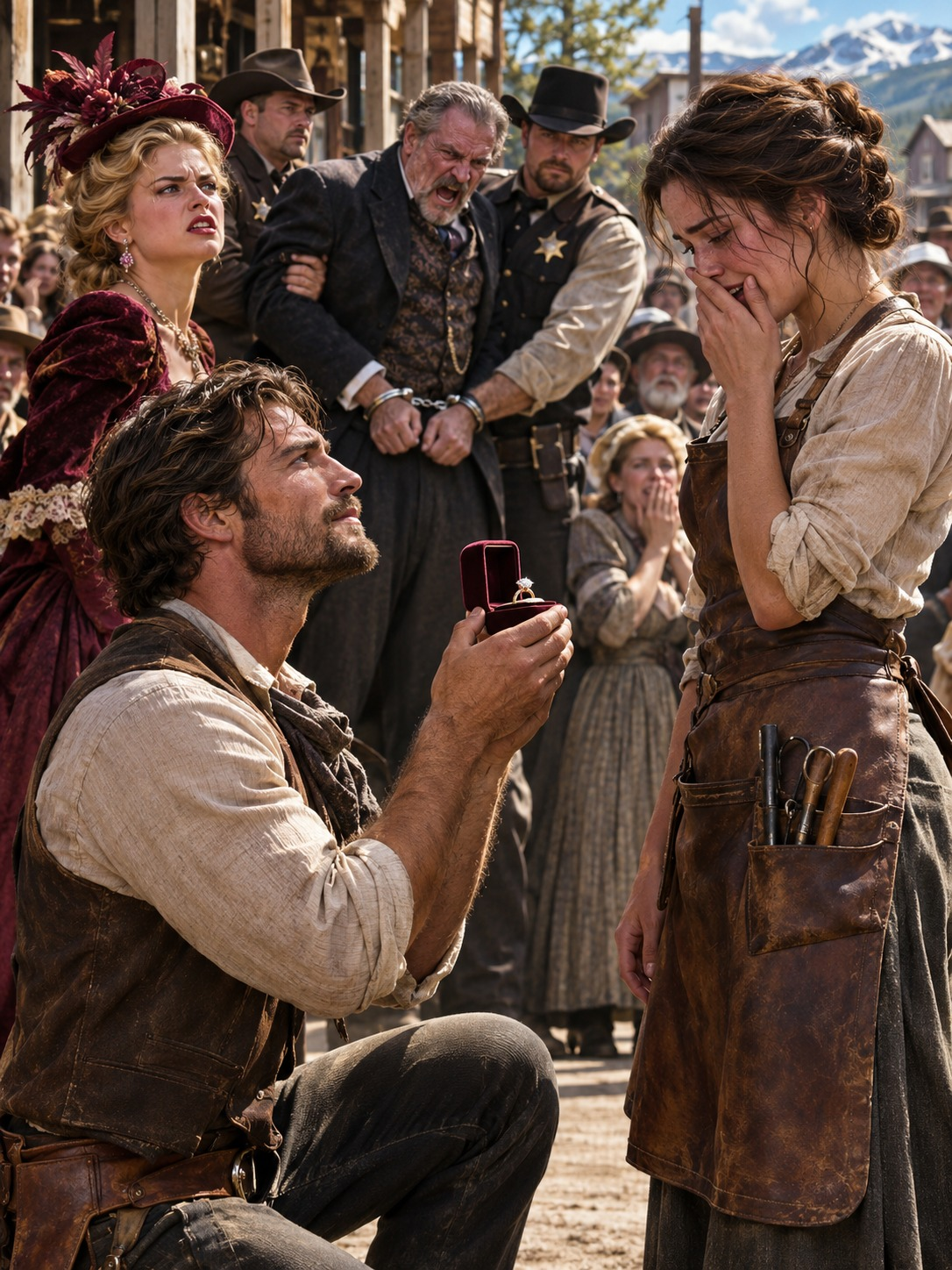
"Don't turn around!" Daniel Price shouted.
Eleanor Whitmore froze in the middle of the newspaper office.
William Carter moved before anyone else could react.
He stepped between Eleanor and the man standing behind her, one hand raised in warning.
"Stay where you are."
The stranger stopped.
He was broad-shouldered, with a scar running from his left ear to the edge of his jaw. His dusty brown coat hung open over a dark vest, and his right hand rested dangerously close to the revolver at his hip.
Eleanor recognized him.
He was one of the two men who had accompanied Vance Marsh to her workshop the night before.
The man smiled.
"Easy, Carter. I came to deliver a message."
William's expression remained hard.
"Then deliver it."
The stranger looked past him toward Eleanor.
"Mr. Marsh wants his property returned."
Eleanor lifted her chin.
"Tell Mr. Marsh he can take his complaints to the court."
The man's smile widened.
"That wasn't the message."
He reached inside his coat.
William shifted his weight.
"Slowly."
The stranger withdrew a folded piece of paper.
He tossed it onto the editor's desk.
"Forty-eight hours, Miss Whitmore. After that, nobody can promise what happens to your little shop."
Daniel staggered against the doorframe.
"He's the one," he whispered.
The stranger turned toward him.
For the first time, his smile disappeared.
"You should've stayed at the bank, boy."
William stepped forward.
"What's your name?"
The man looked back at him.
"Caleb Rourke."
"Then listen carefully, Rourke. If you threaten Miss Whitmore again, you'll answer to the sheriff."
Caleb laughed.
"Funny thing about sheriffs. They usually listen to the people who pay the taxes."
William took another step.
"Get out."
For several seconds, the two men stared at each other.
Then Caleb tipped his hat toward Eleanor.
"Pleasure seeing you again, ma'am."
He walked out.
The door closed behind him.
Only then did Daniel's knees begin to buckle.
Eleanor caught his arm.
"Daniel!"
William grabbed a chair.
"Sit him down."
The young clerk collapsed into it, breathing heavily.
Blood had soaked through the fabric near his left shoulder.
Eleanor hurried toward the editor's desk.
"Mr. Finch, do you have clean cloth?"
The editor stood motionless.
"Mr. Finch!"
He blinked.
"Yes. Yes, of course."
"Bring it. And send someone for Doctor Hayes."
William knelt beside Daniel.
"Who hurt you?"
Daniel swallowed.
"Rourke."
"Why?"
"Because I found something."
Eleanor pressed a folded cloth against the wound.
Daniel winced.
"Hold still," she said.
He looked at her.
"Miss Whitmore, I'm sorry."
"For what?"
"I should have told you sooner."
William leaned closer.
"Told her what?"
Daniel's eyes moved toward the newspaper lying on the desk.
"That article wasn't the beginning."
He struggled to breathe.
"Mr. Marsh has been planning this for months."
Doctor Hayes arrived fifteen minutes later.
He examined Daniel's shoulder and determined that the wound was a deep cut rather than a gunshot injury.
"You're fortunate," he told the young clerk. "Another inch and you might have lost the use of your arm."
Daniel stared at the floor.
"Can I still work?"
The doctor looked at him.
"You should be worrying about staying alive."
Eleanor stood beside the window, her arms folded tightly.
Outside, Main Street had returned to its ordinary rhythm.
Wagons rolled past.
Merchants carried crates.
Women stopped to exchange gossip.
Children chased one another between the wooden posts supporting the boardwalk.
Nobody seemed to understand that a young bank clerk had just arrived bleeding, carrying information that could destroy one of the most powerful men in Wyoming.
William approached her.
"Are you all right?"
She nodded.
He waited.
"Eleanor."
She turned.
"I'm angry."
"I can see that."
"Not frightened. Angry."
"You have every right."
She looked toward Daniel.
"He was hurt because he tried to tell the truth."
William said nothing.
"And my mother spent years living under the same kind of threat."
He watched her carefully.
"You don't have to solve everything today."
"I know."
"But you intend to try."
"Yes."
A faint smile touched his face.
Then it disappeared.
"There's something else."
Eleanor looked at him.
"The telegram."
Her stomach tightened.
She had almost forgotten the message William had handed her moments before Daniel arrived.
The paper remained folded inside her apron pocket.
She took it out.
The first line read:
ADDITIONAL DOCUMENTS FOUND IN JONATHAN CARTER'S PRIVATE STUDY.
The second line contained a name.
MARGARET WHITMORE.
Below it was a final sentence.
REFERENCE TO PRIVATE AGREEMENT DATED THREE DAYS BEFORE HER DEATH.
Eleanor stared at the words.
Three days before her mother's death.
She remembered those days clearly.
Margaret had been weak from a long illness.
She had barely been able to climb the stairs.
Yet she had insisted on reviewing the workshop accounts.
She had asked Eleanor to bring her the old property deed.
And she had made her daughter promise never to sell the land simply because someone offered an easy way out.
At the time, Eleanor had believed her mother was afraid of leaving her alone.
Now she wondered whether Margaret had been afraid of something else.
"What agreement?" Eleanor asked.
William shook his head.
"Samuel hasn't found the full document."
"Then why did he send this?"
"Because he thought you should know."
Eleanor folded the telegram.
"Your father died before my mother."
"Yes."
"Then how could his private papers contain an agreement dated three days before she died?"
William hesitated.
"Samuel may have added later documents to the collection."
"Or someone wanted those papers kept where Vance Marsh couldn't reach them."
William nodded slowly.
"That's possible."
Eleanor looked toward the street.
"Then we need to find out."
Daniel was resting when Sheriff Reed entered the newspaper office.
He removed his hat.
"Doctor Hayes sent for me."
William turned.
"Good."
The sheriff looked at Daniel's bandaged shoulder.
"Who did this?"
"Caleb Rourke," Daniel answered.
Reed's expression changed.
"Rourke?"
"You know him?" Eleanor asked.
"He's been working for Marsh."
"We know," William said.
The sheriff pulled out his notebook.
"Tell me exactly what happened."
Daniel swallowed.
"I was reviewing the original bank records yesterday evening."
"Why?"
"Mr. Marsh ordered me to retrieve the Whitmore loan ledger."
"And?"
"I found entries that didn't match the newer books."
The sheriff began writing.
Daniel continued.
"Several payments had been transferred between accounts without proper authorization."
"Did you report this?"
"I tried."
"To whom?"
Daniel looked down.
"Mr. Marsh."
William closed his eyes briefly.
The sheriff stopped writing.
"You told Marsh you'd found discrepancies in his own records?"
Daniel nodded.
"He said he'd explain everything in the morning."
"What happened then?"
"Rourke followed me after I left the bank."
Daniel's breathing became uneven.
"He demanded the ledger."
"Did you give it to him?"
"No."
"Where is it?"
Daniel looked at Eleanor.
Then William.
"I hid it."
The sheriff leaned forward.
"Where?"
Daniel hesitated.
"Somewhere Mr. Marsh wouldn't think to look."
Reed closed his notebook.
"Son, if you're withholding evidence—"
"I'm trying to stay alive!"
The sudden outburst startled everyone.
Daniel pressed his uninjured hand against his face.
"I'm sorry."
Eleanor moved closer.
"You don't need to apologize."
The young clerk looked at her.
His eyes were wet.
"I've worked at that bank since I was sixteen. Mr. Marsh gave me my first job. He helped my family when my father died."
He swallowed.
"I thought he was a good man."
Eleanor understood the pain in his voice.
Discovering that someone you trusted had betrayed others was one thing.
Realizing you might have helped them do it was another.
"What changed your mind?" she asked.
Daniel looked toward the sheriff.
"The Whitmore account."
Eleanor's heart tightened.
Daniel continued.
"I found a payment record with your mother's signature. It showed the debt was settled."
"I have the receipt."
"I know."
"Then why is the bank claiming I still owe money?"
Daniel looked down.
"Because someone reopened the account years later."
William frowned.
"Who?"
Daniel hesitated.
Then answered.
"Vance Marsh."
The room became silent.
Sheriff Reed slowly lowered his notebook.
"Are you certain?"
Daniel nodded.
"I saw his initials beside the adjustment."
Eleanor felt a cold anger settle inside her.
Her mother had paid the debt.
The bank had acknowledged it.
And Vance Marsh had deliberately created a false obligation years later.
Not because Eleanor owed him anything.
Because he wanted her land.
By afternoon, word of the confrontation had reached Virginia Marsh.
She was sitting in her father's drawing room when a servant brought the news.
"Miss Marsh, there's been some trouble near the newspaper office."
Virginia looked up from her embroidery.
"What kind of trouble?"
"Mr. Carter was seen arguing with one of your father's men."
Virginia put down her needle.
"William?"
"Yes, miss."
"Was Eleanor Whitmore there?"
The servant hesitated.
"I believe so."
Virginia stood.
"Of course she was."
She walked toward the window.
For several seconds, she watched the street.
Then she turned.
"Have the carriage brought around."
The servant nodded.
Virginia stopped him.
"And find out whether Mr. Carter is still in town."
"Yes, miss."
When the servant left, Virginia crossed the room and opened a drawer.
Inside lay several invitations, letters, and newspaper clippings concerning William Carter.
She had kept them for years.
Announcements of cattle auctions.
Reports of his charitable donations.
Photographs taken during formal gatherings.
A newspaper article describing him as Wyoming's most eligible bachelor.
Virginia picked up the clipping.
She remembered the first time her father had suggested she might marry William.
She had been nineteen.
William had been twenty-five.
At the time, he had barely noticed her.
But Vance had assured her that wealthy men eventually learned to choose practical wives.
"Love is for people who cannot afford security," he had said.
Virginia had believed him.
She had spent years preparing herself to become Mrs. William Carter.
And now a woman who repaired saddles was threatening everything she had imagined.
Virginia tore the clipping in half.
Then again.
She dropped the pieces into the fireplace.
Her expression hardened.
If Eleanor Whitmore wanted a fight, Virginia would give her one.
That evening, Eleanor returned to her workshop with William.
The front door was closed.
The windows appeared undamaged.
But the moment Eleanor stepped inside, she knew something was wrong.
A leather strap lay on the floor.
She had left it hanging beside the workbench.
A drawer stood slightly open.
Her mother's photograph had been moved.
William noticed her expression.
"What is it?"
"Someone's been here."
He looked around.
"Are you certain?"
"Yes."
Eleanor crossed the room.
She opened the cabinet.
Drawer seventeen was empty.
The brass key was gone.
Her stomach dropped.
She hurried toward the staircase.
William followed.
"Eleanor, wait."
She ignored him.
She climbed the stairs and entered her small bedroom.
The trunk beside her bed stood open.
Clothes had been pulled out.
Papers were scattered across the floor.
The loose floorboard near the wall had been lifted.
Eleanor stopped.
The hiding place.
She knelt beside it.
The oilcloth wrapping was gone.
So was the original bank receipt.
For several seconds, she could not breathe.
Then she slowly stood.
"They took it."
William entered behind her.
"What?"
"My mother's receipt."
His expression hardened.
"Are you sure?"
"I hid it here."
He looked at the disturbed floorboard.
"Was anything else taken?"
Eleanor searched quickly.
The original property deed remained inside a separate envelope beneath the mattress.
Her mother's personal letters were still in the trunk.
But the receipt was gone.
And so was the small leather pouch.
"They knew exactly what they wanted," she whispered.
William looked toward the window.
"Rourke."
Eleanor shook her head.
"Maybe."
"Who else?"
"Someone who knew about the drawer."
She looked at him.
"Someone who knew my mother had hidden something."
William considered that.
Then he spoke carefully.
"We need to tell the sheriff."
Eleanor laughed bitterly.
"The same sheriff who arrived with a key to my door?"
"He admitted the order didn't authorize entry."
"And yet someone had a key."
William fell silent.
She looked around the room.
Her mother's belongings had been disturbed.
Her clothes thrown aside.
The little home she had worked so hard to protect no longer felt private.
For the first time, tears threatened.
She turned away before William could see them.
He did not touch her.
He did not tell her everything would be fine.
He simply waited.
After a moment, Eleanor wiped her eyes.
"I'm not leaving."
William nodded.
"I didn't ask you to."
"They want me frightened enough to surrender."
"I know."
"Then they don't know me very well."
William looked at her.
"No," he said quietly. "They don't."
The following morning, Virginia Marsh arrived at the workshop carrying a small parcel.
Eleanor was repairing a harness when the bell above the door rang.
She looked up.
Virginia stood beneath the doorway, smiling.
"Eleanor."
"Virginia."
"I heard about the terrible break-in."
Eleanor continued working.
"News travels quickly."
"It certainly does."
Virginia placed the parcel on the counter.
"I brought you something."
Eleanor glanced at it.
"What?"
"A little gift."
"Why?"
"Because I thought you might need cheering up."
Eleanor looked at the parcel.
It was wrapped in expensive cream-colored paper.
A blue ribbon had been tied around it.
She did not touch it.
"Take it back."
Virginia's smile tightened.
"You haven't even opened it."
"I don't need to."
"Really, Eleanor, you could at least pretend to have manners."
Eleanor set down her needle.
"What do you want?"
Virginia looked around the shop.
"William has been spending a great deal of time here."
"He's a customer."
"Don't insult my intelligence."
"Then stop insulting mine."
Virginia's eyes flashed.
For a moment, the polite mask disappeared.
"You think you've won something, don't you?"
Eleanor stared at her.
"Won what?"
"William."
Eleanor shook her head.
"William Carter isn't a prize."
Virginia laughed.
"How noble."
"He's a person."
"He's the wealthiest rancher in Wyoming."
"I know."
"And you're a woman with a failing business and a disputed property."
Eleanor's expression hardened.
"Get out."
Virginia stepped closer.
"You don't belong in his world."
"Then it's fortunate I have my own."
The words struck Virginia like a slap.
Her cheeks flushed.
"You think your independence makes you special?"
"No."
"Then what?"
Eleanor looked directly into her eyes.
"It means I don't need to marry someone to become important."
Virginia went still.
For several seconds, neither woman spoke.
Then Virginia slowly smiled.
"Be careful, Eleanor."
"About what?"
"People who have nothing can lose everything very quickly."
Eleanor's voice remained calm.
"And people who have everything can still be miserable."
Virginia's smile vanished.
She snatched the parcel from the counter.
"You'll regret this."
Eleanor returned to her stitching.
"Close the door behind you."
Virginia left.
The bell rang sharply.
Eleanor waited until the footsteps faded.
Then she looked toward the window.
Virginia was standing beside her carriage, speaking to a man in a dark coat.
Caleb Rourke.
Eleanor's blood ran cold.
William arrived shortly after noon.
He found Eleanor examining the broken lock on her rear storage door.
"What's happened?"
"Virginia came by."
William sighed.
"What did she want?"
"To remind me I'm poor."
He looked at her.
"Eleanor—"
"Don't worry. I reminded her she's unpleasant."
Despite himself, William smiled.
Then he noticed the damaged lock.
"Was that from the break-in?"
"Yes."
He crouched beside it.
"The wood's been forced."
"I know."
"Have you repaired it?"
"Not yet."
William examined the frame.
"Someone could get in again."
Eleanor folded her arms.
"Then I'll repair it."
He stood.
"May I help?"
She studied him.
"Do you know anything about carpentry?"
"A little."
"Enough to repair a door?"
"Enough to try."
Eleanor considered him.
Then handed him a hammer.
"Fine. But if you damage the frame, you're paying for it."
William laughed.
"Fair enough."
They worked together for nearly an hour.
William removed the damaged wood.
Eleanor measured a replacement piece.
He held it steady while she drove the nails.
Their movements became surprisingly natural.
Neither needed to direct the other constantly.
They simply worked.
At one point, William reached for a nail at the same moment Eleanor did.
Their fingers touched.
Both stopped.
Eleanor looked up.
William was already watching her.
For a moment, neither spoke.
Then Eleanor pulled her hand away.
"You're holding the board crooked."
William glanced down.
"I am?"
"Yes."
He adjusted it.
"Better?"
"Much."
But her cheeks had turned faintly pink.
And William noticed.
When the repair was finished, they sat on the wooden steps behind the workshop.
Eleanor brought two cups of coffee.
William accepted one.
"Thank you."
She nodded.
For several minutes, they watched the afternoon sunlight move across the yard.
Then William spoke.
"Why do you think Virginia hates you?"
Eleanor gave a small laugh.
"Because you keep coming here."
"That can't be the only reason."
"It may be enough."
William looked at his cup.
"Virginia and I have known each other for years."
"I assumed."
"Our families attended the same gatherings."
"Of course."
"Her father has wanted us to marry for a long time."
Eleanor's hand tightened around her cup.
William noticed.
"But I've never asked her."
She looked at him.
"Why not?"
He considered the question.
"Because she never seemed interested in who I was."
Eleanor frowned.
"What do you mean?"
"She liked the ranch. The money. The name. The idea of being Mrs. Carter."
"That's what most people see."
"Yes."
He turned toward her.
"But you didn't."
Eleanor looked away.
"I saw a man with a broken saddle."
William smiled.
"Exactly."
She laughed softly.
It was the first time he had heard that sound without restraint.
He found himself wishing he could hear it again.
Then Eleanor grew serious.
"William, I need you to understand something."
"All right."
"I won't become someone else to make your life easier."
He looked at her.
"I wouldn't ask you to."
"I won't stop working."
"I wouldn't want you to."
"And I won't let people treat me like a charity project."
William nodded.
"Understood."
She studied his face.
"You're very agreeable today."
"Only because you're making sense."
Eleanor smiled faintly.
Then she looked down at her hands.
"People think I'm stubborn."
"You are."
She glanced up.
William continued.
"But that's not always a bad thing."
Eleanor felt warmth rise in her chest.
She had spent years defending herself against people who believed strength in a woman was something to correct.
William Carter seemed to admire it.
That frightened her more than she wanted to admit.
Because she was beginning to care what he thought.
Across town, Vance Marsh summoned Caleb Rourke to his office.
The hired man entered through the rear door.
Vance remained seated behind his desk.
"Did you get the documents?"
Caleb nodded.
"Found the receipt."
"And the other papers?"
"Some letters. Nothing important."
Vance held out his hand.
Caleb placed a leather pouch on the desk.
The banker opened it.
Inside lay Margaret Whitmore's original repayment receipt.
He examined the signature.
His own.
His expression darkened.
"Where was this?"
"Under a floorboard."
Vance cursed quietly.
"Margaret always was too careful."
Caleb leaned against the wall.
"What do you want done with it?"
Vance looked toward the fireplace.
For a moment, he considered burning the paper.
Then he stopped.
Destroying the receipt would remove one piece of evidence.
But it would not explain how Eleanor had found it.
Or what else she might possess.
"Keep it here," he said.
Caleb frowned.
"Why?"
"Because I need to know whether she has copies."
"She might."
"Then find out."
Caleb crossed his arms.
"How?"
Vance looked toward the window.
"People reveal things when they're frightened."
The hired man smiled.
"Want me to pay her another visit?"
Vance shook his head.
"Not yet."
"Then what?"
The banker opened another drawer.
Inside lay a sealed document.
He pushed it across the desk.
"Deliver this to the county assessor."
Caleb picked it up.
"What is it?"
"A request for reassessment of the Whitmore property."
"Why?"
Vance's expression became cold.
"Because if Eleanor won't sell her land, perhaps she can be persuaded she can no longer afford to keep it."
Caleb looked at the document.
Then nodded.
"Understood."
As he turned to leave, Vance spoke again.
"And Rourke?"
The man stopped.
"Yes?"
"No more mistakes."
That evening, Eleanor sat at her workbench examining the remaining documents.
The original receipt was gone.
But she still had her mother's letter.
Jonathan Carter's notebook.
And the signed witness statement.
She had begun making careful copies of everything.
William had suggested sending one set to Henry Caldwell in Cheyenne.
Eleanor had agreed.
Not because she wanted William to handle the matter.
Because she understood that evidence was safer when more than one person possessed it.
She placed the copies inside a thick envelope.
Then wrote the attorney's name across the front.
HENRY CALDWELL, ATTORNEY AT LAW.
CHEYENNE, WYOMING.
She sealed it.
Tomorrow morning, she would send it by registered post.
A knock sounded at the door.
Eleanor looked up.
"Who is it?"
"Mrs. Porter."
She opened the door.
The baker stood outside carrying a small basket.
"I brought you supper."
Eleanor smiled.
"You didn't have to."
"I know."
Mrs. Porter stepped inside.
She placed the basket on the counter.
"Chicken pie. Still warm."
"Thank you."
The older woman looked around.
"How are you holding up?"
"I'm managing."
Mrs. Porter nodded.
Then her expression grew serious.
"Eleanor, there's something you should know."
Eleanor set down the basket.
"What?"
"Virginia Marsh has been visiting people all afternoon."
Eleanor sighed.
"That doesn't surprise me."
"She's telling them you forged your mother's repayment records."
Eleanor went still.
"What?"
"She says the bank has evidence."
"That's a lie."
"I believe you."
Eleanor pressed a hand against the counter.
Mrs. Porter continued.
"She's also saying William Carter has been deceived."
Eleanor closed her eyes briefly.
The rumors were spreading faster than she could answer them.
And every accusation made it more difficult for people to see the truth.
Mrs. Porter touched her arm.
"Don't let them drive you out."
Eleanor looked at her.
"I won't."
"Your mother was a good woman."
"I know."
"And so are you."
For the first time that day, Eleanor felt tears threaten.
She swallowed them.
"Thank you."
Mrs. Porter squeezed her hand.
Then left.
Eleanor locked the door.
She returned to the workbench.
The envelope for Henry Caldwell lay beside the lamp.
She picked it up.
Then hesitated.
Someone had already entered her home once.
Someone had stolen the original receipt.
Someone was watching her movements.
If she waited until morning, the documents might disappear too.
She looked toward the window.
The street was darkening.
The post office was closed.
But the evening mail coach would leave from the freight depot shortly after sunset.
If she hurried, she could give the envelope directly to the driver.
Eleanor wrapped herself in a dark shawl.
She placed the envelope inside her apron.
Then extinguished the lamp.
The freight depot stood near the edge of town.
By the time Eleanor arrived, only a few workers remained.
A wagon waited beside the loading platform.
The mail coach was being prepared for departure.
Eleanor approached the driver.
"Excuse me."
The man turned.
"Yes, ma'am?"
"I need this sent to Cheyenne."
He looked at the envelope.
"Post office is closed."
"I know."
"Then you'll have to wait until morning."
Eleanor hesitated.
"It's important."
The driver studied her.
Then held out his hand.
"Two bits."
She paid him.
He placed the envelope inside the locked mail compartment.
"Should reach Cheyenne in two days."
"Thank you."
Eleanor stepped back.
Relief moved through her.
At least one copy of the evidence would be beyond Vance Marsh's reach.
She turned toward the road.
Then stopped.
A familiar carriage stood near the far end of the depot.
Dark green.
Polished wheels.
A brass lantern hanging beside the driver's seat.
Marsh County Bank.
Eleanor's pulse quickened.
She looked around.
No sign of Vance.
No sign of Virginia.
Then she heard voices coming from behind the storage building.
One belonged to Caleb Rourke.
The other was unfamiliar.
Eleanor moved closer to the shadows.
She knew she should leave.
But then she heard her own name.
"Whitmore sent something out tonight," Caleb said.
The other man answered.
"Then Marsh will want it stopped."
Eleanor's stomach tightened.
The envelope.
They knew.
She stepped backward.
A loose board creaked beneath her boot.
The voices stopped.
Eleanor froze.
Then Caleb spoke.
"Who's there?"
She turned.
And ran.
Her boots struck the packed dirt.
Behind her, footsteps followed.
"Stop!"
She did not.
She reached the corner of the depot.
A wagon blocked the narrow passage.
Eleanor turned toward the street.
Then a hand caught her shawl.
She twisted free.
The fabric tore.
Caleb stumbled.
Eleanor ran harder.
She could see the lights of Main Street ahead.
Then another figure stepped from the shadows.
A tall man.
Broad shoulders.
Dark coat.
Eleanor stopped so suddenly she nearly fell.
The man reached toward her.
She raised both hands defensively.
"Don't touch me!"
He froze.
"Eleanor!"
She recognized the voice.
William Carter.
Relief struck so hard her knees weakened.
"William?"
He caught her before she fell.
"What happened?"
She struggled to breathe.
"Rourke."
William looked past her.
Caleb appeared near the corner.
The hired man stopped when he saw William.
For a moment, nobody moved.
Then William spoke.
"Walk away, Rourke."
Caleb smiled.
"Just having a conversation."
"Not anymore."
The hired man looked at Eleanor.
Then at William.
His smile disappeared.
He turned and vanished into the darkness.
William looked down at Eleanor.
"Are you hurt?"
She shook her head.
"How did you know I was here?"
"Mrs. Porter saw you leave town. She sent word to the ranch."
Eleanor looked toward the depot.
"The envelope."
"What envelope?"
"The copies. I sent them to Caldwell."
William's expression changed.
"Good."
"But Rourke knows."
He looked toward the mail coach.
"Then we need to make sure it leaves."
They returned to the depot together.
The driver was climbing into his seat.
William approached him.
"That mail compartment stays locked until Cheyenne."
The driver looked offended.
"Of course it does."
William held his gaze.
"Good."
The coach rolled away moments later.
Eleanor watched until the lanterns disappeared down the road.
Only then did she allow herself to breathe.
William stood beside her.
"You did the right thing."
She looked at him.
"I was terrified."
"That doesn't make it wrong."
She swallowed.
"I don't want to spend the rest of my life looking over my shoulder."
William's expression softened.
"You won't."
Eleanor looked away.
"Don't promise things you can't control."
He considered that.
Then nodded.
"You're right."
She turned back toward him.
For several seconds, they stood in silence.
Then William spoke quietly.
"But I can promise I won't look away while someone tries to hurt you."
Eleanor felt her throat tighten.
She wanted to tell him how much those words meant.
Instead, she simply nodded.
"Thank you."
They returned to the workshop shortly before midnight.
William insisted on checking the doors and windows.
Eleanor allowed it.
When he finished, he stood beside the entrance.
"Will you be all right?"
"Yes."
"Are you certain?"
She gave him a tired look.
"William."
He smiled faintly.
"All right."
She opened the door for him.
Then hesitated.
"Thank you for coming after me."
He looked at her.
"Always."
The word hung between them.
Simple.
Quiet.
More intimate than either had expected.
Eleanor looked down.
William stepped outside.
"Good night, Eleanor."
"Good night."
She closed the door.
Locked it.
Then leaned against the wood.
For the first time in years, she allowed herself to imagine what it might feel like to trust someone completely.
Not to depend on him.
Not to surrender her independence.
Simply to know that someone would stand beside her when the world became cruel.
She smiled faintly.
Then she turned toward the workbench.
And stopped.
A folded piece of paper lay beside the lamp.
She had not left it there.
Eleanor approached slowly.
Her heart began pounding.
The paper was clean.
Uncreased.
Someone had placed it there recently.
She unfolded it.
Only one sentence appeared.
Your mother wasn't the only Whitmore who knew the truth.
Eleanor stared at the words.
Her father.
The man who had abandoned her when she was a child.
She had spent years believing he wanted nothing to do with her.
Now someone was suggesting he had been connected to the bank's secrets.
A sudden sound came from upstairs.
A floorboard creaked.
Eleanor froze.
She had locked the front door.
William had checked the windows.
Nobody should have been inside.
Another creak.
Then a slow footstep.
Eleanor reached for the heavy leatherworking hammer beside her bench.
She looked toward the staircase.
A shadow moved across the wall.
Someone was standing at the top.
And then a man's voice whispered her childhood nickname.
"Ellie."






Comments 0