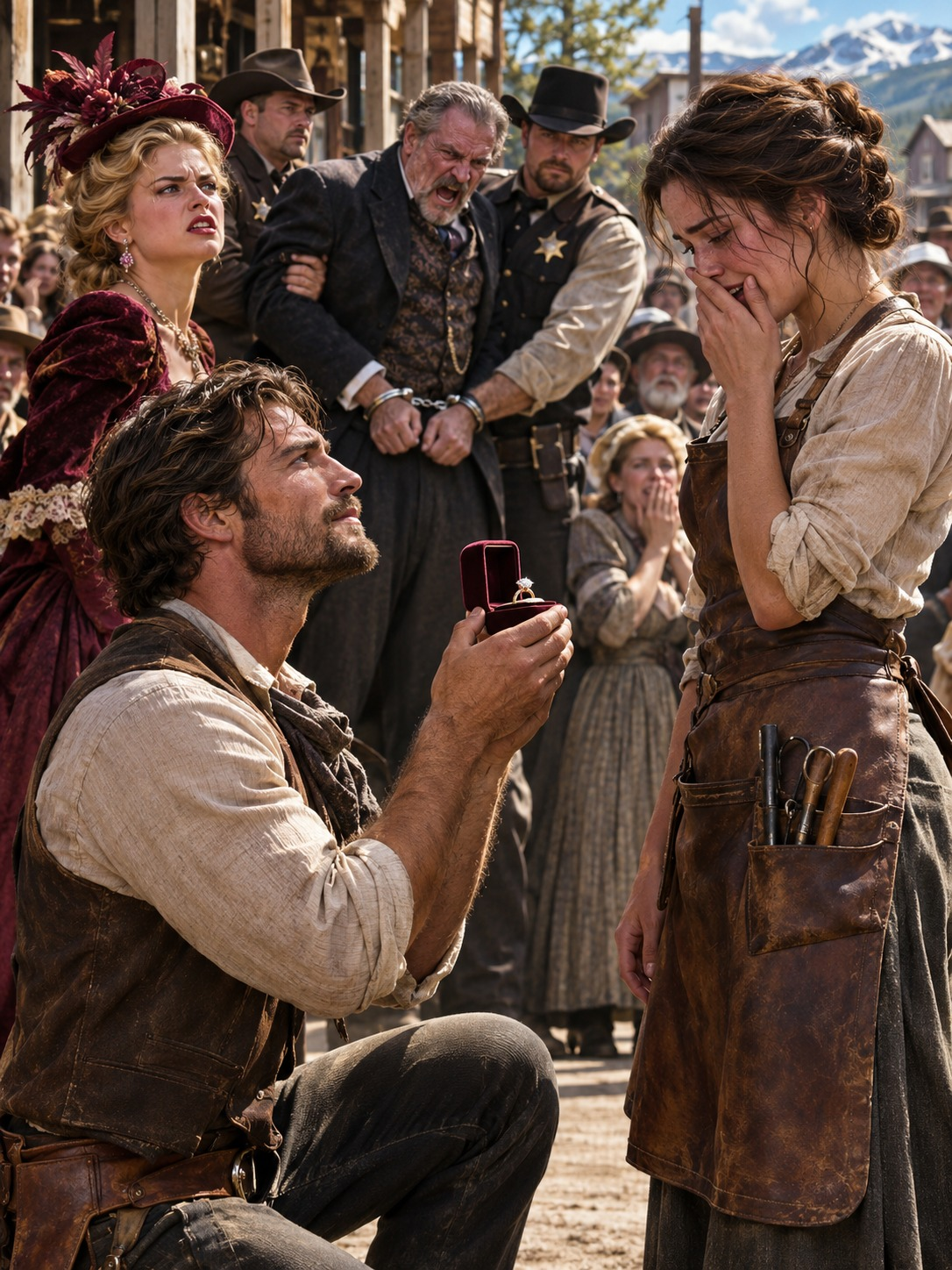
"Get your hands off my mother's property papers!" Eleanor Whitmore shouted as a stranger tried to pull a folded document from her workbench.
William Carter, the richest rancher in Wyoming, stepped through the doorway carrying a damaged leather saddle.
A small red stamp on the document caught his attention.
PAST DUE.
But beneath the stamp was a date that had not yet arrived.
Someone was trying to take Eleanor's land before the debt even existed.
The stranger released the paper.
Eleanor snatched it back and pressed it flat against the workbench.
"Out," she said.
The man looked toward William, apparently expecting the wealthy rancher to intervene.
William said nothing.
"Miss Whitmore, I'm only delivering a notice from Marsh County Bank," the stranger protested.
"You delivered it yesterday."
"And Mr. Marsh expects an answer."
"Then tell Mr. Marsh he can wait until the date printed on his own notice."
The man's face hardened.
"You ought to be careful how you speak about people who own half this town."
Eleanor folded the document.
"And you ought to learn the difference between delivering a letter and stealing one."
The stranger looked at William again.
This time, the rancher spoke.
"You heard the lady."
The man hesitated.
William did not raise his voice.
He simply stood beside the doorway, broad-shouldered and motionless, holding the damaged saddle beneath one arm.
Something about his expression persuaded the messenger that the conversation was over.
The man left.
Eleanor waited until his footsteps faded along the wooden boardwalk before turning back to her work.
"Can I help you?"
William glanced at the folded document.
"Trouble?"
"Not yours."
"Fair enough."
He placed the saddle on the counter.
Eleanor studied it.
Then she looked at him.
"How long have you been riding with this?"
"About six years."
"Not the saddle. The broken stitching."
William frowned.
"Didn't know it was broken."
"That answers my question."
She turned the saddle over and ran her fingers along the worn leather near the rear rigging.
William watched her work.
He was accustomed to people recognizing him immediately.
In Red Hollow, his name opened doors before he reached them.
Bankers stood when he entered a room.
Merchants remembered his preferences.
Men who disliked him still smiled when they shook his hand.
Women from wealthy families had spent years arranging accidental meetings with him.
But Eleanor Whitmore had barely looked at his face.
She was more interested in a damaged piece of leather.
"You're William Carter," she said without looking up.
"I am."
"Then you can afford a better saddle."
William almost smiled.
"That's one way of looking at it."
"It's the correct way."
She pushed the saddle toward him.
"Ride with this saddle for another week, and it will come apart. Your horse will lose balance, you'll slide wrong, and you'll end up on the ground."
William examined the stitching.
"That serious?"
"Worse."
She pointed toward a narrow section beneath the leather flap.
"The rigging is separating. Someone repaired it badly, and the thread has been wearing through for months."
"My ranch hands check my equipment."
"Then whoever checked this needs better eyes."
William stared at her.
Most people in Wyoming would have been terrified to criticize an employee of Carter Ranch.
Eleanor seemed entirely unconcerned.
"A bad saddle doesn't care who you are," she continued. "If it fails when you're far from home, it can hurt you just as badly as anyone else."
William rested one hand on the counter.
"And you can fix it?"
"Yes."
"How long?"
"Three days."
"I need it tomorrow."
"Then you should have brought it three days ago."
He laughed.
It surprised him.
He could not remember the last time a stranger had spoken to him so plainly.
"Do you always talk to customers this way?"
"Only the ones who ask questions."
"That must be most of them."
"Unfortunately."
She reached for a pencil.
"Name?"
William raised an eyebrow.
"You already know my name."
"I know what people call you. I need a name for the repair ticket."
"William Carter."
She wrote it down.
"Deposit is two dollars."
He reached into his pocket and placed a five-dollar gold piece on the counter.
Eleanor looked at it.
Then at him.
"Two dollars."
"Keep the change."
"No."
"Why not?"
"Because the work costs two dollars today. The balance is due when you collect it."
William slowly retrieved the coin.
He replaced it with the correct amount.
For the first time that morning, Eleanor gave him a small nod.
"Thank you, Mr. Carter."
He studied her for another moment.
Her copper-red hair was loosely braided over one shoulder. A faded sage-green blouse showed signs of careful mending near the cuffs. Her tan leather apron was scratched and darkened from years of work.
Her hands were strong.
Her nails were short.
There was a faint scar across one knuckle.
Nothing about her suggested the polished elegance expected of a woman seeking the attention of Wyoming's wealthiest rancher.
And yet William found himself reluctant to leave.
"Who taught you this trade?"
"My mother started teaching me when I was twelve."
"She still work here?"
"No."
The answer was quiet.
William understood.
"I'm sorry."
Eleanor returned to examining the saddle.
"She was good at what she did."
"Sounds like she taught you well."
"She taught me not to make promises I couldn't keep."
William looked at the saddle.
"Three days, then."
"Three days."
He picked up his hat.
As he approached the doorway, Eleanor called after him.
"Mr. Carter?"
He turned.
"Yes?"
"Don't ride your horse with a loose replacement saddle while you wait. Check the rigging first."
William smiled.
"I'll remember that."
"See that you do."
He stepped outside.
And for reasons he could not explain, the richest man in Red Hollow walked away feeling as though he had just met someone far more interesting than anyone who had attended his last dozen dinner parties.
By noon, three people had already stopped Eleanor on the street to ask why William Carter had visited her shop.
The first was Mrs. Abigail Porter, who owned the bakery.
The second was Thomas Bell, a ranch hand who occasionally brought Eleanor damaged harnesses.
The third was a woman Eleanor had spent years trying to avoid.
Virginia Marsh.
Virginia arrived wearing an expensive midnight-blue velvet dress that looked entirely unsuited to a dusty frontier street.
Her black hair was arranged beneath a feathered hat.
White gloves covered her hands.
She entered Eleanor's shop without knocking.
"Eleanor."
"Virginia."
"I heard William Carter was here."
Eleanor continued stitching a leather strap.
"He was."
Virginia waited.
When Eleanor offered nothing else, she stepped closer.
"Why?"
"He needed something repaired."
"What?"
"A saddle."
Virginia glanced around the shop.
The shelves were lined with leather straps, buckles, tools, and unfinished harnesses.
A narrow wooden staircase led to Eleanor's small living quarters above the workshop.
There were no silk curtains.
No expensive furniture.
No decorations intended to impress visitors.
Virginia wrinkled her nose.
"Surely William has people at his ranch who can handle something as simple as a saddle."
"Apparently not this one."
Virginia's smile tightened.
"You know, Eleanor, some women might misunderstand a visit like that."
Eleanor pulled the thread through the leather.
"Then those women should ask better questions."
"I'm trying to be kind."
"Are you?"
Virginia's eyes hardened.
"My father has always been generous to people in this town."
Eleanor stopped stitching.
"Your father runs a bank."
"A very successful bank."
"That doesn't make him generous."
Virginia stepped closer.
"You should remember who helped your mother keep this place when business was difficult."
"My mother paid every dollar she owed."
"With help."
"With work."
For a moment, neither woman spoke.
Virginia looked toward the folded bank notice lying near the counter.
Her expression changed.
"So you've received Father's letter."
"Yes."
"Then you understand how serious things have become."
"I understand that the date on the notice is wrong."
Virginia gave a short laugh.
"Do you really intend to argue over a date?"
"When someone threatens to take my property, yes."
"Eleanor, you cannot fight people like my father."
"Then he should stop looking for a fight."
Virginia's smile vanished.
"You think because William Carter walked into this miserable little shop, your life is about to change?"
Eleanor looked directly at her.
"No."
"Good."
"I think my life will change when people stop interrupting my work."
Virginia's cheeks flushed.
She turned toward the door.
Before leaving, she paused.
"William Carter will marry a woman worthy of his position. You would do well to remember that."
Eleanor returned to her stitching.
"Close the door behind you."
Virginia slammed it.
The sound rattled the glass.
Eleanor sat motionless for several seconds.
Then she put down her needle.
She unfolded the bank notice again.
Her mother's name appeared near the top.
Margaret Whitmore.
Below it was the description of the small parcel of land on which the workshop stood.
The land had belonged to Eleanor's family for nearly twenty years.
Her mother had bought it when Red Hollow was little more than a muddy crossing surrounded by cattle trails.
She had worked through harsh winters, dry summers, illness, and poverty to keep it.
When Margaret died, she left Eleanor three things.
The workshop.
Her tools.
And a promise.
"Never let anyone convince you that honest work makes you less than they are."
Eleanor could still hear her mother's voice.
She folded the letter carefully.
Then she reached beneath the counter and removed a small wooden box.
Inside were her mother's original property documents.
She examined them for the third time that week.
The boundaries were clear.
The ownership was clear.
The signatures were clear.
Yet Vance Marsh had begun insisting that an old financial obligation remained unresolved.
Eleanor knew her mother had settled that obligation years earlier.
She remembered the day.
Margaret had returned home carrying a receipt, laughing and crying at the same time.
"We're free, Ellie," she had said.
But the receipt was missing.
Eleanor had searched every drawer and box in the workshop.
She had found nothing.
And without that receipt, Vance Marsh was beginning to act as though the land belonged to him.
William Carter returned to his ranch that afternoon with an unexpected problem.
He could not stop thinking about Eleanor Whitmore.
His foreman, Samuel Briggs, noticed immediately.
Samuel was fifty-three, broad-faced, and had worked for the Carter family since William was a boy.
He watched William examine a replacement saddle for the fourth time.
"Something wrong with that one too?"
"Checking the rigging."
Samuel grunted.
"Been checking saddles for thirty years."
"Apparently we missed something."
"Who told you that?"
"Miss Whitmore."
Samuel looked up.
"Margaret's girl?"
"You know her?"
"Everybody knows Eleanor."
William adjusted the leather strap.
"What do you know about her?"
Samuel leaned against the stable door.
"Hard worker. Doesn't cheat. Doesn't complain much. Fixes things other people throw away."
"Anything else?"
Samuel studied him.
"Why?"
"Just asking."
"Her mother was a fine woman. Tough as old boot leather. Taught that girl everything she knew."
William nodded.
"And the father?"
"Left when Eleanor was little. Margaret raised her alone."
"Does she have family nearby?"
"None that I know of."
Samuel paused.
"She's been having trouble with Marsh."
William turned.
"What kind of trouble?"
"Bank trouble."
"How much?"
"Don't know. Heard he's trying to get his hands on her property."
William's expression darkened.
"Why?"
"That little strip of land sits right beside the road leading to the new freight depot. Worth more now than it used to be."
William considered that.
"Marsh has been buying property near the depot."
"Sure has."
"Did Eleanor borrow money from him?"
"Her mother did, years back. Folks said she paid it off."
"Then why is he bothering Eleanor?"
Samuel shrugged.
"Vance Marsh doesn't need a reason when he sees something he wants."
William said nothing.
He remembered the messenger in Eleanor's shop.
The way the man had tried to take her papers.
The way Eleanor had refused to back down.
Samuel watched him.
"William?"
"Yes?"
"Whatever you're thinking, be careful."
William looked at him.
"About what?"
"That girl has spent her whole life standing on her own feet. She won't thank you for treating her like somebody who needs carrying."
William considered the warning.
Then he smiled faintly.
"That much I already figured out."
The following morning, Virginia Marsh arrived at Carter Ranch in a polished carriage.
William was reviewing cattle records in his office when Samuel announced her.
"Miss Marsh is here."
William sighed.
"Did she say why?"
"Something about an invitation."
"Of course."
Virginia entered moments later.
Her expression brightened when she saw him.
"William!"
"Virginia."
"I hope I'm not interrupting."
"I was working."
"Then I'll only take a moment."
She placed an envelope on his desk.
"Father is hosting a dinner next Saturday. Several important families will attend."
William glanced at the invitation.
"Thank you."
"We were hoping you might come."
"I have cattle arriving from Montana."
"Surely your foreman can handle that."
"My foreman has enough to do."
Virginia moved closer.
"William, you cannot spend your entire life hiding behind ranch work."
He looked up.
"I'm not hiding."
"Then why do you keep refusing invitations?"
"Because I don't enjoy them."
Virginia laughed lightly.
"You're impossible."
"So I've been told."
She noticed the repair ticket lying on his desk.
ELEANOR WHITMORE — SADDLE REPAIR.
Her expression changed.
"You've been visiting that leatherworker."
William followed her gaze.
"Yes."
Virginia's voice became carefully casual.
"People are talking."
"People usually are."
"She's not the sort of woman you should encourage."
William set down his pen.
"Encourage?"
"You know what I mean."
"No, Virginia. I don't."
She hesitated.
"Girls like Eleanor sometimes misunderstand kindness from men in your position."
William leaned back.
"Has Eleanor said something to you?"
"Not exactly."
"Has she asked me for money?"
"No."
"Has she asked me for favors?"
"No."
"Has she asked me for anything at all?"
Virginia's jaw tightened.
"William, I'm trying to protect you."
"From a woman repairing my saddle?"
"From embarrassment."
The room became quiet.
William looked at Virginia for a long moment.
"Miss Whitmore has treated me with more honesty in ten minutes than most people manage in ten years."
Virginia's face flushed.
"You barely know her."
"That's true."
"Then you shouldn't defend her."
William stood.
"I don't need to know someone for years to recognize when they're being treated unfairly."
Virginia stepped backward.
She had never heard him speak to her this way.
"You're making a mistake."
"Possibly."
"Father won't like this."
William's expression cooled.
"Your father doesn't decide who I speak to."
Virginia gathered her gloves.
"One day you'll understand that some people simply don't belong in our world."
William walked to the office door.
"Good day, Virginia."
She stared at him.
Then she left without another word.
Three days after their first meeting, William returned to Eleanor's shop.
He arrived shortly after nine in the morning.
Eleanor was working behind the counter.
Without looking up, she said, "You're early."
"You said three days."
"And I said the saddle would be ready after noon."
William glanced at the clock.
"That you did."
She continued stitching.
He waited.
After several seconds, she looked up.
"Was there something else?"
"Actually, yes."
"What?"
"I wanted to ask whether you've eaten breakfast."
Eleanor blinked.
"Breakfast?"
"Yes."
"Why?"
"Because I haven't."
"There's a bakery two doors down."
"I know."
"Mrs. Porter makes excellent biscuits."
"I've had them."
Eleanor studied him.
William looked almost uncomfortable.
It was a strange expression on a man who owned thousands of acres and employed more people than Eleanor could count.
"Mr. Carter, are you asking me to breakfast?"
"I believe I am."
"Why?"
"Because I'd like to talk to you."
"About your saddle?"
"Not necessarily."
She placed her needle on the counter.
"People will talk."
"They already do."
"You don't understand."
"Then explain it."
Eleanor hesitated.
She could have told him about Virginia's visit.
About the bank notice.
About the way people in Red Hollow had spent years treating her as though poverty were a personal failure.
But she had no intention of inviting William Carter into her troubles.
"You're a wealthy man," she said.
"So I've heard."
"And I'm a leatherworker."
"I noticed."
"People will think I'm trying to get something from you."
William looked around the shop.
"Are you?"
"No."
"Then I suppose they'll be wrong."
Eleanor almost smiled.
Almost.
"You make everything sound simple."
"No. I just don't think other people's opinions should decide whether two people can share breakfast."
She studied him for a long moment.
Then she removed her apron.
"One hour."
William smiled.
"One hour."
"And you're paying for your own breakfast."
"Wouldn't dream of doing otherwise."
Mrs. Porter nearly dropped a tray of biscuits when William Carter walked into her bakery beside Eleanor Whitmore.
Within minutes, half the town knew.
By lunchtime, the story had grown.
Some claimed William had bought Eleanor a diamond necklace.
Others insisted he had promised to purchase her workshop.
One woman swore she had seen him kiss Eleanor's hand.
None of it was true.
They had eaten biscuits.
They had drunk coffee.
They had talked.
William learned that Eleanor loved horses but disliked crowded social gatherings.
He learned that her mother had taught her to repair saddles before she could properly write a business invoice.
He learned that she kept a small collection of books upstairs and read whenever she had time.
Eleanor learned that William had inherited the Carter Ranch at twenty-six after his father's death.
She learned that he had spent years rebuilding the ranch after a disastrous winter killed hundreds of cattle.
She learned that wealth had brought him more suspicion than happiness.
And she learned something that surprised her.
William Carter listened.
He did not interrupt.
He did not turn every conversation toward himself.
He did not treat her opinions as amusing little observations from someone beneath him.
When she spoke, he paid attention.
By the time they returned to the shop, Eleanor was beginning to understand why so many women wanted his attention.
But she also understood something they might not.
William Carter was lonely.
Not because he lacked company.
Because almost everyone who approached him wanted something.
At the workshop door, he stopped.
"Thank you for breakfast."
"You paid for your own."
"I meant the company."
Eleanor looked down.
"You're welcome."
"Would you consider doing it again?"
She hesitated.
Then she answered honestly.
"Perhaps."
William nodded.
"I'll take perhaps."
He tipped his hat and walked away.
Eleanor watched him go.
For the first time in years, she caught herself smiling at absolutely nothing.
Then she remembered the bank notice.
The smile disappeared.
That evening, Vance Marsh sat behind his enormous oak desk while Virginia paced across the carpet.
"He took her to breakfast," she said.
Vance looked up from his ledger.
"Who?"
"William Carter."
"And?"
"With Eleanor Whitmore."
Vance stopped writing.
For several seconds, he said nothing.
Then he closed the ledger.
"Are you certain?"
"Half the town saw them."
Vance leaned back.
His gray mustache twitched.
"Interesting."
"Father, this isn't interesting. It's humiliating."
"Calm yourself."
"She's a nobody."
"Virginia."
"She repairs saddles. She lives above a shop. She has nothing."
Vance looked toward the window.
"Not quite nothing."
Virginia stopped pacing.
"What do you mean?"
"She has land."
"That miserable little property?"
"Land beside the freight road."
Virginia frowned.
"I thought you were handling that."
"I am."
"Then why does she still own it?"
Vance opened a drawer.
Inside was a folder bearing Margaret Whitmore's name.
He removed several documents and studied them.
"Because her mother was more careful than I expected."
Virginia approached the desk.
"Can you take it?"
Vance looked at her.
"Everything has a price."
"And if Eleanor refuses?"
"Then we'll make refusal expensive."
Virginia smiled for the first time that evening.
"Good."
But Vance did not smile.
He was studying an old signature.
Margaret Whitmore.
The woman had been dead for years.
Yet something about her paperwork still troubled him.
He turned to another page.
A notation appeared in the margin.
PAYMENT RECEIVED IN FULL.
Vance stared at the words.
Then he reached for his pen.
Across town, Eleanor was closing the workshop when she heard footsteps outside.
She looked through the window.
The street was nearly empty.
A man stood beneath the wooden awning.
He wore a dark coat and carried a leather satchel.
Eleanor opened the door a few inches.
"Can I help you?"
"Miss Whitmore?"
"Yes."
"I was told to deliver this personally."
He handed her a sealed envelope.
The paper was thick.
The wax seal bore the initials V.M.
Vance Marsh.
Eleanor's stomach tightened.
"What is it?"
"Official notice."
"From the bank?"
"Yes."
She opened the envelope.
Inside was a document demanding immediate payment of an alleged outstanding debt secured against her mother's property.
The amount was nearly three times what her mother had originally borrowed.
Eleanor read the page twice.
"This is impossible."
The messenger said nothing.
"My mother paid this loan."
"Then you'll need to prove it."
"I have the property deed."
"The bank is questioning the validity of the final settlement."
Eleanor looked up.
"On what grounds?"
"You'll have to speak with Mr. Marsh."
She examined the notice again.
At the bottom was a deadline.
Forty-eight hours.
If payment was not made, the bank would begin proceedings against the property.
Eleanor felt a cold pressure settle in her chest.
"Forty-eight hours?"
"That's correct."
"This is not legal."
"I'm only the messenger."
She folded the paper.
"Tell Mr. Marsh I'll be there tomorrow."
The man nodded and walked away.
Eleanor locked the door.
For several minutes, she stood motionless.
Then she climbed the narrow staircase to her room.
She knelt beside her mother's old wooden trunk and opened it.
Inside were letters, photographs, faded dresses, and a small Bible.
Eleanor searched through everything.
She found receipts for leather purchases.
Old business invoices.
Tax records.
A photograph of her mother standing proudly outside the newly opened workshop.
But not the missing bank receipt.
She sat back on her heels.
"Where did you put it, Mama?"
Her voice sounded small in the quiet room.
She hated that.
She had promised herself years ago that she would never allow fear to make her helpless.
But now the land her mother had sacrificed everything to protect was in danger.
And the man threatening it controlled the only bank in the county.
Eleanor looked at the photograph again.
Margaret Whitmore stood beside the workshop door, one hand resting on a leather saddle.
Behind her was a handwritten sign.
WHITMORE LEATHER REPAIR.
Eleanor turned the photograph over.
There was a message in her mother's handwriting.
For my Ellie. Never surrender what you have earned.
Below the message was something else.
A small number.
17.
Eleanor frowned.
She had never noticed it before.
She examined the photograph more closely.
Then she remembered an old wooden cabinet downstairs.
Seventeen narrow drawers.
Her mother had used it to store metal buckles, sewing needles, and saddle fittings.
Eleanor hurried down the staircase.
She crossed the workshop.
The cabinet stood beneath the rear window.
She counted the drawers.
One.
Two.
Three.
She reached the seventeenth.
It was locked.
Eleanor stared at it.
She had never known her mother to lock a drawer containing ordinary tools.
She searched the nearby shelves.
No key.
She returned to the cabinet and pulled gently on the handle.
Nothing.
Then she noticed a narrow scratch beneath the brass lock.
Someone had tried to open it before.
Recently.
Eleanor's pulse quickened.
She reached for a small screwdriver.
Before she could touch the lock, three heavy knocks struck the workshop door.
She froze.
Another knock.
Then a man's voice came from outside.
"Miss Whitmore?"
Eleanor recognized the voice.
It belonged to Vance Marsh.
She slowly turned toward the door.
The banker had never visited her workshop at night.
Not once.
"Eleanor," he called again. "I know you're in there."
She glanced at the locked drawer.
Then toward the front window.
A dark carriage waited outside.
Two men stood beside it.
Vance spoke again.
"I believe you found something that belongs to my bank."
Eleanor's fingers tightened around the screwdriver.
She looked back at drawer seventeen.
The brass lock shifted.
A faint click sounded from inside the cabinet.
And the drawer began to open.






Comments 0