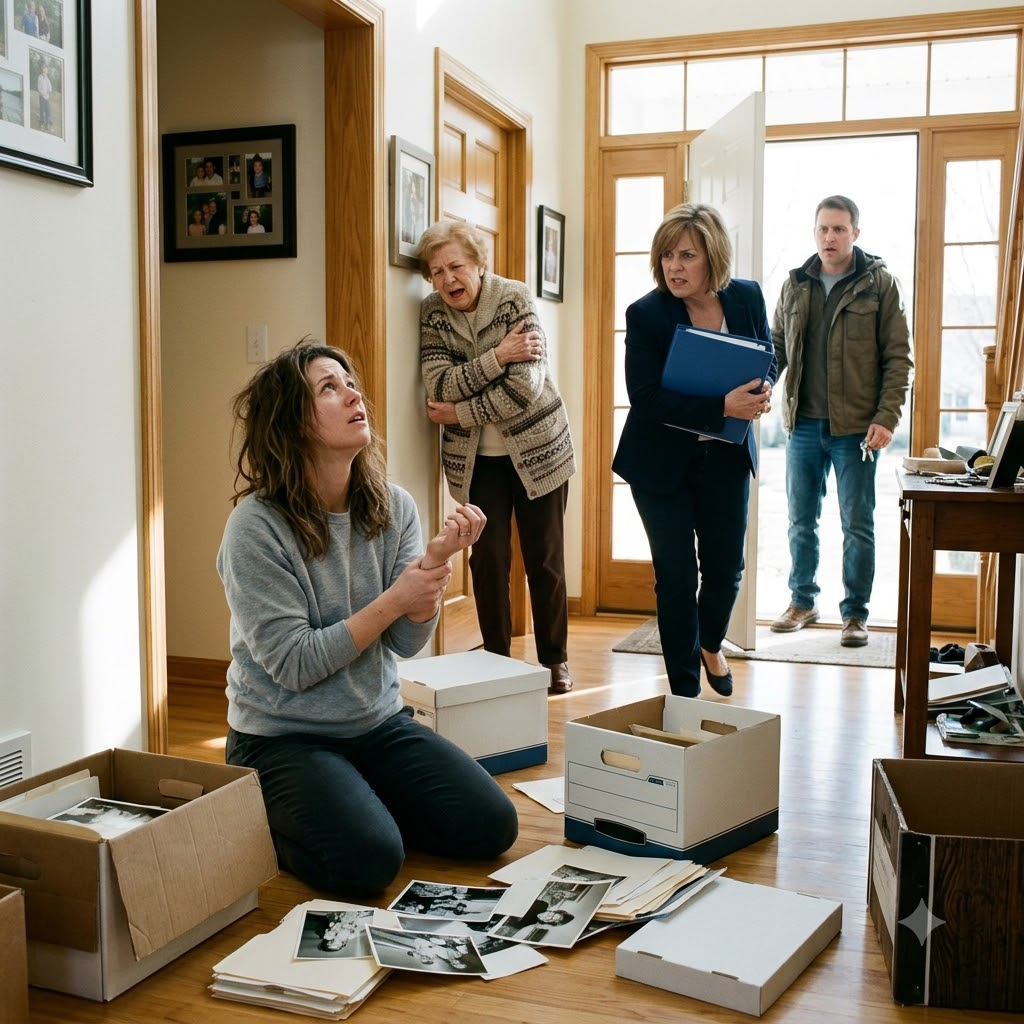
"Harleen... you need to see this."
Reed held his mother's phone toward me, but his hand was shaking so badly that the words blurred across the screen.
I took one step closer.
The message was from Evelyn Price, the director of the Beaver Valley Historical Museum.
"The airport plan failed. Do not let Harleen get access to the ledger. If the police find what is under the felt, we're finished."
For a moment, I forgot how to breathe.
Not because I was surprised that Christa had an accomplice.
I had already suspected that.
But because Evelyn Price was the woman who had personally approved my promotion, praised my integrity in front of the museum's board, and trusted me with the most sensitive historical records in our collection.
She had looked me in the eye just two weeks earlier and promised to help me find whoever was stealing artifacts from Drawer 14.
Now her name was glowing on my mother-in-law's phone.
And she was discussing how to keep evidence away from the police.
"Give me that!"
Christa lunged toward Reed.
He instinctively pulled the phone away.
"Mom, stop!"
Her hand caught his sleeve.
"That's private!"
Reed stared at her.
"Private?"
His voice cracked.
"You're talking to Harleen's boss about some airport plan!"
Christa's eyes darted toward Sergeant Okafor.
Then toward me.
I knew what she was thinking.
She was wondering how much we had seen.
How much we understood.
And whether she still had time to change the story.
"Reed," she said, forcing her voice to soften, "you don't understand the context."
"Then explain it."
"I can't."
"Why not?"
"Because there are things happening that you don't know about."
I watched my husband's expression change.
For years, that sentence had been enough to silence him.
His mother would tell him that something was complicated, that people were being unfair, that he needed to trust her.
And Reed would trust her.
But now he was holding proof that she had been communicating with the woman responsible for my museum career.
He looked at the message again.
"What ledger?"
Christa didn't answer.
"What airport plan?"
Still nothing.
Then he asked the question that made her face go completely white.
"Did you put a gun in my wife's suitcase?"
The silence that followed seemed to stretch forever.
Dot made a small sound from her chair.
Officer Bennett moved closer to her.
Christa looked at Reed as though he'd betrayed her.
"How could you even ask me that?"
"Because I need an answer!"
His voice rose.
"Did you?"
Christa pressed one hand against her chest.
"I have spent my entire life taking care of this family."
"That's not an answer."
"I raised you by myself after your father left."
"Mom."
"I sacrificed everything for you."
"Mom!"
His voice echoed through the hallway.
Christa flinched.
I had never heard Reed speak to his mother like that.
Not once.
For a brief moment, I felt something close to relief.
Then I remembered that he had shouted at me with exactly the same intensity less than an hour earlier.
The difference was that I had been kneeling on the floor with an injured wrist.
Christa was standing upright, defending herself.
I wasn't ready to feel sorry for either of them.
Sergeant Okafor stepped forward.
"Mr. Mercer, please don't delete or alter anything on that phone."
Reed looked at him.
"I wasn't going to."
"Good. And please stop scrolling for the moment."
Christa immediately reached toward the device.
"It's my property."
Okafor nodded.
"Yes, ma'am. We're not going to conduct an unauthorized search of your phone. But everyone here has now seen a message that may be relevant to an active investigation."
Christa's mouth tightened.
"I want a lawyer."
"That's your right."
"I haven't done anything wrong."
Okafor didn't respond to that.
Instead, he turned toward me.
"Mrs. Mercer, I'd like you to tell me exactly what happened last night, from the beginning."
I looked toward the staircase.
My mind went back to the sound that had awakened me.
The soft pressure of feet against the hallway floor.
The faint scrape of a bedroom door.
And the clock beside my bed.
12:12 AM.
I could still see those glowing red numbers.
I had stared at them while pretending to sleep.
Because the moment I heard Christa outside my bedroom, something inside me had warned me not to move.
I didn't understand that instinct at the time.
Now I was grateful I'd listened.
The night before, I had gone upstairs at 10:30.
My flight to Chicago was scheduled for 7:40 the following morning.
I was supposed to attend a national museum conference, where I would give a presentation about the importance of accurate collection records.
The irony of that presentation would haunt me for a long time.
I had spent nearly three weeks preparing it.
My slides were finished.
My notes were printed.
My blazer was folded neatly inside my carry-on.
And I had checked my museum files one final time before going to bed.
Christa had been unusually friendly that evening.
She made tea.
Asked whether I needed a ride to the airport.
Offered to prepare breakfast.
She even complimented the forest-green sweater I had laid across the back of the guest-room chair.
"You always look so professional," she'd said.
At the time, I thought she was making an effort.
Reed and I had been married long enough for me to understand that his mother and I would never be close.
But I had hoped we could eventually become comfortable around each other.
That hope had survived years of small humiliations.
Christa criticizing my cooking.
Christa questioning why I worked late.
Christa suggesting that a woman who cared so much about old objects probably wasn't interested in having children.
I had learned to ignore most of it.
Reed always said she didn't mean anything by her comments.
"That's just Mom," he'd tell me.
I used to accept that explanation.
Now I wondered how many warning signs I had dismissed because I wanted peace.
At 11:00, I checked on Reed downstairs.
He was lying on the basement sofa with a heating pad against his lower back.
He had strained himself setting up folding tables for Dot's eightieth birthday celebration.
"Don't forget your alarm," he murmured.
"I won't."
"Call me when you land."
"I will."
He reached for my hand.
"Love you."
"Love you too."
I kissed his forehead.
Then I went upstairs.
I remember that moment with painful clarity.
Because it was the last time I felt completely safe in that house.
I fell asleep shortly afterward.
Then, at 12:12, I heard the footsteps.
Christa had a distinctive way of walking when she thought no one was watching.
She placed her weight on the outer edges of her feet.
It made her steps unusually quiet.
But it also produced a faint, uneven shuffle on the hardwood.
I recognized it immediately.
The guest-room door opened.
I kept my eyes closed.
For several seconds, nothing happened.
Then I heard her move toward the foot of the bed.
My suitcase stood beside a small upholstered chair.
I had zipped it shut before going to sleep.
The zipper was stiff.
I knew because I'd struggled with it while packing.
Christa began opening it.
Slowly.
One tooth at a time.
I lay completely still.
My heart started pounding.
At first, I thought she was searching through my clothes.
Maybe looking for something she could criticize.
Maybe trying to find evidence that I was hiding money from Reed.
It seemed ridiculous.
But I had seen her invade smaller boundaries before.
Then I heard something drop.
A dull, heavy sound.
Not loud enough to wake someone downstairs.
But unmistakable.
Metal against fabric.
Christa paused.
I heard her breathing.
Then the zipper moved again.
There was a faint rustling of paper.
Something small being tucked into the bag.
A few seconds later, she closed the suitcase.
I wanted to sit up.
I wanted to demand an explanation.
But something stopped me.
Perhaps it was the care she'd taken to remain silent.
Perhaps it was the fact that she had entered my room after midnight.
Or perhaps it was simply the knowledge that innocent people don't usually sneak objects into someone else's luggage while they sleep.
Christa moved toward the doorway.
Then her phone made a faint sound.
She answered immediately.
"It's in her carry-on," she whispered.
I stopped breathing.
"Tip off airport security at six."
A pause.
Then she added, "Make sure they search the inner pocket."
My skin went cold.
She ended the call.
The door closed.
I stared into the darkness.
I wanted to believe I'd misunderstood.
I wanted to believe she had been talking about something harmless.
But I knew what I'd heard.
I checked the clock.
12:14.
Then I waited.
Twenty minutes.
Twenty agonizing minutes while every sound in the house seemed amplified.
The refrigerator humming downstairs.
The furnace turning on.
A car passing outside.
The faint creak of old floorboards.
At 12:34, I finally moved.
I reached for a tissue from the nightstand.
My hands were shaking.
I didn't know what Christa had placed in my bag.
But I knew enough about evidence handling to avoid touching it unnecessarily.
I used the tissue to pull the zipper.
Then I turned on my phone flashlight.
The inner pocket was slightly open.
I aimed the light inside.
And saw black metal.
For one terrible second, my mind refused to identify it.
Then the shape became clear.
A handgun.
Compact.
Black.
Heavy-looking.
Resting on top of my folded blazer.
I stumbled backward.
My shoulder struck the bedframe.
I clapped a hand over my mouth.
I had never owned a gun.
I had never handled one.
And I certainly had never packed one for a flight.
I stared at the suitcase.
The entire plan suddenly became obvious.
An anonymous tip.
An airport security search.
A firearm discovered in my carry-on.
My name in a police report.
My career destroyed before I even reached Chicago.
But something still bothered me.
Why would Christa go to such lengths merely to embarrass me?
Why risk planting a gun?
Why involve airport security?
I forced myself to look again.
Without reaching into the pocket, I angled my phone light farther inside.
Behind the mesh charger pouch, I saw white tissue paper.
The corner had been folded carefully.
Exactly the way museum staff folded protective tissue around small metal objects.
My stomach tightened.
I recognized the shape before I saw the artifact.
A small, curved object.
About two inches long.
I moved the light.
A bronze Roman brooch.
The decorative pin had a distinctive raised ridge along its center.
I had examined that exact brooch dozens of times.
It belonged to Drawer 14 of the Beaver Valley Historical Museum's study collection.
And it had been reported missing the previous month.
I felt dizzy.
I leaned against the bed.
The gun was bad enough.
But the brooch changed everything.
Someone wasn't merely trying to get me arrested at an airport.
Someone was trying to make me look like the person stealing artifacts from my own museum.
I looked closer.
The accession number on the back had been scraped away.
A pale, uneven scar marked the bronze where the identification had once been.
I knew that mark.
I had described it in my missing-item report.
The brooch was one of three artifacts that had disappeared from the same drawer.
And the only people who knew the exact details of those reports were museum staff with access to the collection database.
I sat on the edge of the bed.
My thoughts raced.
Christa had planted the objects.
But where had she obtained the brooch?
She had no reason to visit the museum's restricted study collection.
She didn't work there.
She wasn't a volunteer.
She wasn't a donor.
She had never shown any serious interest in Roman history.
Someone had given it to her.
Someone who knew what it was.
Someone who understood that finding it in my luggage would make me look guilty.
I stared at the phone in my hand.
My first instinct was to call Reed.
Then I remembered Christa's words.
"Tip off airport security at six."
There was another person involved.
Possibly more than one.
And I had no idea who I could trust.
I opened the camera on my phone.
Carefully, without touching the objects, I photographed the open pocket.
The handgun.
The white tissue.
The visible edge of the brooch.
Then I took a wider photograph showing the suitcase beside the guest-room chair.
I checked the time.
12:41 AM.
I sent the photographs to a private email account I used for personal records.
Then I sat in the dark.
I didn't sleep again.
"Harleen?"
Sergeant Okafor's voice brought me back to the hallway.
I blinked.
He was watching me carefully.
"Are you all right?"
I nodded.
"I was remembering the suitcase."
He glanced at his notebook.
"You said you photographed the contents before bringing the luggage to the station?"
"Yes."
"Do you still have those photographs?"
"Yes."
"Good."
Reed stood beside the console table.
His face looked drained of color.
He had listened without interrupting.
For once, his mother hadn't interrupted either.
Christa stood near the stairs with her arms folded tightly across her chest.
Her expression was unreadable.
But her eyes never left my phone.
Reed finally spoke.
"Why didn't you wake me?"
I looked at him.
"I was afraid."
His face tightened.
"Of me?"
"No."
I paused.
"Of what might happen if your mother knew I'd found the gun."
He looked toward Christa.
She immediately shook her head.
"Reed, this is absurd."
He didn't answer.
I continued.
"I didn't know whether you would believe me. And I couldn't risk having someone remove the objects before the police saw them."
Reed rubbed his forehead.
"I would have helped you."
I wanted to believe that.
But the memory of him shouting at me while I knelt on the floor was still too fresh.
"You didn't help me this morning," I said.
He looked away.
Christa seized the opportunity.
"Because he saw what happened to his grandmother!"
Dot lifted her head.
"Christa, stop."
Everyone turned.
The old woman was sitting straighter now.
Her hands still trembled, but her eyes were clear.
"I never said Harleen hurt me."
Christa stared at her.
"Mother—"
"No."
Dot's voice cracked.
"I am tired of being told what I saw."
Reed moved toward her.
"Grandma, what do you mean?"
Dot looked at him.
Then at me.
"I heard your mother outside Harleen's room last night."
Christa's expression hardened.
"We've already discussed that."
Dot ignored her.
"And this morning, when Harleen came back, Christa was waiting for her."
My heart began pounding again.
"What happened?" I asked.
Dot swallowed.
"She was angry."
Christa stepped forward.
"That's enough."
Officer Bennett raised one hand.
"Mrs. Mercer, please let her speak."
Dot took a shaky breath.
"She wanted to know what Harleen had told the police."
Reed turned toward his mother.
"How did you know she'd gone to the police?"
Christa said nothing.
Dot continued.
"Harleen said she had reported the gun."
I remembered that conversation.
Christa had been standing near the console table.
She had looked furious.
Not frightened.
Furious.
As though I had ruined something important.
"She said Harleen had destroyed everything," Dot whispered.
The hallway went silent.
I stared at Christa.
She looked away.
Reed's voice was barely audible.
"Mom?"
Christa closed her eyes.
Then she opened them and looked directly at him.
"You don't understand what was at stake."
My stomach dropped.
It was the closest thing to an admission I'd heard from her.
Sergeant Okafor straightened.
"What was at stake, Mrs. Mercer?"
Christa looked at him.
Then at Reed.
Then at me.
For one brief moment, I thought she might finally tell the truth.
Instead, she said, "My family."
I felt a cold anger settle inside me.
"My career was at stake," I said.
Christa looked at me.
"My freedom was at stake."
She pressed her lips together.
"You put a gun in my suitcase."
"Prove it."
The words came out before she could stop them.
Reed stared at her.
So did the officers.
Christa seemed to realize what she'd said.
She quickly added, "I mean, you can't simply accuse someone without evidence."
But the damage was done.
I looked at her.
For years, I'd wondered why she seemed to enjoy making me uncomfortable.
Why she always found ways to undermine me.
Why every achievement I celebrated somehow became an opportunity for criticism.
Now I understood something.
This wasn't ordinary jealousy.
This was fear.
She had been afraid of what I might discover.
And the missing museum artifacts had brought that fear to the surface.
I turned toward Sergeant Okafor.
"There's something I haven't mentioned yet."
He looked up.
"What is it?"
"The gun wasn't the only thing that seemed carefully placed."
I opened the photographs on my phone.
"The brooch was wrapped in museum tissue. But it wasn't wrapped the way I would have wrapped it."
He studied the image.
"What do you mean?"
"At the museum, we use a specific folding method for small metal artifacts. The tissue is folded around the object without applying pressure to delicate surfaces."
I enlarged the photograph.
"This wrapping was different."
"Different how?"
"The corners were folded inward, like someone wrapping a gift."
He nodded.
"And that matters because?"
"Because whoever wrapped it knew enough to use archival tissue, but not enough to handle the artifact correctly."
I looked toward Christa.
"Someone gave her the brooch already wrapped."
Her face remained still.
But I saw her fingers curl into her palms.
I continued.
"And whoever did that probably had access to our conservation supplies."
Reed looked at me.
"You're saying someone at the museum helped her?"
"Yes."
He looked down at his mother's phone.
Evelyn Price's name was still visible on the screen.
The silence grew heavier.
Then Sergeant Okafor spoke.
"Mrs. Mercer, I need you to understand that we'll have to verify all of this independently."
"I know."
"The photographs, the museum records, the messages, and the physical evidence will all need to be examined."
"I understand."
He nodded.
"But you've given us several specific leads."
For the first time that morning, I felt the smallest flicker of hope.
Not because the nightmare was over.
It wasn't.
But because someone was finally treating my words as information instead of excuses.
Reed sat down heavily on the edge of the console bench.
He stared at the floor.
Then he looked up.
"Harleen, I need to ask you something."
I waited.
"When you found the gun..."
His voice broke.
"Did you think I was involved?"
The question hurt more than I expected.
I looked at the man I'd married.
The man who had promised to stand beside me.
The man who had believed his mother's accusation without asking whether I was injured.
I could have lied.
I could have told him I never doubted him.
But I was tired of protecting people from the truth.
"I didn't know," I said.
He closed his eyes.
"That's not an answer."
"It's the only honest answer I have."
He nodded slowly.
Then he looked toward his mother.
"Mom, I want you to tell me everything."
Christa's expression changed.
She seemed to understand that Reed was no longer asking for reassurance.
He was asking for facts.
And facts were dangerous.
She took a step backward.
"I think we should wait for my attorney."
Sergeant Okafor nodded.
"That's your decision."
Christa glanced toward the stairs.
Then toward the front door.
I recognized that look.
She was searching for an exit.
Not necessarily from the house.
From the situation.
From the questions.
From the evidence.
Then her phone vibrated again.
This time, Reed was still holding it.
He looked down.
His face changed.
"Another message," he said.
Christa reached for the phone.
"Give it back."
Reed didn't move.
The notification appeared across the screen.
It was from Evelyn Price.
Only one sentence was visible.
"Tell me she didn't find the second pocket."
I felt every muscle in my body tighten.
The second pocket.
I stared at the words.
My suitcase had two inner compartments.
One held the handgun.
The other contained my charger pouch and the stolen brooch.
But there was another pocket.
A narrow, concealed compartment behind the suitcase lining.
I had forgotten about it.
I hadn't used it in years.
And I hadn't checked it that morning.
I looked at Sergeant Okafor.
"My suitcase is still at the police station, isn't it?"
He nodded.
"Yes."
I swallowed.
"Then you need to examine it again."
Reed stared at me.
"Why?"
I couldn't answer.
Because I didn't know what was hidden there.
I only knew that Evelyn Price was afraid I might find it.
And that meant whatever was inside could be more important than the gun.
More important than the brooch.
Possibly more important than the ledger itself.
Sergeant Okafor reached for his radio.
He gave a brief instruction to the station.
Then he waited.
Christa stood completely still.
Her face had lost all color.
For the first time, she wasn't looking at Reed.
She wasn't looking at the officers.
She was looking at me.
And there was something in her expression I had never seen before.
Not hatred.
Not contempt.
Fear.
Real fear.
A voice crackled through Okafor's radio.
"Sergeant, we located the concealed compartment."
My heart stopped.
Okafor straightened.
"Go ahead."
A pause.
Then the officer on the other end said,
"There's something inside. It appears to be a sealed envelope."
Christa made a small, strangled sound.
Reed turned toward her.
"Mom?"
She didn't answer.
The radio crackled again.
"Sergeant, there's writing on the front."
Okafor looked at me.
Then he pressed the button.
"Read it."
Another pause.
Longer this time.
Then the officer spoke.
"The envelope is addressed to Harleen Mercer."
I felt my knees weaken.
But the officer wasn't finished.
"Underneath her name, someone wrote a warning."
Okafor's voice remained steady.
"What warning?"
The response came slowly.
As though the officer couldn't quite believe what he was reading.
"IF HARLEEN FINDS THIS, DO NOT LET HER BOARD THE PLANE."
Reed stood up.
Christa grabbed the edge of the console table.
And before anyone could speak, the officer added one final sentence.
"Sergeant, there's something else written on the back."
Okafor raised the radio.
"What does it say?"
The line went silent.
Then came the words that made Christa reach for the front door.
"Sir... it's a name."
A sharp burst of static filled the hallway.
Then the officer began to read it aloud.






Comments 0