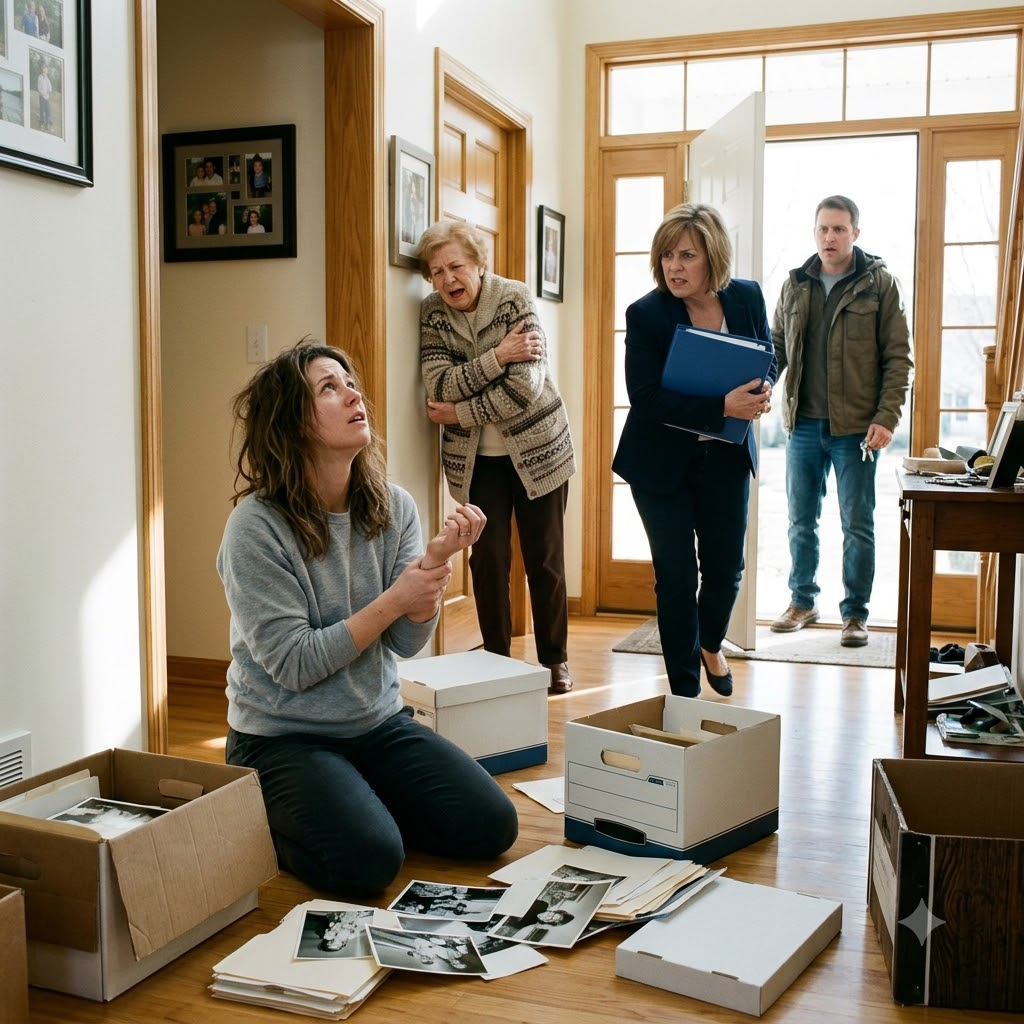
The elderly woman stood in Christa's doorway, holding a leather document case.
Lydia stood beside her.
Neither woman appeared frightened.
Both were waiting.
When Detective Mitchell showed me the photograph, I looked at Eleanor.
She was trembling.
"That's impossible," she whispered again.
I held her arm.
"Who is she?"
Eleanor stared at the screen.
Then she finally answered.
"Her name is Margaret Eleanor Mercer. She was my mother."
I looked at the photograph again.
The elderly woman had the same pearl necklace as the woman in the old family pictures. The same narrow face. The same scar above her eyebrow.
But there was something else.
Her eyes.
They were the same eyes I had seen in the mirror every morning for thirty-three years.
I felt my throat tighten.
"Why did everyone believe she was dead?"
Eleanor slowly sat down.
"Because she arranged her own disappearance."
I looked at her.
"Why?"
"To protect the collection. And to protect the children."
I shook my head.
"Then why did she allow all of this to happen?"
Eleanor looked at me with exhausted eyes.
"Because she believed that keeping everyone separated was the only way to prevent Thomas and Arthur from taking control of the family trust."
I looked toward Detective Mitchell.
"Can we go to Christa's house?"
Mitchell nodded.
"The officers have secured the property. We'll go together."
For the first time that night, I felt that we were finally approaching the truth.
Not another photograph.
Not another altered certificate.
Not another mysterious letter.
The actual truth.
And this time, nobody was going to take it away from me.
When we arrived at Christa's house, the front door was open.
Two officers stood outside.
Lydia was sitting on the living-room sofa.
Her hands were wrapped around a cup of tea.
The elderly woman sat opposite her.
Christa stood beside the fireplace.
Reed was nowhere to be seen.
I walked toward Lydia.
She looked up.
For several seconds, neither of us spoke.
Then she whispered, "Harleen."
I sat beside her.
"Are you all right?"
She nodded.
"I'm sorry."
"Why?"
"For not telling you sooner."
I studied her face.
"You knew?"
"Not everything. But I knew Christa had lied about my identity."
She looked down at her hands.
"I found some documents in her bedroom when I was nineteen. They mentioned a hospital, a baby, and a woman named Margaret."
I swallowed.
"Why didn't you tell anyone?"
"Because Christa threatened to send me away. She told me I had nowhere else to go."
I felt sadness settle in my chest.
"How long have you known?"
"Almost ten years."
She looked toward the elderly woman.
"She found me six months ago."
I turned.
The woman was watching us.
Her expression was surprisingly gentle.
"I am Margaret Mercer," she said. "And I owe you both an explanation."
I stood.
"Then tell us everything."
She nodded.
"Sit down, Harleen."
I remained standing.
"I've spent enough time sitting quietly while people decide what happens to my life."
She accepted that.
Then she began speaking.
Margaret explained that the Mercer family collection had originally belonged to her father.
She had inherited responsibility for its preservation, but Thomas had gradually taken control of the family business.
When she discovered that he was arranging private sales, she confronted him.
Thomas threatened to expose several family secrets.
One concerned his marriage to Elaine.
Another concerned his daughter, Margaret.
And the most dangerous involved the children born into the family.
Margaret had realized that Thomas intended to use the children's identities to establish control over the collection.
She disappeared before he could force her to sign the transfer documents.
Arthur Bell helped arrange her disappearance.
But Arthur had his own ambitions.
He wanted the collection for himself.
He began altering birth records, transferring artifacts, and creating false family documents.
Over time, Thomas and Arthur became enemies.
Both believed the other possessed the original agreement.
And both used the children as leverage.
I listened carefully.
"Then what happened to the babies?"
Margaret looked at me.
"Three girls were involved in the arrangement."
Evelyn had been born in 1982 to Margaret and Thomas.
Elaine had later given birth to two daughters.
One was Harleen.
The other was Lydia.
But Arthur altered the hospital records so that their identities could not easily be established.
I looked at Lydia.
She was crying silently.
Margaret continued.
"Evelyn was taken from me as a child. Arthur raised her under a different arrangement. Harleen was placed with Elaine and Robert. Lydia was raised under Christa's supervision."
I swallowed.
"Why did Christa agree?"
"Because Arthur promised her financial security."
Christa looked down.
"I thought I was helping a child who needed a home."
I turned toward her.
"You knew Lydia wasn't your daughter."
Christa nodded.
"Yes."
"And you never told her?"
"No."
I looked at Lydia.
She was staring at the floor.
I understood that no explanation could give her back the years she had lost.
But at least the lie had finally ended.
Detective Mitchell asked Margaret about the forged documents.
She explained that Thomas had arranged for several transfers using Reed's signature.
Reed had believed he was signing administrative paperwork.
Evelyn had handled the actual transactions.
Daniel Whitmore had witnessed several of them.
Christa had helped conceal the missing artifacts.
Arthur had created the false records.
And Margaret had been trying to recover the original agreement before the entire collection disappeared.
I looked at Christa.
"Was the gun your idea?"
She nodded.
"Yes."
My stomach tightened.
"Why?"
"Because Evelyn told me that you were going to expose the transfers."
"So you decided to frame me?"
Christa began crying.
"I thought if you were arrested, the investigation would stop."
"You thought I would spend years in prison?"
She shook her head.
"I didn't think it would go that far."
I looked at her.
"That is what people say when they don't want to accept responsibility."
She lowered her eyes.
I turned toward Mitchell.
"I want everything documented."
Mitchell nodded.
"It will be."
The investigation continued over the following weeks.
The firearm was traced to an illegal private purchase arranged through Daniel's contacts.
The bronze brooch was confirmed as stolen museum property.
The remaining artifacts were recovered from two private storage facilities.
The altered documents were examined by forensic specialists.
And the original family agreement was authenticated.
For the first time in decades, the truth existed in one official record.
Nobody could quietly change it again.
Evelyn was arrested two days later.
She had attempted to leave Pennsylvania after learning that the original documents had been recovered.
Police found her at a private storage facility.
Inside were several missing artifacts, financial records, and correspondence with Daniel.
Her arrest was the beginning of a much larger investigation.
Daniel eventually admitted his involvement in the transfers.
Arthur Bell was located through financial records connected to the property trust.
He had spent years using false identities and private accounts.
He was charged in connection with the forged documents, financial crimes, and the unlawful transfer of historical property.
Christa also faced charges for her role in planting the firearm and conspiring to frame me.
She eventually accepted responsibility.
She did not ask me to forgive her.
I respected that more than any apology she could have offered.
Margaret gave a complete statement.
She provided the investigators with the documents she had preserved and explained the original arrangement.
The authorities confirmed her identity through independent records and DNA testing.
The woman who had spent decades living under a different name was finally recognized as Margaret Mercer.
And the woman buried under Eleanor's name was identified as a victim of the original identity scheme.
The cemetery records were corrected.
The false death certificate was formally withdrawn.
For the first time, every person involved had a name that belonged to them.
The most difficult conversation was with Robert.
We met in a small café near the hospital.
He arrived early.
He had ordered coffee but hadn't touched it.
When I entered, he stood immediately.
"Harleen."
I sat opposite him.
For a moment, we simply looked at each other.
Then he said, "I know I owe you an apology."
I nodded.
"Yes."
He lowered his eyes.
"I should have told you."
"Why didn't you?"
"Your mother and I were afraid."
"Of Thomas?"
"Of everyone involved."
I looked out the window.
"I spent my entire life believing I knew where I came from."
Robert reached into his coat pocket.
He placed a small envelope on the table.
Inside was a photograph of Elaine holding me as a newborn.
Her face was tired.
Her hair was untidy.
But she was smiling.
On the back, she had written:
Our little girl. Finally home.
I felt tears fill my eyes.
Robert spoke quietly.
"She loved you more than anything."
I held the photograph.
"Did you?"
He looked at me.
"Every single day."
I believed him.
Not because he had never lied.
But because I remembered the man who had stayed beside my hospital bed when I was sick.
The man who had taught me to drive.
The man who had celebrated every promotion.
The man who had cried when he walked me down the aisle.
He had made terrible choices.
But he had also been my father.
And I wasn't ready to lose him.
"I need time," I said.
He nodded.
"I understand."
I reached across the table.
"Don't disappear again."
He took my hand.
"I won't."
My marriage to Reed ended quietly.
There were no dramatic courtroom arguments.
No public accusations.
We met with attorneys and completed the necessary legal proceedings.
The DNA results confirmed that we shared the same biological father.
That truth made our marriage legally and emotionally impossible to continue.
Reed accepted it.
He apologized for signing the transfer agreement and cooperated with the investigation.
He also provided information about Christa's involvement.
For a long time, I couldn't look at him without remembering everything that had happened.
But eventually, the anger softened.
Not into forgiveness.
Into acceptance.
We had both been born into a lie.
Neither of us had chosen the family circumstances that had shaped our lives.
We simply had to decide what to do with the truth once we knew it.
On the day the divorce became final, Reed sent me one message.
I hope you find the peaceful life you deserved.
I read it once.
Then I put my phone away.
For the first time in months, I felt no need to respond.
Lydia and I began rebuilding our relationship slowly.
Our first meeting without police officers or lawyers took place at a quiet restaurant.
She arrived wearing a dark green sweater.
I wore a cream blouse.
Neither of us knew what to say.
Finally, she smiled nervously.
"So, we're sisters."
I laughed softly.
"Apparently."
She looked down.
"I used to imagine having a sister."
I felt my throat tighten.
"Me too."
We began with small things.
Our favorite books.
Our childhood memories.
The schools we attended.
The places we had traveled.
She told me about the years she spent trying to understand why Christa treated her differently from everyone else.
I told her about Elaine.
We discovered that we both loved old photographs.
We both preferred quiet mornings.
And we both had a habit of keeping unnecessary documents because we were afraid we might need them someday.
One afternoon, Lydia brought a box of photographs.
Inside was a picture of the two of us as babies.
We were lying side by side.
Our tiny hands were touching.
I stared at the photograph for a long time.
Then I placed it carefully in my bag.
It was the first photograph I had ever seen of us together.
And I decided it would not be the last.
Margaret also began visiting us.
At first, I struggled to call her family.
She never pressured me.
She understood that a relationship couldn't be created simply because a DNA test confirmed it.
She attended counseling.
She cooperated fully with the investigation.
And she helped establish a permanent record of the collection's history.
One afternoon, she brought me a small package.
Inside was the original bronze Roman brooch.
The stolen artifact.
It had been recovered, examined, and formally returned to the museum.
But Margaret had included something else.
A handwritten note.
I once believed protecting the past meant keeping the truth hidden.
I was wrong.
You spent your life preserving other people's histories. I hope you will allow yourself to create your own.
I folded the note.
Then I looked at her.
"Thank you."
She smiled through tears.
It was not a perfect relationship.
There were still difficult conversations.
There were still questions.
But there was no longer a secret between us that either of us needed to protect.
That was enough to begin.
Six months later, the Beaver Valley Historical Museum reopened its restored Roman collection.
The museum board had appointed an independent director.
Every disputed artifact had been audited.
The original donation agreement was displayed in a new exhibition about historical preservation and institutional responsibility.
My professional suspension was formally withdrawn.
The investigation confirmed that I had reported the missing artifacts before the conspiracy against me began.
My name was cleared.
My registrar credentials were restored.
And I was offered the position of director of collections.
I accepted.
On opening day, I stood inside the main exhibition hall.
The bronze brooch rested in a secure glass case.
Its original accession information had been restored.
A small plaque beside it explained how the object had disappeared, how the records had been altered, and how it had eventually been recovered.
I looked at the plaque.
Then I looked at the visitors walking through the gallery.
Families.
Students.
Researchers.
People who had come to learn about history.
For eleven years, I had believed my job was to preserve objects.
Now I understood that preserving the truth mattered just as much.
Lydia stood beside me.
"Are you happy?"
I looked around.
Then I smiled.
"Yes."
And for the first time in a very long while, I meant it.
The following spring, we held a small gathering in the garden behind my new home.
Robert came early and helped arrange the chairs.
Lydia brought flowers.
Margaret arrived carrying a homemade cake.
Even Eleanor attended, wearing the pearl necklace from the old family photographs.
The women who had once been separated by secrets were finally sitting together.
There were no hidden documents.
No altered birth certificates.
No mysterious envelopes.
Just a family trying to understand what it meant to begin again.
Robert raised his glass.
"To Elaine."
Everyone became quiet.
He continued.
"She loved a little girl when the world was telling her to let go. She chose love over fear, and that choice gave Harleen a life."
I looked down.
Then I raised my glass.
"To Elaine."
Lydia added, "And to the family we found."
Margaret smiled.
"To the family we can finally tell the truth about."
We laughed.
Later, when everyone had gone, I walked into my study.
The old photograph of Elaine holding me was framed above my desk.
Beside it was the photograph of Lydia and me as newborns.
And beneath them sat the restored museum ledger.
I opened it to the page containing the original accession record.
The small pencil mark was still visible.
I ran my finger beside it.
For months, that mark had represented danger, betrayal, and the secrets that had nearly destroyed my life.
Now it represented something different.
The truth had survived.
I closed the ledger.
Then I turned off the light.
Outside, the evening was quiet.
There were no footsteps approaching my bedroom door.
No anonymous messages.
No strangers waiting outside.
No one was coming to take my identity away.
My name was Harleen Carter.
I was a museum director.
I had a sister.
I had a father who was finally telling the truth.
And I had a family that was no longer built on secrets.
For thirty-three years, other people had decided what my past meant.
Now I could decide what my future would become.
I turned off the last light and went upstairs.
For the first time in my life, I wasn't afraid of what tomorrow might reveal.
I finally had nothing left to hide.






Comments 0