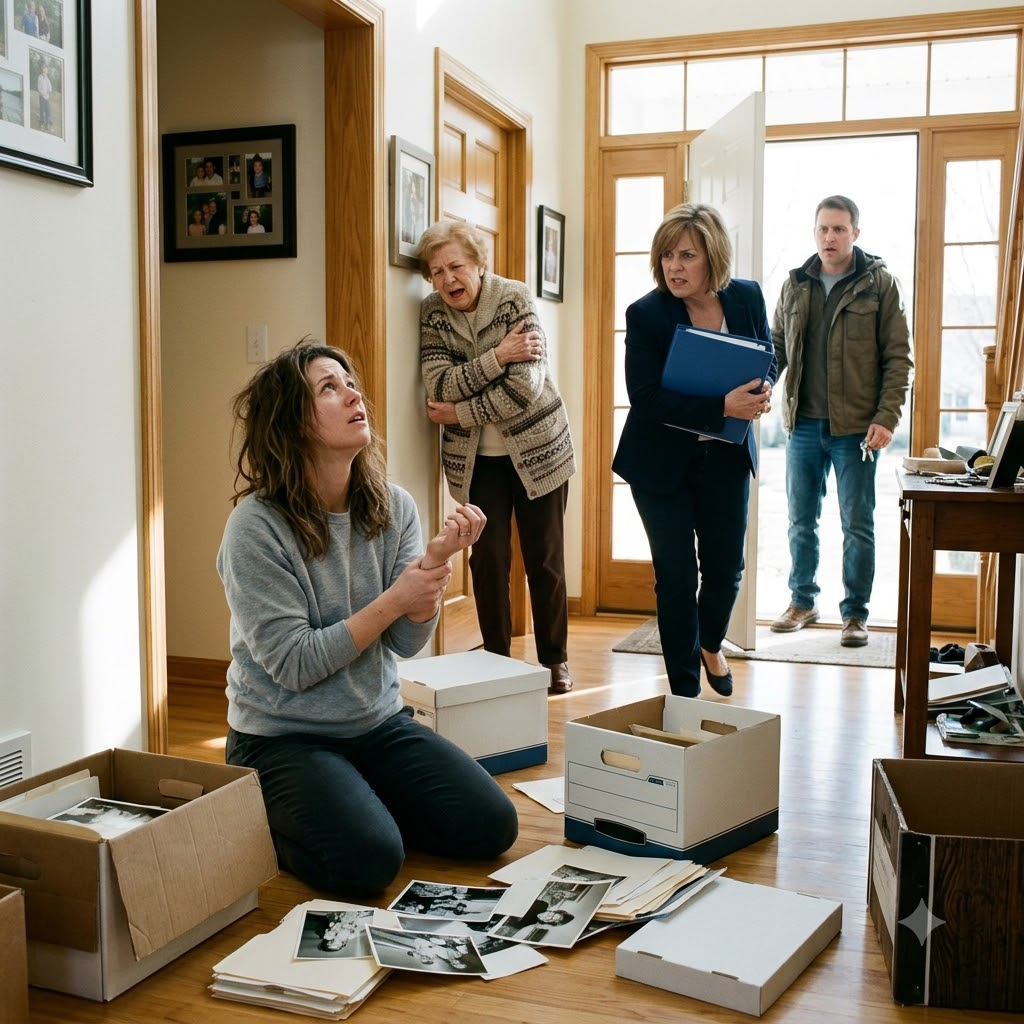
I was kneeling on the hardwood floor, clutching my bruised wrist, when a man's voice exploded through the hallway.
"How dare you lay a hand on my frail grandmother!"
When my husband, Reed, rushed through the front door, he found a leather-bound museum ledger in his mother's hands.
A tiny pencil mark was hidden beneath its felt pad.
And that little mark was about to destroy everything his family had planned.
I remember the silence that followed his accusation more clearly than I remembered the pain in my wrist.
It was the kind of silence that made every small sound seem enormous.
The faint ticking of the clock above the hallway entrance.
The soft rustle of paper beneath my knees.
The uneven breathing of Dot, Reed's eighty-year-old grandmother, who stood against the wall with one hand resting on the wooden trim.
And the quiet movement of Christa's fingers tightening around the old leather ledger.
I looked at Reed.
His face was red. His sandy-blond hair was disheveled, and his dark burgundy shirt was partly untucked from his jeans. He still had his car keys in his right hand.
He looked at me as though he had walked into a crime scene.
Not as though he had walked into his own home and found his wife injured.
"Reed," I said quietly.
"Don't."
He raised his hand.
"Don't you dare start making excuses."
I lowered my eyes to my wrist.
A dark purple bruise was already forming beneath the sleeve of my forest-green sweater.
I could feel every heartbeat against the swollen skin.
But I wasn't going to explain myself while Christa was standing three feet away, pretending to be frightened.
I had learned something important about my mother-in-law.
When Christa wanted people to believe a story, she never told it directly.
She arranged the room.
She placed the right objects in the right hands.
She made sure someone else arrived at exactly the right moment.
Then she stepped back and allowed everyone to reach the conclusion she had prepared for them.
That morning, she had arranged everything beautifully.
Except for one thing.
She hadn't expected me to recognize the ledger.
"Reed, your grandmother is upset," Christa said.
Her voice trembled just enough to sound sincere.
"She came in here trying to help, and Harleen suddenly became violent."
I looked at her.
She didn't look back.
Instead, she held the leather ledger closer to her chest.
"Mom, what happened?" Reed demanded.
Christa lowered her head.
"I don't want to make things worse."
That was her favorite sentence.
She used it whenever she wanted to make things worse.
Dot shifted her weight.
"Reed..."
Her voice was barely audible.
He turned toward her immediately.
"Grandma, are you hurt?"
Dot glanced at me.
For a fraction of a second, I thought she might speak.
Then her eyes moved toward Christa.
She closed her mouth.
That small movement told me more than a dozen explanations could have.
Something was wrong.
Very wrong.
And Reed was about to make it worse.
"Look at her!" he shouted, pointing toward me. "She's sitting there like nothing happened!"
I slowly raised my head.
"I haven't said that nothing happened."
"Then explain the mess!"
I glanced at the scattered papers.
White archival folders.
Photographs.
Old inventory sheets.
A cardboard storage box lying on its side.
A few family pictures that had fallen from the console table.
The hallway looked as though someone had searched it in a hurry.
Because someone had.
But it hadn't been me.
I remembered the first sound.
A sharp crash.
Then Christa's voice.
Then the pain in my wrist.
I remembered trying to move away while she grabbed at the documents.
And I remembered the ledger.
That was the detail I couldn't stop thinking about.
The ledger did not belong in Christa's hands.
It belonged to the Beaver Valley Historical Museum.
And according to the museum's records, it should have been secured in an archival storage room in Pennsylvania.
I had worked there for eleven years.
I knew the collection.
I knew the records.
I knew the handwriting of the people who had cataloged the artifacts decades before I was born.
Most importantly, I knew what had been disappearing from Drawer 14.
Three artifacts.
Three separate missing-item reports.
Three investigations that had gone nowhere.
And now Christa was holding a museum ledger in the middle of a family confrontation.
"Reed," she whispered, "please don't argue with her."
He turned back toward me.
"You heard my mother."
I almost laughed.
Not because anything was funny.
Because I suddenly understood how carefully the scene had been constructed.
Christa had not merely wanted Reed to believe I was dangerous.
She wanted him to believe it before I could say anything.
She wanted his anger to become the evidence.
And she wanted Dot standing nearby to make the accusation look believable.
I took a slow breath.
"Where did you get that book?" I asked.
Christa's eyes flickered.
"What?"
"The ledger."
Her fingers tightened around the cover.
"This has nothing to do with you."
"It has everything to do with me."
Reed stepped between us.
"Stop interrogating my mother."
I looked at him.
For eleven years, I had believed that marriage meant having someone who would at least listen before deciding you were guilty.
I had defended Reed when his family criticized him.
I had helped organize Dot's birthday party.
I had stayed at Christa's house because it was closer to the airport than our own home.
I had even packed an extra cardigan for Dot because the older woman always complained that the house was cold in the morning.
And now my husband was standing over me, protecting the very person who had put a gun in my suitcase.
He didn't know that part yet.
Or perhaps he did.
I wasn't ready to decide.
"Move," Reed said.
I didn't.
Not because I wanted to challenge him.
Because I needed to see Christa's hands.
The ledger had a dark brown leather cover, slightly worn along the corners. A narrow strip of faded green felt was attached near the lower edge.
It was an unusual repair.
I had seen it before.
Not on this particular ledger.
On another archival book from the same collection.
The felt had been added to protect a small metal fitting beneath the cover.
And underneath that felt, someone had once made a pencil mark.
A mark that wasn't visible unless the book was tilted toward the light.
I had noticed it months earlier during an inventory review.
At the time, it had seemed insignificant.
Now it was the only thing keeping me from losing my composure.
"Give me the ledger," I said.
Christa shook her head.
"Absolutely not."
Reed's expression hardened.
"You've done enough."
I looked at him.
"Do you know what your mother is holding?"
"It's a book."
"No."
I paused.
"It's evidence."
Christa's face changed.
Only slightly.
But I saw it.
The corners of her mouth tightened. Her eyes moved toward Reed, then returned to me.
For the first time that morning, she seemed unsure of what to say.
Reed noticed the exchange.
"What evidence?"
Christa answered too quickly.
"She's confused. She's been under a lot of stress."
I lowered my eyes again.
There it was.
Another carefully prepared explanation.
If I was confused, nobody needed to listen to me.
If I was stressed, nobody needed to believe me.
If I was violent, nobody needed to ask why I had a bruised wrist.
I had spent eleven years documenting the history of objects that other people had forgotten.
I knew how easy it was to manipulate a record.
Change a date.
Remove a number.
Replace a description.
Move an object from one drawer to another.
A person could make something disappear without ever carrying it out of a building.
And if that person controlled the paperwork, the disappearance might never be discovered.
Unless someone knew where to look.
I shifted my weight and carefully pushed myself upright.
My wrist hurt.
I ignored it.
Reed immediately moved toward me.
"Don't come any closer."
I stopped.
Then I looked at Dot.
"Grandma Dot, are you all right?"
The old woman swallowed.
Her eyes filled with uncertainty.
"I... I don't know."
Christa turned sharply.
"Dot, sweetheart, you don't need to worry about this."
The older woman's shoulders sank.
I watched her carefully.
She wasn't looking at me anymore.
She was staring at the ledger.
I wondered whether she had recognized it too.
Reed lowered his voice.
"Harleen, apologize."
I stared at him.
"For what?"
"For what you did."
I looked at my bruised wrist.
Then at the scattered photographs.
Then at the woman holding the stolen museum ledger.
"No," I said.
It was the quietest word I had spoken all morning.
Reed looked genuinely stunned.
"What did you say?"
"I said no."
His face tightened.
Christa's expression changed again.
This time, she looked almost offended.
Perhaps she had expected me to cry.
Perhaps she had expected me to beg Reed to believe me.
Perhaps she had expected me to fall apart the way I had when the museum first reported the missing artifacts.
But I wasn't that woman anymore.
I had already survived the worst part of the trap.
I had discovered the gun.
I had discovered the stolen brooch.
I had walked into a police station before anyone could accuse me of trying to flee the country.
And I had done something Christa had never considered.
I had created an official record of what happened before her story could become the only version anyone heard.
My phone was still in the pocket of my charcoal trousers.
The police report number was saved in my notes.
The officer's name was there too.
Sergeant Okafor.
I hadn't come this far to let Reed's anger erase what I had already documented.
Christa shifted the ledger against her chest.
"Reed, I think you should take her upstairs."
I turned toward her.
"No."
Her eyebrows lifted.
I continued.
"Don't move that book."
The hallway went still.
Reed looked between us.
"What is wrong with you two?"
Neither of us answered.
Then a small sound came from the front entrance.
A phone vibrating.
Christa glanced down.
She had received a message.
I couldn't see the screen.
But I saw her face.
The confidence disappeared for a moment.
She quickly turned the phone over and slipped it into her pocket.
Reed noticed.
"Who was that?"
"Nobody."
"Mom."
"It's nothing."
I watched her.
Then I looked at the ledger.
I knew what the felt pad was hiding.
I also knew that the pencil mark beneath it had been made by someone who understood the museum's old cataloging system.
It was not a random scribble.
It was a reference.
And if my memory was correct, it connected the ledger to the very first artifact reported missing from Drawer 14.
I took one slow step toward the console table.
Reed immediately blocked my path.
"Where do you think you're going?"
I looked at him.
"To get my phone."
"You aren't going anywhere."
For a moment, I simply studied his face.
Then I spoke.
"Reed, I already went to the police."
His expression changed.
"What?"
Christa's fingers went completely still.
I held his gaze.
"I reported the gun."
Nobody moved.
Dot slowly turned her head.
Reed looked at his mother.
Then at me.
"What gun?"
I didn't answer.
I didn't need to.
Christa's face had already answered for me.
And just as Reed opened his mouth to demand an explanation, the doorbell rang.
Once.
Twice.
Then someone knocked hard against the front door.
Christa took a step backward.
Reed turned toward the entrance.
And from outside, a man's voice called out.
"Harleen? This is Sergeant Okafor. We need to speak with everyone inside."
PHẦN 1/15 — Hoàn thành Chapter 1. Chapter 2 sẽ tiếp nối trực tiếp từ khoảnh khắc Sergeant Okafor xuất hiện trước cửa nhà, không kể lại hoặc lặp lại Chapter 1.






Comments 0