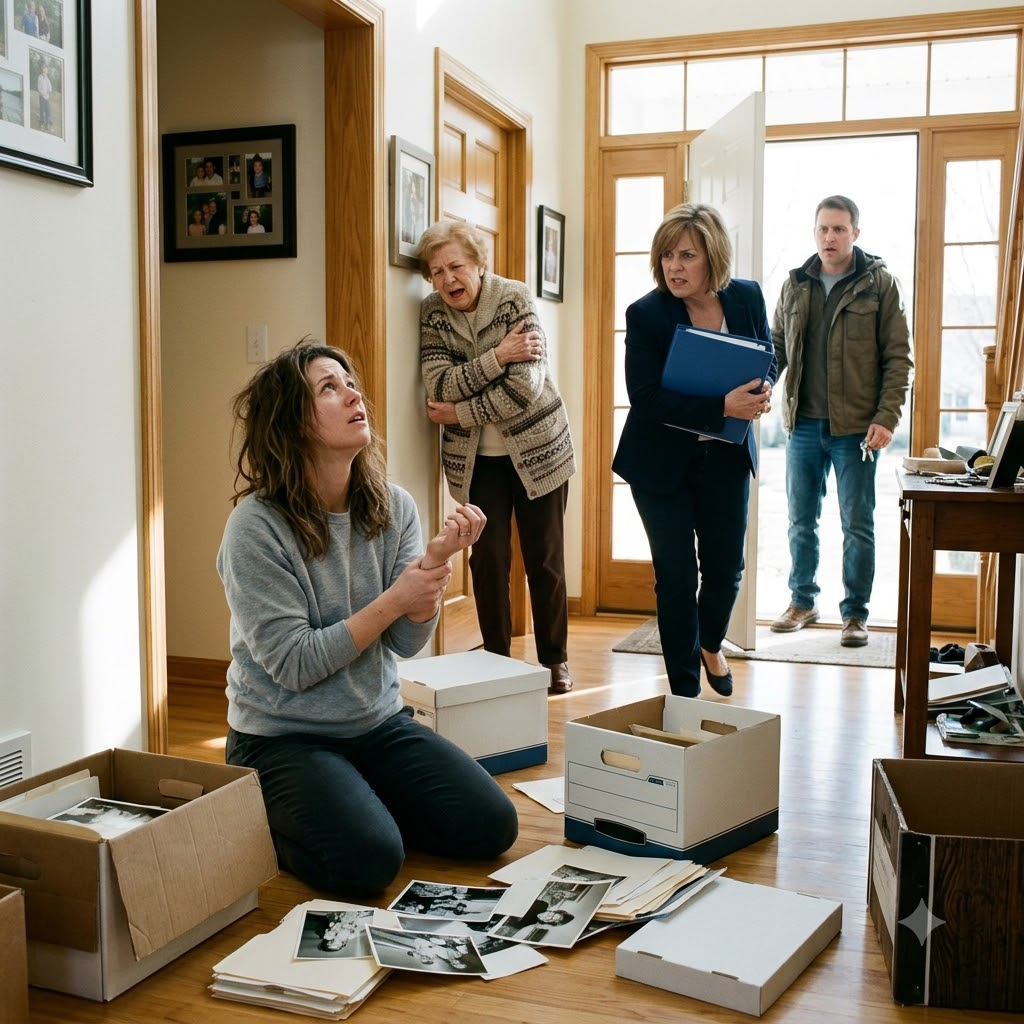
"Harleen? This is Sergeant Okafor. We need to speak with everyone inside."
The knocking stopped.
For three seconds, nobody in the hallway moved.
Then my mother-in-law did something I had never seen her do before.
She looked afraid.
Not the delicate, practiced fear she had displayed when Reed accused me of hurting his grandmother.
This was different.
Her lips parted. Her shoulders stiffened. Her eyes darted toward the narrow hallway leading to the bedrooms.
And the leather-bound museum ledger slipped half an inch in her hands.
"Why are the police here?" Reed demanded.
I looked at him.
"Open the door."
He didn't move.
"Harleen, what have you done?"
The question almost made me laugh.
I was standing in front of my husband with a bruised wrist, surrounded by documents that had been thrown across the floor, while his mother held property that belonged to the museum where I had worked for eleven years.
And somehow, I was still the person being questioned.
"Reed," I said quietly, "open the door."
Christa suddenly found her voice.
"Don't."
We both turned toward her.
She swallowed.
"I mean, we should understand why they're here before letting anyone inside."
Reed frowned.
"Mom, they're police officers."
"That doesn't mean they can just walk into someone's home."
I watched her carefully.
Christa was a woman who had always insisted that innocent people had nothing to hide.
She had said it when she demanded access to Reed's bank statements after our wedding.
She had said it when she asked why I kept my museum work laptop password-protected.
She had even said it three days earlier when she questioned why I needed to lock my carry-on suitcase.
Now, with a police officer standing outside her front door, she suddenly cared very deeply about privacy.
The knocking resumed.
"Mrs. Harleen Mercer? Are you safe?"
My heart gave a painful little jump.
Sergeant Okafor had remembered my name.
More importantly, he was asking the right question.
"I'm safe," I called.
Then I glanced at my wrist.
"For now."
Reed stared at me.
"What does that mean?"
Before I could answer, Dot spoke.
"Let the man in, Reed."
Her voice was thin, but there was something firm beneath it.
Christa turned sharply.
"Mother, please."
Dot looked at her daughter-in-law.
"I said let him in."
Reed hesitated, then reached for the door.
The moment it opened, cold morning air entered the hallway.
Sergeant Daniel Okafor stood on the front step wearing a dark police uniform beneath a weatherproof jacket. Another officer, a woman with closely cropped brown hair, stood slightly behind him.
Okafor's expression was calm.
He wasn't a large man, but he had the kind of presence that made people stop talking without being told.
His eyes moved across the hallway.
The overturned boxes.
The scattered photographs.
Dot standing against the wall.
Christa clutching the ledger.
Reed blocking the entrance.
And finally, me.
His gaze settled on my wrist.
"Mrs. Mercer," he said, "what happened to your arm?"
Christa answered before I could.
"There was a family misunderstanding."
Okafor didn't look at her.
"I asked Mrs. Mercer."
I felt something loosen inside my chest.
It was such a small thing.
A man asking me a question and waiting for my answer.
After everything that had happened, it felt almost unfamiliar.
"My mother-in-law grabbed my wrist during an argument," I said. "I pulled away. The boxes fell."
"That's not what happened!" Christa exclaimed.
Okafor finally turned toward her.
"And you are?"
"Christa Mercer. This is my home."
"Thank you, Mrs. Mercer."
His eyes moved toward the ledger.
"Would you mind telling me what you're holding?"
Christa pressed the book against her blouse.
"Family papers."
I looked directly at her.
"That ledger belongs to the Beaver Valley Historical Museum."
The hallway went silent again.
Reed turned toward his mother.
"Mom?"
Christa gave a short, disbelieving laugh.
"Harleen, honestly. Not every old book in Pennsylvania belongs to your museum."
"That one does."
"You can't possibly know that."
"I know the binding."
Christa's smile disappeared.
"And I know the inventory system it was used for," I continued.
Okafor raised one hand.
"All right. One person at a time."
He glanced toward the second officer.
"Officer Bennett, would you check on the elderly lady, please?"
The woman stepped inside after Reed moved aside.
Dot immediately straightened, as though embarrassed to be receiving attention.
"I'm all right," she insisted.
"That's good to hear," Bennett replied gently. "Would you like to sit down?"
Dot nodded.
Reed helped her toward a wooden chair near the hallway entrance.
Christa watched them with an expression I couldn't quite read.
Then she turned back to Sergeant Okafor.
"Officer, my daughter-in-law has been behaving very strangely. She's under investigation at her workplace. She's been accusing people of stealing things, and now she's trying to drag my family into it."
I felt Reed's eyes on me.
"Under investigation?" he repeated.
Christa looked startled, as though she hadn't intended to say that much.
I knew better.
She had intended every word.
"Your wife can explain her employment situation herself," Okafor said.
Christa pressed her lips together.
He turned toward me.
"Mrs. Mercer, I'd like to speak with you privately for a moment."
"Absolutely not," Reed said.
Okafor looked at him.
"Sir?"
"She's my wife."
"That doesn't prevent her from speaking to me."
Reed's jaw tightened.
"You're acting like we're criminals."
"No one has said that."
The officer's tone never changed.
That seemed to irritate Reed more than shouting would have.
I stepped toward the front doorway.
Christa immediately moved.
Not much.
Just enough to put herself between me and the hallway leading toward the bedrooms.
It was a small movement.
Most people wouldn't have noticed.
But I did.
Because Christa had a particular way of moving when she didn't want to be heard.
She walked on the outer edges of her feet.
I had noticed it during my first Christmas at her house, years before Reed and I married.
She had come downstairs after midnight to rearrange the gifts beneath the tree.
I was awake getting water.
I heard a faint, uneven shuffle in the hallway and watched her glide past the kitchen entrance.
When she noticed me, she laughed and said she had developed the habit as a child because her father hated hearing footsteps after bedtime.
I hadn't thought much about it then.
Later, I began noticing the same walk whenever she entered a room without announcing herself.
Whenever she wanted to listen outside a closed door.
Whenever she checked whether someone was asleep.
And at 12:12 that morning, I had heard those footsteps outside my bedroom.
That sound had saved me.
I followed Sergeant Okafor onto the covered front porch.
The door remained partly open behind us.
I could hear Reed speaking to his mother.
"Mom, what investigation?"
Her answer was too quiet to make out.
Okafor waited until I was standing beside the porch railing.
Then he lowered his voice.
"Mrs. Mercer, when you came to the station this morning, you told me you were concerned someone had deliberately placed a firearm and a museum artifact in your luggage."
"Yes."
"You also told me you suspected your mother-in-law."
"Yes."
He glanced toward the doorway.
"Has anything happened since you returned here?"
I looked down at my wrist.
"She confronted me about the museum records. She demanded to know what I'd told the police."
"Did she threaten you?"
"Not directly."
"What happened to your wrist?"
"She grabbed me when I tried to stop her from taking the documents."
He nodded.
"Would you be willing to have that injury photographed?"
"Yes."
He studied my face.
"Do you feel safe remaining here?"
I considered the question.
I could have said no.
I could have asked him to take me somewhere else.
Part of me wanted nothing more than to leave that house and never see Christa again.
But there was something inside the hallway that mattered more than my pride.
The ledger.
And the tiny pencil mark beneath its felt pad.
"I don't want to stay here," I said. "But I need you to understand something about that book."
Okafor listened.
"It isn't just an old museum record. It's connected to a collection I've been auditing. Three artifacts disappeared from Drawer 14 over the past month."
"The Roman brooch was one of them?"
"Yes."
"And you believe the ledger is related?"
"I believe it may contain information about the missing objects."
"Can you identify it positively?"
"Not without examining it."
He nodded again.
"Then we need to be careful about how we proceed."
I understood what he meant.
Suspecting someone wasn't the same as proving they had committed a crime.
A police officer couldn't simply seize every object I pointed toward because I believed it belonged to my employer.
I had spent my career documenting provenance.
I understood the importance of a clear chain of custody.
That was precisely why I had walked into the police station at 4:40 that morning instead of trying to remove the handgun myself.
"I have photographs of the ledger's catalog entry," I said.
"Where?"
"On my phone."
"Show me."
I opened the museum reference folder I'd saved before leaving for the conference.
My hands were steady now.
The screen displayed an old inventory photograph.
A dark leather cover.
Worn corners.
A faded green felt strip near the lower edge.
Okafor studied it.
"That certainly looks similar."
"It is."
"Do you have a record number?"
I zoomed in.
"BVHM-AR-1947-06."
He repeated the number quietly.
Then he took out his notebook.
As he wrote, I heard Christa's voice from inside.
"Reed, she's turning you against your own family."
I closed my eyes for a second.
Even now, she was working.
Even now, she was making sure Reed believed the worst possible version of me.
Okafor glanced toward the door.
"Would you like Officer Bennett to arrange medical attention for your wrist?"
"I'd appreciate that."
He nodded.
"Before we go back inside, there's something else."
I looked at him.
"The firearm you brought to the station has been secured. The brooch has also been documented. We're coordinating with the appropriate investigators regarding the museum property."
My throat tightened.
"Does that mean I'm still a suspect?"
"We haven't reached conclusions about who placed those items in your luggage."
He paused.
"But you did the right thing by reporting them before traveling."
I hadn't realized how badly I needed to hear those words.
For hours, I'd been carrying the fear that my career was already over.
Eleven years of work.
Eleven years of careful records, late evenings, emergency conservation meetings, and school tours.
All of it threatened by a two-inch bronze brooch and a handgun I had never owned.
"Thank you," I whispered.
Okafor closed his notebook.
"Let's go inside."
When we returned, the atmosphere had changed.
Reed was standing beside the console table.
Dot sat in the chair with a glass of water.
Officer Bennett was speaking quietly to her.
Christa was nowhere to be seen.
Neither was the ledger.
I stopped immediately.
"Where's Christa?"
Reed looked up.
"She's getting herself together."
"Where?"
"Upstairs."
I turned toward Okafor.
"She had the ledger when we went outside."
Reed folded his arms.
"Harleen, stop."
"Where did she put it?"
"You're obsessed with that stupid book."
I looked at him.
"Your mother was holding museum property. Now she's gone upstairs with it."
"Because you keep accusing her!"
Okafor stepped between us.
"Mr. Mercer, please lower your voice."
Reed looked furious.
"Are you going to arrest my wife or not?"
The question hit me harder than I expected.
I stared at him.
"Is that what you want?"
He hesitated.
For one brief moment, I saw the man I had married.
The man who used to bring me coffee when I worked late.
The man who sat through my museum presentations even though he barely understood half the terminology.
The man who once told me that my dedication to history was the thing he admired most about me.
Then his expression hardened again.
"I want the truth."
"So do I," I said.
He looked away.
Officer Bennett approached us.
"Mrs. Mercer, I'd like to take a photograph of your wrist, if that's all right."
I nodded.
She guided me toward the window where the light was better.
As she documented the bruise, I watched Dot.
The old woman was staring toward the stairs.
Her hands trembled around the water glass.
"Dot?" I said softly.
She looked at me.
"Did you see what happened to my wrist?"
Reed immediately turned.
"Don't involve Grandma."
But Dot raised one thin hand.
"Let her ask."
The room went quiet.
I knelt beside her chair.
"Dot, I don't want you to say anything that isn't true."
Her eyes filled with tears.
"I know, sweetheart."
"Did I hurt you?"
She shook her head.
It was barely noticeable.
But it was enough.
Reed stepped forward.
"Grandma?"
Dot looked down at her hands.
"I don't remember Harleen hurting me."
Christa's voice suddenly came from the staircase.
"Mother!"
We all turned.
She stood halfway down the stairs, one hand gripping the railing.
The ledger was no longer visible.
Her face had gone pale.
"You're confused," she said sharply. "You were frightened."
Dot flinched.
I saw it.
So did Officer Bennett.
Christa seemed to realize she'd spoken too harshly.
Her expression softened immediately.
"Oh, Mother. I didn't mean it that way."
She came down the remaining steps.
This time, she walked normally.
Heel first.
Carefully.
Deliberately.
I watched every step.
She had changed the way she moved because she knew someone was watching.
Okafor addressed her.
"Mrs. Mercer, may I ask where you placed the leather-bound ledger?"
Christa looked offended.
"In my bedroom."
"Would you be willing to show it to us?"
"Why?"
"Mrs. Mercer has identified it as possible museum property."
Christa gave a brittle laugh.
"My daughter-in-law thinks everything is museum property."
"Then showing us the book may help clear up the confusion."
For a moment, I thought she would refuse.
Then she smiled.
"Of course."
It was a small, confident smile.
The kind that usually meant she'd already prepared an answer.
"Come upstairs."
Okafor glanced toward Bennett.
"Stay with Mrs. Mercer and the others."
He followed Christa toward the stairs.
I watched them disappear.
Then I turned toward Reed.
"Did your mother tell you about the gun?"
He stared at me.
"What gun?"
"The one I found in my suitcase."
His expression changed.
I knew immediately that he hadn't heard about it.
Not from Christa.
Not from anyone.
"What are you talking about?"
I took a breath.
"Someone put a handgun in my carry-on while I was sleeping."
He stared.
"That's impossible."
"I found it at 12:32 this morning."
"Why didn't you wake me?"
"You were downstairs asleep. Your back was hurting after Dot's birthday party."
"You should have told me."
"I was trying to figure out who put it there."
His eyes narrowed.
"And you think my mother did it?"
"I heard her enter my room."
"No."
"Reed—"
"No. You're not doing this."
He stepped away.
"My mother would never do something like that."
I studied his face.
He wasn't pretending.
He genuinely couldn't imagine Christa doing anything cruel enough to destroy someone's life.
That was the advantage she had always possessed.
Reed didn't merely love his mother.
He believed her incapable of calculated harm.
And Christa knew it.
"She called someone after she put the objects in my suitcase," I said.
He shook his head.
"You're making this up."
"She said, 'It's in her carry-on. Tip off airport security at six.'"
He went completely still.
I could see the exact moment those words reached him.
Not because he believed me.
Because they were specific.
Too specific to dismiss easily.
"What objects?" he asked.
"A black handgun and a bronze Roman brooch."
He looked toward the stairs.
"The museum artifact?"
"Yes."
His mouth opened.
Then closed.
I continued.
"The accession number had been scraped off the back."
"Why would anyone do that?"
"To make the brooch harder to identify."
He looked sick.
For the first time since entering the house, he stopped looking at me like an enemy.
He looked confused.
And frightened.
I almost reached for his hand.
Almost.
Then I remembered the way he'd shouted at me while I knelt on the floor holding my bruised wrist.
I kept my hands at my sides.
Upstairs, a door opened.
Then another.
We heard Christa speaking.
Her voice was too distant to understand.
Okafor answered.
A moment later, footsteps approached the stairs.
Christa appeared first.
Her expression was composed again.
Okafor followed.
He was carrying nothing.
My stomach tightened.
"Where's the ledger?" I asked.
Christa gave me a patient smile.
"What ledger, dear?"
I stared at her.
Reed looked between us.
"The one you were holding," he said.
Christa tilted her head.
"I think everyone is getting a little confused."
Okafor stepped forward.
"Mrs. Mercer showed me the books in her bedroom. She says she doesn't know which one you're referring to."
I looked at Christa.
She met my eyes.
And smiled.
It was the smallest smile I'd ever seen.
But I understood it perfectly.
She had hidden the ledger.
Or moved it.
Or given it to someone else.
And she believed I couldn't prove otherwise.
"Officer," I said, "I can identify that book from the photograph on my phone."
"I understand."
"I saw her carrying it upstairs."
"That's something we can document."
Christa folded her hands.
"Perhaps we should all calm down."
I turned toward her.
"Where did you put it?"
"Harleen, please."
"Where?"
Her smile vanished.
"You're embarrassing yourself."
For a second, I felt the old familiar pressure.
The urge to explain.
To defend myself.
To convince everyone that I wasn't imagining things.
Then I remembered something.
The sound at 12:12 AM.
The slow movement outside my bedroom.
The zipper opening one tooth at a time.
The whispered phone call.
And the twenty minutes I'd waited before searching my suitcase.
Christa had believed the house was asleep.
But she hadn't been alone.
Reed had been downstairs.
Dot had been sleeping in the guest room near the hallway.
And someone else might have heard her moving.
I turned toward Dot.
"Grandma, were you awake last night?"
The old woman looked startled.
Christa's face tightened.
"Harleen, she's eighty years old. She doesn't need to be dragged into your accusations."
I ignored her.
"Dot, did you hear anyone walking upstairs around midnight?"
Dot looked at me.
Then at Christa.
Her fingers tightened around the water glass.
"I heard someone," she whispered.
Christa stepped forward.
"Mother."
Dot flinched again.
But this time, she kept speaking.
"I heard the hallway floor creak."
My heart began to pound.
"Did you see who it was?"
Dot hesitated.
"I opened my door a little."
Christa's face went white.
Reed stared at his grandmother.
"What did you see?"
Dot lowered her voice.
"I saw Christa coming out of Harleen's room."
Nobody spoke.
Then Dot added something that made the room feel suddenly smaller.
"She wasn't carrying anything when she went in."
I stopped breathing.
Dot looked toward her daughter-in-law.
"But when she came out, she had something in her hand."
Christa stepped toward her.
"That's enough."
Officer Bennett immediately moved closer to Dot.
"Mrs. Mercer, please let her finish."
Christa stopped.
For the first time, she looked genuinely trapped.
Dot's eyes filled with tears.
"I didn't understand what I was seeing."
"What was she carrying?" I asked.
Dot swallowed.
"A little white bundle."
I felt the blood drain from my face.
White tissue paper.
The Roman brooch had been wrapped in white tissue paper.
The exact kind I used at the museum.
The exact kind I'd found behind the mesh charger pouch in my carry-on.
Reed turned toward his mother.
"Mom?"
Christa opened her mouth.
Nothing came out.
Then she recovered.
"Mother was half asleep. She's remembering things incorrectly."
Dot shook her head.
"No, Christa."
Her voice was stronger now.
"I remember."
Reed looked as though someone had struck him.
He took a step backward.
"Mom, tell me that's not true."
Christa looked at her son.
For a moment, I thought she might confess.
Instead, she reached for his arm.
"Reed, honey, you know how confused your grandmother gets."
Dot began crying quietly.
I wanted to comfort her.
But I couldn't take my eyes off Christa.
Because she was doing it again.
Turning another person's uncertainty into a weapon.
Only this time, there were witnesses.
And this time, Reed had heard enough to begin questioning her.
Sergeant Okafor took out his notebook.
"Mrs. Mercer," he said to Dot, "I'd like to speak with you separately about what you remember."
Dot nodded.
Christa stepped forward.
"I don't think that's necessary."
Okafor looked at her.
"I wasn't asking you."
The words were calm.
Almost gentle.
But Christa stopped moving.
Reed stared at the floor.
I could see his hands trembling.
Then he looked up at me.
"Harleen..."
I waited.
He swallowed.
"Why didn't you tell me any of this before?"
I looked at him for a long moment.
"Because when you walked through that door, you didn't ask what happened."
His face tightened.
"You told me what I had done."
He lowered his eyes.
I could see the shame beginning to form.
But shame wasn't an apology.
And an apology wouldn't erase the gun, the stolen brooch, or the bruise on my wrist.
Not yet.
I turned back toward Sergeant Okafor.
"There's something else I need to tell you."
He looked up.
"Go ahead."
"Last night, when Christa came into my room, I heard her make a phone call."
Christa went rigid.
I continued.
"She told someone to contact airport security at six."
Okafor's expression sharpened.
"Do you know who she called?"
"No."
"Did you hear a name?"
"No."
I paused.
"But I remember exactly what she said."
He wrote down the words as I repeated them.
Christa remained silent.
That frightened me more than her earlier accusations.
She was no longer trying to control the conversation.
She was thinking.
Calculating.
Looking for another way out.
Then her phone vibrated.
The sound came from the pocket of her cream-colored trousers.
She glanced down.
Her expression changed.
Not much.
Just enough.
I saw her thumb move toward the screen.
Then she stopped.
Okafor noticed.
"Mrs. Mercer, is there someone you need to contact?"
"No."
"All right."
She slipped the phone back into her pocket.
But I had already seen the notification.
Only a few words.
I couldn't read the sender's name.
I couldn't see the entire message.
But one phrase was visible.
THE AIRPORT PLAN FAILED.
My stomach dropped.
Someone knew.
Someone outside that house knew I had not boarded my flight.
Someone knew the gun hadn't been discovered at the airport.
And that person was still communicating with Christa.
I looked at Sergeant Okafor.
"Officer, I think there's another person involved."
Christa's head snapped toward me.
"That's ridiculous."
I pointed toward her pocket.
"She just received a message."
Christa's expression hardened.
"How dare you look at my private phone?"
I didn't answer.
I didn't need to.
Because the message had told me something important.
Christa hadn't acted alone.
And whoever was helping her had expected me to be arrested before sunrise.
Reed looked at his mother.
"Who are you texting?"
"No one you know."
"Mom."
"Reed, please."
He held out his hand.
"Show me."
Christa stared at him.
The room fell silent.
For the first time in all the years I'd known them, Reed was asking his mother to prove something.
She looked at his hand.
Then at the police officers.
Then at me.
And I saw it.
The calculation returning.
She was searching for a way to turn the situation around.
Then she said something I didn't expect.
"Fine."
She reached into her pocket.
Pulled out her phone.
And held it toward Reed.
"Go ahead. Look."
Reed took the phone.
His thumb moved across the screen.
I watched his face.
At first, he looked confused.
Then his eyebrows drew together.
He scrolled.
Stopped.
Scrolled again.
"Mom..."
His voice had changed.
Christa stood completely still.
"What?" she asked.
Reed looked up.
"Why do you have messages from someone at Harleen's museum?"
My breath caught.
Christa didn't answer.
Reed looked back at the screen.
Then he read the name aloud.
And the moment I heard it, every instinct I had developed during eleven years of museum work told me that the missing artifacts were only the beginning.
Because the person on Christa's phone was the one person who had access to every inventory report I'd filed.
Reed slowly turned the screen toward me.
At the top of the conversation was a name I recognized.
Evelyn Price.
My museum director.
And beneath her name was an unread message that had arrived less than a minute earlier.
Reed touched the screen.
The message opened.
He read the first line.
His face went pale.
Then he looked at me and whispered,
"Harleen... you need to see this."






Comments 0