For several seconds, I stood in the doorway without moving.
The wooden chest rested beneath the workshop window.
Across its lid, in Grandpa's familiar handwriting, was a date.
My eighteenth birthday.
Rebecca stepped beside me.
"He planned this years ago?"
I nodded, unable to speak.
Sunlight entered through the dusty window, illuminating the old workbench and several shelves along the wall.
The smell of wood brought back memories I hadn't realized were still so vivid.
Saturday mornings.
Grandpa's measuring tape.
The sound of his laughter whenever I made a mistake.
I walked toward the chest.
There was a small envelope attached to its side.
My name was written across the front.
Inside was another brass key and a handwritten note.
Every good thing worth building begins somewhere.
I smiled through my tears.
Then I inserted the smaller key into the chest's lock.
It opened easily.
Rebecca leaned closer.
Inside were several neatly arranged objects.
Grandpa's old leather tool belt.
A collection of photographs.
A wooden ruler.
A small notebook.
And a sealed envelope resting on top of everything.
I picked it up.
For my granddaughter, Poppy Bennett, on her eighteenth birthday.
I sat on an old wooden stool beside the workbench.
Rebecca stood beside me.
Fran and Elizabeth remained near the doorway, giving us space.
I opened the letter.
Dear Poppy,
If you're reading this, you've reached an age when the world will begin expecting you to make important decisions.
Some of those decisions will be exciting. Others will be difficult. You will make mistakes, and I hope you never become so afraid of making them that you stop trying.
I have spent much of my life building things. Buildings, businesses, relationships, and occasionally furniture that your grandmother insisted was uglier than anything sold in a store.
I laughed.
Rebecca smiled.
I continued reading.
Of everything I have built, nothing has given me greater happiness than watching my grandchildren grow.
You and Rebecca are different people. You have different talents, different dreams, and different ways of looking at the world. Neither of you should have to become someone else to deserve love.
My vision blurred.
I wiped my eyes.
I have arranged certain financial provisions for your future. I hope they will give you opportunities, but I hope even more that you will understand their purpose.
Money is a tool, Poppy. It can build a home, provide an education, or help someone through a difficult season. But it cannot purchase honesty, responsibility, or genuine affection.
Never confuse being needed with being loved.
I stopped.
Those words reached somewhere deep inside me.
For years, I had believed that being useful was the safest way to belong.
If I asked for less, people would appreciate me.
If I sacrificed more, people would love me.
If I solved everyone's problems, perhaps nobody would have a reason to disappoint me.
Grandpa had understood that long before I did.
I continued.
This property is intended to give you another kind of security. A place where you can think, learn, work, and decide what comes next.
You may live here when the time is right. You may eventually decide to do something entirely different. That choice should be yours.
I had the old workshop door brought here because I knew you would recognize it. I hope you still have your key.
I reached into my pocket.
The little brass key was still there.
Rebecca began crying.
I continued reading.
Remember that a home is not measured by its size or its price. It is measured by whether the people inside it can be themselves without fear.
Whatever happens, keep your curiosity. Keep your kindness. And please remember that kindness includes being kind to yourself.
Happy eighteenth birthday, sweetheart.
I'm proud of you.
Love always,
Grandpa.
I lowered the letter.
For a long time, I couldn't speak.
Rebecca wrapped her arms around me.
I leaned against her and cried.
Not the frightened tears I had shed during the investigation.
Not the angry tears that had followed the discoveries about my parents.
These were different.
I missed him.
I missed him so much that standing inside that workshop felt like stepping into a memory I had spent five years trying to preserve.
Eventually, I looked around.
The workbench had been relocated from the original property.
Several of Grandpa's old tools hung above it.
Even the small wooden shelf where he used to keep pencils had survived.
Fran explained that Grandpa had arranged for certain workshop fixtures and personal belongings to be moved before the original property was sold.
The chest had remained secured according to his instructions.
Nobody had been waiting to take anything from me.
Nobody needed my signature to release money.
Nobody expected me to solve a problem.
Grandpa had simply left me something.
And he had expected nothing in return.
Elizabeth joined us near the workbench.
She explained that the remaining property verification had been completed.
The house had been held through a separate arrangement established by Grandpa, with independent administration and provisions for my benefit upon reaching adulthood.
The associated expenses had been funded through reserves established for that purpose.
My father had never been responsible for managing those assets.
The property was separate from the three-million-dollar inheritance.
And after the remaining administrative formalities were completed, it would be transferred to me according to Grandpa's instructions.
I stared at her.
"So this house really is mine?"
She smiled.
"That's what Walter arranged."
Rebecca laughed through her tears.
"Well, somebody finally got a house on your eighteenth birthday."
I burst out laughing.
Then she hugged me again.
We spent the next hour exploring the property.
The house had three bedrooms, a modest kitchen, a comfortable living room, and a small porch overlooking the backyard.
The wallpaper was outdated.
Several cabinets needed repairs.
The garden had become overgrown.
But I loved it.
I loved the sunlight entering through the kitchen windows.
I loved the old wooden floors.
I loved the quiet.
Most of all, I loved knowing that nobody had decided how I was supposed to use it.
I could paint the walls any color.
I could turn a bedroom into a study.
I could keep the workshop exactly as Grandpa had left it.
I could make mistakes.
I could change my mind.
It was mine.
Over the following months, the remaining financial issues gradually reached their conclusions.
The accounting process established that the approximately $185,000 in questioned distributions included some legitimate expenses incurred for my benefit.
However, $172,000 had been improperly diverted toward other purposes.
The remaining $13,000 was supported by records of expenses that fell within the original trust's provisions.
Elizabeth explained the findings carefully.
The distinction mattered.
I didn't want to accuse my parents of taking money that had legitimately been spent on me.
I wanted an accurate accounting.
And finally, I had one.
The investigation also established that the signature on the declaration from Rebecca's studio paperwork had not been written by me.
Mom eventually admitted that she had signed my name herself and then signed the witness section.
She claimed she had believed the declaration was merely supporting paperwork for a temporary financial arrangement.
But whatever she had believed, she had knowingly represented my signature as genuine.
Dad also acknowledged that the document supposedly reflecting Grandpa's authorization had been prepared after Grandpa's death.
He had relied on his own interpretation of conversations that had never resulted in the authorization he claimed existed.
Neither explanation excused what they had done.
The relevant institutions corrected their records.
The disputed documents were formally repudiated, and the necessary confirmations were obtained that I had no responsibility for the obligations those documents had attempted to associate with me.
Elizabeth ensured that the evidence was preserved and that the appropriate reporting and legal requirements were addressed.
My parents retained their own legal counsel.
They accepted responsibility through a formal resolution rather than continuing to dispute the accounting.
The resolution required repayment of the improperly diverted $172,000, along with agreed interest and certain professional expenses.
It also established enforceable repayment provisions and safeguards.
My parents were permanently excluded from any authority over my inheritance.
There would be no more distribution requests submitted on my behalf.
No more documents prepared without my knowledge.
No more signatures that weren't mine.
The Walter Bennett Legacy Trust remained independently administered according to its terms.
Fran continued helping me understand my finances, and Elizabeth remained available whenever legal questions arose.
I was able to review statements, ask questions, and participate in decisions concerning my own future.
Nobody told me that I was too young to understand.
Nobody suggested that asking for documentation was disrespectful.
The original purchase of Rebecca's house was officially terminated.
My father lost a portion of the earnest money deposit under the negotiated resolution with the sellers.
The remainder of the associated obligations was addressed through his own financial arrangements.
The proposed additional distribution of $1,250,000 never happened.
Neither did the later request for $600,000.
Those requests became part of the documented history of what had occurred.
They never became my responsibility.
Eventually, Mom and Dad sold our childhood home.
It was difficult for all of us.
On the final weekend before the sale closed, Rebecca and I helped them pack.
We found old Christmas decorations.
School photographs.
Birthday cards.
A collection of mismatched mugs Mom had accumulated over twenty years.
At one point, Dad carried a box into the living room and stopped beside the window.
"I always thought we'd stay here forever."
I stood beside him.
"Things change."
He nodded.
"I suppose they do."
For several moments, we looked out at the backyard.
Then he spoke quietly.
"Poppy, I owe you more than money."
I turned toward him.
He continued.
"I owe you an apology for making you feel responsible for my disappointments."
I remained silent.
He looked down.
"I spent years blaming my father for things I should have taken responsibility for myself."
His voice became unsteady.
"When I saw what he'd left you, I convinced myself that I deserved some of it."
I felt tears forming.
Dad continued.
"I knew what I'd signed. I knew he'd already helped me. But admitting that meant admitting I'd wasted opportunities other people would have been grateful to receive."
He looked at me.
"So I blamed him. And then I blamed you."
I swallowed.
"Grandpa loved you."
Dad nodded.
"I know."
"He wanted you to succeed."
"I know that too."
He wiped his eyes.
"I wish I'd understood it sooner."
For the first time, Dad's apology didn't contain an excuse.
He didn't ask me to reconsider the repayment agreement.
He didn't ask me to withdraw a complaint.
He didn't ask for financial assistance.
He simply acknowledged what he had done.
I appreciated that more than he probably realized.
"I hope things get better for you," I said.
He nodded.
"I'm going to try."
And this time, trying would mean something different.
Not pursuing another expensive investment.
Not waiting for somebody else's money.
Not attempting to recover a version of success that had never existed.
It would mean living within his means.
Working steadily.
Paying his obligations.
And rebuilding the relationships he had damaged.
Mom and Dad moved into a smaller townhouse.
The sale of their home allowed them to address a significant portion of their outstanding obligations and make the initial payments required under our agreement.
They established a realistic financial plan with independent professional guidance.
Dad continued working.
Mom found a part-time administrative position and began attending counseling to address the patterns that had contributed to her financial secrecy.
They stopped pretending everything was fine.
Their life became smaller in some ways.
But gradually, it became more honest.
Rebecca also faced the consequences of her previous financial arrangements.
Her independent attorney helped determine which studio obligations remained valid and which had already been settled.
She negotiated manageable repayment terms for the obligations that were genuinely hers.
She didn't ask me to pay them.
She created a budget.
She worked additional hours when necessary.
And she learned to distinguish between something she wanted and something she could afford.
Several months after starting at the art supply store, she began teaching beginner painting classes on Saturday mornings.
Her first class had six students.
She was so excited that she called me immediately afterward.
"Poppy, somebody actually paid me to teach them how to paint a sunflower!"
I laughed.
"Was it a good sunflower?"
"It looked more like a confused fried egg."
We both laughed.
"But she loved it," Rebecca added.
"Then it was a good class."
Over time, her classes became popular.
She rented a small shared workspace with another local artist.
Nothing extravagant.
Just enough room for a few tables, supplies, and people who wanted to learn.
She paid for it with money she had earned and carefully saved.
When she invited me to see it, I found her standing beside a hand-painted sign.
She looked happier than she had on the opening day of her expensive Chicago studio.
"Well?" she asked.
I looked around.
"It's beautiful."
She smiled.
"And everything here is paid for."
I hugged her.
"I'm proud of you."
Her eyes filled.
"Grandpa would be proud of us, wouldn't he?"
I nodded.
"I think so."
That autumn, I began attending Ohio State.
I decided to study accounting.
There was something deeply satisfying about learning how financial records worked.
How decisions were documented.
How institutions established accountability.
How careful planning could protect people who didn't always know which questions to ask.
I wasn't interested in becoming someone who simply accumulated money.
I wanted to understand it.
I wanted to use it responsibly.
And eventually, I wanted to help others understand it too.
I continued working part-time at the hardware store during my first semester.
Mr. Collins was delighted when I told him about college.
"Accounting, huh?"
I nodded.
He laughed.
"Well, maybe you'll finally figure out why our inventory system never agrees with itself."
"I'll charge you a consulting fee."
He grinned.
"There's the businesswoman."
I enjoyed earning my own paycheck, even though my inheritance meant I didn't need to work the same hours I once had.
The difference was that I was working because I wanted to.
Not because I believed my needs were an inconvenience.
With Fran's guidance, I established a reasonable budget for tuition, living expenses, and repairs to Grandpa's house.
I kept most of the inheritance invested for long-term financial security.
I didn't purchase expensive cars.
I didn't suddenly surround myself with luxury.
I wanted my life to grow at a pace I could understand.
The house became my favorite project.
Rebecca helped me paint the living room.
We chose a warm cream color.
I repaired several cabinets with tools Grandpa had left behind.
Mr. Collins recommended a reliable contractor for the repairs I couldn't safely complete myself.
I planted flowers beside the front porch.
I turned one bedroom into a study.
And I placed Grandpa's photograph above the workbench in the detached garage.
The green door remained exactly as it was.
Scratches.
Dents.
Faded paint.
I refused to replace it.
It reminded me where I had started.
One afternoon, Rebecca arrived carrying a wrapped package.
"Housewarming present."
I opened it.
Inside was a painting of Grandpa's old workshop.
The original brick house stood in the background.
The green door was open.
Sunlight spilled across the workbench.
A little girl sat beside an older man, holding a wooden ruler.
I immediately recognized the scene.
"Rebecca."
She smiled nervously.
"I worked from some old photographs. And from what I remembered."
I stared at the painting.
It was beautiful.
Not because it was technically perfect.
Because she had understood exactly what that place meant to me.
"I love it."
She hugged me.
We hung it in the living room that afternoon.
Nearly a year after the birthday breakfast, the final payment required under the financial resolution arrived.
The improperly diverted $172,000 had been restored, together with the agreed interest and expenses.
Elizabeth confirmed that the repayment obligations had been satisfied.
The remaining administrative matters were closed.
The financial institutions had corrected their records.
The disputed documents no longer represented outstanding claims against me.
The accounting was complete.
I read Elizabeth's confirmation twice.
Then I closed my laptop.
I didn't feel the overwhelming excitement I had once imagined.
I felt relief.
The money had been returned.
My future was protected.
And I no longer needed to spend every conversation wondering what someone might be hiding.
That evening, I called Fran.
"Thank you."
She laughed gently.
"You've thanked me many times."
"I know. But I mean it."
She paused.
"Your grandfather would be very pleased with how you've handled everything."
I smiled.
"I hope so."
"Poppy, he didn't leave you those resources because he expected you to become perfect."
I listened.
"He left them because he wanted you to have the freedom to become yourself."
I looked around my living room.
Rebecca's painting.
The books on my coffee table.
The secondhand furniture I had chosen.
The sunlight entering through the windows.
"I think I'm starting to understand that."
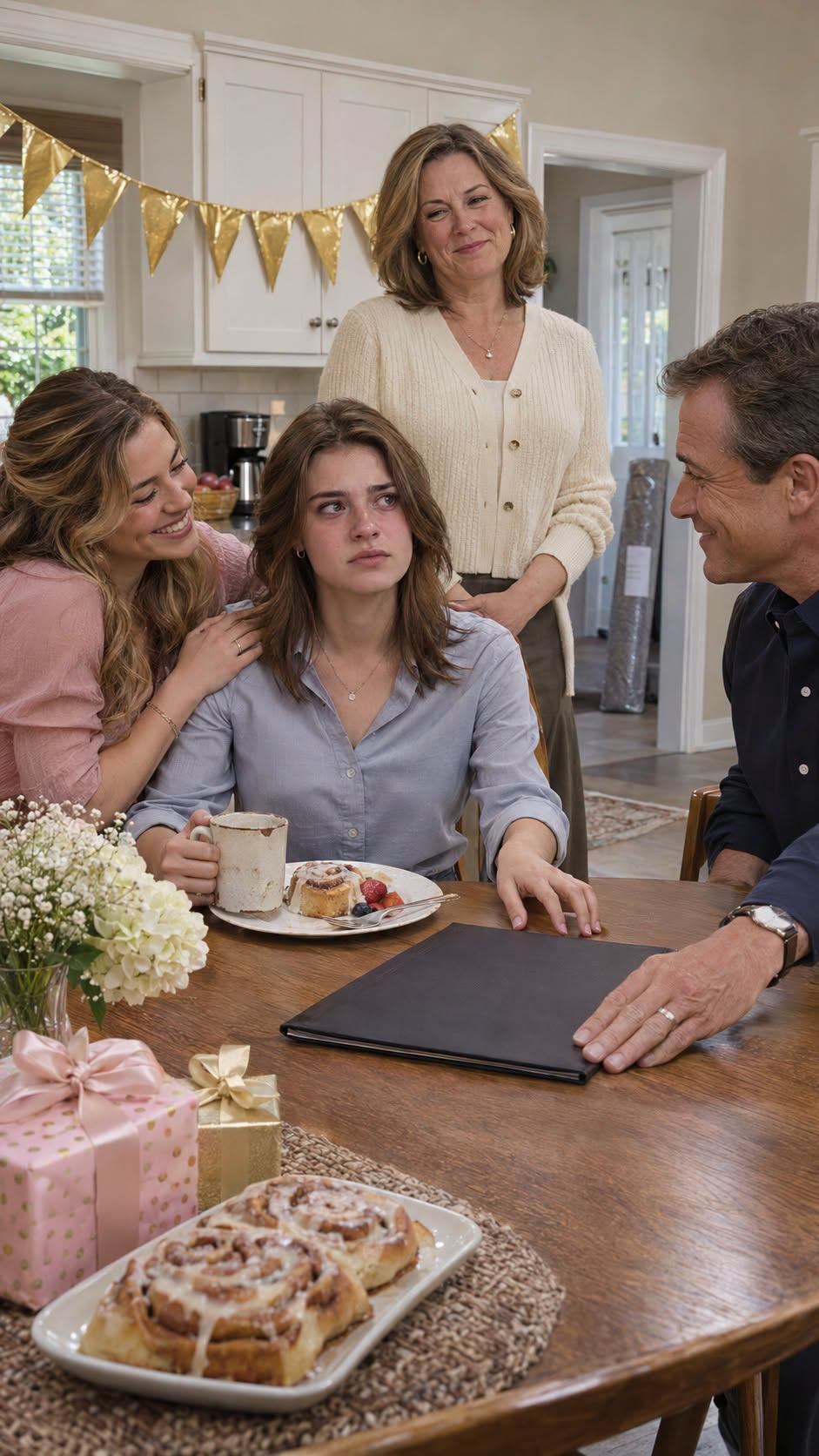
On my nineteenth birthday, I invited my family to breakfast.
Not because everything had returned to the way it used to be.
It hadn't.
Our relationships were different.
Trust had returned slowly, through consistent behavior rather than promises.
Mom no longer asked questions about the balance of my inheritance.
Dad no longer referred to it as family money.
Rebecca no longer assumed that financial assistance would appear whenever she needed something.
And I no longer apologized for making decisions about my own life.
At eight that morning, Rebecca arrived carrying cinnamon rolls.
Mom brought flowers.
Dad brought a small wrapped package.
Fran stopped by later with a birthday card.
There were no purchase agreements.
No authorization forms.
No blue folders.
Nobody was waiting for a financial institution to open.
Nobody had scheduled a closing.
We sat around my kitchen table and drank coffee.
Rebecca told us about her latest painting class.
Mom discussed her work.
Dad mentioned a small repair project he was completing at their townhouse.
I talked about college.
Ordinary conversations.
The kind I had wanted for years.
After breakfast, Dad handed me his present.
Inside was a new measuring tape.
I looked at him.
He smiled awkwardly.
"Your grandfather taught me how to use one of those when I was about your age."
I turned it over in my hands.
"Thank you."
He nodded.
"I thought you might find it useful."
There was no hidden meaning.
No request attached.
Just a gift.
Mom gave me a handwritten card.
Rebecca had painted a small picture of sunflowers on the envelope.
I opened it.
Inside, Mom had written that she was proud of the life I was building.
She apologized again for the ways she had made my kindness feel like an obligation.
And she thanked me for allowing our relationship to develop at a pace that felt comfortable to me.
I hugged her.
She cried.
So did I.
Forgiveness hadn't arrived all at once.
It had come through many small moments.
Honest conversations.
Kept promises.
Respect for boundaries.
And the willingness to accept that love couldn't erase accountability.
I hadn't forgotten what happened.
I didn't need to forget.
But I no longer wanted the worst morning of my life to define every morning that followed.
After everyone left, Rebecca stayed to help wash the dishes.
She looked around the kitchen.
"You know what's funny?"
"What?"
"A year ago, I thought I needed a million-and-a-half-dollar house to be happy."
I smiled.
"And now?"
"Now I'm excited because I finally saved enough to buy a decent washing machine."
I laughed.
She grinned.
"It's a really good washing machine."
"I'm sure it is."
She dried the last plate.
Then she looked at me.
"Thanks for not buying me that house."
I raised an eyebrow.
"That's a different birthday message."
She laughed.
"I mean it."
Her expression became serious.
"If you'd signed those papers, I probably would've spent years living in a house that wasn't really mine, depending on people who were hiding things from me."
I nodded.
She continued.
"And you would've lost something Grandpa wanted you to have."
I looked toward the backyard.
"We both needed something different."
Rebecca hugged me.
"We found it."
That evening, I walked into Grandpa's workshop.
The sun was beginning to set.
Golden light entered through the dusty window and fell across the old wooden workbench.
I opened the chest again.
Inside were the photographs, letters, and tools Grandpa had left me.
I took out his birthday letter.
I had read it so many times that I knew several passages by heart.
But one sentence always stayed with me.
Never confuse being needed with being loved.
I sat on the wooden stool and thought about everything that had happened.
The birthday breakfast.
The purchase agreement.
The missing money.
The signatures.
The family secrets.
The difficult meetings.
The moment Dad discovered that my inheritance was no longer available to him.
At eleven fifty-eight on the night before my eighteenth birthday, I had protected my money.
But everything that followed had taught me how to protect something even more valuable.
My right to decide what kind of life I wanted.
I could still be generous.
I could still help people.
I could still love my family.
But I could do those things freely, without fear or pressure.
My inheritance was secure.
My education was underway.
My sister was building a life of her own.
My parents were finally accepting responsibility for theirs.
And the house Grandpa had left me was no longer simply a property recorded in financial documents.
It was my home.
I returned his letter to the chest and closed the lid.
Then I picked up the little brass key.
I stepped outside, locked the green workshop door, and walked toward the house.
The porch light was glowing.
Through the living room window, I could see Rebecca's painting hanging above the sofa.
My textbooks were waiting on the kitchen table.
A vase of fresh flowers stood beside the window.
Everything was quiet.
Everything was ordinary.
And everything was enough.
I stopped on the porch and looked back at the workshop.
"Thank you, Grandpa," I whispered.
The evening breeze moved gently through the trees.
I smiled.
Then I opened my front door and stepped inside.
For the first time in my life, I didn't feel that I owed anyone an explanation for being happy.
I didn't have to earn my place.
I didn't have to surrender my future.
I didn't have to make myself smaller so someone else could feel bigger.
Grandpa had given me the opportunity to build something of my own.
And I had finally understood what he meant.
I had built a life filled with honest relationships, meaningful work, independence, and peace.
A life where generosity was a choice.
Where love didn't come with a price.
Where my dreams mattered just as much as anyone else's.
I placed the brass key beside my grandfather's photograph, turned on the living room lamp, and settled into my favorite chair.
I was home.
And this time, my happiness belonged entirely to me.






Comments 0