"Close the laptop, Poppy."
Dad stepped farther into my bedroom.
I remained seated.
Elizabeth was still on the telephone.
"Why?" I asked.
"Because you're looking at documents you don't understand."
I glanced at the screen.
The sentence beneath Grandpa's supposed authorization was unmistakable.
No original executed authorization is available. The attached document was prepared to reflect the previously expressed intentions of Walter Bennett.
Below those words was Dad's signature.
I looked up.
"Grandpa never signed the original?"
Dad reached toward my laptop.
I pulled it away.
"Don't touch it."
He stopped.
For a moment, he seemed more surprised by my refusal than by the document itself.
"Poppy, you're making a terrible mistake."
Elizabeth spoke through my phone.
"Poppy, is someone there with you?"
"My father."
Dad looked at the phone.
"You're talking to her right now?"
"Yes."
His expression hardened.
"End the call."
I shook my head.
Elizabeth remained calm.
"Glenn, if you have questions concerning the documents, you're welcome to communicate with my office through the appropriate channels."
Dad stared at the phone.
"This is a private family matter."
"These records concern my client's financial interests."
"Your client is my daughter."
"Your daughter is also an adult."
The room became silent.
Dad looked at me.
For eighteen years, he had been able to end uncomfortable conversations simply by reminding me that he was my father.
Now someone had reminded him that I was no longer a child.
He didn't know how to respond.
Finally, he stepped backward.
"Fine."
He pointed toward the laptop.
"But when you discover what this is really about, don't say I didn't warn you."
He left the room.
I closed the door and locked it.
Then I sat down again.
My hands were shaking.
"Elizabeth?"
"I'm here."
"Did Dad create a document pretending Grandpa had authorized those withdrawals?"
"We need to determine exactly how the document was prepared and used."
"But he admitted there was no original."
"That's what his written statement indicates."
I stared at the signature.
"Why would someone submit an authorization from a dead person?"
Elizabeth paused.
"That is one of the questions your father will need to answer."
I looked toward Grandpa's personal letter resting on my desk.
His real handwriting.
His real words.
His real intentions.
Then I looked back at the financial document.
Someone had attempted to speak on his behalf after he was no longer alive to contradict them.
And that someone was his own son.
The following morning, I woke to the sound of my parents arguing downstairs.
I remained in bed for several minutes, listening.
Dad's voice was louder than Mom's.
"You told me those records were taken care of."
Mom answered something I couldn't understand.
Then Dad spoke again.
"She's got copies, Marilyn. Copies of everything."
I sat up.
Everything?
I doubted that.
Elizabeth had repeatedly explained that the investigation was still incomplete.
If Dad believed we already possessed everything, perhaps there were additional documents he was worried about.
I got dressed and went downstairs.
The moment I entered the kitchen, both of them stopped talking.
Mom turned toward the sink.
Dad folded a newspaper that he clearly hadn't been reading.
"Good morning," I said.
Neither answered immediately.
Finally, Mom whispered, "Morning, sweetheart."
I poured myself a glass of water.
Dad watched me.
"Are you going to work today?"
"Later."
"Seeing your attorney again?"
"Yes."
He shook his head.
"I hope you realize how expensive this is becoming."
I looked at him.
"What is?"
"Lawyers. Accountants. Investigations."
I took a sip of water.
"Providing complete records would probably make it less expensive."
Mom closed her eyes.
Dad stood.
"You think you know everything now, don't you?"
"No."
I placed the glass on the counter.
"That's why I'm asking questions."
He stared at me.
Then he picked up his briefcase and left.
Mom remained beside the sink.
For a moment, I thought she might say something.
Instead, she turned on the faucet.
I went upstairs, collected my documents, and drove to Elizabeth's office.
Fran was already waiting when I arrived.
Several folders covered the conference table.
There were more records than I had seen during any previous meeting.
Elizabeth greeted me.
"We've received additional material from the financial institution and several archived files."
I sat down.
"Did you find out where the money went?"
"We're making progress."
Fran opened a spreadsheet.
She explained that they had identified several transactions requiring further examination.
Some appeared connected to Rebecca's studio.
Others were associated with payments passing through Mom's separate account.
A smaller number involved financial obligations connected to Dad.
I looked up.
"Dad had his own debts?"
Elizabeth nodded.
"That's what some of the preliminary records suggest."
Fran turned another page.
"Your father's financial circumstances may have been more complicated than he disclosed."
I thought about his endless discussions concerning investments.
The business opportunities he had mentioned.
The expensive watch he purchased after receiving a promotion.
The confident way he spoke whenever money came up.
He had always presented himself as someone who understood finances better than everyone around him.
Perhaps that confidence had concealed something entirely different.
Elizabeth placed a document in front of me.
It was a distribution request from three years earlier.
The stated purpose was educational support for the beneficiary.
I examined the amount.
$32,000.
"I was fifteen."
Fran nodded.
"Do you remember any educational expenses approaching that amount?"
"No."
"Private tuition? Specialized programs? Educational travel?"
I shook my head.
I attended public school.
I bought most of my school supplies with money from my part-time job.
When I needed a new laptop, I had saved for months because Dad said the family budget was tight.
I remembered standing inside an electronics store, comparing prices and trying to decide whether I could afford a refurbished computer.
Thirty-two thousand dollars had apparently been withdrawn from my trust around that same period.
And I had been worried about spending four hundred dollars.
Fran showed me another record.
The distribution had passed through the account associated with Mom.
A portion appeared to have been used for Rebecca's studio.
Another portion appeared connected to an unrelated financial obligation.
I felt a familiar ache in my chest.
"Did they ever spend any of these distributions on me?"
Fran looked at Elizabeth.
"We've identified some expenses that may have legitimately benefited you. But a substantial portion remains unexplained or appears inconsistent with the stated purposes."
Elizabeth emphasized that the accounting was still ongoing.
They weren't going to assign responsibility without sufficient evidence.
But the pattern was becoming increasingly difficult to dismiss.
I looked at the next document.
Another distribution.
Another description.
Another amount.
Every page seemed to reveal a different version of my childhood.
There was the childhood I remembered.
And there was the financial record my parents had created.
According to the paperwork, I had received considerable support.
According to my memories, I had spent years trying not to become an expense.
"Why would Dad describe these withdrawals as beneficiary support?" I asked.
Elizabeth folded her hands.
"Because the stated purpose of a distribution matters under the trust's terms."
"So if he admitted the money was being used for other people, there might have been a problem?"
"Potentially."
I looked down at the documents.
"Then he knew."
Elizabeth didn't immediately agree.
"The records raise serious questions about what he knew and why he submitted those descriptions. That's what we need to establish."
She removed another folder.
Inside was the disputed authorization supposedly reflecting Grandpa's intentions.
Fran placed an authentic letter from Grandpa beside it.
I studied the signatures.
There were noticeable differences.
The questionable signature looked unusually stiff.
The authentic one flowed naturally across the page.
But Elizabeth reminded me that visual differences alone were not enough to establish who had written a signature.
The surrounding records mattered.
So did the document's origin.
She showed me a series of communications associated with the authorization.
One message had been sent by Dad.
In it, he claimed that Grandpa had verbally approved certain financial arrangements before his death.
Another communication requested written evidence of that approval.
Then came the disputed document.
And finally, Dad's acknowledgment that no original executed authorization existed.
I read the messages carefully.
"Did Grandpa ever tell Fran that he wanted my inheritance used for these things?"
Fran shook her head.
"Not in any conversation I had with him."
"Did he ever tell you Rebecca should receive money from my trust?"
"No."
"What about Mom and Dad?"
"No."
I leaned back.
For years, Dad had spoken about Grandpa's intentions as though they were obvious.
Grandpa wanted the family to be comfortable.
Grandpa believed in helping relatives.
Grandpa would have wanted me to share.
But the woman who had actually helped Grandpa organize his finances was telling me something very different.
Elizabeth opened the original trust agreement.
She showed me the provisions governing distributions.
The language was complicated, but the central purpose was clear.
The trust had been established for my benefit.
Not Rebecca's business.
Not Mom's investments.
Not Dad's financial ambitions.
Mine.
I touched the edge of the document.
"Why didn't Grandpa just leave everything to me directly?"
Fran looked thoughtful.
"You were thirteen when he died. He wanted the money managed responsibly until you reached adulthood."
"He trusted Dad."
"He hoped he could."
That distinction hurt.
Elizabeth turned to another document.
"We've also reviewed the proposed additional distribution of $1,250,000."
I sat straighter.
"Did you find out what it was for?"
"Partially."
She showed me a preliminary schedule of anticipated payments.
There were references to outstanding loans, refinancing arrangements, settlement amounts, and proposed reserves.
Several entries appeared connected to Mom's earlier financial activities.
Others concerned obligations Dad had undertaken more recently.
And one entry referred to the property purchase deposit.
I pointed toward it.
"Was the fifty-thousand-dollar deposit borrowed?"
"The available records suggest that at least part of it may have been financed through a short-term arrangement."
I stared at her.
"So Dad didn't even have the money for the deposit?"
"We're still confirming the source."
I thought about his anger at breakfast.
The way he had accused me of putting the deposit at risk.
He had committed money he might not have possessed, expecting my inheritance to rescue him.
Then he had attempted to make me responsible for the consequences.
"Did the lender know he was planning to use my trust?"
Elizabeth showed me a communication referencing anticipated family funds.
"That appears to have been represented as a potential source of repayment."
I closed my eyes.
The house purchase hadn't simply been an extravagant gift.
It had become part of a much larger financial arrangement built around money my parents didn't control.
My eighteenth birthday had apparently been their deadline.
Not because they wanted to celebrate my adulthood.
Because they needed access to my inheritance.
Fran handed me a tissue.
I hadn't realized I was crying.
"I thought they were excited because I was turning eighteen," I whispered.
She didn't answer immediately.
Then she said, "I'm sure there were many emotions involved."
I appreciated that she didn't pretend to know exactly what my parents felt.
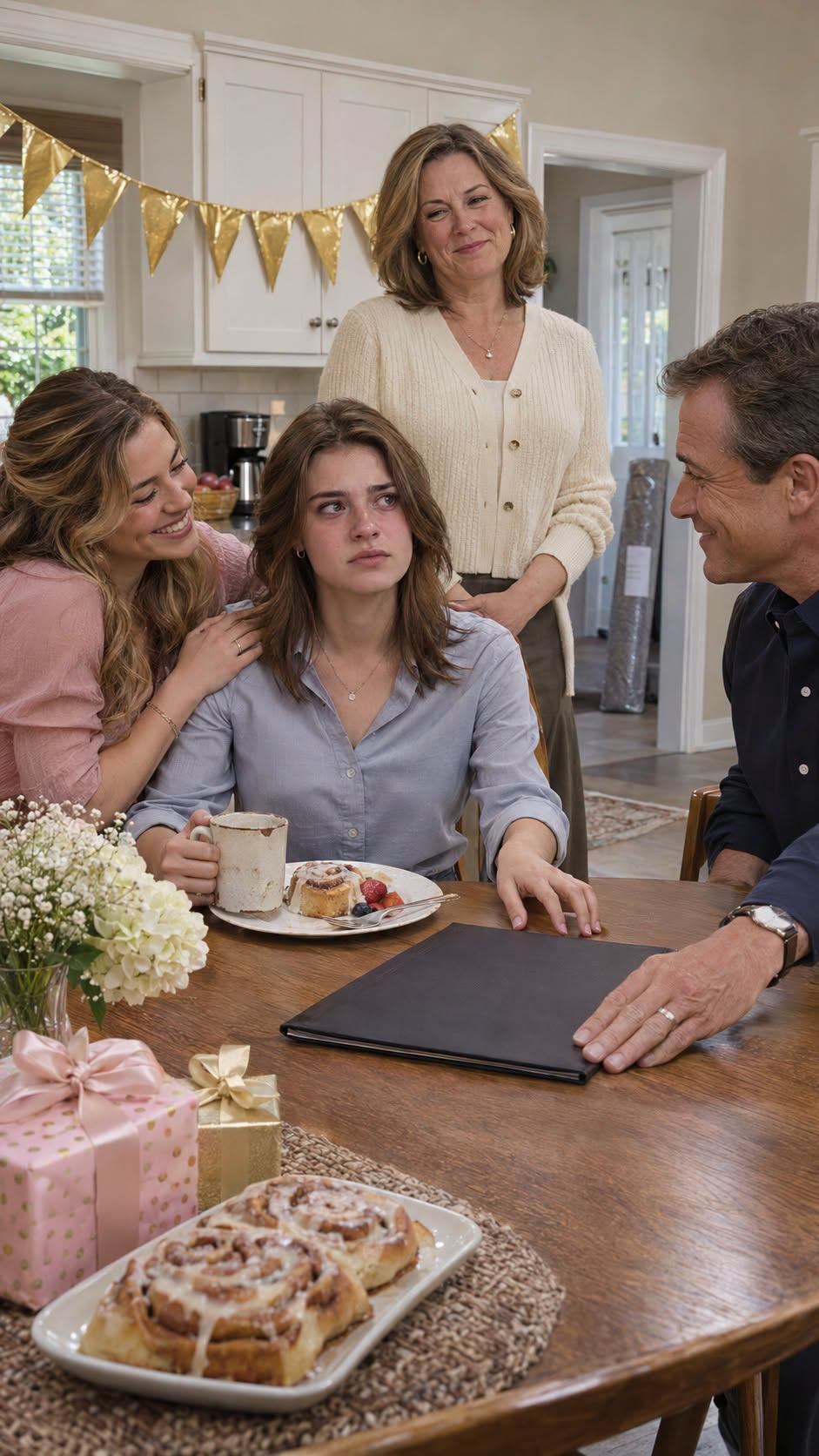
But I couldn't stop thinking about the decorations.
The flowers.
The birthday presents.
The cinnamon rolls.
Every detail had seemed affectionate until I understood what they expected in return.
Elizabeth gave me several minutes before continuing.
Then she explained that Dad had responded to the formal accounting request through a brief written statement.
He claimed that the disputed distributions had been made in good faith.
He described them as necessary family expenditures consistent with Grandpa's wishes.
He also indicated that certain supporting records were no longer readily available.
I looked at her.
"Can he just say the records are missing?"
"He can say that. It doesn't necessarily resolve his obligation to account for his actions."
"What happens next?"
"We'll request further documentation and clarification. If the matter cannot be resolved appropriately, we can evaluate the available legal options."
I nodded.
For the first time, I understood that protecting my remaining inheritance had only been the beginning.
Recovering the truth would require considerably more patience.
And possibly more courage.
Before I left, Elizabeth handed me a copy of Dad's written response.
I placed it inside my bag.
Then I drove to the hardware store for my afternoon shift.
Mr. Collins was arranging inventory near the entrance when I arrived.
He looked at me.
"Rough week?"
I gave a small laugh.
"You could say that."
He nodded toward the break room.
"Take a few minutes before you start."
"Thanks."
I sat beside the vending machine and looked around.
The familiar shelves.
The fluorescent lights.
The smell of cardboard and lumber.
For years, I had considered this job a temporary necessity.
Now it felt like one of the few places where the rules were straightforward.
Customers paid for what they purchased.
Employees recorded their hours.
Mistakes were corrected.
Nobody expected me to surrender my paycheck because someone else had made a bad decision.
Mr. Collins entered carrying two cups of coffee.
He handed me one.
"You don't have to tell me what's going on," he said. "But you look like someone who's carrying too much."
I looked down.
"My family's having financial problems."
He nodded.
"Those can be difficult."
"They expect me to fix them."
He took a sip of coffee.
"Can you?"
"Technically, maybe."
"Should you?"
I thought about the question.
"No."
He nodded again.
"There's a difference."
I smiled faintly.
Grandpa would have liked him.
After work, I received a message from Rebecca.
I got an interview at the art supply store.
I immediately congratulated her.
She responded with a photograph of her résumé.
Then another message appeared.
I know it sounds small compared to everything that's happening, but I'm actually excited.
I smiled.
It doesn't sound small.
For the first time, Rebecca was pursuing something without waiting for Mom or Dad to finance it.
She was beginning to build a life that belonged to her.
I hoped I could do the same.
When I returned home, Dad was waiting in the living room.
Mom sat beside him.
There were no decorations.
No coffee.
No carefully arranged breakfast.
Just a folder on the coffee table.
Dad gestured toward the empty chair.
"Sit down."
I remained standing.
"What is this about?"
He pointed toward the folder.
"We've prepared a proposal."
My stomach tightened.
"What kind of proposal?"
Mom spoke gently.
"We want to resolve everything without making the situation worse."
Dad opened the folder.
Inside was a document titled Family Financial Resolution Agreement.
I stared at it.
He explained that they were willing to acknowledge certain misunderstandings concerning the previous distributions.
They were prepared to discuss repayment arrangements.
They wanted to avoid unnecessary legal expenses.
And they believed the family could move forward if everyone agreed to cooperate.
For a moment, I felt hopeful.
Perhaps they were finally accepting responsibility.
Perhaps Dad had decided to provide the records.
Perhaps Mom was ready to tell the truth.
Then I read the second page.
The proposed agreement included language concerning the withdrawal of my accounting request.
Another section referred to releasing certain potential claims connected to past financial transactions.
And near the bottom was a provision concerning financial assistance for my parents.
I looked up.
"You want me to stop the investigation?"
Dad leaned forward.
"We want to settle this privately."
"Before I know where the money went?"
"We've already explained most of it."
"No, you haven't."
Mom reached toward me.
"Sweetheart, this could save everyone a lot of pain."
I continued reading.
The proposed financial assistance was substantial.
Not as much as the original requests.
But enough to make my stomach turn.
I placed the document on the table.
"Did an attorney prepare this?"
Dad hesitated.
"We've received some guidance."
"From whom?"
"That's not important."
I almost laughed.
Every time I asked a question about money, the answer seemed to become unimportant.
I picked up the folder.
"I'll have Elizabeth review it."
Dad immediately stood.
"No."
I looked at him.
"What?"
"This is an opportunity for us to resolve things as a family."
"Then Elizabeth can review it."
Mom shook her head.
"She'll only make things more complicated."
"Reading an agreement before signing it isn't complicated."
Dad took the folder from my hands.
"We're trying to help you understand the consequences."
"What consequences?"
He looked toward Mom.
She began crying.
Dad continued.
"If this investigation goes much further, it could affect people you care about."
I stared at him.
"Is that supposed to make me stop?"
"I'm telling you to think carefully."
I looked at the folder.
"Then send it to my attorney."
He closed it.
"We'll discuss it later."
I went upstairs.
As soon as I reached my bedroom, I contacted Elizabeth and described the proposed agreement.
She asked me not to sign anything and requested a copy for review.
I explained that Dad had taken the folder back.
She told me to write down everything I remembered.
So I did.
The title.
The proposed release.
The request to discontinue the accounting.
The financial assistance provision.
And Dad's statement about people I cared about.
When I finished, I looked at Grandpa's letter.
I wondered how disappointed he would have been to discover that his son was still trying to obtain money from me, even after the original plan had failed.
The next several days passed slowly.
Elizabeth continued requesting documents.
Fran continued examining the transactions.
Rebecca attended her interview and began organizing her own financial records.
At home, my parents barely spoke to me.
Dad spent hours in his study.
Mom moved through the house quietly, occasionally asking whether I needed anything.
The atmosphere was uncomfortable.
But something had changed inside me.
I no longer felt responsible for making everyone comfortable.
One afternoon, I received a call from Elizabeth while leaving school.
"Poppy, we have something new."
I stopped beside my car.
"What is it?"
"An archived communication connected to the preparation of the disputed authorization."
My heart began pounding.
"Does it show who created it?"
"It provides important information about the circumstances."
She asked whether I could come to her office.
I agreed immediately.
When I arrived, Fran was sitting beside her.
Neither woman smiled.
Elizabeth placed several printed emails on the table.
The first had been sent by Dad to Mom three years earlier.
It discussed a pending distribution request.
The second was Mom's response.
She expressed concern that the financial institution might ask additional questions about the intended use of the money.
The third message contained Dad's reply.
I read it slowly.
We'll explain that Walter intended the funds to support the family. There shouldn't be a problem.
I looked at Elizabeth.
"He knew the money wasn't for me."
She pointed toward the next message.
I continued reading.
Mom had apparently questioned whether there was any written evidence of Grandpa's approval.
Dad's response was brief.
I'll handle the documentation.
I felt sick.
There it was.
Not an explanation invented after the fact.
Not a vague memory.
A written conversation from the time the disputed distribution was being arranged.
Elizabeth handed me another page.
It contained a later communication discussing the document that carried Grandpa's questionable authorization.
I read the words carefully.
Then I looked at Fran.
"How could he do this?"
She shook her head.
"I wish I had an answer."
I stared at the papers.
For years, Dad had told me that Grandpa would be disappointed if I questioned him.
Yet these records suggested that he had used Grandpa's memory to justify decisions Grandpa might never have approved.
I pressed my hands against the table.
"Does this mean we can recover the money?"
Elizabeth explained that the documents strengthened the need for a complete accounting and further legal review.
They were significant.
But she wouldn't promise an outcome before the remaining evidence had been examined.
I understood.
I was learning that the truth rarely arrived as one dramatic revelation.
Sometimes it arrived through a hundred small pieces of paper.
Each one revealing something somebody had hoped would remain hidden.
Elizabeth gathered the documents.
Then she looked at me.
"There's one more matter."
I waited.
"Your father has requested a meeting."
"With you?"
"With all of us."
I frowned.
"Why?"
"He says he has information that could change how we understand certain transactions."
I looked at Fran.
"Is he finally going to explain everything?"
"We don't know."
Elizabeth continued.
"He also indicated that he intends to bring additional documents."
I thought about the missing records he had claimed were unavailable.
Perhaps he had finally found them.
Or perhaps he had realized that refusing to cooperate was no longer working.
"When does he want to meet?"
"Tomorrow morning."
I agreed.
That evening, I returned home and found Dad standing beside the kitchen window.
He turned when I entered.
"Elizabeth told you about the meeting?"
"Yes."
He nodded.
For several seconds, he looked as though he wanted to say something.
Finally, he spoke.
"Poppy, there are things about your grandfather's estate you haven't been told."
I stared at him.
"What things?"
He looked toward the hallway.
"Tomorrow."
"Why not now?"
"Because I want everyone to hear the same explanation."
That was the first time I had ever heard him say something like that.
I studied his expression.
He looked exhausted.
Older.
Almost defeated.
Then he added, "Whatever happens tomorrow, remember that your mother and I were trying to keep this family together."
I didn't answer.
I went upstairs and tried to sleep.
The following morning, I arrived at Elizabeth's office shortly before nine.
Fran was already there.
Rebecca had agreed to attend because some of the records concerned her former studio.
We sat around the conference table.
At exactly nine, Dad entered.
Mom followed him.
He carried a black briefcase I recognized from my childhood.
He placed it on the table.
Elizabeth greeted them and explained the purpose of the meeting.
Dad nodded impatiently.
Then he opened the briefcase.
Inside were several folders, envelopes, and financial statements.
He removed a thick document and placed it in front of Elizabeth.
"I want you to read this before we discuss anything else."
She examined the first page.
Her expression changed.
Fran leaned closer.
Mom stared at the floor.
Rebecca looked at me.
"What is it?"
Elizabeth didn't answer immediately.
She turned another page.
Then another.
Finally, she looked at Dad.
"Where did you obtain this?"
He swallowed.
"From my father's personal records."
Fran reached for the document.
The moment she saw it, she went completely still.
I felt my heartbeat accelerate.
"What does it say?"
Dad looked directly at me.
"Poppy, there's a reason your grandfather left you three million dollars."
I stared at him.
Elizabeth turned toward me.
Dad opened a second envelope.
And on the first page was a handwritten statement claiming that my inheritance had originally belonged to someone else.






Comments 0