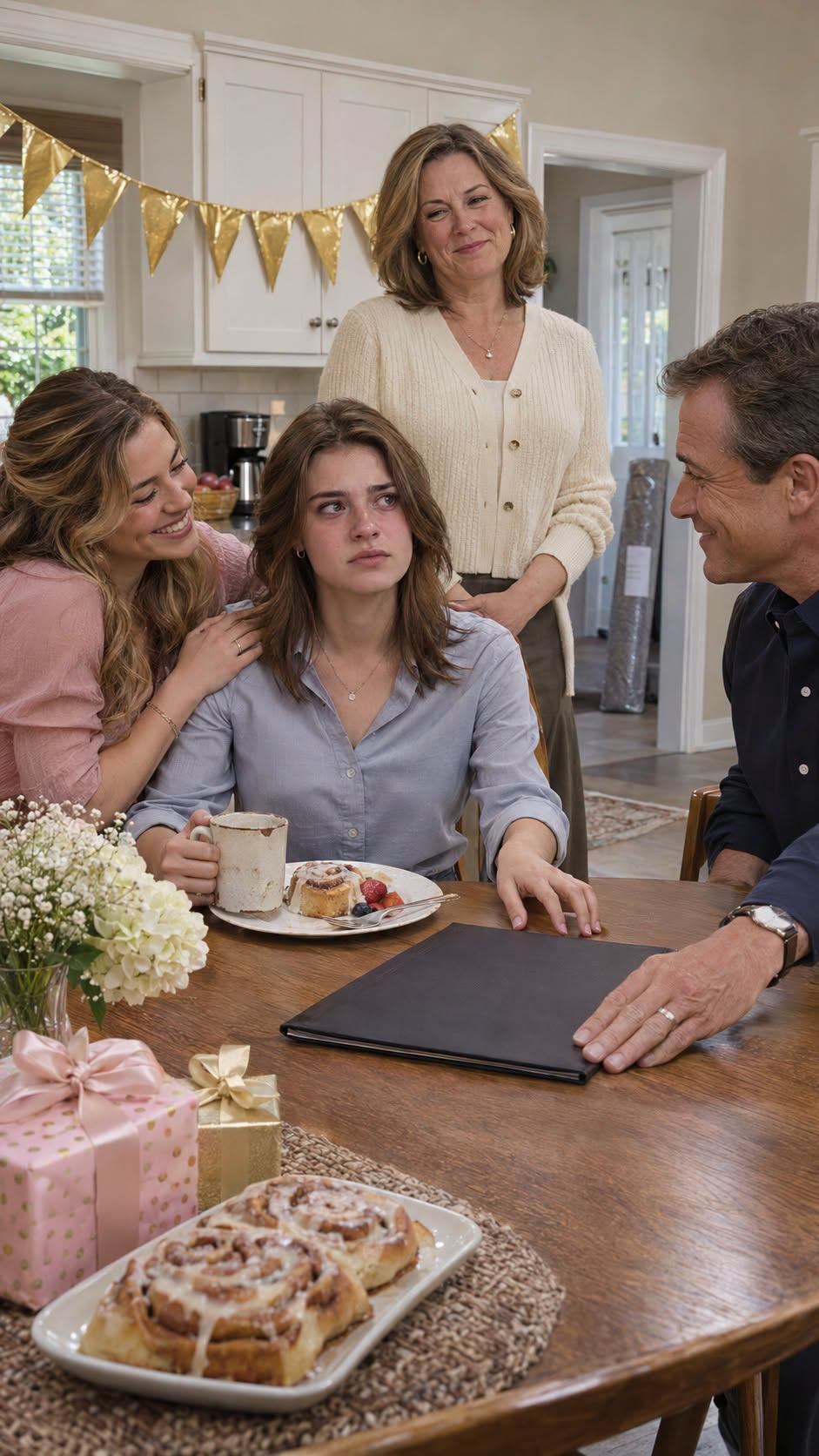
I heard the garage door opening and quickly returned the real estate documents to their original positions.
My mother's car was already outside.
That meant Dad had come home.
I grabbed a glass from the cabinet, filled it with water, and tried to look like someone who hadn't just discovered that her eighteenth birthday was being treated as a financial transaction.
Dad entered the kitchen carrying his leather briefcase.
"You're home early."
"Study hall was canceled."
He nodded, set his briefcase on the counter, and immediately noticed the paperwork.
His eyes moved from the documents to my face.
"Did you need something?"
"No. Just getting water."
He gathered the papers without another word.
I watched him disappear into his study.
A few seconds later, I heard the door close.
Then came the unmistakable sound of the lock turning.
My father had never locked his study during the afternoon before.
I went upstairs, closed my bedroom door, and sat on the edge of my bed.
My hands were shaking.
I wanted to believe there was an innocent explanation.
Perhaps my parents were planning to borrow money temporarily. Perhaps they intended to discuss everything with me before making a decision. Perhaps the note about my birthday referred to something completely unrelated.
But every explanation required me to ignore something I had already seen.
Rebecca's messages.
The expensive house.
My mother's handwriting.
My father's evasiveness.
And now, the funding estimate.
I opened my nightstand drawer.
Beneath an old birthday card and a collection of inexpensive jewelry was a little brass key attached to a faded leather ring.
I picked it up.
The metal felt cold against my palm.
It had been almost ten years since Grandpa gave it to me, and five years since I had last heard his voice.
Yet whenever I held that key, I could remember exactly how it felt to be loved without having to earn it.
Walter Bennett wasn't the kind of grandfather who arrived at family gatherings wearing expensive clothes or talking about his accomplishments.
He drove an old pickup truck long after he could afford something better. He wore work shirts with his name stitched above the pocket. His hands were rough, his fingernails were rarely spotless, and he had a habit of carrying a small notebook everywhere.
He had built a mechanical contracting business from a single truck and a borrowed set of tools.
By the time I was born, the company employed dozens of people.
By the time I was eight, it had become one of the most respected independent contracting businesses in central Ohio.
But Grandpa never seemed particularly impressed by his own success.
He was more interested in whether a machine worked properly, whether his employees were paid fairly, and whether the people around him kept their promises.
Especially that last part.
"Anybody can make a promise, Poppy," he once told me. "Pay attention to what they do when keeping it costs them something."
I was too young to understand.
Years later, I would discover that those words explained almost everything about my family.
Grandpa lived in a modest brick house about twenty minutes from ours. Behind it stood a detached workshop with a green metal door and two narrow windows.
To me, that workshop was more magical than any amusement park.
There were drawers filled with screws, shelves lined with old radios, wooden boxes containing mysterious mechanical parts, and tools hanging neatly against a pegboard.
Everything had a place.
Everything had a purpose.
Even things that appeared broken were treated as though they deserved another chance.
On my eighth birthday, Grandpa took me there after our family celebration.
Rebecca had received most of the attention that afternoon because she had recently won an art competition.
I didn't mind.
At least, that was what I told everyone.
Grandpa noticed anyway.
He drove me to his house, made two mugs of hot chocolate, and placed a small envelope on his workbench.
"What's this?" I asked.
"Open it."
Inside was the brass key.
I held it up.
"What does it open?"
He pointed toward the workshop door.
"This place."
I looked at him in astonishment.
"Really?"
"Really."
"But what if I lose it?"
"Then we'll figure something out."
"What if I break something?"
"We'll fix it."
"What if I do something wrong?"
He smiled.
"Then you'll learn something."
I stared at the key.
Nobody had ever given me permission to make mistakes before.
At home, being good meant avoiding inconvenience.
With Grandpa, being good meant trying, learning, and taking responsibility.
He pulled a stool toward the workbench.
"A key means somebody trusts you," he said. "It doesn't mean you're perfect. It means they believe you'll respect what belongs to them."
I slipped the leather ring around my finger.
"Can Rebecca have one too?"
Grandpa chuckled.
"Rebecca has her own gifts. This one is yours."
Mine.
He said the word so naturally.
As though something could belong to me without requiring an explanation.
As though receiving something didn't create an obligation to give it away.
I didn't realize how unusual that feeling was until much later.
Over the following years, Grandpa taught me things nobody else thought an ordinary little girl needed to know.
How to read a tape measure.
How to change batteries in a smoke detector.
How to check the oil in a car.
How to recognize when someone was charging too much for a simple repair.
He also taught me how to read numbers.
One Saturday morning, when I was eleven, I helped him organize receipts at his kitchen table.
He handed me a calculator and a stack of invoices.
"Tell me if those totals match."
I worked carefully, adding each amount twice.
One invoice contained an error.
It was only twenty-seven dollars.
I pointed it out.
Grandpa examined the receipt.
"Good catch."
"Does twenty-seven dollars matter when you have a whole company?"
He put down his coffee.
"Every dollar belongs somewhere."
I waited.
"If somebody makes an honest mistake, you correct it. If somebody deliberately hides where money went, that's a different problem."
"How do you know the difference?"
"You ask questions."
"What if they get angry?"
He leaned back in his chair.
"Getting angry isn't an answer."
I remembered that conversation as I sat in my bedroom holding the brass key.
Every time I had asked Dad about the trust, he had become irritated.
Every time I requested information, he reminded me that he was my father.
Every time I questioned a withdrawal, he made me feel guilty.
Getting angry wasn't an answer.
Grandpa had told me that years before I needed to hear it.
I wondered whether he had known something about Dad that I didn't.
There had always been tension between them.
Nothing dramatic enough for outsiders to notice, but enough that I remembered certain conversations.
Dad wanted Grandpa to expand the company more aggressively.
Grandpa preferred steady growth.
Dad believed appearances were important.
Grandpa believed reputation mattered more than appearances.
Dad liked talking about opportunities.
Grandpa wanted to see the numbers behind them.
Once, during Thanksgiving dinner, Dad announced that Grandpa should invest in a business venture involving one of his friends.
He described it as a guaranteed opportunity.
Grandpa asked three questions.
Who was responsible for the debt?
Where were the financial statements?
What happened if the business failed?
Dad couldn't answer any of them.
"You're always looking for reasons not to do something," Dad complained.
Grandpa continued eating his dinner.
"No. I'm looking for reasons to trust the people asking for my money."
Dad didn't speak to him for the remainder of the evening.
I was twelve at the time.
I remembered Mom following Grandpa into the hallway before he left.
She spoke quietly, but I heard part of their conversation.
"Glenn just wants a chance to prove himself."
Grandpa sighed.
"Then he needs to build something of his own."
"He's your son."
"I know exactly who he is."
Something about the way Grandpa said those words stayed with me.
He hadn't sounded angry.
He had sounded tired.
A year later, everything changed.
Grandpa sold his company.
The sale had been under discussion for months, although I understood very little about it.
I knew he wanted to retire.
I knew his knees hurt more frequently.
I knew his doctor had encouraged him to reduce his workload.
And I knew Dad was unusually interested in the sale.
He started visiting Grandpa more often.
He asked questions about retirement plans, investment opportunities, and property values.
Sometimes Mom accompanied him.
They always sent me outside or asked me to watch television when the conversation turned to money.
One afternoon, Grandpa found me sitting on his back porch, drawing circles in a notebook.
"What's bothering you?"
"Nothing."
He sat beside me.
"That's a pretty heavy nothing."
I hesitated.
"Is Dad mad at you?"
Grandpa looked toward the workshop.
"Your father and I disagree about a few things."
"About the company?"
"Among other things."
"Did you do something wrong?"
He smiled sadly.
"No, sweetheart."
"Did Dad?"
Grandpa didn't answer immediately.
Instead, he took the notebook from my lap and turned to a blank page.
He drew two small circles.
"This one's you," he said, pointing to the first.
"And this one's somebody you love."
He drew a line between them.
"Being connected to someone is a wonderful thing. But being connected doesn't mean you stop being your own person."
I studied the drawing.
"Like me and Rebecca?"
"Exactly."
He drew a larger circle around both.
"Family can help you grow. It can give you somewhere to belong. But nobody inside that circle owns anybody else."
I nodded.
He handed back the notebook.
"Remember that."
At thirteen, I thought Grandpa was teaching me about independence.
At seventeen, I began to suspect he had been preparing me for something.
Not long after selling his business, Grandpa established a trust containing three million dollars for my benefit.
I didn't learn all the details immediately.
He explained that the money was intended to give me a secure future.
College, a home, a business, or whatever meaningful direction I eventually chose.
He didn't want me to spend my life trapped in circumstances simply because I couldn't afford another option.
My father would manage the trust until I reached eighteen, subject to the instructions Grandpa had established.
At the time, I didn't understand why Grandpa had chosen Dad.
Later, I wondered whether it had been one final act of faith in his son.
Perhaps Grandpa believed responsibility would encourage Dad to become more responsible.
Perhaps he wanted to give him the opportunity to honor a commitment.
Whatever the reason, I knew Grandpa had not intended the trust to become a family checking account.
He made that clear during one of our final conversations.
By then, he was seriously ill.
His workshop remained closed most days.
The pickup truck sat unused in the driveway.
His hands, once strong enough to loosen stubborn bolts, had become thin and unsteady.
I hated seeing him that way.
Every visit felt like something precious was slipping through my fingers.
One evening, I sat beside his bed while Mom and Dad spoke with a nurse downstairs.
Grandpa reached for my hand.
"You still have your key?"
I nodded.
"Good."
He looked toward the bedroom door.
"There's something I need you to remember."
I leaned closer.
"When you turn eighteen, call Fran Whitaker before you sign anything."
"Who's Fran?"
"My financial adviser."
"Why do I need to call her?"
"Because she understands the arrangements I've made for you."
I frowned.
"Won't Dad explain everything?"
Grandpa squeezed my fingers.
"Your father has responsibilities. Fran can help you understand your rights."
The distinction meant little to me then.
"Is something wrong?"
"No. I just want you to have someone independent to talk to."
He paused to catch his breath.
"Promise me."
"I promise."
"Before you sign anything."
"I won't forget."
He relaxed against the pillow.
For a while, neither of us spoke.
Then he looked at me with the same gentle expression he had worn when he gave me the brass key.
"You're a good kid, Poppy. But you don't have to prove it by giving people everything they ask for."
My eyes filled with tears.
I didn't know why those words hurt so much.
Maybe because nobody had ever told me that being generous and having boundaries could exist together.
Maybe because I was beginning to understand that Grandpa wouldn't always be there to remind me.
He died several weeks later.
At his funeral, people filled the church.
Former employees.
Customers.
Neighbors.
Men who had worked beside him when the company was nothing more than a truck and a toolbox.
They told stories about his kindness.
About the time he paid an employee's wages while the man's wife was recovering from surgery.
About the young apprentice he helped through technical school.
About the customers he refused to overcharge, even when they wouldn't have known the difference.
I sat between Rebecca and Mom, holding the brass key inside my coat pocket.
Dad delivered the eulogy.
He spoke about integrity, hard work, and family loyalty.
Everyone applauded when he finished.
I cried because I missed Grandpa.
I never imagined that five years later, Dad would use those same ideas about family loyalty to justify taking money Grandpa had left specifically for me.
After the funeral, Grandpa's house was eventually sold.
The workshop was emptied.
Dad told me there was no reason to keep old tools that nobody would use.
I asked whether I could have something from the workbench.
He gave me Grandpa's old tape measure.
I kept it beside the brass key.
The key no longer opened a door I could visit.
But I couldn't bring myself to throw it away.
Now, sitting in my bedroom at seventeen, I understood that Grandpa had given me something more valuable than access to a workshop.
He had taught me that trust wasn't the same thing as obedience.
And I was beginning to realize that my parents expected me to confuse the two.
I opened my laptop and searched for Fran Whitaker.
Her professional profile appeared almost immediately.
She still worked in central Ohio.
Her photograph showed a woman in her late fifties with short brown hair, glasses, and a composed expression.
I copied her office number into my notebook.
For several minutes, I considered calling.
Then I stopped.
What would I say?
That my parents were looking at expensive houses?
That Rebecca had sent me strange messages?
That my mother had written something suspicious beside a floor plan?
I had concerns.
But I didn't yet have enough information to explain precisely what was happening.
I decided to gather my records first.
I pulled the shoebox from beneath my bed and spread the statements across my desk.
Some were photographs I had printed.
Others were copies of documents Dad had left around the house.
I arranged them by date.
Then I created a spreadsheet.
Opening balances.
Closing balances.
Investment returns.
Fees.
Distributions.
I worked until my eyes began to ache.
There were gaps in the records, and I knew I couldn't draw reliable conclusions without the missing statements.
Still, several withdrawals caught my attention.
They were much larger than ordinary account fees.
I marked each one.
Then I opened my old messages with Rebecca.
I began comparing dates.
One withdrawal occurred shortly before she announced that her Chicago rent problem had been resolved.
Another appeared near the time her art studio closed.
A third coincided with the arrival of her replacement car.
Coincidences weren't proof.
Grandpa had taught me better than that.
But three coincidences were enough to make me uncomfortable.
I closed the laptop when I heard Mom calling me downstairs for dinner.
Rebecca was visiting that weekend.
She arrived carrying a bottle of sparkling cider and a collection of paint samples.
Mom hugged her.
Dad asked how the apartment search was going.
Rebecca glanced toward me and grinned.
"Pretty soon, I won't have to worry about apartments anymore."
Mom gave her a warning look.
Rebecca laughed.
"Oops."
I pretended not to notice.
During dinner, they discussed her artwork, a potential gallery exhibition, and furniture she wanted to purchase.
Nobody mentioned the house directly.
But when Rebecca described a large room with beautiful natural light, Mom interrupted.
"We might need that room for something else."
Rebecca frowned.
"I thought we agreed it would be my studio."
"We'll discuss it later."
Dad changed the subject.
I kept eating.
That evening, Rebecca showed me a photograph of a dining table she liked.
"Can you imagine having Thanksgiving at my place?"
"It looks expensive."
She shrugged.
"Dad says we shouldn't worry about the furniture budget yet."
I looked at her.
"Who's paying for everything?"
She smiled.
"You're going to find out soon."
She kissed my cheek and went downstairs.
I stood in my bedroom doorway long after she disappeared.
Something was happening around me, and everyone seemed to know more about it than I did.
Even Rebecca, who apparently believed I was responsible for making her dream possible, had been instructed to keep the details from me.
I thought about Grandpa's final request.
Call Fran Whitaker before you sign anything.
He hadn't said to call her if something went wrong.
He hadn't said to call her if I became suspicious.
He had said to call her before signing anything.
The specificity suddenly frightened me.
Why had he been so concerned about my signature?
What had he imagined someone might ask me to sign?
I retrieved my phone and entered Fran's number.
Before I could press the call button, I heard Dad's voice downstairs.
He was speaking loudly enough that I could hear him through the heating vent near my desk.
I put the phone down.
"Yes, we've discussed the purchase price."
A pause.
"No financing. It'll be a cash transaction."
My heart began pounding.
I moved toward my bedroom door.
Dad was in his study.
The door was partly open.
I stepped into the hallway and approached quietly.
"The funds will be available after her birthday," he continued.
I stopped.
Another pause.
"Yes, everything is arranged."
My fingers closed around the brass key.
For the first time, I wasn't listening to vague promises or trying to interpret somebody's handwriting.
I was hearing my father discuss a real transaction.
A transaction that depended on my birthday.
I waited for him to say that he still needed to speak with me.
He didn't.
Instead, he laughed.
"She's a good kid. She understands the importance of family."
My stomach tightened.
He continued speaking.
"We're closing the next morning."
I stepped backward.
My heel touched a loose floorboard.
It creaked.
Dad stopped talking.
I hurried toward my bedroom and slipped inside before he reached the hallway.
For several seconds, I stood motionless behind my door.
Then I heard his footsteps retreat.
I returned to my desk.
My phone was still displaying Fran Whitaker's number.
I was about to save it when another sound came from downstairs.
Mom's voice.
"Did you tell her about the buyer's name?"
Dad answered quietly.
"Not yet."
"And if Poppy refuses?"
There was a long silence.
I moved closer to the doorway.
Then my father spoke.
"She won't refuse once she sees what I've prepared."
A drawer opened.
Paper rustled.
My mother asked him what he intended to do with the document.
Dad lowered his voice.
I couldn't hear his answer.
But a moment later, my mother's footsteps approached the staircase.
I rushed back to my desk.
The brass key slipped from my fingers and struck the floor.
I bent to retrieve it.
Before I could stand, my bedroom door opened.
Dad was standing there.
And in his hand was a document with my name already printed beneath the signature line.






Comments 0