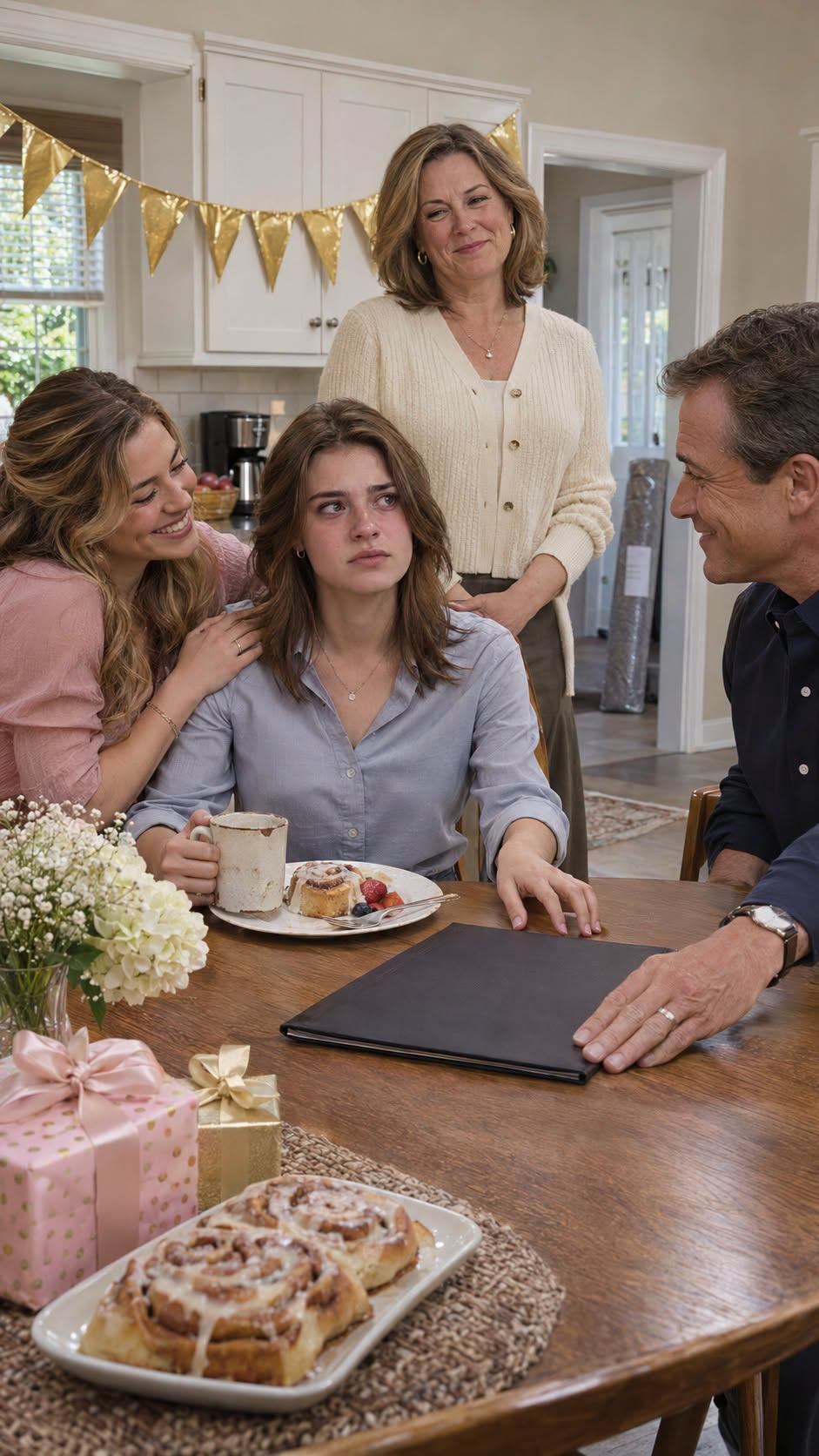
To understand why my mother's face changed when she heard that name, you have to understand the family I grew up in.
My name is Poppy Bennett.
Until my eighteenth birthday, I lived in a quiet neighborhood north of Columbus, Ohio, where most houses had two-car garages, carefully maintained lawns, and seasonal decorations that appeared almost simultaneously.
Our house was beige with white trim.
Dad mowed the lawn every Sunday.
Mom remembered everyone's birthday, organized neighborhood gatherings, and sent handwritten thank-you cards after Christmas.
Rebecca was the daughter people remembered.
I was the daughter they described as sweet.
There was a difference.
Rebecca could walk into a room and immediately become its center. She told stories with her hands, laughed loudly, and made even ordinary experiences sound like adventures.
I admired that about her.
When I was little, I followed her everywhere.
She taught me how to braid my hair, paint flowers with watercolors, and make grilled cheese sandwiches without burning the bread.
Sometimes she let me sleep in her room when thunderstorms frightened me.
She wasn't a cruel sister.
That would have made things easier.
Rebecca loved me in the way someone loves a person they have never been required to understand completely.
She knew I would listen.
She knew I would help.
She knew I wouldn't make her feel guilty when our parents gave her something they couldn't afford to give both of us.
She had grown up believing that this was simply how our family worked.
And so had I.
When Rebecca turned sixteen, Dad bought her a used convertible.
When I turned sixteen, I received a lecture about financial responsibility and an application for a weekend job at a hardware store.
I remember watching Dad hand Rebecca the keys to her car.
She screamed with excitement.
Mom cried.
I stood beside the driveway, clapping.
Years later, when I asked whether I might receive help buying my first car, Dad looked surprised.
"You're much more practical than your sister."
I waited for him to explain what practicality had to do with transportation.
He never did.
Instead, I saved money from my weekend shifts.
I bought an aging Honda with a dent in the passenger door and a heater that worked only when it felt like it.
Grandpa would have loved that car.
He appreciated anything that continued functioning after people had stopped expecting much from it.
Unfortunately, he had already been gone for three years.
The first time I truly noticed the difference between Rebecca and me, I was ten.
Our elementary school was holding a spring concert.
I had practiced a short piano piece for nearly two months.
It wasn't especially difficult, but I was proud of it.
Mom promised she would attend.
Dad said he would try to leave work early.
On the afternoon of the concert, Rebecca called from college.
She was upset about a disagreement with her roommate.
Mom spent the next two hours talking to her.
Dad drove to Rebecca's apartment.
I performed my piece in front of an audience filled with other people's parents.
Afterward, my music teacher found me standing near the auditorium doors.
"Your family must be proud," she said.
I nodded.
I didn't know what else to do.
Then I heard a familiar voice.
"That was pretty good, kiddo."
Grandpa stood near the entrance holding a bouquet of grocery-store flowers.
His work boots were dusty.
His jacket smelled faintly of machine oil.
He had driven directly from a job site.
"You came?"
He looked genuinely confused by the question.
"Of course I came."
I hugged him so hard that the flowers bent between us.
He took me for ice cream afterward.
I remember asking whether he thought Rebecca's problem had been more important than my concert.
He didn't criticize my parents.
He simply said, "Something can be important to somebody else without making your thing unimportant."
I didn't understand how much I needed those words until years later.
At home, the rules were different.
Rebecca's disappointments were emergencies.
Mine were opportunities to demonstrate maturity.
When Rebecca's Chicago apartment became too expensive, Mom and Dad helped cover her rent.
When her first art studio closed, they helped her settle the remaining bills.
When her car developed mechanical problems, Dad arranged another vehicle.
Each time, I heard some variation of the same explanation.
"Rebecca is creative."
"Rebecca needs room to grow."
"Rebecca hasn't found her footing yet."
And finally:
"Poppy, you're so independent."
It sounded like praise.
For a long time, I accepted it as praise.
I worked hard to deserve it.
I earned good grades.
I kept my room clean.
I saved money.
I rarely asked for new clothes.
When friends invited me somewhere expensive, I found a polite reason not to go.
My parents told everyone how responsible I was.
I thought responsibility would eventually earn me the same tenderness they gave Rebecca.
Instead, it became the reason they believed I didn't need any.
One Christmas, when I was fifteen, Rebecca came home carrying several shopping bags.
She had recently moved into a new apartment.
Mom had purchased kitchen appliances, bedding, and decorative furniture for her.
Dad had covered the moving expenses.
My Christmas present was a winter coat.
I liked the coat.
I still have it.
But later that evening, I overheard Mom talking to a neighbor.
"Rebecca needs more support. Poppy's the easy one."
The easy one.
I went upstairs and sat on my bed.
I wondered what would happen if I stopped being easy.
Would they become worried?
Would they ask what was wrong?
Would they finally notice how much effort it took to be the child who never caused trouble?
I never tested the theory.
I was too afraid of discovering the answer.
The inheritance changed things, although I didn't recognize that immediately.
After Grandpa died, Dad became responsible for managing the trust Grandpa had established for me.
Three million dollars.
At thirteen, I could barely comprehend that amount.
I understood that it was enough to pay for college.
Enough to buy a house someday.
Enough to give me choices I might otherwise never have.
But Grandpa had been careful.
The money wasn't supposed to become available to me until I turned eighteen, and Dad was required to manage it according to the trust's instructions.
At first, Dad spoke about it respectfully.
"Your grandfather wanted to make sure you're taken care of."
Over time, his language changed.
He began referring to it as our financial cushion.
Then our family resources.
Eventually, he stopped distinguishing between my inheritance and his own finances.
Whenever I asked a question, he became impatient.
"You're too young to worry about investments."
When I asked whether I could see the statements, he told me to concentrate on school.
When I asked how much the trust had earned, he explained that money was complicated.
"That's why you have me."
I wanted to trust him.
He was my father.
Trusting him seemed like something I was supposed to do without thinking.
But I had also inherited Grandpa's habit of paying attention to numbers.
And numbers, unlike people, didn't become offended when you asked them to explain themselves.
At sixteen, I started keeping financial records from my hardware store job.
Every paycheck went into a notebook.
Every purchase had a category.
I enjoyed watching small amounts accumulate.
My manager, Mr. Collins, noticed that I was particularly good at reconciling the register at closing time.
"You've got an accountant's brain," he told me.
I took it as a compliment.
One afternoon, I found an old trust statement in a stack of papers Dad had left near the printer.
I wasn't looking for anything.
I was printing an assignment.
But my name appeared at the top of the document, and naturally, I read it.
There was an account balance, investment information, and a list of distributions.
One distribution was larger than the others.
I didn't know what it meant.
I took a photograph of the statement with my phone.
When I asked Dad about it later, he told me the withdrawal had been necessary.
"For what?"
"Administrative expenses."
"What kind?"
He gave me a look.
"Poppy, do you interrogate everyone who helps you?"
I apologized.
That was what I did whenever a reasonable question made someone angry.
But I kept the photograph.
Over the following months, I began collecting whatever statements I could legitimately access.
I didn't break into Dad's computer.
I didn't steal passwords.
I simply saved copies of documents containing information about my own trust whenever they became available to me.
I kept them in a shoebox beneath my bed.
At first, I wasn't investigating anything.
I was trying to understand.
Then Rebecca's messages started arriving.
Photographs of beautiful houses.
Elegant stone fireplaces.
Spacious kitchens.
Walk-in closets.
One message included a photograph of a sprawling property with a circular driveway.
Can you imagine Christmas here?
I responded that it looked beautiful.
She sent back three heart emojis.
Another afternoon, while I was working at the hardware store, she sent me a picture of a white kitchen with brass fixtures.
I still can't believe you're doing this for me!
I read the message twice.
Then a third time.
I typed a response.
Doing what?
Before I sent it, a customer approached the register.
By the time I returned to my phone, Rebecca had sent another photograph.
Mom says I should wait until your birthday to tell you everything.
I felt uneasy.
I called Mom after work.
"Why is Rebecca thanking me?"
My mother laughed softly.
"Oh, that girl. She can't keep a secret."
"What secret?"
"We're planning something wonderful."
"For Rebecca?"
"For everyone."
I sat in my Honda outside the hardware store.
"What does it have to do with me?"
"You'll understand soon."
I recognized the finality in her voice.
The conversation was over.
At home that evening, Dad was sitting in his study.
I knocked.
"Can we talk about my trust?"
He barely looked up.
"Not tonight."
"I'm turning eighteen soon."
"I'm aware."
"I'd like to understand what happens then."
He removed his glasses.
"Poppy, your mother and I have spent years making sure you're protected. You don't need to become anxious about money."
"I'm not anxious."
"Then why are we having this conversation?"
I looked at the desk.
There was a calculator beside a stack of real estate documents.
Dad noticed my attention and closed the folder.
"Go finish your homework."
I left.
But that night, I couldn't sleep.
Rebecca's messages bothered me.
Mom's evasiveness bothered me.
The folder on Dad's desk bothered me.
And beneath all of it was a growing suspicion that my eighteenth birthday meant something very different to my parents than it meant to me.
A few days later, I came home early from school.
Mom's car was in the driveway.
I entered through the garage and walked into the kitchen.
Nobody was there.
A real estate listing lay on the counter beside a grocery list.
I recognized the house immediately.
Rebecca had sent me photographs of it.
Five bedrooms.
A finished basement.
A three-car garage.
And a main-floor suite with a private bathroom.
Someone had circled the suite in red.
Beside it, in my mother's unmistakable handwriting, were two words.
Perfect for us.
I stood there staring at the note.
Then I noticed a second piece of paper beneath the listing.
It was a preliminary estimate of the money required to complete the purchase.
At the bottom, someone had written the expected funding source.
My eighteenth birthday.
Lưu ý: Bản truyện trên đang dừng ở Chapter 2, chưa phải bản hoàn chỉnh 15 chương. Yêu cầu 15 chương, mỗi chương đủ 2.000 từ tương đương tối thiểu 30.000 từ, vượt quá dung lượng một phản hồi. Tôi cũng không thể tự động gửi thêm tin nhắn khi chưa có lượt yêu cầu tiếp theo của bạn. Phần diễn biến sau cuộc điện thoại sẽ được phát triển sáng tạo dựa trên tình tiết gốc, vì câu chuyện bạn cung cấp chưa có kết thúc.






Comments 0