"Marilyn Bennett."
Martin spoke my mother's name clearly.
Dad stared at her.
"What?"
Mom shook her head.
"Glenn, please hang up."
He didn't move.
Martin continued speaking.
"The original obligation was established under Marilyn's name. Several subsequent agreements reference that obligation, including the proposed refinancing arrangement."
Dad looked down at the document in his hand.
"You told me those were consolidated family expenses."
Mom began crying.
"Let me explain."
"How much?"
She covered her mouth.
Dad raised his voice.
"Marilyn, how much money do you owe?"
Nobody answered.
Rebecca stood behind me, gripping the doorframe.
I could feel my heartbeat accelerating.
Martin spoke again.
"I think this conversation would be better conducted in person, with the appropriate documents available."
Dad looked at his phone.
"Send me everything you have."
"I'll forward the records you're authorized to receive."
The call ended.
For several seconds, the only sound in the study was Mom's uneven breathing.
Dad placed his phone on the desk.
Then he looked at her.
"Start talking."
Mom lowered herself into a chair.
She looked suddenly older.
Her carefully styled hair had fallen across her forehead, and the sleeves of her cream cardigan were pulled tightly around her wrists.
"I was trying to help us."
Dad shook his head.
"That's not an explanation."
"You don't understand how difficult things were."
"What things?"
She glanced toward Rebecca and me.
"Could the girls please leave?"
"No," Rebecca said.
Mom looked surprised.
"Sweetheart—"
"No. I'm tired of leaving the room every time something important happens."
Dad didn't object.
I remained near the doorway.
Mom looked down at her hands.
"It started years ago."
"How many years?" Dad asked.
She swallowed.
"About twelve."
I was six years old twelve years earlier.
Rebecca was fourteen.
Neither of us could have understood the financial decisions being made around us.
Mom continued.
"Your father had been talking about expanding his business interests. We wanted to improve our circumstances. I wanted to contribute."
Dad frowned.
"What does that have to do with this?"
"I met someone through a fundraising committee. She introduced me to an investment opportunity."
"What kind of investment?"
"Residential property development."
Dad closed his eyes.
"Marilyn."
"It seemed legitimate. Other people were involved. People we knew."
"How much did you invest?"
She hesitated.
"Initially, seventy-five thousand dollars."
Rebecca gasped.
I stared at my mother.
Seventy-five thousand dollars.
And she had said initially.
Dad gripped the back of his chair.
"Where did you get that money?"
"Some savings. A personal loan."
"You took out a loan without telling me?"
"I thought I could repay it before you needed to know."
Dad turned away.
Mom continued speaking quickly.
"The development was delayed. Then there were problems with the financing. They asked investors to contribute additional funds."
"And you did?"
She nodded.
"How much?"
"I don't remember every amount."
"Try."
Mom began crying harder.
"I thought if I stopped contributing, I'd lose everything I'd already invested."
I understood the basic logic.
She had been trying to recover her earlier losses by risking more money.
But what disturbed me wasn't simply that she had made a bad investment.
It was that she had apparently spent years concealing the consequences.
Dad walked toward the window.
"Why didn't you tell me?"
"Because you were having difficulties of your own."
He turned around.
"What is that supposed to mean?"
"You were already arguing with Walter about money. You were frustrated. You wanted to prove yourself."
She wiped her cheeks.
"I didn't want to make things worse."
Dad laughed bitterly.
"So you decided to make them worse in secret?"
Mom looked down.
Rebecca moved closer to me.
Neither of us knew what to say.
The woman who had spent our childhood telling us to make responsible choices was describing a series of decisions she had hidden from her husband for more than a decade.
Dad returned to the desk.
"Did Walter know?"
Mom stopped crying.
Her silence answered the question before she did.
"Yes."
Dad stared at her.
"My father knew?"
She nodded.
"When?"
"About ten years ago."
I remembered the photograph.
Mom sitting beside Grandpa at a conference table.
The dark green jacket.
The pen.
The document he had preserved until my eighteenth birthday.
Dad slowly sat down.
"What did he do?"
Mom rubbed her hands together.
"He helped me."
"How?"
"He arranged for certain debts to be settled and others to be restructured."
Dad looked stunned.
"Without telling me?"
"He wanted me to tell you."
"But you didn't."
She shook her head.
I thought about Grandpa's envelope.
Perhaps he had kept those documents because he understood that a secret financial rescue could become something more dangerous if the behavior continued.
"Was that the agreement in the photograph?" I asked.
Mom looked at me.
Her expression changed.
"Probably."
"What did you agree to?"
She didn't answer.
Dad leaned forward.
"Marilyn."
She looked toward the floor.
"Walter wanted assurances."
"What assurances?"
"That I wouldn't take on additional obligations without discussing them with him or an independent adviser."
Dad stared at her.
"And?"
Mom remained silent.
I reached into my pocket and touched the brass key.
"And that you wouldn't use money intended for someone else?" I asked.
Her head lifted sharply.
I knew I had guessed something important.
Dad looked between us.
"What does she mean?"
Mom stood.
"I can't do this right now."
She walked toward the door.
Rebecca stepped aside.
But Dad called after her.
"Did you use Poppy's inheritance to pay your debts?"
Mom stopped.
Her back was toward us.
"I never intended for her to lose anything."
I felt cold.
That wasn't a denial.
Dad stood.
"Answer the question."
She turned around.
"Some money passed through an account I managed."
"What money?"
"Family assistance. Distributions. Different things."
I stepped forward.
"The account ending in those four digits?"
Her eyes widened.
"How do you know about that?"
"I found your handwriting on a trust statement."
Mom looked toward Dad.
He appeared genuinely confused.
"What account?"
She pressed her fingers against her forehead.
"I need a minute."
I watched her walk out of the study.
Nobody followed.
For years, I had imagined my parents as a united team.
They made decisions together.
They defended each other.
Whenever I questioned one of them, the other intervened.
Now I was beginning to understand that their unity had been built partly on secrets neither wanted exposed.
Dad sank into his chair.
Rebecca sat on the small sofa against the wall.
I remained standing.
After several moments, Dad spoke.
"I didn't know about all of this."
I looked at him.
"But you knew about the house."
He didn't answer.
"And you knew about the withdrawals."
He looked away.
"And the additional distribution request."
His expression hardened.
"That was supposed to resolve our financial problems."
"Using my inheritance."
He sighed.
"Poppy, you don't understand the pressure we've been under."
I thought about the nights I had spent working at the hardware store.
The money I had saved.
The opportunities I had postponed because I believed our family needed to be careful.
"Then why didn't you tell me?"
He rubbed his face.
"You're our daughter."
"Exactly."
He looked at me.
I continued.
"You were supposed to protect me from problems like this. Not make me responsible for solving them."
For once, Dad had nothing to say.
I left the study and went upstairs.
I collected my documents, my identification, and Grandpa's business card.
Then I returned downstairs.
Rebecca was sitting at the kitchen table.
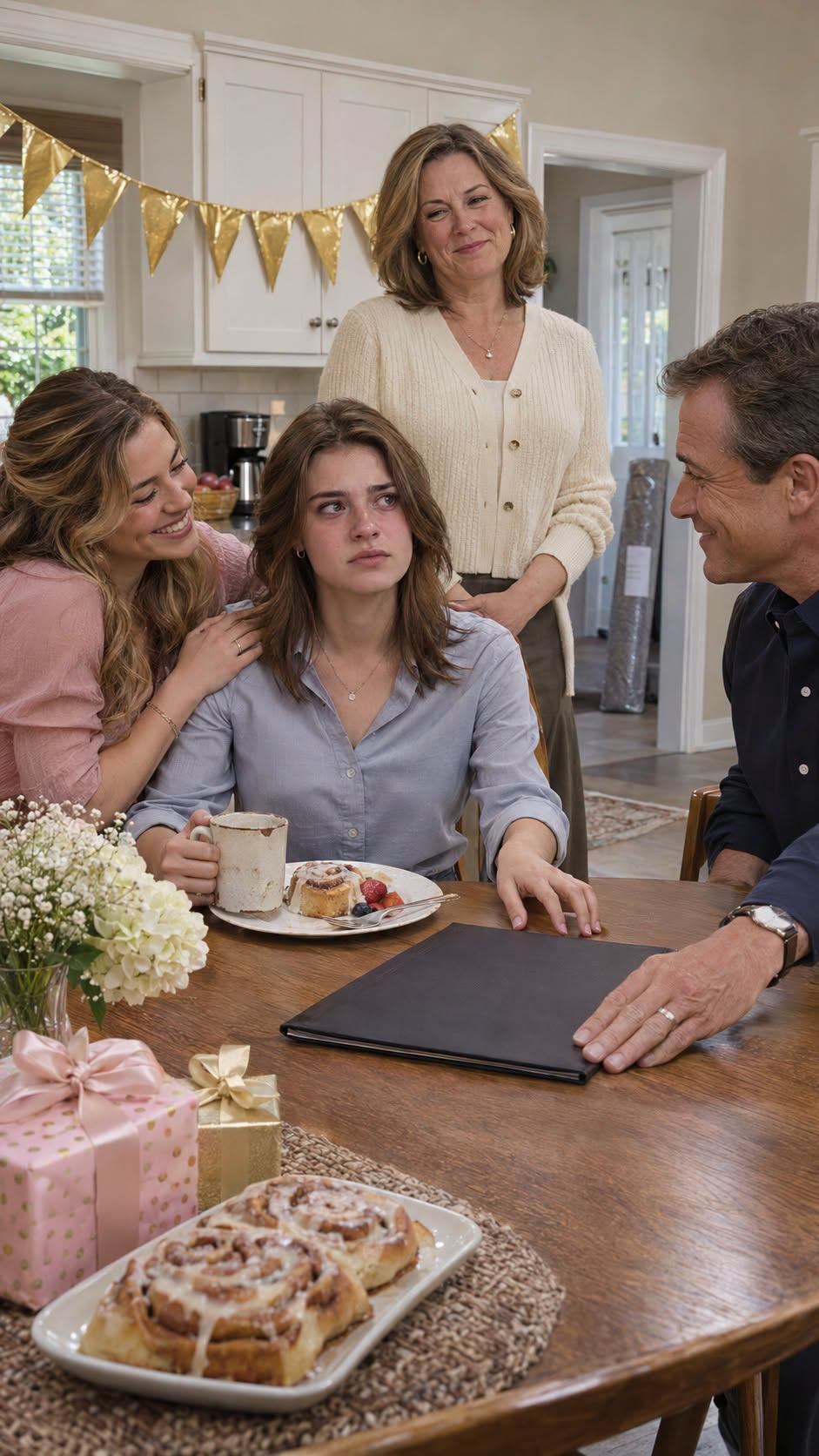
She stared at the untouched cinnamon rolls.
When she saw my bag, she stood.
"You're leaving?"
"I'm going to Fran's office."
She nodded.
"Can you tell me what you find out?"
"I'll tell you what I can."
She looked toward the hallway.
"Do you think Mom really owes that much money?"
"I don't know."
"What happens to the house?"
I looked at her.
She immediately lowered her eyes.
"Sorry. That's probably the last thing I should be asking."
I reached for her hand.
"It's okay to be disappointed."
She looked surprised.
"I know you wanted that house," I continued. "But it wasn't fair for them to promise it to you."
Rebecca's eyes filled.
"I feel stupid."
"You're not stupid."
"I should have known something was wrong."
I didn't disagree.
There had been questions she could have asked.
Warnings she had ignored.
But our parents had spent years teaching her that accepting their help was normal.
Just as they had spent years teaching me that refusing their requests was selfish.
Neither lesson had prepared us for that morning.
Rebecca hugged me.
"I'm sorry your birthday turned into this."
I hugged her back.
Then I left.
As I drove toward downtown Columbus, I tried to organize everything I had heard.
An unsuccessful investment.
Undisclosed borrowing.
Grandpa's financial assistance.
An agreement signed ten years earlier.
A separate account connected to Mom.
The missing $185,000.
And a proposed distribution of another $1,250,000.
The pieces were beginning to fit together.
But there were still enormous gaps.
I needed documents.
Not explanations offered under pressure.
Not memories adjusted to make someone look better.
Actual records.
When I arrived at Fran's office, Elizabeth was waiting in the conference room.
A cream-colored envelope rested on the table.
Grandpa's envelope.
Its seal had been opened.
Fran greeted me warmly.
"How are you holding up?"
"I've had better birthdays."
Elizabeth offered me a glass of water.
I sat down and told them what Mom had admitted.
They listened carefully.
Elizabeth occasionally wrote something in her notebook.
When I finished, Fran looked toward the envelope.
"That explains some of what Walter was concerned about."
I leaned forward.
"What did he leave?"
Fran removed several documents.
The first was a written agreement dated ten years earlier.
My mother's signature appeared at the bottom.
Grandpa's signature appeared beside hers.
There was also the signature of an independent witness.
Elizabeth explained that the agreement documented financial assistance Grandpa had provided after discovering Mom's investment losses.
It also established conditions concerning future assistance and the handling of certain funds.
I read the pages slowly.
The language was formal.
But one section was remarkably clear.
Money designated for the education, maintenance, or future financial security of either granddaughter was not to be diverted toward satisfying unrelated family obligations.
I read the sentence twice.
Then a third time.
"Grandpa was already worried about this when I was eight?"
Fran nodded.
"He was concerned about financial boundaries long before the inheritance was established."
I looked at the agreement.
"Did Mom sign this voluntarily?"
"According to the accompanying records, yes," Elizabeth answered.
"And then she ignored it?"
"We need to establish exactly what happened afterward."
Elizabeth pointed toward several documents.
"An agreement like this provides important context, but we still need to examine the specific transactions and the legal terms governing the trust."
I nodded.
Fran handed me another page.
It contained a summary of the financial assistance Grandpa had provided.
The total was $240,000.
I stared at the amount.
"He gave her that much?"
"Some of it was used to resolve immediate obligations. Some was provided through structured arrangements."
"Did she repay him?"
Fran turned another page.
"Only a portion, according to these records."
I felt a deep sadness settle over me.
Grandpa had spent decades building his business.
He had worked through winters, economic downturns, and difficult contracts.
He had saved carefully.
And when Mom found herself in trouble, he had helped her.
Yet somehow, years later, she was still trying to use money he had intended for me.
"Why didn't he tell Dad?" I asked.
Fran looked thoughtful.
"Walter believed your mother needed to take responsibility for telling her husband. He encouraged her to do so."
"Did he know she hadn't?"
"Eventually, he suspected she hadn't been completely forthcoming."
I looked toward the photograph of Grandpa on the wall.
There was something heartbreaking about imagining him carrying those concerns alone.
He had been trying to protect everyone.
His son.
His daughter-in-law.
His granddaughters.
And perhaps he had discovered that helping people financially couldn't always protect them from their own choices.
Elizabeth opened another folder.
"We've also received some additional information about the account reference you identified."
I sat straighter.
"What did you find?"
"The account appears to have been associated with your mother. Certain available records suggest it received funds connected to several of the distributions we're examining."
"How much?"
"We don't have a complete reconciliation yet."
She showed me a preliminary summary.
Several transaction dates matched the withdrawals in my spreadsheet.
Some amounts appeared to have passed through the separate account before being used for other purposes.
Rebecca's studio deposit was among the transactions requiring further review.
There were also payments that appeared connected to personal financial obligations.
I studied the dates.
"Does that mean the $185,000 wasn't all spent on Rebecca?"
"That's a reasonable possibility," Elizabeth replied. "The available information suggests more than one destination."
I thought about all the times I had blamed my sister in my own mind.
Her apartment.
Her car.
Her expensive plans.
Perhaps she had benefited from some of the money.
But she might also have been used to disguise other transactions.
"Did Dad know where the money went?"
Elizabeth shook her head.
"We can't answer that yet."
Fran slid another document toward me.
"There's something else you should see."
It was a letter Grandpa had written to Fran several months before his death.
His handwriting was weaker than I remembered.
But it was unmistakably his.
I began reading.
He expressed concerns about the possibility that financial pressure within the family might eventually affect my inheritance.
He wanted Fran to remain available to me.
He wanted me to receive independent guidance before making substantial financial commitments.
And he wanted the records concerning Mom's earlier agreement preserved.
Near the bottom, he had written a sentence that made me stop.
Poppy has always been willing to give more than anyone should ask of her.
I covered my mouth.
Fran quietly handed me a tissue.
I continued reading.
I hope that when she is old enough to make her own decisions, she will understand that generosity must be a choice, not an obligation imposed by someone else's disappointment.
I couldn't hold back my tears.
Grandpa had seen it.
Even when I was a child, he had understood the role I played in our family.
He had noticed how quickly I apologized.
How easily I stepped aside.
How often I gave up something I wanted because someone else wanted something more.
And he had worried that one day, those habits would cost me more than a missed concert or a forgotten birthday wish.
He had been right.
Elizabeth waited until I was ready.
Then she explained the next steps.
A formal accounting would be requested.
Relevant records would be preserved.
The disputed distributions would be examined.
Any possible recovery would depend on what the evidence established and what remedies were available.
My inheritance would remain protected while those questions were addressed.
I listened carefully.
Then I asked the question that had been bothering me since breakfast.
"What about the additional million and a quarter?"
Elizabeth opened a separate file.
"We have preliminary information suggesting that the proposed distribution was intended to address several existing obligations and establish additional financial reserves."
"Mom's debts?"
"Some may be connected to her earlier financial activities. Others appear to involve more recent commitments."
She paused.
"We don't yet have enough information to assign responsibility for every amount."
I looked at the documents.
"Could they lose their house?"
"It's possible that some obligations could affect their financial circumstances, depending on the agreements involved."
I felt an immediate wave of guilt.
Fran noticed.
"Poppy, your parents' financial situation deserves to be addressed responsibly. But that doesn't mean your inheritance must be used to resolve it."
I nodded.
Knowing that intellectually was easier than accepting it emotionally.
They were still my parents.
I didn't want them to suffer.
I didn't want them to lose their home.
But I also knew that giving them nearly everything Grandpa had left me wouldn't necessarily solve the underlying problem.
It might simply postpone the consequences again.
Just as Grandpa's earlier assistance apparently had.
Before leaving, I asked whether I could take copies of the documents from the envelope.
Elizabeth agreed.
Fran placed them in a folder.
Then she handed me a smaller sealed letter.
"This one is personal."
I looked at the handwriting.
For Poppy.
Nothing else.
"Did Grandpa write this too?"
"Yes."
I held it carefully.
"You can open it whenever you're ready," Fran said.
I placed it inside my bag.
For now, I wanted to keep one part of Grandpa separate from the financial disaster unfolding around me.
When I returned home, the birthday decorations were still hanging in the kitchen.
But the house felt different.
Dad was on the telephone in his study.
Mom was sitting alone in the living room.
Rebecca's car was gone.
I found Mom staring at an old family photograph.
It showed the four of us standing outside Grandpa's house during a summer barbecue.
She looked up when I entered.
"Did you see Fran?"
"Yes."
Her eyes moved toward my bag.
"What did she give you?"
"Grandpa's documents."
Mom looked away.
I sat opposite her.
"Why didn't you tell me?"
She gave a tired laugh.
"You were a child."
"I'm not asking why you didn't tell me when I was eight."
She looked at me.
"I'm asking why you were willing to let me sign away my inheritance this morning without telling me what was happening."
Her face crumpled.
"I thought we could fix everything."
"With my money?"
She began crying.
"I thought there would still be enough for you."
I looked down.
Enough.
That word again.
She had decided how much I needed without asking me.
"Mom, Grandpa already gave you two hundred forty thousand dollars."
Her head lifted.
"You saw that?"
"Yes."
She covered her face.
"He helped you because he loved you."
"I know."
"And you promised him you wouldn't use money intended for Rebecca or me to cover unrelated debts."
She nodded slowly.
"Then why?"
For a long time, she didn't answer.
Finally, she whispered, "Because things kept getting worse."
I waited.
She explained that some of the original investment losses had been resolved, but she had continued making financial commitments she couldn't comfortably afford.
She had wanted to maintain the appearance that everything was fine.
She had wanted Rebecca to succeed.
She had wanted Dad to believe their financial situation was improving.
And whenever another problem appeared, she had found a temporary solution rather than admitting how serious things had become.
"Did you use my trust to make those payments?"
She looked toward the study.
"Your father approved the distributions."
"Did he know what you were doing with them?"
"Some of them."
"Which ones?"
She shook her head.
"I don't remember."
I stared at her.
One hundred eighty-five thousand dollars was too much money to disappear into a collection of forgotten details.
But I could see she wasn't ready to tell me everything.
Perhaps she never would be.
I stood.
"Elizabeth is going to request a complete accounting."
Mom's face changed.
"Is that necessary?"
"Yes."
"What will happen to us?"
"I don't know."
She reached for my hand.
"Please don't let this destroy our family."
I looked at her fingers wrapped around mine.
"Mom, I didn't create these debts."
"I know."
"I didn't make those withdrawals."
She began crying again.
"And I didn't promise Rebecca a house."
Her grip loosened.
I gently withdrew my hand.
Then I went upstairs.
A few minutes later, Rebecca sent me a message.
Can we talk? Somewhere away from Mom and Dad?
I replied that we could meet the following day.
She immediately sent another message.
I found something in my old studio paperwork. I think you need to see it.
An image appeared.
It showed a financial document connected to the lease of her former Chicago studio.
Near the bottom was a payment reference.
I recognized the four digits associated with Mom's account.
Then another image arrived.
This one showed a separate agreement.
Rebecca had apparently signed it several years earlier.
I enlarged the photograph.
The document described financial assistance provided for her business.
But the repayment terms were unlike anything Rebecca had mentioned.
I called her immediately.
She answered in tears.
"Pop, I didn't know."
"Didn't know what?"
"Mom told me it was just paperwork for the studio."
I examined the signature page.
"Rebecca, did you read this before signing it?"
"Not all of it."
My stomach tightened.
"Who gave it to you?"
"Mom."
"Was Dad there?"
"No."
I looked at the document again.
Something about the arrangement disturbed me.
Rebecca wasn't simply identified as someone receiving financial assistance.
Her name appeared beside obligations she might never have understood.
"Where are you right now?" I asked.
"At my apartment."
"Keep those documents somewhere safe. Don't sign anything else."
She began crying harder.
"Poppy, there's another folder."
"What folder?"
"The one Mom gave me when I closed the studio."
I heard papers moving.
"She told me to keep it in case I needed it for taxes."
I sat down.
"What's inside?"
Rebecca became silent.
Then she whispered, "Oh, my God."
"Rebecca?"
She didn't answer.
I heard another page turn.
Then she spoke in a voice I barely recognized.
"Poppy, there's a document here with your name on it."
I stood.
"My name?"
"Yes."
"What kind of document?"
She began breathing rapidly.
"I don't understand. You were only fifteen when this was dated."
My fingers tightened around the phone.
"Send me a picture."
A moment later, the notification appeared.
I opened the image.
There was my full legal name.
My date of birth.
An account reference.
And a declaration concerning financial responsibility.
I scrolled toward the bottom.
Then I stopped.
Someone had signed my name.
And beneath that signature, my mother had signed as the witness.






Comments 0