I stared at my father's signature until the letters began to blur.
There was no mistaking it.
I had seen that signature on school permission slips, birthday cards, and countless documents throughout my childhood.
Now it appeared beneath a signature that was supposed to belong to me.
A signature I had never written.
“Patricia,” I whispered, “what exactly am I looking at?”
“A proposed release of your remaining interests in certain assets connected to your grandmother's estate.”
“Remaining interests?”
“Yes.”
“I thought the money was gone.”
“The cash inheritance is only part of the situation.”
I sat down slowly.
“What else did she leave me?”
“Your grandmother had an ownership interest in a small piece of commercial property. Your mother has provided information suggesting that your grandmother intended for a portion of that interest to pass to you.”
I looked at the document again.
“Commercial property?”
“That's correct. However, there are records I still need to review before I can establish exactly what rights you have.”
“And my father wants me to give those rights away?”
“That appears to be the purpose of the document submitted to my office.”
I pressed my fingers against my forehead.
“Did he tell you I signed it?”
“The document was presented as though you had.”
“But I didn't.”
“That's why I contacted you directly.”
I walked toward the window.
Outside, the backyard was dark.
Somewhere in the house, Linda was watching television.
The ordinary sounds of another person's evening seemed completely disconnected from what was happening in mine.
“Can they take it without my permission?”
“I've stopped processing the document. Nothing will proceed through my office on the assumption that this signature is genuine.”
I breathed a little easier.
“Thank you.”
“Madison, I strongly recommend that you obtain independent legal representation. I handled matters involving your grandmother's estate, but you need someone who can specifically protect your interests.”
“I understand.”
“Have you kept the documents your mother gave you?”
“Yes.”
“Keep the originals if you receive them. Preserve the messages and photographs as well.”
“I will.”
Before we ended the conversation, Patricia promised to send me copies of the records she was authorized to provide.
I thanked her again.
Then I sat alone in my bedroom.
The blue folder rested on my desk.
It had become considerably thicker since I purchased it.
I opened it and placed the newly printed document behind the others.
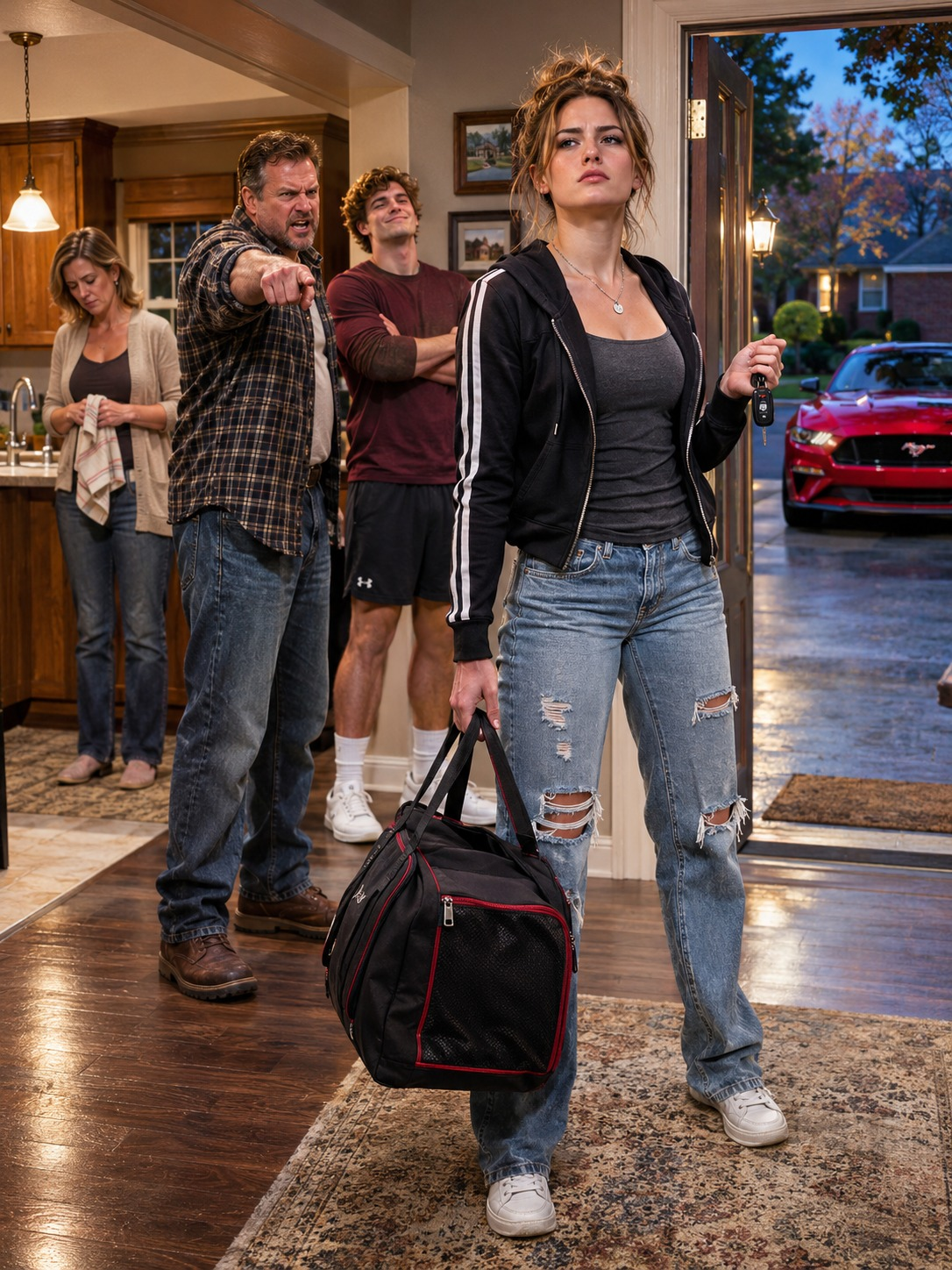
My father had thrown me out of his house because I refused to surrender my Mustang.
Now I was discovering that even after I left, he hadn't stopped trying to control things that belonged to me.
I wanted to call him.
I wanted to hear him explain why his signature appeared beneath mine.
But I knew what would happen.
He would tell me I misunderstood.
He would accuse Mom of creating problems.
He would remind me of everything he had provided during my childhood.
And somehow, I would become responsible for his decisions.
I wasn't going to give him that opportunity.
Not tonight.
I closed the folder and placed it inside my dresser.
Tomorrow, I had an interview.
For once, something important in my life had nothing to do with Brandon.
I wasn't going to let him ruin it.
The following morning, I arrived at the coffee shop before six.
Teresa noticed my expression immediately.
“You look like you fought a bear last night.”
“Didn't sleep much.”
“Family again?”
I nodded.
She handed me an apron.
“Well, the espresso machine's behaving badly. Maybe you two can work through your problems together.”
I laughed.
It was exactly what I needed.
For the next several hours, I concentrated on orders.
Hot coffee.
Iced coffee.
Breakfast sandwiches.
Customers who couldn't remember what they wanted until they reached the register.
By the time my shift ended, I was exhausted but calmer.
Rachel found me changing out of my apron.
“Today's the interview, right?”
“Yeah.”
“Nervous?”
“Very.”
She smiled.
“Good. Means you care.”
I thanked her and drove back to Linda's house.
I showered, changed into clean jeans and a button-down shirt, and collected my résumé.
Then I drove across Charlotte to Hayes Automotive.
The building wasn't particularly impressive from the outside.
It had a faded sign, several service bays, and a modest customer waiting area.
Cars occupied nearly every available parking space.
I could hear tools operating before I even switched off the Mustang's engine.
I smiled.
This was where I wanted to be.
I entered through the front door.
A receptionist looked up.
“Can I help you?”
“I'm Madison Reed. I have an appointment with Mr. Hayes.”
She nodded.
“He's expecting you.”
A few minutes later, a tall man with gray hair and a navy work shirt appeared.
He looked to be in his late fifties.
His hands carried the permanent marks of someone who had spent decades repairing machinery.
“Madison?”
“Yes, sir.”
“Robert Hayes.”
He shook my hand.
“Come on back.”
His office was small and crowded.
Service manuals filled the shelves.
Photographs of employees and customers covered one wall.
A framed picture showed a much younger Robert standing beside an old pickup truck.
He sat behind his desk and examined my résumé.
“Three years at a diner?”
“Yes.”
“Cleaning offices?”
“On weekends.”
“And now you're working at a coffee shop and a dealership?”
“Yes, sir.”
He looked up.
“How much sleep do you get?”
“More than I used to.”
He smiled slightly.
“Mike says you're dependable.”
“I try to be.”
“He also says you're interested in learning diagnostics.”
“Eventually. I know I have a lot to learn first.”
Robert leaned back.
“That's probably the smartest thing you've said.”
I wasn't sure whether he was joking.
Then he continued.
“Everybody wants to diagnose complicated problems. Nobody wants to clean equipment, organize parts, or learn the fundamentals.”
“I don't mind starting there.”
“Good. Because that's exactly where you'd start.”
He asked about my education.
I explained that I was researching automotive programs at local community colleges.
He asked whether I had transportation.
I pointed toward the parking lot.
“The red Mustang?”
“Yes.”
“Nice car.”
“Thank you.”
“Who bought it?”
“I did.”
He raised an eyebrow.
“Working at that diner?”
“And cleaning offices.”
He looked through the window at the Mustang.
Then he returned his attention to me.
“Why a Mustang?”
I thought about my answer.
“Because it was something I wanted for myself.”
He nodded.
“That's a decent reason.”
He stood.
“Let's take a walk.”
We entered the service area.
The smell of rubber, oil, and metal immediately surrounded me.
Technicians were working on several vehicles.
One was replacing worn components.
Another was examining an engine.
A third was discussing repair options with a customer.
Robert introduced me to a technician named James, who had worked at the shop for nearly twelve years.
“James, this is Madison. She's interested in learning.”
James glanced at me.
“Ever worked in a repair shop?”
“No.”
“Know how to use tools?”
“Some basic ones.”
He nodded.
“At least you're honest.”
Robert handed me a clipboard containing a vehicle inspection sheet.
“Tell me what you understand about this.”
I examined the document.
Some sections were familiar.
Others contained terminology I had only encountered in textbooks.
I explained what I knew.
When I reached something unfamiliar, I admitted it.
Robert listened without interrupting.
Finally, he took back the clipboard.
“Not bad.”
We returned to his office.
He explained that he could offer me an entry-level shop assistant position.
The hours would initially be limited.
The pay was modest.
My responsibilities would include organizing parts, assisting technicians with appropriate tasks, maintaining work areas, and learning basic service procedures under supervision.
It wasn't the kind of position people bragged about.
To me, it sounded extraordinary.
“When can I start?” I asked.
He laughed.
“Don't you want to know the pay first?”
“Oh. Right.”
He explained the details.
The amount wasn't dramatically higher than what I earned at the dealership, but the opportunity was far more valuable.
“I'd like to accept.”
“Talk to your current employer first. Don't disappear on people who've helped you.”
“I won't.”
“Good.”
He stood and shook my hand again.
“Welcome to Hayes Automotive.”
I walked outside feeling almost weightless.
I climbed into the Mustang and sat behind the wheel.
Then I called Ellen.
“I got it.”
She screamed so loudly that I pulled the phone away from my ear.
“You got the job?”
“Yes!”
“Oh, Madison!”
I laughed.
She asked about the shop, the responsibilities, and the people I had met.
I told her everything.
When we finished talking, I looked at my father's number.
For one brief moment, I wanted to call him too.
I wanted to tell him that I had found an opportunity in the industry I loved.
I wanted him to be proud.
That instinct hadn't disappeared simply because I had moved away.
But I knew what he would probably say.
Something about wasting my time.
Something about coming home.
Something about Brandon.
I put the phone away.
I had spent enough years waiting for congratulations that never came.
That afternoon, I spoke with Mike at the dealership.
He was genuinely pleased.
“Robert's a good man,” he said. “You'll learn a lot.”
“Thank you for recommending me.”
“You earned the recommendation.”
I offered to continue working until he found someone to replace me.
He appreciated that.
Two weeks later, I completed my final dealership shift.
Carlos handed me an old automotive service manual before I left.
The cover was worn.
Several pages contained handwritten notes.
“Thought you might find this useful.”
I accepted it carefully.
“Are you sure?”
“Absolutely.”
“Thank you.”
He smiled.
“Remember, good technicians investigate.”
“I won't forget.”
I placed the manual inside my backpack.
Then I drove away from the dealership that had given me my first opportunity to work around cars.
I was grateful.
And I was ready for the next step.
My first week at Hayes Automotive was humbling.
I knew less than I thought I did.
There were tools I couldn't identify.
Parts I couldn't recognize.
Procedures that looked simple until someone asked me to perform them correctly.
James corrected me frequently.
Robert expected punctuality.
Nobody gave me special treatment because I was young or because I had an interesting story.
I appreciated that.
I didn't want special treatment.
I wanted a fair chance.
One afternoon, James found me struggling to organize a collection of replacement parts.
“You're putting too much pressure on yourself.”
I looked up.
“I'm trying not to make mistakes.”
“You're going to make mistakes.”
“That doesn't sound encouraging.”
He laughed.
“The trick is catching them before they become expensive.”
He showed me a better way to organize the inventory.
Then he explained why the system mattered.
I listened carefully.
At the end of the day, I wrote everything down.
That became my routine.
Every new procedure went into my notebook.
Every unfamiliar term became something to research.
Every mistake became something I tried not to repeat.
I continued working mornings at the coffee shop.
Then I spent afternoons at the automotive shop.
Several evenings each week, I studied.
On Sundays, I did laundry, prepared inexpensive meals, and reviewed my finances.
My life wasn't glamorous.
There were no vacations.
No expensive dinners.
No evenings spent shopping for things I didn't need.
But my savings were growing.
Slowly.
Consistently.
Every dollar belonged to me.
Several months after arriving in Charlotte, I enrolled in evening automotive technology courses.
I received some financial assistance and arranged payments for the remaining expenses.
The first night of class, I sat near the front.
Most of the students were men.
Several were older than I was.
Some already had years of practical experience.
I felt intimidated.
Then the instructor began explaining electrical fundamentals.
Within minutes, I forgot about everyone around me.
I was learning something I loved.
For the first time in my life, education felt like a choice rather than an obligation.
I stayed after class to ask questions.
I completed assignments early.
I practiced whenever appropriate opportunities became available at the shop.
Sometimes I returned to Linda's house so exhausted that I fell asleep with an open textbook beside me.
But I never considered quitting.
Not because I wanted to prove my father wrong.
Although that thought occasionally crossed my mind.
I continued because I had finally discovered something that made the future exciting.
Meanwhile, the legal situation moved slowly.
Through a referral, I arranged a consultation with an independent attorney in Pennsylvania.
Her name was Susan Mitchell.
She reviewed the documents I had collected and explained that establishing what had happened would require additional records.
The missing inheritance and the possible property interest involved separate questions.
She warned me against assuming that every document my mother possessed established a complete legal claim.
There were details to verify.
There were deadlines to understand.
There were decisions I would eventually need to make.
Most importantly, she helped me take steps to dispute the unauthorized document and protect whatever rights I might have.
I followed her advice.
I preserved everything.
I requested records through appropriate channels.
And I made sure nobody could reasonably claim that I had voluntarily surrendered my interests.
I couldn't afford a prolonged legal battle.
Not while paying rent, tuition, insurance, and living expenses.
But I could afford to be careful.
The blue folder remained inside my dresser.
Occasionally, I opened it.
Occasionally, I added something.
Then I returned to building my life.
Mom continued calling.
Sometimes our conversations lasted only a few minutes.
Sometimes she cried.
Sometimes she tried to explain why she had remained silent for so long.
One evening, she told me Dad was furious because Patricia had contacted him about the disputed signature.
“What did he say?” I asked.
“He thinks you're making trouble.”
I almost laughed.
“Of course.”
“He says the document was supposed to simplify things.”
“By pretending I signed it?”
“He didn't explain it to me that way.”
“Then how did he explain it?”
She hesitated.
“He said you wouldn't understand.”
I looked at the textbook open on my desk.
That was another familiar excuse.
Whenever Dad wanted to make a decision without me, he claimed I wouldn't understand.
“Mom, I'm not discussing this with him.”
“He wants you to call.”
“Then he can call me.”
“He's your father.”
“And I'm his daughter.”
She became quiet.
I waited.
Then she asked, “Are you happy there?”
The question surprised me.
I considered it carefully.
“I think I'm becoming happy.”
“What does that mean?”
“It means I'm tired. I work a lot. School is difficult. But I'm doing something I want to do.”
“Your grandmother would've liked that.”
I swallowed.
“Yeah.”
For once, we ended the conversation without arguing.
But the distance between us remained.
She had given me the truth.
That mattered.
It didn't erase the years she had hidden it.
My father eventually called.
I was sitting inside the Mustang after an evening class.
His name appeared on the screen.
I answered.
“Hello?”
“So you're talking to lawyers now?”
No greeting.
No question about my health.
No acknowledgment that we hadn't spoken properly in months.
Just an accusation.
“Yes.”
“Do you have any idea what you're doing?”
“Protecting myself.”
“From your own family?”
“Apparently.”
He sighed.
“You're letting people fill your head with nonsense.”
“Did you sign that document?”
“What document?”
“The one with my name on it.”
“I don't have time for this.”
“Then why did you call?”
He became angry.
“You think you're so smart now?”
“No.”
“You're working in some garage, living in somebody else's house, and acting like you've accomplished something.”
I stared through the windshield.
Months earlier, those words would have devastated me.
Now they simply sounded familiar.
“I have accomplished something.”
He laughed.
“What?”
“I've supported myself.”
“Congratulations. Millions of people do that.”
“Exactly. Brandon could too.”
The line went silent.
Then Dad spoke slowly.
“Your brother has nothing to do with this.”
I shook my head.
“He has everything to do with this.”
“You need to stop blaming him for your problems.”
“I haven't blamed him for any problem he didn't create.”
Dad raised his voice.
I lowered mine.
“I'm not having this conversation.”
“Don't you dare hang up on me.”
“Goodnight, Dad.”
I disconnected.
Then I sat quietly.
My hands weren't shaking.
My heart wasn't racing.
I didn't feel the familiar need to apologize.
That was progress too.
The following day, I returned to work.
Robert had assigned me to assist James with a series of basic service tasks.
As we worked, James asked me about school.
“Still enjoying it?”
“Absolutely.”
“Even the electrical stuff?”
“Especially the electrical stuff.”
He laughed.
“You're unusual.”
“So I've heard.”
Over the following year, my responsibilities increased.
I learned to perform basic maintenance procedures under supervision.
I became more comfortable with inspection equipment.
I developed a better understanding of mechanical and electrical systems.
Robert occasionally allowed me to explain straightforward service findings to customers, provided an experienced technician had reviewed them first.
I discovered that I enjoyed those conversations.
Many customers arrived feeling confused.
Some worried they were being overcharged.
Others didn't understand why a repair was necessary.
I remembered how helpless it felt when people withheld information from me.
So I explained things clearly.
I showed customers what we had found.
I distinguished between urgent repairs and work that could reasonably wait.
I encouraged questions.
One afternoon, an elderly woman brought in a sedan with several maintenance concerns.
She looked frightened when James presented the initial estimate.
“Is all of this necessary today?” she asked.
James reviewed the list with her.
Then he asked me to explain the maintenance schedule.
I sat beside her in the waiting area.
We discussed the recommendations one at a time.
I helped her understand which items required immediate attention and which could be planned for later, based on the technician's assessment.
When we finished, she smiled.
“Thank you for not making me feel stupid.”
The words stayed with me.
Later, Robert approached my workstation.
“That customer asked for your name.”
“Was something wrong?”
“Quite the opposite.”
He smiled.
“She said you're the first person who's explained car repairs in a way she actually understands.”
I laughed.
“That's nice.”
“It's important.”
He folded his arms.
“Knowing how to repair a vehicle is valuable. Knowing how to earn someone's trust is just as valuable.”
I nodded.
That afternoon, I began imagining something bigger.
Not merely becoming a technician.
Not merely earning a steady paycheck.
I imagined owning an automotive business where customers understood what they were paying for.
A place where young employees received opportunities based on effort.
A place where nobody had to pretend they knew everything to deserve respect.
I didn't have enough money to open a business.
I didn't have enough experience.
I didn't even have a complete qualification yet.
But I had a vision.
And I knew how to save.
On my twentieth birthday, Teresa brought a small cake to the coffee shop.
Rachel gave me a birthday card signed by the employees.
Linda prepared dinner.
Ellen called from Pennsylvania.
Even Robert and James wished me a happy birthday.
My father didn't call.
Brandon didn't send a message.
Mom called late that evening.
She sounded apologetic.
“Your father has been busy.”
I smiled sadly.
“That's okay.”
“He didn't forget.”
I didn't argue.
Maybe he hadn't forgotten.
Maybe he had simply chosen not to call.
Either way, I wasn't spending my birthday waiting beside the phone.
After dinner, I opened my savings notebook.
My balance was healthier than it had been in years.
I had paid my tuition installments.
My rent was current.
My Mustang was maintained.
I had no unfamiliar debts showing on my credit reports.
I wasn't rich.
But I was stable.
At twenty, stability felt like an achievement worth celebrating.
I turned to a fresh page.
At the top, I wrote three words.
FUTURE BUSINESS FUND.
Underneath, I entered my first contribution.
Two hundred dollars.
It wasn't much.
But neither had been the thirty-two dollars that started my Mustang fund.
I understood the power of beginnings.
Over the next two years, I completed my automotive program and continued developing my skills.
I pursued relevant professional certifications as my experience allowed.
My responsibilities at Hayes Automotive expanded.
Eventually, I was earning enough to leave the coffee shop.
Saying goodbye to Rachel and Teresa was harder than I expected.
They had known me when I was sleeping inside my car.
They had helped me find work, housing, and confidence.
On my final morning, Teresa hugged me.
“Don't forget us when you're famous.”
I laughed.
“I'm fixing cars, not becoming a movie star.”
“Same difference.”
Rachel handed me a small envelope.
Inside was a handwritten note.
You walked in here before we opened, asking for a chance. Never lose that determination.
I kept it.
Some people gave me documents that revealed betrayal.
Others gave me reminders of kindness.
Both kinds of paper mattered.
By twenty-two, I was living in a small apartment of my own.
It had one bedroom, a modest kitchen, and a parking space where I could see the Mustang from my window.
The first evening I moved in, I purchased a cheap dining table from a secondhand furniture store.
I assembled it myself.
Then I sat there eating takeout from a paper container.
I looked around the apartment and smiled.
Four years earlier, I had slept behind the steering wheel.
Now I had a kitchen.
A bedroom.
A couch.
A door with my own key.
Nobody could tell me to leave because I refused to give Brandon something.
I called Ellen.
Then Teresa.
Then Linda.
I wanted the people who had helped me to know what their kindness had made possible.
Finally, I called Mom.
She answered quietly.
“Madison?”
“I moved into my own apartment.”
“Oh, sweetheart. That's wonderful.”
“It's small, but I like it.”
“I'm proud of you.”
I stopped.
She rarely said those words without adding something about Dad or Brandon.
This time, she didn't.
“Thank you, Mom.”
For several minutes, we talked about furniture, work, and ordinary things.
Then I asked about home.
She sighed.
“Your brother's trying another business idea.”
“What kind?”
“Something involving online sales.”
“Is he working?”
“Not exactly.”
I leaned back in my chair.
Brandon was twenty-seven.
Still living with our parents.
Still searching for opportunities that apparently required someone else to finance them.
“Dad's helping him?”
“Yes.”
Of course.
I didn't ask for details.
Their financial decisions were no longer my responsibility.
Before we ended the call, Mom said something that surprised me.
“Madison, I'm glad you didn't give him the car.”
I remained silent.
She continued.
“I should have said that when you were standing in the hallway.”
I swallowed.
“Yes. You should have.”
“I know.”
It wasn't forgiveness.
But it was the beginning of an honest conversation.
Several weeks later, Robert called me into his office.
He was reviewing financial reports.
“Close the door.”
I immediately wondered whether something was wrong.
He gestured toward a chair.
“Sit down.”
I sat.
He removed his glasses.
“How long have you been here now?”
“Almost four years.”
“Feels longer.”
“Should I be offended?”
He laughed.
“No.”
He looked toward the service bays.
“You've become one of the most dependable people I've got.”
“Thank you.”
“You understand the technical side. Customers trust you. And you're good at keeping things organized.”
I waited.
He folded his hands.
“Have you ever thought about running a shop?”
My heart began beating faster.
“Someday.”
“Seriously?”
“Very seriously.”
He nodded.
“Good.”
He explained that he was considering expanding certain aspects of the business.
He needed someone who could help manage service operations, coordinate customer communication, and support the technicians.
He wanted me to take on additional leadership responsibilities.
The position came with increased pay.
More importantly, it came with an opportunity to learn how an automotive business actually operated.
Scheduling.
Expenses.
Inventory.
Customer retention.
Employee management.
Profit margins.
Everything I would eventually need to understand.
“I'd love to,” I said.
Robert smiled.
“Thought you might.”
I walked out of his office feeling the same excitement I had experienced when he first offered me a job.
Only this time, I wasn't an inexperienced eighteen-year-old asking for a chance.
I had earned his confidence.
That evening, I increased the amount I contributed to my future business fund.
Then I drove the Mustang home.
The car was older now.
Its paint had a few imperfections.
The driver's seat showed signs of wear.
But I loved it more than ever.
It had carried me away from Pennsylvania.
It had sheltered me when I had nowhere else to sleep.
It had taken me to interviews, classes, and countless shifts.
Every scratch reminded me of a life I had built without surrendering the one thing my father demanded.
I parked outside my apartment.
As I collected my belongings, my phone vibrated.
An email from Susan Mitchell.
My attorney.
I hadn't heard from her in several months.
The subject line immediately caught my attention.
Additional Property Records Located.
I carried my backpack upstairs and opened the email at my dining table.
Susan explained that she had obtained further historical records connected to my grandmother's commercial property interest.
There were several documents attached.
She wanted to arrange a conversation before I reached any conclusions.
I downloaded the files.
The first contained ownership information.
The second included correspondence concerning a proposed transfer.
The third contained financial records I didn't fully understand.
Then I opened the final attachment.
It was a scanned letter dated several weeks before my grandmother died.
Her signature appeared at the bottom.
The letter was addressed to my mother.
I read the first paragraph.
Then the second.
Grandma had expressed concerns about Brandon's behavior and Dad's willingness to rescue him financially.
She had also written about protecting my future.
Near the bottom, one sentence had been underlined.
If anything happens to the assets intended for Madison, she must be told the truth about the arrangement concerning the family home.
I stopped reading.
The family home?
What did our house have to do with Grandma's commercial property?
I opened the ownership records again.
There was an address I recognized.
The house where I had grown up.
The house Dad had always claimed belonged entirely to him.
The house he had thrown me out of.
I reached for my phone and called Susan.
Her office was closed.
I left a message.
Then I called Mom.
She answered after several rings.
“Madison?”
“Mom, I need to ask you something.”
“Of course.”
“What arrangement did Grandma make concerning our house?”
The line went silent.
“Mom?”
“Where did you hear about that?”
“I have her letter.”
She began breathing heavily.
“What letter?”
“The one she wrote before she died.”
I heard a chair scrape against the floor.
“Madison, you shouldn't discuss this over the phone.”
“Why?”
“Because your father doesn't know you have that information.”
I stared at the ownership records.
“Does Dad own the house?”
She didn't answer.
“Mom, please.”
A long silence followed.
Then she whispered, “There's another document. I've kept it hidden since your grandmother died.”
My fingers tightened around the phone.
“What document?”
“I'll send you a photograph.”
A moment later, my phone vibrated.
I opened the attachment.
It showed an old agreement bearing three signatures.
My grandmother's.
My mother's.
My father's.
I enlarged the section describing the property.
Then I scrolled toward the bottom.
There was a fourth name.
And it was mine.






Comments 0