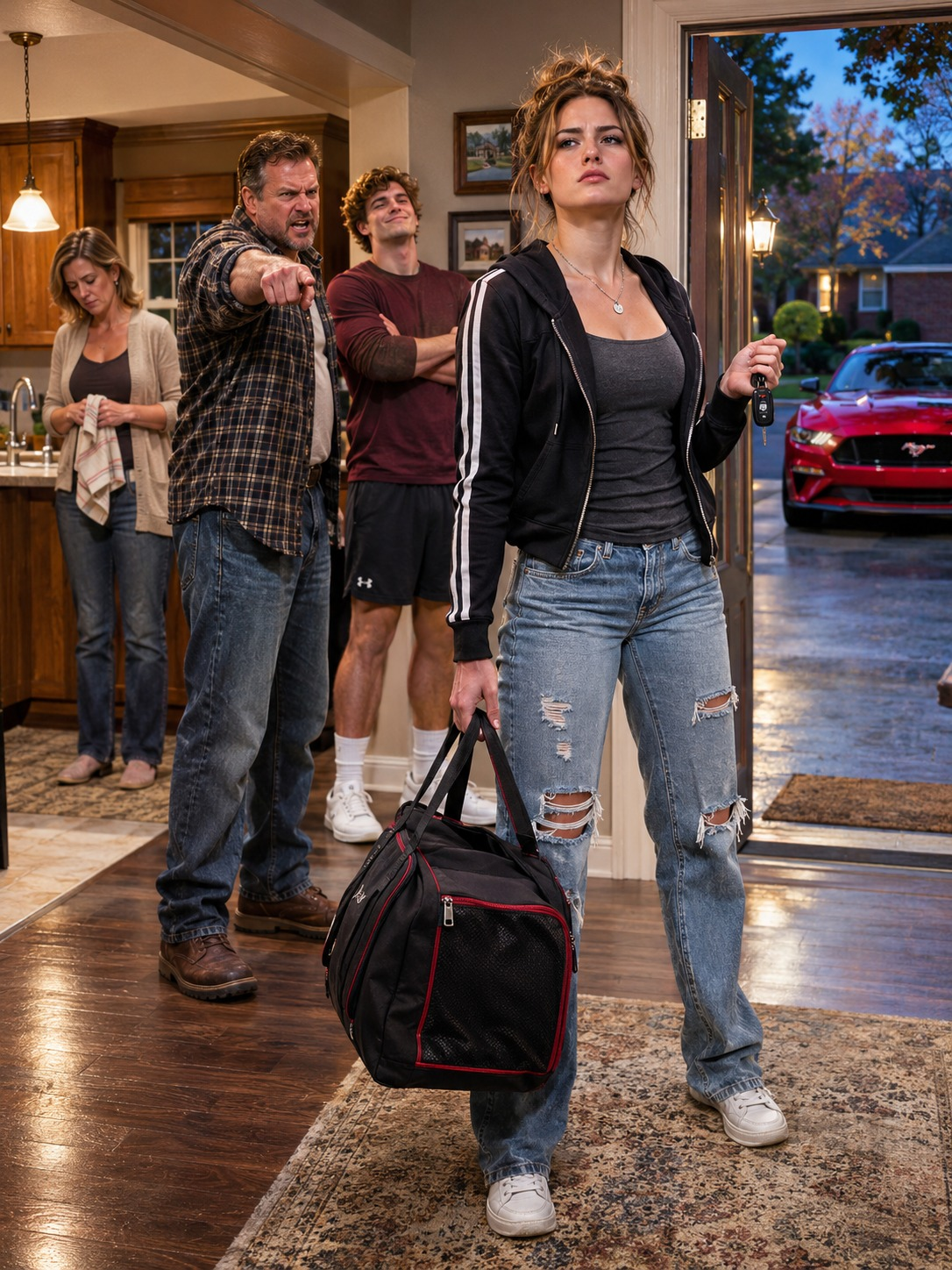
“Who are the people outside your house?”
My father didn't answer immediately.
I heard movement in the background.
A door slammed.
Then my mother's voice rose above the noise.
“Tell them we don't know where he is!”
I stood behind my office desk.
“Dad, what's happening?”
“They're looking for Brandon.”
“Who?”
“People he owes money to.”
I closed my eyes.
“Where's Brandon?”
“If I knew that, Madison, I wouldn't be dealing with this.”
His irritation was familiar.
Even in the middle of a crisis, he sounded offended that someone expected him to explain himself.
“Are you and Mom safe?”
“Yes.”
“Has anyone threatened you?”
“No. They're demanding answers.”
“Then don't make promises on Brandon's behalf. If anyone threatens you, contact the police.”
He sighed impatiently.
“I didn't call you for instructions.”
“Then why did you call?”
Silence.
For nearly ten years, my father had made it clear that he didn't need my opinions.
He hadn't attended my graduation.
He hadn't visited my first apartment.
He hadn't congratulated me when I opened my business.
He hadn't asked how I survived those nights inside my Mustang.
Now, suddenly, my number was worth dialing.
“Madison,” he said finally, “your brother's having some financial difficulties.”
I looked down at the financing document Mom had mailed me.
“I'm aware.”
“What do you mean?”
“Mom sent me some paperwork.”
Another silence.
Then his voice hardened.
“She had no business doing that.”
“She's worried.”
“She doesn't understand what's happening.”
I almost laughed.
My mother never understood anything, according to Dad.
Neither did I.
Apparently, the only people qualified to make financial decisions were the two men who had spent years creating financial disasters.
“Dad, how much money does Brandon owe?”
“It's complicated.”
“Give me a number.”
“I don't have everything in front of me.”
“An estimate.”
He hesitated.
“His company has obligations.”
“Every company has obligations.”
“Don't start lecturing me about business.”
I looked through my office window.
Two technicians were working on vehicles.
My service coordinator was speaking with a customer.
A delivery truck had just arrived with replacement parts.
I had spent nearly a decade learning how businesses operated.
Yet my father still spoke to me as though I were a child who couldn't understand a household budget.
“I'm not lecturing you,” I said. “I'm trying to understand why people are standing outside your house.”
“Brandon had some arrangements with suppliers and investors.”
“Did those arrangements involve personal guarantees?”
He didn't answer.
“Did you guarantee his loans?”
“Some of them.”
I looked at the document again.
“And the house?”
His breathing changed.
“Your mother shouldn't have sent you that.”
“Did you use the house as collateral?”
“It was necessary.”
“For what?”
“To help your brother.”
There it was.
The explanation that had followed me throughout my entire childhood.
To help your brother.
My inheritance had disappeared to help my brother.
My mother had remained silent to help my brother.
My father had demanded my Mustang to help my brother.
Now the family home was apparently at risk for exactly the same reason.
“Dad, what do you want from me?”
He became quiet.
Then he said something I hadn't heard from him in years.
“I need your help.”
I sat down.
Not because I was shocked that he needed help.
Because I was shocked that he had finally admitted it.
“What kind of help?”
“Financial help.”
I stared at the blue folder inside my desk drawer.
“Be specific.”
“We need some time to straighten things out.”
“How much time?”
“A few months.”
“And how much money?”
He hesitated.
“Can you come home?”
The question caught me off guard.
Home.
He had used that word as a weapon when I was eighteen.
He had stood beside the front door and told me that keeping my own car meant losing my home.
Now he was inviting me back because keeping his house apparently depended on my money.
“I have a business to run,” I said.
“This is important.”
“So is my business.”
“Madison, we're your family.”
I leaned back in my chair.
“I remember.”
He sighed.
“Your mother wants to see you.”
“Then let me speak to her.”
“She can't talk right now.”
“Why not?”
“She's upset.”
“Put her on the phone.”
He hesitated.
I heard him moving through the house.
A few seconds later, Mom's voice came through.
“Madison?”
“Are you okay?”
She began crying.
“Oh, sweetheart.”
“Mom, are you safe?”
“Yes.”
“Who are those people?”
“Some men Brandon did business with. They came looking for him.”
“Where is he?”
“I don't know.”
“When did you last see him?”
“Yesterday morning.”
“Has he answered your calls?”
“No.”
I rubbed my forehead.
“Did you sign any documents involving his business?”
She became quiet.
“Mom?”
“Your father told me everything would be fine.”
“That isn't what I asked.”
“I signed some papers.”
My stomach tightened.
“What papers?”
“I don't know all the details.”
I looked at the envelope she had sent.
For years, I had warned her to understand every financial document before signing it.
Apparently, those warnings hadn't been enough.
“Please collect everything you signed,” I said. “Don't throw anything away. Don't sign anything new until someone independent has reviewed it.”
“Okay.”
“And if Brandon contacts you, don't agree to send him money.”
She started crying again.
“He's still my son.”
“I know.”
“What if he's in trouble?”
“Then he needs to deal with it.”
She didn't respond.
I understood her fear.
But I also understood what happened when that fear became an excuse to rescue Brandon from every consequence.
It had been happening for decades.
And now there was almost nothing left to sacrifice.
Dad took the phone again.
“Can you come this weekend?”
“I'll think about it.”
“Think about it?”
“Yes.”
“We could lose everything!”
I remained silent.
Then I said, “Send me the financial documents.”
“What?”
“The loan agreements. The notices. The guarantees. Everything related to the house and Brandon's business.”
“You don't need all that.”
“If you're asking me for money, I absolutely do.”
He exhaled sharply.
“You always have to make things difficult.”
I smiled without humor.
Some things never changed.
“Send the documents, Dad.”
Then I ended the call.
For several minutes, I remained seated behind my desk.
I had imagined hearing from my father many times over the years.
Sometimes, in those imaginary conversations, he apologized.
Sometimes he admitted that he had treated me unfairly.
Sometimes he simply asked whether I was happy.
I had never imagined that our first meaningful conversation after years of distance would begin with strangers demanding money outside his house.
But perhaps I should have.
My father had never been particularly interested in my life unless something I possessed could benefit Brandon.
Now I possessed considerably more than a Mustang.
And he knew it.
That afternoon, I called Susan Mitchell.
She had helped me protect my interests regarding Grandma's estate and the disputed financial documents.
Over the years, we had maintained occasional contact as additional records became available.
I explained what Dad had told me.
Then I forwarded the paperwork Mom had sent.
Susan listened carefully.
“Have you agreed to provide any money?”
“No.”
“Have you signed anything?”
“Absolutely not.”
“Good.”
I looked toward the blue folder.
“Could the situation affect the arrangements involving my grandmother?”
“Potentially. I would need to examine the current financing documents and property records.”
“Dad says he used the house as collateral.”
“That raises several questions, particularly given the earlier agreements we've reviewed.”
I leaned forward.
“Do you think he disclosed those agreements?”
“I wouldn't speculate without seeing the records.”
“Understood.”
She advised me not to make financial commitments until the circumstances were clearer.
She also reminded me that my mother's interests might differ from my father's and that Mom could benefit from independent legal advice.
After we ended the call, I opened the folder.
The first document was the photocopied bank statement Mom had hidden inside my savings notebook when I was eighteen.
The paper had begun to yellow around the edges.
I ran my fingers across the circled withdrawals.
Then I examined Grandma's letter.
Her handwriting still affected me.
Nearly ten years had passed since I first read it in Linda's spare bedroom.
Ten years of working.
Learning.
Saving.
Building.
Ten years of wondering whether my father would ever acknowledge what he had done.
I had stopped expecting an apology.
But that didn't mean I had forgotten.
I closed the folder and returned to work.
That evening, I drove home in the Mustang.
The engine sounded as familiar as ever.
I had maintained the car carefully over the years.
Some components had been replaced.
The interior had been repaired where necessary.
The paint had received professional attention.
But it was still the same car.
The same red Mustang GT my father had demanded I hand over to Brandon.
When I parked inside my garage, I remained behind the wheel for a while.
I remembered the night I left Pennsylvania.
The black travel bag.
The paper bag of sandwiches Mom had given me.
The tears I had wiped away before entering Ellen's diner.
I remembered waking inside the Mustang with a stiff neck and no idea how long my savings would last.
Back then, $4,800 had represented everything standing between me and complete uncertainty.
Now I had financial reserves, a successful business, a comfortable home, and employees who depended on my decisions.
I could afford to help my parents under certain circumstances.
That was what made the situation difficult.
If I had been struggling financially, refusing would have been simple.
But I wasn't struggling.
I had resources.
And somewhere inside me, the frightened eighteen-year-old who still wanted her father's approval whispered that perhaps this was my chance.
Perhaps helping him would finally make him appreciate me.
Perhaps he would recognize everything I had accomplished.
Perhaps he would admit that he had been wrong.
I hated that those thoughts still existed.
After everything he had done, some part of me still wanted to hear him say he was proud of me.
I went inside and prepared dinner.
Then I called Robert.
We had remained close after I opened my own shop.
He had become more than a former employer.
He was a mentor and a trusted friend.
When I explained the situation, he listened without interrupting.
Finally, he asked, “Do you know how much they need?”
“Not yet.”
“Do you know what happened to the money?”
“No.”
“Do you know whether paying one debt would solve the problem?”
“No.”
He paused.
“Then you don't have enough information to make a decision.”
I laughed softly.
“That's what my attorney said.”
“Sounds like you've got a sensible attorney.”
I leaned against my kitchen counter.
“I keep thinking about my mother.”
“Of course you do.”
“She could lose her home.”
“That's a serious concern.”
“I don't want her ending up with nowhere to go.”
Robert remained quiet for a moment.
Then he said, “Helping your mother and rescuing your brother don't have to be the same thing.”
I looked toward the garage door.
Those words stayed with me.
For most of my life, Dad had insisted that family problems belonged to everyone except the person who created them.
Robert was reminding me that I could choose how to help.
I didn't have to accept my father's terms.
The following morning, an email arrived from Dad.
There were three attachments.
A financing statement.
A notice concerning missed payments.
A spreadsheet containing several figures.
I reviewed them carefully.
The situation was worse than I had expected.
Brandon's company had borrowed heavily to finance inventory, advertising, warehouse expenses, and expansion.
The available documents suggested that sales had failed to keep pace with obligations.
There were outstanding supplier balances.
Missed payments.
Accumulating interest.
And substantial financial exposure involving my parents.
I called Dad.
“Is this everything?”
“That's what I could find.”
“Where are the company's financial statements?”
“Brandon handles those.”
“Bank records?”
“I don't have access.”
“Inventory reports?”
“I told you, Brandon handles the business.”
I closed my eyes.
“You guaranteed substantial debt without reviewing the company's finances?”
“He's my son.”
“That doesn't answer the question.”
“He had a plan.”
“Did you read it?”
“Madison.”
“Did you?”
He became angry.
“You think you're better than everybody because you've got a successful business?”
“No.”
“Then stop interrogating me.”
I looked at the figures on my screen.
“I'm asking the questions any responsible lender or investor would ask.”
“I'm not asking an investor. I'm asking my daughter.”
I sat back.
“And that means I shouldn't ask questions?”
He didn't respond.
“How much are you asking me to provide?”
He cleared his throat.
“We need at least a hundred thousand dollars immediately.”
I stared at the computer.
“A hundred thousand?”
“To stabilize things.”
“What does that mean?”
“Catch up on payments. Deal with some people Brandon owes. Keep everything from falling apart.”
“Would that resolve the debt?”
“Not completely.”
“How much would?”
“I don't know.”
I let the silence settle.
Then I asked, “Dad, do you realize what you're asking?”
“You own a business.”
“Yes.”
“You're doing well.”
“Yes.”
“Then you should be able to help.”
I looked around my office.
My business wasn't a pile of cash waiting for my relatives to claim it.
It was payroll.
Rent.
Equipment.
Insurance.
Taxes.
Supplier obligations.
Years of disciplined financial decisions.
People's livelihoods depended on it.
“I'm not taking money out of my company to cover Brandon's debts.”
“I'm not asking you to destroy your company.”
“You're asking me for a hundred thousand dollars without knowing whether it would solve anything.”
“We're talking about your family's home!”
I remained calm.
“The same home you told me I couldn't live in unless I gave Brandon my car.”
He went silent.
I waited.
For several seconds, I thought he might finally acknowledge it.
Instead, he said, “That was a long time ago.”
I stared at the wall.
“Yes. It was.”
“You can't hold onto things forever.”
“I'm not the one who called asking for money.”
His breathing became louder.
Then he said, “Your mother could end up on the street.”
I closed my eyes.
He knew exactly where to apply pressure.
He knew I still cared about her.
And he was using that love the same way he had used it when I was eighteen.
“I'm willing to understand the situation,” I said. “But I won't promise money.”
“Madison—”
“Send me the rest of the documents.”
I disconnected.
My hands were trembling.
I stood and walked toward the service area.
The familiar sounds of the shop helped settle my thoughts.
A technician asked me to review a customer concern.
Another needed approval for a parts order.
My service coordinator wanted to discuss the following week's schedule.
I handled each issue.
By lunchtime, I felt more like myself.
My father's emergency didn't erase my responsibilities.
And I wasn't going to abandon the people who depended on me simply because Brandon had abandoned the people who depended on him.
Later that afternoon, I received a message from an unfamiliar number.
It's Brandon. Dad says you're refusing to help.
I stared at the screen.
He was apparently alive.
And capable of using a phone.
I typed a response.
Where are you?
His reply arrived quickly.
That's not important.
Mom is worried.
I'm handling things.
I almost laughed.
Handling things.
By disappearing while creditors visited our parents' house?
I asked whether he intended to return.
He ignored the question.
Instead, he sent another message.
You could fix this if you wanted to.
I replied.
Send me your company's complete financial records.
Several minutes passed.
Then another message appeared.
You wouldn't understand the situation.
I looked at those words.
My brother, who had borrowed money he couldn't repay, was telling me that I wouldn't understand business finances.
I had spent nearly ten years studying, working, managing, and building a profitable automotive company.
He still believed I was incapable of understanding anything he did.
Or perhaps he was afraid I would understand it too well.
Without the records, there's nothing to discuss, I wrote.
His response came immediately.
You really are something else.
Then another.
After everything Dad did for you.
I placed the phone facedown.
I wasn't going to argue about my childhood through text messages.
Not with someone who had benefited from nearly every unfair decision my father had made.
An hour later, Mom called.
“Brandon contacted us.”
“Is he coming home?”
“He says he needs a few days.”
“Where is he?”
“He won't tell us.”
I sighed.
“Mom, you need to stop protecting him.”
“He sounds frightened.”
“I'm sure he is.”
“He's made mistakes.”
“I know.”
“He didn't mean for any of this to happen.”
I looked at the stack of financial documents on my desk.
“Intentions don't pay debts.”
She began crying.
I softened my voice.
“I'm not saying I don't care about him. I'm saying he needs to take responsibility.”
“I just want my children to be okay.”
I swallowed.
“Then you should want that for both of us.”
She became quiet.
I waited.
Finally, she whispered, “I do.”
For a moment, neither of us spoke.
Then she asked whether I would consider coming to Pennsylvania.
“Your father hasn't been sleeping,” she said. “He's barely eating.”
“Has he seen a doctor?”
“He says he's fine.”
“Of course he does.”
“Madison, please. I don't know what to do anymore.”
There was something different in her voice.
For years, she had sounded apologetic whenever she discussed Dad.
Now she sounded defeated.
I imagined her standing inside the kitchen.
The same kitchen where she had held a dish towel while my father threatened to throw me out.
She was older now.
Probably more tired.
Still trying to maintain peace in a house where peace depended on everyone agreeing with Dad.
I couldn't rescue her from every decision she had made.
But I could at least listen.
“I'll come,” I said.
She stopped crying.
“You will?”
“Yes. But I'm coming to understand what's happening. I'm not promising to pay anything.”
“Of course.”
“And I want everyone there.”
“What do you mean?”
“You. Dad. Brandon.”
She hesitated.
“I don't know whether Brandon will come.”
“Tell him I'm considering the financial situation. He'll come.”
I knew my brother.
The possibility of money would bring him home faster than any expression of concern.
Mom promised to arrange dinner for the following weekend.
After we ended the call, I sat quietly.
I hadn't returned to that house since the night I left.
Nearly ten years.
I had occasionally visited Pennsylvania for other reasons, including seeing Ellen, but I had always avoided the street where I grew up.
I had never stood on that front porch again.
Never entered my old bedroom.
Never sat at the dinner table where my father had placed the vehicle transfer form in front of me.
Now I was going back.
Not because I had failed.
Not because I needed somewhere to live.
Not because I had finally agreed to surrender the Mustang.
I was returning because the people who once believed they could take everything from me had discovered that they needed something I possessed.
And this time, I would decide what happened.
Over the next several days, I arranged for my management team to oversee the business during my absence.
I reviewed schedules.
Confirmed supplier arrangements.
Delegated customer concerns.
Made sure the shop could operate without me.
My service coordinator smiled when I explained that I would be away for a few days.
“Don't worry. We've got everything covered.”
I appreciated hearing that.
A business that depended entirely on its owner wasn't as strong as it appeared.
I had spent years building a team capable of handling responsibilities independently.
Now that work was paying off.
The evening before my departure, I opened the blue folder again.
I removed the documents one at a time.
Grandma's letter.
The old bank statements.
Brandon's handwritten confession disguised as a request for secrecy.
The disputed release bearing my father's signature.
The agreement concerning the family home.
The more recent financing documents.
Susan had helped me understand many of them.
Others still contained unresolved questions.
I organized everything carefully.
Then I placed the folder inside my travel bag.
I wasn't bringing it because I wanted revenge.
I was bringing it because my father had spent years rewriting our family's history.
He had convinced himself that every decision he made was reasonable.
That every sacrifice I was expected to make was necessary.
That every consequence Brandon avoided was proof of his love as a father.
I wanted the conversation to take place with the truth sitting on the table.
Not his version.
Not Brandon's excuses.
The truth.
That night, I called Ellen.
When I told her I was returning to Pennsylvania, she became quiet.
“Are you sure you're ready?”
“I think so.”
“Going back can bring up things you thought you'd dealt with.”
“I know.”
“Just remember something.”
“What?”
“You're not that frightened girl who walked into my diner with a suitcase anymore.”
I smiled.
“I know.”
“And you don't have to earn your place at anybody's table.”
My eyes filled with tears.
“Thank you, Ellen.”
“Call me when you get here.”
“I will.”
After we disconnected, I walked into the garage.
The Mustang waited beneath the overhead light.
I had considered renting a newer vehicle for the trip.
Something more comfortable for the long drive.
Something with better fuel economy.
But there was only one car I wanted to take back to Pennsylvania.
I ran my hand across the hood.
“Looks like we're going home,” I whispered.
Then I laughed at myself.
I wasn't going home.
I already had a home.
I was returning to the place where I had learned the difference.
I checked the car's condition, packed what I needed, and prepared for an early departure.
Before going to bed, I received a message from Mom.
Brandon says he'll be here Saturday.
I wasn't surprised.
Another message followed.
Your father is glad you're coming.
I wondered whether that was true.
Then Dad sent me a message himself.
We'll discuss everything over dinner. No need to bring lawyers into family matters.
I stared at the words.
He still thought he could establish the rules before I arrived.
I didn't respond.
Instead, I checked my email.
There was a new message from Susan.
She had received additional records after reviewing the financing documents Mom had provided.
Her subject line read:
Please Call Before Leaving for Pennsylvania.
I opened the email.
The message was unusually brief.
She had identified a significant issue involving the family's property arrangements and a more recent financial transaction.
She wanted to explain it directly rather than risk misunderstandings through email.
I looked at the time.
It was nearly nine thirty.
I assumed she wouldn't be available until morning.
Then my phone rang.
Susan.
I answered immediately.
“Is everything okay?”
“Madison, have you left Charlotte yet?”
“No. I'm leaving tomorrow.”
“Good.”
Her tone was serious.
“I've reviewed the additional records, and there's something you need to know before you meet your family.”
I sat down at my kitchen table.
“Is it about the house?”
“Yes.”
“Did Dad conceal Grandma's agreement when he arranged the financing?”
“That's one of the issues we're examining.”
I reached for the blue folder.
“What else?”
“Your brother's company appears to have submitted information concerning a proposed financial arrangement several months ago.”
I frowned.
“What kind of arrangement?”
“One involving additional business support and potential repayment resources.”
“I don't understand.”
“Madison, did you ever agree to become involved in Brandon's company?”
“No.”
“Did you authorize anyone to represent that you would provide financial assistance?”
“Absolutely not.”
“Did you give your father permission to discuss your personal assets or business finances with anyone?”
“No.”
Susan became quiet.
I heard her typing.
Then she said, “I'm sending you a copy of something your mother's records led us to.”
My laptop chimed.
A new email.
I opened the attachment.
Brandon's company name appeared across the top of the document.
Below it were several paragraphs describing the business, its financial circumstances, and its proposed sources of support.
I continued reading.
Then I saw a section labeled Anticipated Financial Backing.
My stomach tightened.
There was a familiar company name.
Reed Automotive Solutions.
My company.
I leaned closer to the screen.
“Susan?”
“Keep reading.”
Beneath my company's name was a statement claiming that I had agreed to provide substantial financial support to Brandon's business.
I had never made such an agreement.
I scrolled farther down.
There was an attached letter.
It appeared to have been printed on my company's letterhead.
My office address was correct.
My business telephone number was correct.
Even the logo was correct.
But I had never written that letter.
I felt cold.
“Who submitted this?”
“We're still establishing that.”
I looked at the signature.
Someone had attempted to reproduce mine.
Again.
I stood so abruptly that my chair struck the wall.
“Are you telling me they've been using my company's name?”
“That's what we need to investigate.”
I stared at the document.
Then Susan spoke again.
“There's one more attachment, Madison.”
I opened it.
It was a copy of a recent communication sent in support of the proposed arrangement.
The sender's name appeared at the top.
My father's.
I read the opening sentence.
Then the second.
He had assured someone that I would cooperate.
That I had the necessary financial resources.
That he could guarantee my participation.
I clenched my jaw.
But Susan wasn't finished.
“Madison, look at the final page.”
I scrolled down.
There was a handwritten note beneath the correspondence.
It was dated before my father had called asking for help.
Before Brandon had disappeared.
Before Mom had mailed me the financing documents.
I recognized Dad's handwriting immediately.
The note contained instructions addressed to Brandon.
I enlarged it.
And suddenly, I understood why they were so desperate to get me back to Pennsylvania.
My father had already promised them my business.






Comments 0