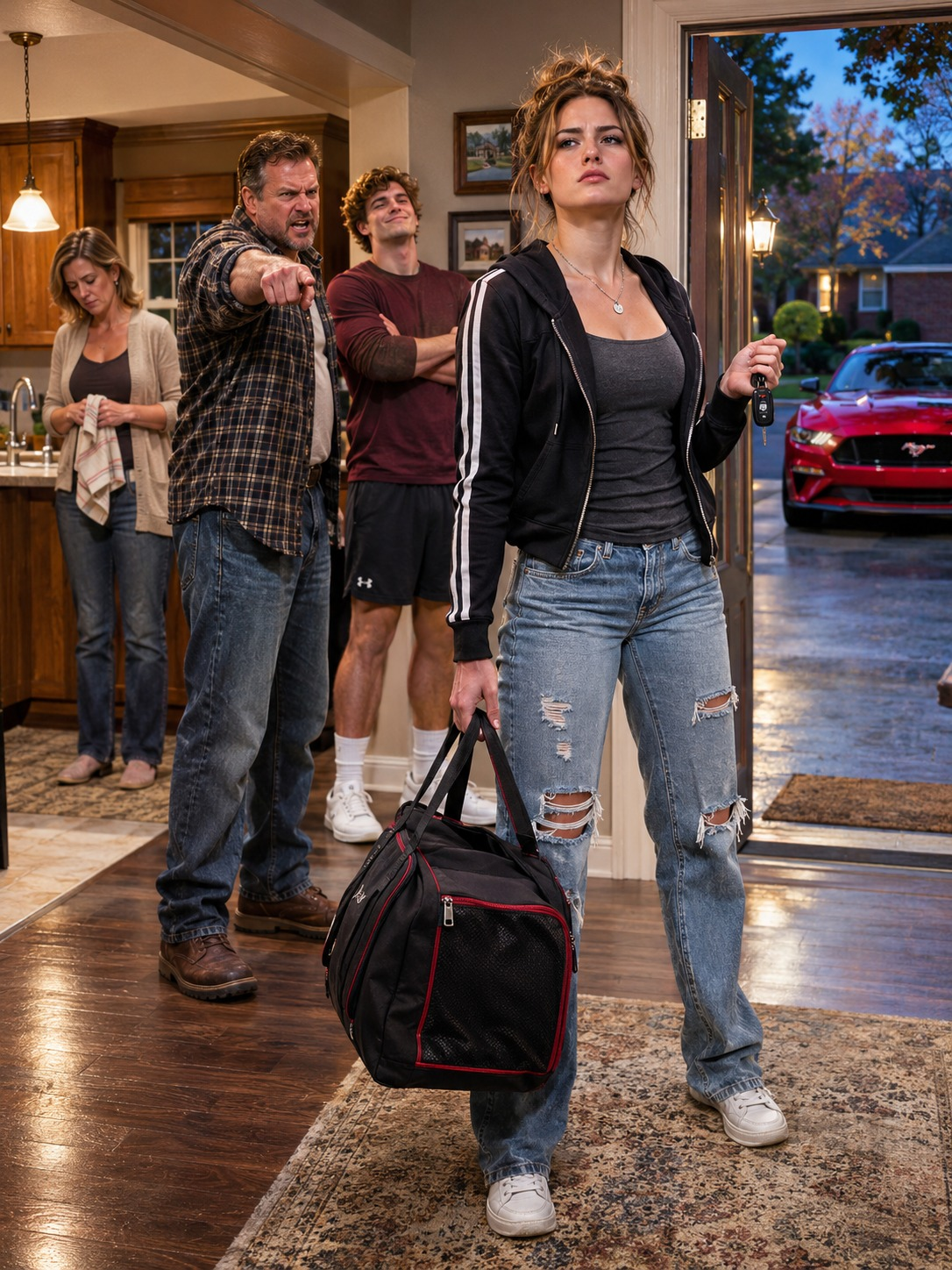
“Dad, we need to talk.”
Brandon stood on the porch beside a man wearing an expensive gray coat.
My father stared at the stranger.
“Victor?”
The man nodded.
“Good evening.”
I looked between them.
“You know each other?”
Dad swallowed.
“He was one of Brandon's business associates.”
Brandon stepped forward.
“Victor has a solution.”
I remained in the doorway.
“What kind of solution?”
Victor extended his hand.
“Victor Hale. I've been discussing certain financial opportunities with your brother.”
I shook his hand briefly.
“Madison Reed.”
He smiled.
“Yes. I've heard quite a bit about you.”
I glanced at Brandon.
“I'm sure you have.”
Dad stepped outside.
“What are you doing here, Victor?”
Victor removed a document from his leather briefcase.
“Your son contacted me regarding the difficulties surrounding your property. I believe we may be able to arrange something beneficial for everyone.”
Brandon nodded eagerly.
“He can stop the sale, Dad.”
Mom appeared behind me.
“What does that mean?”
Victor explained that he was interested in acquiring certain outstanding financial obligations and potentially negotiating an arrangement involving the house.
In exchange, my parents would need to cooperate with his proposed terms.
I listened carefully.
Then I asked, “Would my parents retain ownership of their home?”
Victor hesitated.
“That would depend on the final structure.”
“Would they be required to transfer any ownership interests?”
“Potentially.”
“Would Brandon receive any financial benefit?”
Brandon immediately interrupted.
“That's not important.”
I looked at him.
“Then you shouldn't have a problem answering.”
Victor glanced toward my brother.
“There has been discussion of a possible business opportunity for Brandon following the completion of the arrangement.”
Dad stared at his son.
“What business opportunity?”
Brandon rubbed his forehead.
“Victor needs somebody to help manage certain operations.”
I almost couldn't believe what I was hearing.
My brother had apparently found another way to benefit from the financial disaster he had created.
Even if it meant my parents losing their home.
Dad looked at Victor.
“And what happens to us?”
Victor adjusted his briefcase.
“We could potentially discuss a temporary occupancy arrangement.”
Mom gasped.
“Occupancy?”
I turned toward her.
“He means you might be allowed to remain in the house for a limited period, depending on the agreement.”
She stared at Brandon.
“You were going to let somebody take our house?”
Brandon shook his head.
“I'm trying to prevent something worse.”
Dad looked at him.
“Worse for whom?”
Brandon stopped speaking.
Victor cleared his throat.
“I understand this is an emotional situation. However, time is limited.”
I nodded.
“Then you'll understand why these documents need to be reviewed by independent attorneys immediately.”
He looked at me.
“Of course.”
“Has any acquisition already been completed?”
“No. Discussions are ongoing.”
“Have my parents authorized you to negotiate on their behalf?”
“Not formally.”
“Then there's nothing for them to sign tonight.”
Brandon became angry.
“Madison, this might be their only chance!”
I looked directly at him.
“You said the same thing about my financial contribution.”
He turned toward Dad.
“Tell her.”
My father remained silent.
Brandon stepped closer.
“Dad, we don't have time for this.”
Dad looked at the documents Victor was holding.
Then he looked at Mom.
Finally, he turned toward Brandon.
“No.”
My brother blinked.
“What?”
“I said no.”
“Dad, listen—”
“No!”
His voice echoed across the porch.
“I'm not signing anything until my attorney reviews it.”
Brandon stared at him.
Victor calmly returned the documents to his briefcase.
“That's certainly your decision.”
Dad nodded.
“It is.”
I watched my father.
For the first time, he had refused Brandon without looking toward me for reassurance.
He had made the decision himself.
Victor handed Dad his business card.
Then he excused himself and walked toward his vehicle.
Brandon remained on the porch.
He looked furious.
“You're making a huge mistake.”
Dad shook his head.
“I've already made enough of those.”
“You're going to lose the house!”
“Maybe.”
Brandon stared at him.
Dad continued.
“But I'm not losing anything else because you tell me to sign a piece of paper.”
Mom began crying.
Brandon looked at me.
“This is your fault.”
Before I could respond, Dad stepped forward.
“No, Brandon.”
My brother turned.
“It's mine.”
The words surprised all of us.
Dad continued.
“I kept giving you money. I kept making excuses. I kept telling myself that helping you meant protecting you from every consequence.”
He swallowed.
“And I hurt your sister because of it.”
Brandon looked away.
Dad's voice became firmer.
“Madison didn't create these debts. She didn't sign those documents. She didn't tell me to borrow against this house.”
He pointed toward the driveway.
“And she didn't make you disappear when things went wrong.”
Brandon stared at him.
For once, he had nothing to say.
Dad opened the front door wider.
“You can come inside and give us every financial record you've been withholding. You can cooperate with the attorneys. You can start taking responsibility.”
He paused.
“But if you're here to demand money, there's nothing for you.”
Brandon looked from Dad to Mom.
Then he looked at me.
I remained silent.
This was a conversation my father needed to have with his son.
Finally, Brandon lowered his head.
“I'll get the records.”
Dad nodded.
“Good.”
That evening, Brandon returned with his laptop, several folders, and additional correspondence concerning his company.
There were no more dramatic promises.
No speeches about his next great opportunity.
He looked exhausted.
And for the first time, he seemed to understand that nobody was coming to rescue him from the truth.
We sent the relevant information to the attorneys.
Michael reviewed the correspondence involving Victor and confirmed that my parents had not agreed to his proposed arrangement.
Susan continued addressing the unauthorized representations involving my company.
I returned to my hotel shortly before midnight.
I barely slept.
At eight the following morning, my phone rang.
Michael.
“Madison, I have an update.”
I sat upright.
“What happened?”
“The immediate sale has been postponed.”
I closed my eyes.
For several seconds, I couldn't speak.
“Are you certain?”
“Yes. We've received confirmation. There are conditions and deadlines that still need to be addressed, but your parents have additional time.”
I released a breath I hadn't realized I was holding.
“Thank you.”
He reminded me that the debt remained unresolved.
The postponement wasn't forgiveness.
It was an opportunity to establish a lawful and realistic path forward.
I understood.
And that was enough for the moment.
I called Mom immediately.
When I told her the news, she began crying.
“Oh, thank goodness.”
“Mom, listen. This doesn't mean everything is fixed.”
“I know.”
“You and Dad need to follow Michael's advice.”
“We will.”
Then Dad took the phone.
“Madison?”
“Yes?”
“Thank you.”
I smiled faintly.
“You're welcome.”
He hesitated.
“I mean it.”
“I know.”
For the first time in my life, my father was thanking me for helping without suggesting that I owed him more.
It was a small difference.
But after twenty-eight years, it felt enormous.
I remained in Pennsylvania for several additional days.
During that time, the attorneys began separating the legitimate obligations from those involving disputed authorizations.
My parents cooperated fully.
Dad provided a formal statement acknowledging that he had misrepresented my willingness to support Brandon's company.
Brandon eventually admitted that he had prepared the unauthorized letter bearing my company's name.
He also acknowledged using signatures without permission in connection with certain financial arrangements.
The attorneys documented everything.
The appropriate parties were notified.
Nobody promised Brandon immunity from consequences.
Nobody asked me to conceal what he had done.
And for once, nobody suggested that protecting the family required sacrificing the truth.
Before returning to Charlotte, I met with Susan privately.
She had reviewed the additional records Mom had preserved, including Arthur Bennett's correspondence and Grandma's original agreements.
“What happens now?” I asked.
Susan explained that the remaining interests associated with Grandma's commercial property arrangements could finally be addressed using the complete documentation.
The attempted release had never been validly authorized by me.
My rights had been preserved.
There were also questions concerning the missing inheritance funds and the obligations connected to the family home.
Those matters would require further work.
But for the first time, we had enough information to pursue a comprehensive resolution.
I looked down at Grandma's photograph.
“She really tried to protect me.”
Susan smiled.
“She certainly appears to have understood the importance of making her intentions clear.”
I nodded.
“I wish I could thank her.”
Susan looked at the photograph.
“Perhaps living the life she wanted you to have is one way of doing that.”
I smiled through my tears.
Before leaving Pennsylvania, I visited Grandma's grave.
I brought flowers and sat beside her headstone for a while.
The cemetery was quiet.
A gentle breeze moved through the trees.
I told her about the Mustang.
About Charlotte.
About Ellen.
About the coffee shop and the repair shop.
About the business I had built.
I told her that I had finally read the letters she had written for me.
And I thanked her for believing in a little girl whose own father had often made her feel invisible.
“I kept the car, Grandma,” I whispered.
Then I laughed softly.
“And I kept everything else that mattered, too.”
When I returned to the family house, Dad was standing in the driveway.
He looked at my packed Mustang.
“Leaving?”
“Yes.”
He nodded.
“Long drive.”
“It is.”
Mom came outside carrying a paper bag.
“I made you something for the road.”
I looked inside.
Two sandwiches.
An apple.
A bottle of water.
For a moment, I couldn't move.
It was almost exactly what she had given me the night I left at eighteen.
She noticed my expression.
Then her eyes filled with tears.
“I remember,” she whispered.
I hugged her.
“This time, I'm leaving because I have somewhere to go.”
She held me tightly.
“I know, sweetheart.”
Dad stood beside us.
When Mom stepped away, he reached into his pocket.
He removed a small object.
An old key.
I recognized it immediately.
The key to the family house.
He held it out.
“I should've never made you feel like you weren't welcome here.”
I looked at the key.
Ten years earlier, I would have given almost anything to hear him say that.
Now I no longer needed access to that house to feel secure.
Still, I accepted it.
“Thank you, Dad.”
He nodded.
Then he glanced toward the Mustang.
“Drive carefully.”
“I will.”
“And Madison?”
“Yes?”
He swallowed.
“I'm proud of you.”
I stared at him.
The words were simple.
Ordinary words that millions of children heard from their parents without thinking twice.
But I had waited nearly three decades to hear them from mine.
My eyes filled with tears.
“Thank you.”
He hugged me.
Then he stepped backward and allowed me to leave.
Nobody demanded my keys.
Nobody told me I was making a mistake.
Nobody threatened to withdraw their love.
I climbed into the Mustang and drove toward Charlotte.
This time, I didn't cry because I was losing my home.
I cried because I was finally free to decide what home meant.
The following months weren't easy for my family.
There were difficult negotiations, uncomfortable conversations, and consequences that couldn't be avoided.
My parents eventually accepted that keeping their existing house wasn't financially realistic.
They decided to sell it voluntarily under an arrangement reviewed by their attorney and the relevant parties.
The sale proceeds, together with other available assets and negotiated resolutions, addressed the legitimate secured obligations associated with the property.
Dad sold his truck.
He reduced unnecessary expenses.
He took a part-time position at a local hardware store.
At first, he was embarrassed.
Later, he told me he actually enjoyed the work.
Mom began managing her own finances with independent guidance.
She opened an account in her own name and started participating in every important household decision.
For the first time in decades, she stopped asking Dad for permission to understand their financial situation.
They moved into a smaller, comfortable house in a quiet neighborhood.
It had two bedrooms, a modest kitchen, and a little garden behind the garage.
Mom loved the garden.
Dad built several wooden planters for her.
They didn't have everything they once possessed.
But they were no longer risking their future to maintain Brandon's lifestyle.
I helped with a limited portion of their moving expenses.
It was a gift I chose to provide.
Not a loan extracted through guilt.
Not a commitment made without my knowledge.
And certainly not money intended to rescue Brandon's business.
Dad thanked me.
Then he insisted on handling the remaining expenses himself.
As for Brandon, his company couldn't be saved.
After independent professional review, he began the process of winding down its operations and addressing its outstanding obligations.
Inventory and available business assets were dealt with through the appropriate procedures.
The unauthorized signatures and financial misrepresentations were investigated.
Brandon faced legal and financial consequences, including a court-supervised repayment arrangement connected to his misconduct.
It was difficult for Mom.
She cried often.
But she didn't ask me to intervene.
Dad didn't offer to pay Brandon's obligations.
And neither of them attempted to convince me that my brother's future mattered more than my own.
Eventually, Brandon obtained a regular job working in a warehouse.
He moved into a modest apartment.
He sold several possessions he could no longer afford.
For the first time in his adult life, he had to live within his own means.
Several months passed before he contacted me directly.
One evening, I received an email.
The subject line was simple.
I'm sorry.
I opened it cautiously.
Brandon wrote that he had spent months dealing with the consequences of his decisions.
He admitted that he had resented me for being successful.
He had convinced himself that I owed him assistance because he didn't want to acknowledge how much help he had already received.
He apologized for taking money intended for me.
For the Mustang.
For using my company's name.
For blaming me when everything fell apart.
Near the end, he wrote something that surprised me.
Dad always told me I deserved another chance. I think I started believing another chance meant I never had to change.
I read the email twice.
Then I closed my laptop.
I didn't respond immediately.
An apology didn't automatically restore trust.
But it was a beginning.
Several days later, I wrote back.
I told him I appreciated his acknowledgment.
I hoped he would continue rebuilding his life.
I explained that I wasn't prepared to have a close relationship with him yet, and that financial boundaries between us would remain permanent.
He replied with two sentences.
I understand. I'll respect that.
And he did.
Over time, he began making the required repayments.
They were modest.
But they came from money he had earned himself.
That mattered more than the amount.
Meanwhile, Susan completed the work involving Grandma's remaining financial arrangements.
My preserved interest associated with the commercial property was formally resolved, and I received the distribution to which I was entitled.
The missing inheritance funds were addressed separately through the negotiated settlement and applicable repayment arrangements.
I finally had a complete accounting of what had happened.
There were no more hidden documents.
No more unexplained withdrawals.
No more signatures appearing where I had never placed them.
The blue folder that had traveled with me through nearly ten years of uncertainty was eventually stored securely in my home office.
I no longer needed to open it every time my father called.
I decided to use part of the money Grandma had intended for my future to establish an automotive training scholarship.
It would support young adults who wanted to enter the automotive industry but lacked the financial resources or family support to pursue their education.
I named it in her memory.
Robert helped me develop the program.
Ellen insisted on contributing a small amount from her retirement savings.
I initially refused.
She laughed.
“Madison, I know the difference between being forced to give something and choosing to give it.”
I smiled.
She was right.
Our first scholarship recipient was a nineteen-year-old woman who worked evenings at a grocery store.
She wanted to become an automotive technician.
During her interview, she admitted that several relatives had told her she should choose a different career.
“Why?” I asked.
She shrugged.
“They don't think I'm the kind of person who could do this.”
I looked at her.
“Do you think you can?”
She nodded.
“Yes.”
“Then that's where we start.”
When we informed her that she had been selected, she began crying.
I remembered Ellen handing me my first paycheck.
Carlos giving me an old service manual.
Robert offering me an opportunity.
All the people who had helped me become someone my family had never expected me to be.
Now I could offer that same kind of support to somebody else.
And unlike the financial help Brandon had received, this assistance wasn't intended to protect anyone from responsibility.
It was intended to give someone a genuine opportunity to succeed.
A year after my return to Pennsylvania, Reed Automotive Solutions opened its second location.
We had planned carefully.
The financing was appropriate.
Our reserves were protected.
The management team was prepared.
Robert attended the opening.
So did Ellen.
Several former coworkers came to celebrate.
Teresa and Linda arrived carrying flowers.
I stood outside the new building, looking at the sign above the entrance.
My name.
My business.
Something I had built without surrendering the principles that mattered to me.
Then a familiar voice called from behind me.
“Madison!”
I turned.
Mom was walking across the parking lot.
Dad was beside her.
They had driven from Pennsylvania the previous day.
It was the first time my father had ever visited one of my shops.
Mom hugged me immediately.
Dad looked toward the building.
Then he looked at the vehicles parked outside.
“Is all this yours?”
I smiled.
“It's the company's second location.”
He shook his head in amazement.
“Two locations.”
“Yes.”
He looked at me.
“You really did it.”
I laughed.
“We did.”
I introduced him to my employees.
He shook their hands.
Asked questions.
Listened while they explained their responsibilities.
One of my technicians told him how much he appreciated working for me.
Dad looked surprised.
Then another employee explained how I had helped him continue his training.
Dad listened quietly.
Later, I showed him the service bays.
He examined the equipment and asked how we handled customer appointments.
I explained everything.
Not because I needed to prove myself.
Because he was genuinely interested.
When we finished the tour, he stood beside my office window.
“You know something?”
“What?”
“I used to tell people Brandon was going to be a successful businessman.”
I waited.
He looked toward the service area.
“I never told them about you.”
I nodded.
“I know.”
He swallowed.
“I've been correcting that.”
I looked at him.
“Have you?”
He smiled.
“Everybody at the hardware store knows my daughter owns two automotive shops.”
I laughed.
“Everybody?”
“Probably more people than necessary.”
I smiled.
Then he became serious.
“I wish I'd paid attention sooner.”
I reached for his hand.
“You're paying attention now.”
He nodded.
“I am.”
That evening, we went out to dinner.
Dad paid for his own meal.
He insisted on paying for mine, too.
Not because he wanted something afterward.
Not because he expected me to repay him.
Because, as he put it, he had missed enough opportunities to take his daughter out for dinner.
We talked about ordinary things.
His work.
Mom's garden.
My business.
The weather.
The Mustang.
For the first time, a family dinner didn't involve financial demands or uncomfortable negotiations.
It was simply dinner.
And I discovered that ordinary moments could be more valuable than dramatic apologies.
Our relationship continued improving slowly.
Dad called me regularly.
Sometimes he asked about work.
Sometimes he told me about something funny that had happened at the hardware store.
Sometimes he simply wanted to hear my voice.
He never again asked me to finance Brandon's decisions.
Mom became more confident.
She started volunteering at a community center and made several new friends.
She visited Charlotte whenever she could.
We cooked together.
Went shopping.
Talked about things we had avoided for years.
She continued apologizing through her actions rather than repeating the same words.
Eventually, I forgave her.
And in time, I forgave Dad too.
Not because what they had done became acceptable.
Not because I forgot.
Because they had finally accepted responsibility and demonstrated that they were capable of behaving differently.
Forgiveness didn't require me to abandon my boundaries.
It allowed me to enjoy the relationship we were building without spending every moment waiting for the past to repeat itself.
As for Brandon, our relationship remained more distant.
But it became respectful.
He continued working.
He attended counseling to address his gambling behavior and the financial habits that had contributed to his problems.
He honored the boundaries I had established.
And eventually, he began rebuilding his life without expecting somebody else to provide the foundation.
I was glad for him.
I didn't need him to fail in order for me to succeed.
Several years after that unforgettable dinner, my parents came to Charlotte for Thanksgiving.
Brandon joined us after asking whether I would be comfortable with him attending.
I agreed.
We gathered around my dining table.
There was roasted turkey, mashed potatoes, green beans, and homemade rolls.
Mom brought a pie.
Dad helped set the table.
Brandon washed the dishes afterward without being asked.
Nobody mentioned the old house.
Nobody asked how much money my business was making.
Nobody discussed what I could afford to give them.
Instead, we laughed.
We told stories.
We remembered Grandma.
At one point, Dad raised his glass.
“To Madison.”
I looked at him.
He smiled.
“For building a wonderful life.”
Mom smiled too.
Brandon nodded.
I raised my glass.
“To second chances,” I said.
Dad's eyes filled with tears.
He understood.
Not the kind of second chances he had once given Brandon without expecting anything to change.
The kind that required honesty, responsibility, and genuine effort.
After dinner, Dad asked whether he could see the Mustang.
We walked into the garage.
The car was still there.
Older now.
Still red.
Still beautiful.
I had received several offers from people interested in buying it.
I had refused every one.
Dad stood beside the driver's door.
“You'll never sell this thing, will you?”
I laughed.
“Probably not.”
He smiled.
“Good.”
Then he looked at me.
“Would you take me for a ride?”
I picked up the keys.
“Of course.”
We climbed inside.
I started the engine.
Dad laughed when he heard the familiar rumble.
“Still sounds great.”
I backed out of the garage and drove through the neighborhood.
The evening sky was turning orange.
Streetlights began appearing along the road.
For several minutes, neither of us spoke.
Then Dad looked at me.
“You know, I never actually rode in this car.”
I smiled.
“I remember.”
He nodded.
“I was too busy trying to give it away.”
I laughed softly.
“So you were.”
He looked out the window.
“I'm glad you didn't listen to me.”
I glanced at him.
“That's something I never thought I'd hear you say.”
He laughed.
“Neither did I.”
We continued driving.
Eventually, we stopped at a quiet overlook.
The city lights stretched across the distance.
Dad looked at them.
Then he looked at me.
“Are you happy, Madison?”
I smiled.
It was the question I had waited years for him to ask.
And now I could answer without hesitation.
“Yes, Dad.”
He nodded.
“Good.”
He reached for my hand.
“That's all I wanted to know.”
I looked at the city.
Somewhere beyond those lights stood the first coffee shop that had hired me.
The dealership where Carlos had taught me to investigate problems rather than guess.
The repair shop where Robert had recognized my potential.
The little house where Linda had rented me a room.
The places where a frightened eighteen-year-old had slowly built a life.
I thought about the night my father had opened the front door and demanded that I choose between my Mustang and my family.
At the time, I believed I had lost everything.
But walking through that door had given me the opportunity to discover what I was capable of becoming.
I had built a career.
Created a business.
Helped other people pursue their dreams.
Protected what belonged to me.
And eventually, I had found a way to welcome my family back into my life without surrendering myself.
The Mustang had carried me through all of it.
I looked at Dad.
“Ready to go home?”
He smiled.
“Yes.”
I started the engine.
We drove back to my house, where Mom and Brandon were waiting.
Warm light spilled through the windows.
The front door opened as we pulled into the driveway.
Mom waved.
Dad smiled beside me.
I parked the Mustang inside the garage and switched off the engine.
Then I placed the keys in my pocket.
They were mine.
They had always been mine.
But the most valuable thing I had protected that night, all those years ago, wasn't a car.
It was my right to choose the life I wanted.
I stepped out of the Mustang and walked toward the house with my father.
This time, nobody stood in the doorway demanding that I give something up before I could come inside.
There was laughter.
There was warmth.
There was a family that had finally learned that love wasn't measured by how much one person was willing to sacrifice for another.
I had spent years believing that the road away from Pennsylvania had taken me away from home.
In reality, it had taken me toward the woman I was always meant to become.
And when I finally opened my own front door, surrounded by people who loved me without conditions, I knew that the long journey was over.
I was home.






Comments 0