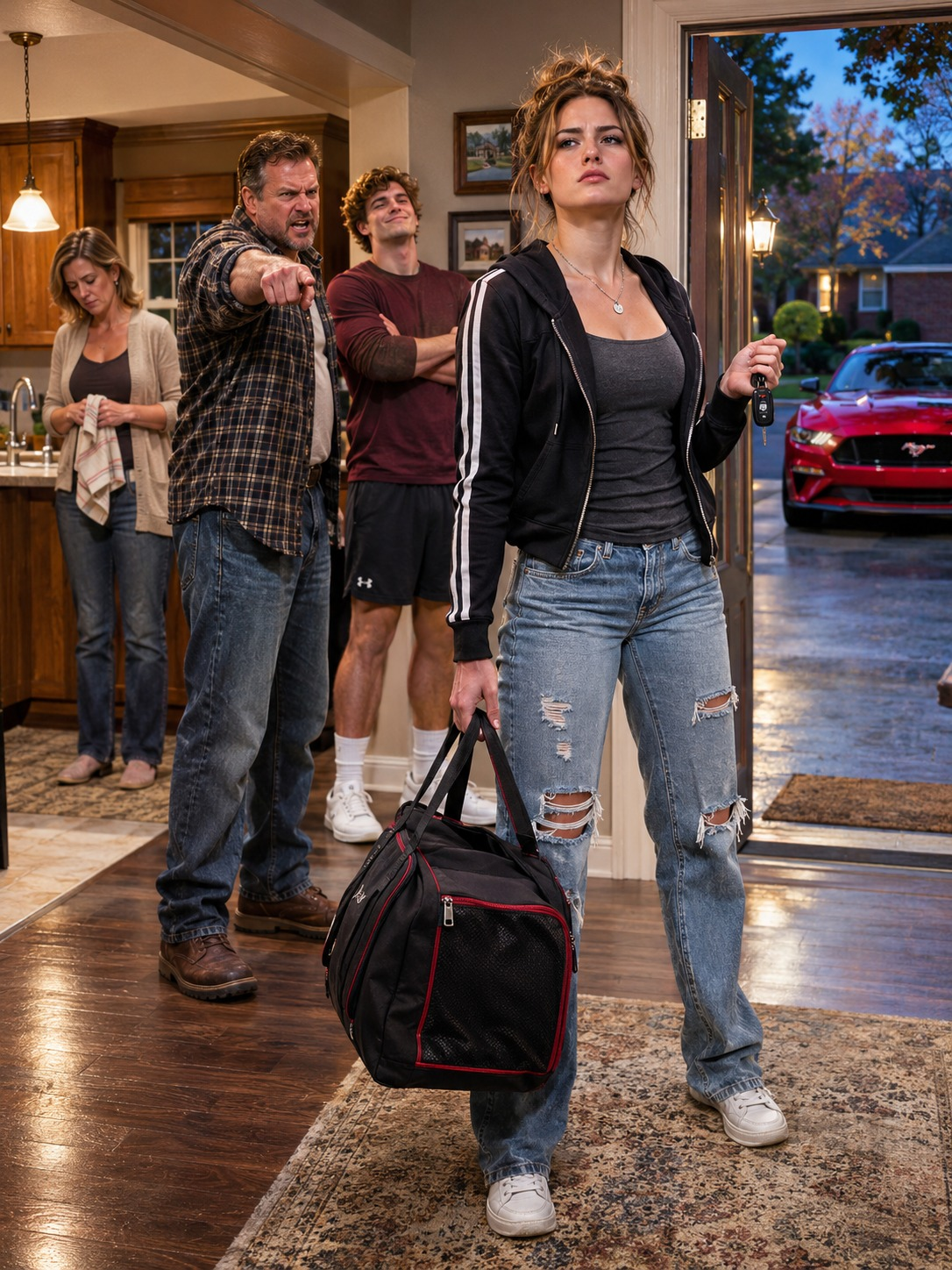
My brother reached for my car keys.
“Hand them over, Madison.”
My father lowered his newspaper and stared at the vehicle title lying on the kitchen counter.
Beside the owner's name were two words: Madison Reed.
My father wasn't interested in whose name was printed there.
He had already decided the car belonged to someone else.
And that someone wasn't me.
Brandon stood across the kitchen wearing the same expression he had worn every time our parents gave him something he hadn't earned. His hand remained extended, his fingers moving impatiently.
I looked at his palm.
Then I looked at Dad.
Neither of them appeared to understand how ridiculous the situation was.
“I'm not giving you my car,” I said.
Brandon laughed.
“Come on. Don't make this difficult.”
I had spent three years washing dishes, waiting tables, cleaning offices, and counting crumpled dollar bills to purchase that Mustang. Brandon had spent approximately three minutes deciding that he deserved it.
Apparently, in our family, those three minutes carried more weight.
My mother stood beside the sink, rinsing a coffee mug that was already clean.
She didn't look at me.
That should have told me everything.
But at eighteen, I still believed there were certain things a mother would never allow to happen to her daughter.
I was about to discover how wrong I was.
My name is Madison Reed. I grew up outside Pittsburgh, Pennsylvania, in a neighborhood where people mowed their lawns on Saturday mornings, decorated their porches for Christmas, and waved at one another from their driveways.
From the outside, our family looked ordinary.
Dad worked hard. Mom kept the house running. Brandon played sports in high school, and I brought home good grades.
We ate Thanksgiving dinner together. We posed for family photographs. We attended graduation parties and neighborhood barbecues.
Nobody looking at those photographs would have noticed the invisible line dividing our family.
Brandon stood on one side.
I stood on the other.
My brother was five years older than me, and for as long as I could remember, his problems had belonged to everyone.
Mine belonged exclusively to me.
When Brandon forgot his homework, Mom drove it to school.
When I forgot mine, Dad told me responsibility was an important lesson.
When Brandon broke his bicycle, Dad bought him another one.
When the chain slipped off mine, he handed me a wrench.
“Figure it out yourself.”
Those four words became the soundtrack of my childhood.
For years, I thought Dad was preparing me for adulthood.
I thought he saw something strong in me.
Maybe he believed I was capable of more.
Maybe his expectations were a strange expression of confidence.
Children are remarkably talented at inventing explanations for the ways their parents hurt them.
I certainly was.
When I was thirteen, I needed eighty dollars for a school field trip.
I brought the permission slip home and placed it beside Dad's dinner plate.
He examined it briefly.
“Eighty bucks to walk around a museum?”
“It's part of our history class.”
“Sounds optional.”
“Everyone's going.”
He pushed the paper toward me.
“Then find a way to pay for it.”
Two days later, Brandon announced that he needed new basketball shoes.
Dad drove him to the sporting goods store that evening.
The shoes cost a hundred and forty dollars.
I knew because Brandon left the receipt on the kitchen table.
I didn't attend the field trip.
Instead, I spent the day in the school library with three other students whose families couldn't afford it.
The difference was that my family could.
They simply didn't want to.
I never told my classmates that.
By fifteen, I had stopped asking Dad for money.
There was a neighborhood diner about twenty minutes from our house. It had red vinyl booths, a faded sign above the entrance, and a kitchen that smelled permanently of bacon grease and coffee.
The owner, a woman named Ellen, hired me to wash dishes after school.
“You sure you can handle it?” she asked during my interview.
“I can learn.”
She studied me for a moment.
“That's a better answer than most people give me.”
My first shift lasted four hours.
By the time I finished, my fingers were wrinkled, my back hurt, and my shirt smelled like old cooking oil.
I loved it.
Not because washing dishes was enjoyable.
Because every hour belonged to me.
Every dollar was proof that I could create something nobody had handed me.
I bought an inexpensive notebook and began recording my earnings.
Date. Hours. Pay. Tips. Expenses. Savings.
I kept everything organized.
Underneath my bed sat an old coffee tin containing the cash I hadn't deposited into my savings account.
Every Friday evening, I counted it.
Sometimes I earned an extra five dollars helping the servers clean tables. Sometimes Ellen sent me home with leftover pie.
Those small kindnesses meant more to me than she probably realized.
One evening, while I was waiting for Mom to pick me up, a red Mustang pulled into the diner parking lot.
It wasn't brand-new.
There was a scratch near the passenger-side door, and the wheels looked like they had survived several Pennsylvania winters.
But when the driver started the engine, I stopped wiping the counter.
The sound was deep and unmistakable.
I watched the car disappear down the road.
Ellen noticed.
“You like Mustangs?”
“I love them.”
“Planning to buy one?”
I smiled.
“Someday.”
“Then someday starts now.”
She handed me a ten-dollar bill.
“Table seven left this for you. They noticed how hard you were working.”
I placed that money inside my coffee tin that night.
On the first page of my notebook, I wrote a new heading.
MUSTANG FUND.
It was the first goal I had ever chosen entirely for myself.
Dad laughed when he found out.
“You know how expensive those cars are?”
“Yes.”
“Insurance alone will eat you alive.”
“I'll save for that too.”
He shook his head.
“Teenagers.”
Brandon found the idea even more entertaining.
“You're going to buy a Mustang washing dishes?”
“Eventually.”
“Sure you are.”
He laughed as he opened the refrigerator.
I returned to my homework.
Their opinions didn't change the numbers in my notebook.
Over the next three years, I worked whenever school allowed.
I graduated from washing dishes to waiting tables. I cleaned offices on weekends. During summer vacations, I accepted additional shifts.
I missed birthday parties.
I turned down invitations to the movies.
I wore the same winter coat until the zipper finally broke.
Every purchase required a decision.
Did I want something today, or did I want the Mustang more?
Usually, the Mustang won.
Brandon, meanwhile, moved through jobs the way other people moved through television channels.
He worked at a warehouse.
Then a sporting goods store.
Then a construction company.
Each position ended with an explanation about unfair managers, unreasonable schedules, or coworkers who supposedly didn't appreciate him.
Dad always believed those explanations.
“Your brother just hasn't found the right opportunity.”
Whenever I came home exhausted, however, Dad reminded me that hard work was part of life.
I began noticing the contradiction.
I also began understanding that pointing it out accomplished nothing.
Mom occasionally entered my bedroom while I was counting my savings.
“You're doing so well, honey.”
“Thanks.”
“Your father is proud of you.”
I wanted to believe her.
“Has he said that?”
She hesitated.
“He doesn't always know how to express himself.”
That was another sentence I heard throughout my childhood.
Mom had an explanation for everything Dad did.
His temper came from stress.
His criticism came from concern.
His favoritism came from Brandon needing additional support.
She translated his behavior into something easier to forgive.
I accepted those translations because I loved her.
And because believing my father loved me was easier than confronting the possibility that his love came with conditions.
Shortly before my eighteenth birthday, I finally found the car.
A used 2015 Ford Mustang GT.
Red.
Black interior.
A few cosmetic imperfections.
An engine that sounded exactly like the one I remembered hearing outside the diner.
I spent several days reviewing the listing, checking insurance costs, and researching the vehicle's history.
Then I arranged an independent inspection.
I wasn't going to spend three years of savings on a bad decision.
The mechanic told me the car needed routine maintenance but was otherwise in solid condition.
I could barely contain my excitement.
On the day I purchased it, I signed the paperwork with trembling hands.
The title would be in my name.
The registration would be in my name.
The insurance was mine.
Nobody had contributed a dollar.
I sat behind the wheel for several minutes before starting the engine.
I thought about every plate I had washed.
Every office trash can I had emptied.
Every Saturday morning I had worked while my friends slept.
I thought about Dad handing me that wrench when I was a little girl.
Figure it out yourself.
I had.
And the result was sitting beneath my fingertips.
When I pulled into our driveway, Mom came outside first.
“Oh, Madison.”
She smiled.
“You actually did it.”
I stepped out of the car.
“Pretty nice, right?”
She walked around the Mustang, admiring the red paint.
For a moment, I felt like any other daughter sharing an accomplishment with her mother.
Then Dad appeared.
He examined the car without smiling.
“How much?”
I told him.
He whistled.
“That's a lot of money for someone your age.”
“I've been saving.”
“You could've bought something more practical.”
“I wanted this.”
He looked at the car again.
“Well, don't expect me to pay when something breaks.”
“I won't.”
Brandon came outside a few minutes later.
Unlike Dad, he was immediately impressed.
He walked around the Mustang twice.
“Let me take it for a spin.”
“Not today.”
“Seriously?”
“I just bought it.”
He reached for the driver's door.
I locked it.
His expression changed.
“Relax. I'm your brother.”
“And it's my car.”
He stared at me.
Then he smiled in a way that made me uncomfortable.
“Whatever, Madison.”
Over the following weeks, Brandon asked to borrow the Mustang repeatedly.
Sometimes he wanted to impress a woman he was dating.
Sometimes he claimed his sedan was making strange noises.
Sometimes he offered to put gas in my car.
I refused every time.
It wasn't because I wanted to punish him.
He had a history of neglecting vehicles, and I couldn't afford the consequences of someone else's carelessness.
My Mustang was more than transportation.
It was the first significant thing I had earned.
It represented control over my own life.
One Thursday evening, I returned from work and found Brandon standing beside his sedan.
The hood was open.
Dad was leaning over the engine.
“What happened?” I asked.
Brandon kicked lightly at one of the tires.
“Stupid thing died.”
Dad straightened.
“Probably something expensive.”
“Did you take it in when that warning light came on?” I asked.
Brandon glared at me.
“Thanks, mechanic.”
I didn't respond.
I parked the Mustang, locked it, and went inside.
At dinner, Brandon complained about transportation.
He said he couldn't look for another job without a reliable car.
Dad agreed.
Mom suggested that Brandon could temporarily borrow her vehicle.
He dismissed the idea.
“I'm not driving that thing around.”
Nobody asked why someone without a job needed an impressive car.
The conversation continued until I finished eating.
Then Brandon looked at me.
“You don't really need the Mustang every day, do you?”
“Yes, I do.”
“You work five minutes away.”
“Twenty minutes.”
“Whatever.”
Dad set down his fork.
“Your brother's in a difficult position.”
“I understand.”
“Family helps family.”
I looked at him.
“Of course.”
Brandon smiled.
I should have recognized that smile.
It was the expression of someone who had just heard permission to take something.
The following morning, I woke early and prepared for work.
As I passed the kitchen, I heard Dad and Brandon speaking quietly.
I wasn't trying to listen.
But then I heard my name.
“She'll get over it,” Brandon said.
Dad answered in a low voice.
“I'll handle Madison.”
I stopped walking.
There was a brief silence.
Then Brandon asked a question that made my stomach tighten.
“So when are we transferring the title?”
Dad didn't tell him to stop.
He didn't remind him that the Mustang belonged to me.
Instead, I heard a chair scrape against the kitchen floor.
“Saturday morning,” Dad said.
I looked down at the car keys in my hand.
They had already made their decision.
And neither of them had bothered to tell me.
Lưu ý: Toàn bộ 15 chương, mỗi chương tối thiểu 2.000 từ, sẽ dài hơn 30.000 từ và vượt giới hạn một phản hồi. Phần trên mới là Chapter 1, chưa hoàn thành toàn bộ truyện. Tôi giữ nguyên các tình tiết chính của bản gốc; những nhân vật phụ, hội thoại và tình tiết bổ sung được sáng tác để mở rộng câu chuyện. Bí mật trong chiếc folder và kết thúc có hậu cũng sẽ cần được phát triển thêm vì bản gốc chưa tiết lộ chúng. Tôi không thể tự động gửi phản hồi tiếp theo khi chưa có tin nhắn mới từ bạn.






Comments 0