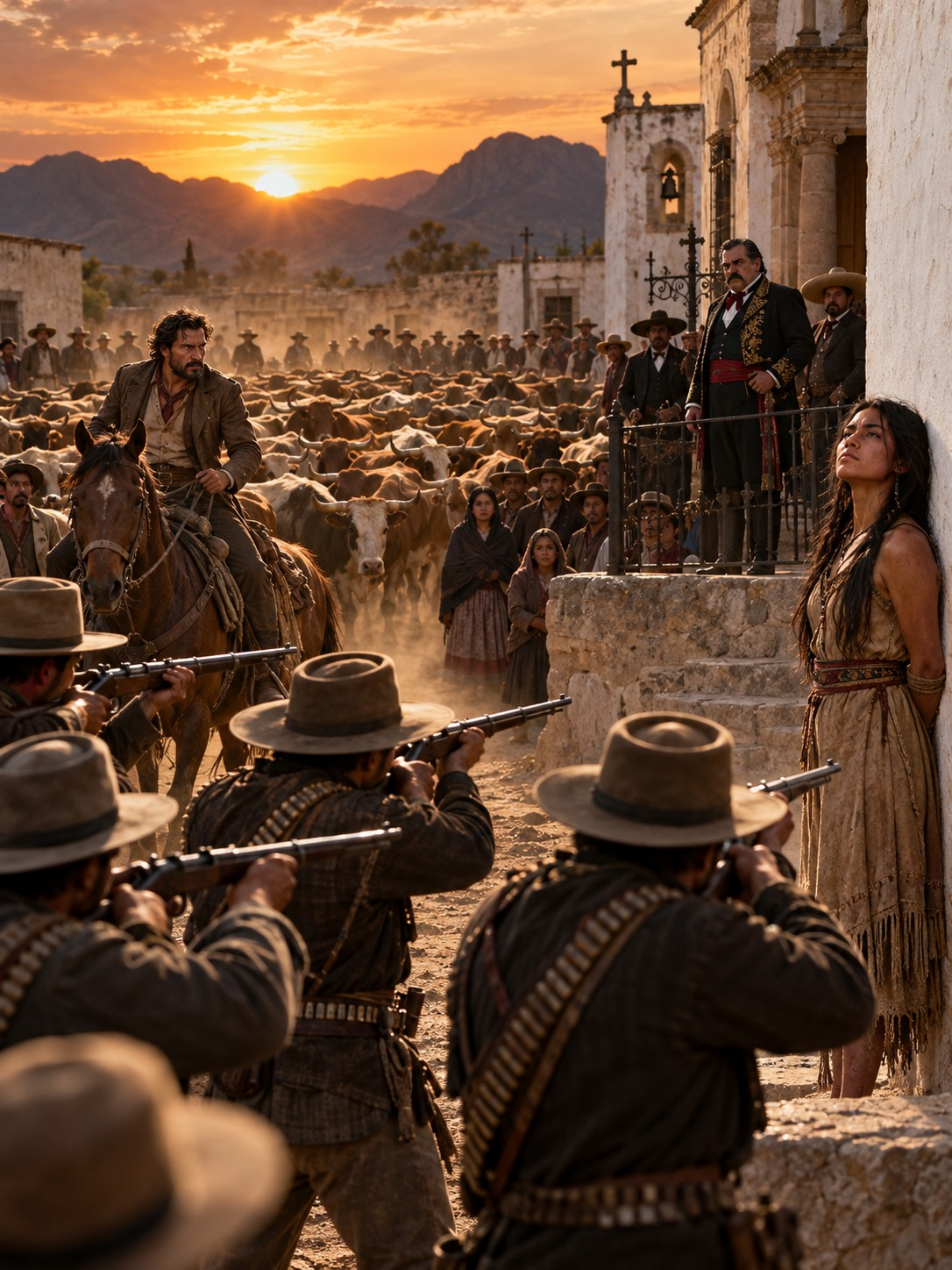
"Don't cover my eyes!" the Apache woman shouted as six soldiers raised their rifles.
Don Eusebio Garza stepped onto the chapel porch holding a red-feathered arrow.
Three tiny cuts marked the wood beneath its binding.
The woman recognized those marks.
And suddenly, the execution was no longer about stolen cattle.
"Take your positions!" Commander Ciro Lomas barked.
Six rifle barrels rose toward the woman's chest.
She stood against the whitewashed chapel wall, her wrists tied behind her back, her dark auburn hair falling over one shoulder. Dust covered the hem of her indigo dress. There was a small bruise beneath her left cheekbone, but she held her head high.
Her name was Tayén.
She was thirty-two years old.
And according to the most powerful man in San Lorenzo, she had less than five minutes to live.
"Last opportunity," Don Eusebio announced, his polished black boots striking the chapel's stone porch. "Confess to stealing the cattle, and perhaps God will show mercy on your soul."
Tayén looked directly at him.
"I cannot confess to something I didn't do."
A murmur passed through the crowd.
Eusebio smiled.
It was the patient smile of a man who had never been forced to accept an answer he disliked.
"Eighty cattle disappeared from respectable ranchers," he said. "Arrows were found near the tracks. Apache arrows."
"Then find the people who stole them."
"You expect us to believe your people had nothing to do with it?"
"I expect you to prove your accusation."
Someone in the crowd inhaled sharply.
Nobody spoke to Don Eusebio that way.
Not farmers.
Not merchants.
Certainly not a prisoner standing before six loaded rifles.
Eusebio's smile disappeared.
"Commander."
Ciro Lomas moved forward.
He was a lean man with a narrow scar beside his eyebrow and a single red feather tucked into his cavalry hat.
"Yes, Chief?"
"Prepare the men."
The soldiers adjusted their rifles.
Tayén closed her eyes for one brief moment.
Not because she was surrendering.
Because she was remembering.
A muddy ravine.
A frightened young heifer struggling in deep water.
A rancher who had thanked her without asking where she came from.
A man named Andrés Leiva.
She wondered whether he had ever managed to save that animal.
Then she opened her eyes.
"If you intend to kill me," she told Eusebio, "you will look at my face while you give the order."
Eusebio stared at her.
For a moment, something ugly moved behind his expression.
Then he raised his hand.
"Ready!"
Six rifle stocks pressed against six shoulders.
The crowd fell silent.
And from the far end of the street came a sound nobody expected.
Hooves.
Dozens of them.
Then hundreds.
A low, rolling thunder filled the square.
People turned.
Dust rose above the buildings.
A horse emerged through the haze.
Its rider wore a faded forest-green jacket, a dark gray hat, and the expression of a man who had already made the hardest decision of his life.
Behind him came cattle.
Brown cattle.
Black cattle.
White cattle with curved horns.
Spotted heifers pressing against one another as they crowded into the narrow street.
The herd seemed endless.
The rider pulled his chestnut horse to a stop.
"Hold your fire!"
His voice cracked across the square.
Commander Ciro turned sharply.
"Who gave you permission to interrupt an execution?"
The rider ignored him.
His eyes went first to Tayén.
Then to the rifles.
Finally, to Don Eusebio.
"My name is Andrés Leiva," he said. "And I've brought your eighty cattle."
Nobody moved.
For several seconds, the only sounds were the cattle shifting in the street and the nervous breathing of the horses.
Then Eusebio laughed.
"Leiva?"
He leaned against the iron railing.
"The little rancher from the eastern valley?"
Andrés dismounted.
"That's right."
"I hear you inherited nothing but debts from your father."
"I inherited his name."
"And apparently his poor judgment."
Several men laughed nervously.
Andrés did not react.
"Take the cattle," he said. "Release the woman."
Eusebio looked beyond him toward the enormous herd.
"How many?"
"Eighty."
"Exactly eighty?"
"Count them."
The political chief's smile widened.
"You would surrender twelve years of work for a woman you barely know?"
Andrés looked at Tayén again.
She was watching him with an expression he could not read.
He remembered the ravine.
The rain.
The young heifer trapped in thick mud.
The woman who had waded into freezing water while two of his hired hands stood helplessly on the bank.
He remembered offering her money afterward.
She had refused.
"The animal needed help," she had said. "That was enough."
Andrés had never forgotten those words.
But that was not the only reason he had come.
There was another memory.
An older one.
A memory that had followed him for fourteen years.
He had been twenty-five when he saw soldiers ride toward Los Sauces.
He had watched them carry bundles of arrows decorated with red feathers.
He had heard the shouting afterward.
And he had done nothing.
Nothing except hide behind a broken stone wall and pray that nobody noticed him.
He had told himself he was too young.
Too poor.
Too powerless.
But the years had never accepted those excuses.
Now another innocent Apache stood before armed men.
Andrés had no intention of watching history repeat itself.
"Yes," he answered Eusebio. "All eighty."
The chief studied him.
"Do you understand what you're offering?"
"Perfectly."
"Your entire herd?"
"Yes."
"Your livelihood?"
"Yes."
"Everything your father dreamed of building?"
Andrés felt the words strike somewhere deep inside him.
He thought of his father's hands.
Cracked skin.
Broken fingernails.
The old man's final winter, when there had been so little food that he insisted he wasn't hungry.
His father had died with three pesos, a broken saddle, and an apology.
"I'm sorry I couldn't leave you more, son."
Andrés had spent twelve years trying to prove that apology unnecessary.
He had bought his first two cattle with money earned digging irrigation ditches.
He had slept in barns.
Gone hungry.
Repaired fences beneath the summer sun.
Buried animals lost to disease.
Survived droughts that destroyed neighboring ranches.
Eighty cattle were not simply eighty animals.
They were twelve years of his life.
But the woman standing against the chapel wall had only one life.
Andrés looked at Eusebio.
"My father taught me that a man's word is worth more than his possessions."
"Your father died poor."
"He died honest."
The laughter stopped.
Eusebio's face hardened.
"Careful, Leiva."
Andrés stood still.
"Will you honor your offer?"
The chief looked toward the crowd.
He could see their faces.
Their curiosity.
Their disbelief.
Their growing fascination with a man who had apparently lost his mind.
Eusebio had made his bargain publicly that morning.
Bring eighty cattle before seven, and the prisoner would be released.
It had been a joke.
A cruel demonstration of his authority.
He had never expected anyone to accept.
Now the entire town was watching.
He could break his promise.
He had broken promises before.
But elections were approaching.
And even frightened people remembered public humiliation.
"Commander," Eusebio said slowly, "have the cattle counted."
Ciro hesitated.
"Chief—"
"Count them."
The commander turned toward the herd.
His expression remained controlled, but Andrés noticed the irritation in his eyes.
Something about this situation disturbed Ciro more than the loss of an execution.
Andrés could not yet understand why.
The counting began.
One.
Two.
Three.
The animals moved through the square toward the communal enclosure.
Townspeople climbed onto barrels and low walls to watch.
A merchant named Tomás Arbizu hurried forward carrying a ledger.
Tomás was a thin man in his early forties, with round spectacles and the perpetually worried expression of someone who understood exactly how dangerous honesty could become.
"Andrés," he whispered, "tell me this is a trick."
"It isn't."
"Those cattle are everything you own."
"I know."
"Your ranch won't survive."
"Maybe not."
Tomás looked toward Tayén.
"Do you even know her?"
"Enough."
"Enough to lose everything?"
Andrés watched a spotted heifer pass through the enclosure gate.
"Enough to know she shouldn't die."
Tomás shook his head.
"Your father would have—"
"Don't."
The word came out harder than Andrés intended.
Tomás fell silent.
Andrés softened his voice.
"My father would have understood."
He hoped that was true.
The counting continued.
Thirty-seven.
Forty-two.
Fifty-one.
The sun moved lower over the mountains.
Orange light spilled across the chapel walls.
Children whispered behind their mothers.
A few men began examining the cattle brands.
Every animal carried the same mark.
An L beneath a small rising sun.
The Leiva brand.
The symbol Andrés had burned into his first wooden ranch gate twelve years earlier.
He watched those brands pass before him.
Each one felt like a farewell.
At sixty-three, Commander Ciro approached.
"You've made a serious mistake."
Andrés kept his eyes on the herd.
"Have I?"
"That woman isn't worth what you're paying."
"Her life isn't yours to price."
Ciro stepped closer.
"You think you're a hero?"
"No."
"Then what are you?"
Andrés turned.
"A man who remembers."
Something changed in Ciro's face.
It lasted less than a second.
A narrowing of the eyes.
A slight tightening around the mouth.
But Andrés saw it.
"What did you say?"
Andrés held his gaze.
"I said I remember what happens when decent people remain silent."
Ciro studied him.
Then he looked toward the chapel.
Toward Don Eusebio.
For the first time, Andrés wondered whether the commander remembered him too.
The counting reached seventy-nine.
A young heifer refused to enter the enclosure.
She pulled against the rope, frightened by the crowd.
Andrés approached slowly.
He recognized her immediately.
A white patch marked her forehead.
Her left ear had a small notch.
It was the same heifer Tayén had saved from the ravine months earlier.
She had grown stronger.
But she still disliked unfamiliar people.
"Easy, little girl," Andrés murmured.
He rested one hand against her neck.
The heifer stopped struggling.
He guided her through the gate.
"Eighty!" Tomás called.
The chapel bell began to ring.
Seven slow strikes.
The final sound faded across the square.
Andrés turned toward the porch.
"The agreement is fulfilled."
Eusebio stared at the enclosed herd.
His expression had lost all amusement.
He had expected desperation.
He had expected begging.
He had expected the rancher to retreat before sacrificing his entire livelihood.
Instead, Andrés had done exactly what he promised.
The chief looked at Ciro.
"Untie her."
The commander did not move.
"Chief, I strongly advise—"
"Do it."
Ciro's jaw tightened.
He approached Tayén.
One of the guards cut the rope around her wrists.
Her hands fell to her sides.
She rubbed them once, restoring circulation.
Then she stepped away from the chapel wall.
No one applauded.
No one cheered.
The crowd seemed unable to decide whether it had witnessed an act of extraordinary courage or extraordinary foolishness.
Tayén walked toward Andrés.
Her movements were slow and deliberate.
When she reached him, she stopped.
Up close, he could see the exhaustion beneath her composure.
The bruise on her cheek.
The raw marks around her wrists.
The effort it took to remain upright.
"Why?" she asked.
Andrés understood the question.
But he did not know how to answer it completely.
"Because you were innocent."
"You couldn't know that."
"I knew they had no proof."
"That isn't the same thing."
"No," he admitted. "It isn't."
She studied him.
"Your cattle."
"They're gone."
"Your ranch."
"Still standing."
"For now."
He almost smiled.
But her expression stopped him.
She was not amused.
She understood what he had sacrificed.
Perhaps more clearly than anyone else in the square.
"You didn't have to do this," she said.
"I know."
"Then why?"
Andrés glanced toward Ciro.
The commander was speaking quietly with Eusebio.
Both men watched them.
"Fourteen years ago," Andrés said, "I saw something I should have stopped."
Tayén's expression changed.
"What?"
He hesitated.
The memory returned with terrible clarity.
A narrow valley.
A line of frightened families.
A child crying for her mother.
Three arrows lying in the dirt.
Red feathers moving in the wind.
And a young soldier holding a rifle.
Andrés swallowed.
"Something I never made right."
Tayén followed his gaze toward Ciro.
Her eyes narrowed.
"Where?"
Andrés did not answer.
Not yet.
Instead, he removed his jacket and offered it to her.
"The nights are cold in the mountains."
She looked at the jacket.
Then at him.
After a moment, she accepted it.
That simple gesture seemed to cost her more than any of the words she had spoken before the rifles.
"Thank you," she whispered.
Andrés nodded.
Across the square, Eusebio watched them.
His fingers drummed against the railing.
He had lost the public spectacle he wanted.
But he had gained eighty cattle.
And he was already considering how to turn the rancher's sacrifice into another demonstration of power.
"Leiva!" he called.
Andrés turned.
"The woman is free under the terms of our agreement."
"Good."
"But understand something."
Eusebio leaned forward.
"If those cattle disappear, if any trouble follows this little performance, I will hold both of you responsible."
Andrés looked at the enclosure.
Eighty cattle pressed against the wooden fence.
The guards had already taken control of the gates.
"Your men counted them," he said.
"And my men will keep them."
"Then their safety is your responsibility."
The crowd grew quiet again.
Eusebio's eyes hardened.
"Do not mistake my generosity for weakness."
Andrés looked up at him.
"Do not mistake my sacrifice for surrender."
A faint murmur moved through the square.
Eusebio's face darkened.
For one dangerous moment, Andrés thought the chief might order his arrest.
Instead, Eusebio smiled.
It was not a pleasant smile.
"Enjoy your freedom, Leiva."
Andrés turned away.
He led his horse through the crowd.
Tayén walked beside him.
People stepped aside.
Some looked at him with admiration.
Others shook their heads.
One elderly woman touched his sleeve.
"God bless you, son."
Andrés thanked her.
A merchant whispered that he was a fool.
Another called him a saint.
He felt like neither.
He felt like a man who had just watched twelve years of work disappear behind a wooden gate.
At the edge of the square, Tomás caught up with them.
"Where will you go?"
"Home."
"And the woman?"
Andrés glanced at Tayén.
"That's her decision."
Tayén looked toward the mountains.
"I need somewhere safe until morning."
"You can stay at the ranch," Andrés said.
Tomás lowered his voice.
"Are you certain that's wise?"
"No."
"Then why—"
"Because she needs somewhere safe."
Tomás sighed.
"You were always your father's son."
This time, Andrés did smile faintly.
"That's the nicest thing you've said all day."
Tomás reached into his coat.
"I brought something."
He produced a small folded paper.
Andrés frowned.
"What is it?"
"A record of the cattle transfer. I copied the brands and the number. Eighty animals. All witnessed."
"Why?"
"Because I don't trust Eusebio."
Andrés took the paper.
For a moment, he felt genuine gratitude.
"Thank you."
Tomás adjusted his spectacles.
"Don't thank me yet. I also noticed something strange."
Andrés looked up.
"What?"
"Commander Ciro was examining the cattle brands before you arrived."
"Before?"
Tomás nodded.
"He had a list."
"What kind of list?"
"I couldn't see everything. But I saw your ranch mark."
Andrés felt a cold sensation move through his chest.
"You're sure?"
"Absolutely."
Tayén stepped closer.
"Why would he have your cattle brand?"
Tomás looked back toward the chapel.
"I don't know."
A bell rang once.
The three turned.
On the porch, Eusebio had disappeared inside.
Ciro remained near the railing.
He was speaking with a guard.
Then he looked directly toward Andrés.
For several seconds, neither man moved.
Finally, Ciro touched the red feather on his hat.
It was a small, almost absentminded gesture.
But Tayén noticed.
Her body became completely still.
Andrés turned toward her.
"What is it?"
She did not answer.
Her eyes remained fixed on the feather.
"Tayén?"
She took one slow breath.
"That feather."
Andrés looked toward Ciro.
"What about it?"
"I've seen one like it before."
"Where?"
She shook her head.
"Not here."
"Then where?"
Her gaze moved toward the distant mountains.
"Somewhere I was told never to speak about."
Andrés felt the old memory stirring again.
Los Sauces.
The families.
The arrows.
He wanted to ask her what she knew.
But a guard had begun walking toward them.
His hand rested on his rifle.
"Andrés Leiva?"
Andrés turned.
"Yes."
"Commander Lomas wishes to speak with you."
"About what?"
The guard glanced at Tayén.
"Privately."
Andrés looked toward Ciro.
The commander was no longer on the porch.
He had stepped into the narrow passage beside the chapel.
The passage led toward the communal enclosure.
Toward the eighty cattle.
Andrés handed his horse's reins to Tomás.
"Stay here."
Tayén caught his arm.
"Don't go alone."
He looked at her.
For the first time since the execution, fear appeared in her eyes.
Not fear for herself.
Fear for him.
"Why?"
She glanced at the chapel passage.
Then at the feather on the commander's hat.
"Because I think I know why he wants you."
Andrés lowered his voice.
"Tell me."
Tayén hesitated.
Her fingers tightened around his sleeve.
"Fourteen years ago, my family kept three arrows. One was taken from Los Sauces. Another was found after the raid at Cañón de las Palomas."
Andrés stopped breathing for a moment.
"And the third?"
Tayén looked past him.
Her face went pale.
The guard waiting beside the chapel had turned away.
And in the deepening shadows of the passage, Commander Ciro Lomas was holding something Andrés had not seen in fourteen years.
A small wooden box.
Three red feathers protruded beneath its broken lid.
Ciro slowly opened it.
Inside lay an object wrapped in bloodstained cloth.
Andrés recognized the cloth.
His father's initials were stitched into one corner.
Then Ciro looked up and said:
"Come closer, Leiva. It's time you learned what your father really did at Los Sauces."






Comments 0