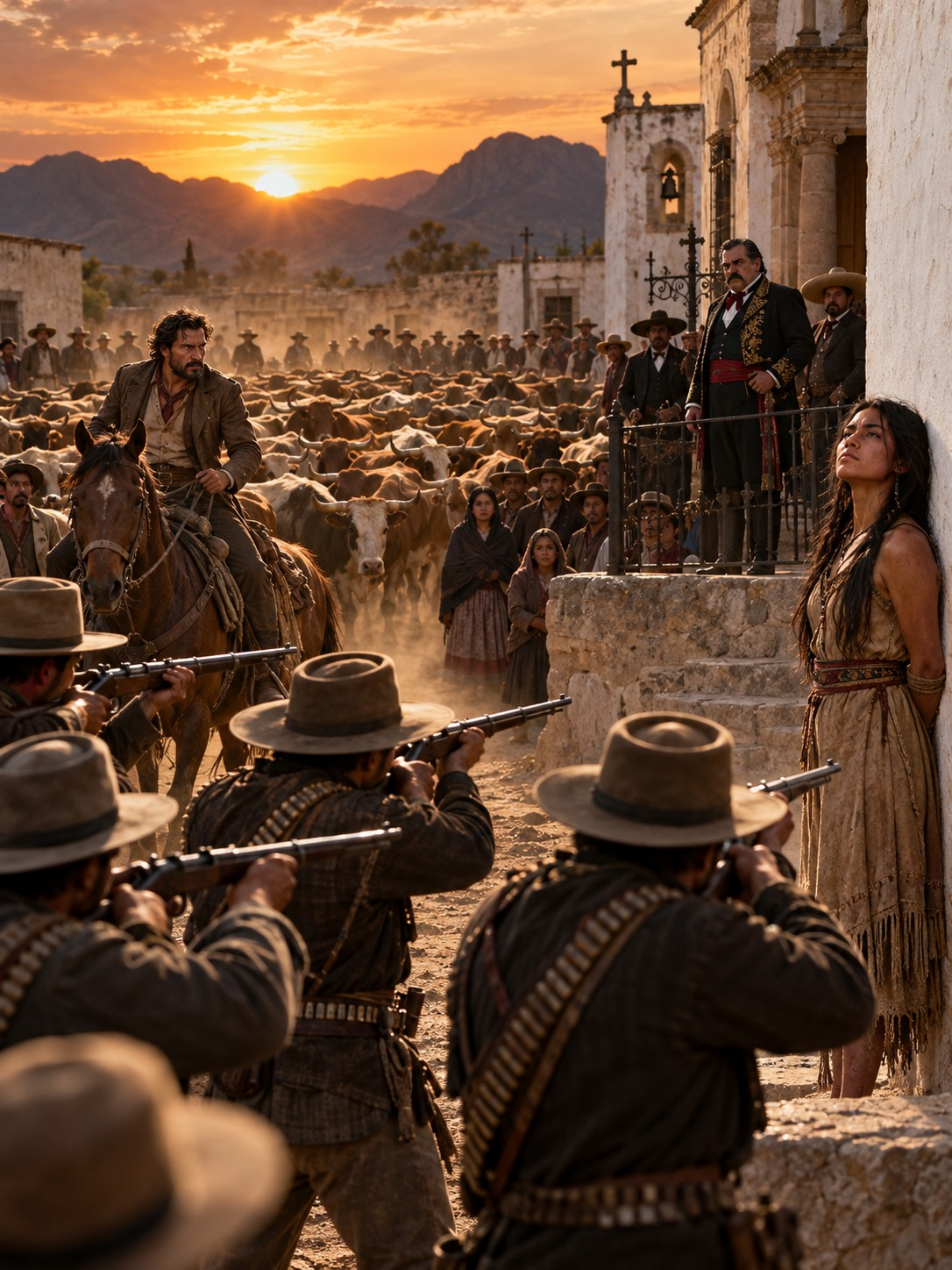
"Get down!" Andrés Leiva shouted as Don Eusebio Garza aimed his revolver at Isela.
The shot struck the limestone wall inches above her head.
Tayén threw herself over her younger sister, pulling her behind a broken water trough as fragments of stone scattered across the ground.
Above the ruined kiln, Baltasar Varela worked the lever of his rifle.
Below him, the territorial inspector lay motionless beside his fallen horse.
Blood darkened the front of his coat.
Six deputies stood frozen between conflicting orders.
Commander Ciro Lomas drew his revolver.
"Nobody moves!" he shouted.
But nobody was listening anymore.
One hundred and sixty cattle were pressing against the southern fence. Their frightened bellows filled the enclosure. Dust rose beneath their hooves, swallowing the lower walls in a thick brown cloud.
Andrés saw the red-feathered arrow lying beside the inspector's open wooden box.
He saw Ciro turn toward it.
And he understood that the next few seconds would decide whether fourteen years of murder remained hidden.
He ran.
Ciro fired.
The bullet tore through the sleeve of Andrés's forest-green jacket.
Andrés stumbled, hit the ground, and rolled behind a stone trough.
Another shot struck the wall above him.
"Leiva!" Ciro roared. "Stay down!"
Andrés ignored him.
The arrow lay six feet away.
Six feet between the truth and the men who intended to destroy it.
He crawled forward.
A third shot struck the dirt beside his hand.
Then a voice shouted from behind the cattle.
"Commander! The gate!"
Tomás Arbizu had climbed onto the western fence and was swinging a length of chain against the wooden posts.
The frightened animals surged toward the opening.
Ciro turned.
Andrés lunged.
His fingers closed around the arrow.
He rolled beneath the trough just as another bullet struck the ground.
The arrow was in his hand.
Its red feathers were dirty.
Its pinewood shaft was worn.
But beneath the iron arrowhead, he could see a small official stamp.
And beside it, nearly invisible beneath years of scratches, were three tiny cuts.
The same marks his father had drawn on the map.
Andrés slipped the arrow inside his jacket.
Then he looked toward the inspector.
The wounded man moved.
Barely.
But enough.
He was alive.
"Help him!" Andrés shouted toward the deputies.
One of the younger men, a broad-shouldered officer with a sandy mustache, dropped to his knees beside the inspector.
"Sir!"
The inspector groaned.
The deputy pressed a folded cloth against the wound.
"He's breathing!"
Ciro strode toward them.
"Leave him. Arrest Leiva."
The deputy looked up.
"He's been shot."
"I gave you an order."
The young officer hesitated.
Then he said, "My orders came from the territorial government, Commander. Not from you."
Ciro stopped.
For the first time that morning, Andrés saw uncertainty cross his face.
The other deputies looked at one another.
They had arrived expecting to arrest a cattle thief.
Instead, they had witnessed a political chief fire at an unarmed woman and a rifleman shoot a government inspector.
And now Ciro was ordering them to abandon the wounded man.
Don Eusebio descended the ridge, his burgundy coat swinging around his legs.
"Arrest them all!" he shouted.
The young deputy stood.
"Chief Garza, lower your weapon."
Eusebio stared at him.
"Do you know who I am?"
"Yes, sir."
"Then obey me."
The deputy raised his rifle.
"Lower your weapon."
For a moment, Eusebio appeared unable to comprehend what was happening.
He had spent years giving orders that nobody dared question.
Now a young officer was pointing a rifle at him.
His face darkened.
"You insolent fool."
The deputy did not move.
Behind him, the inspector groaned again.
Andrés used the distraction to reach Tayén and Isela.
"Are you hurt?"
Tayén shook her head.
"Isela?"
Her sister was trembling, but she was conscious.
"No."
Andrés looked toward the ridge.
Baltasar had disappeared behind the rocks.
He might be repositioning.
Or escaping.
Either possibility was dangerous.
"We need to get away from the open ground," Andrés said.
Tayén glanced toward the cattle.
"They're going to break through."
Andrés followed her gaze.
The southern fence bowed under the weight of the herd.
Reina, his oldest cow, stood at the front.
Behind her, dozens of animals pushed forward.
The damaged gate would not hold.
Andrés felt an idea take shape.
Not a desperate idea.
A rancher's idea.
He knew those cattle.
He knew their habits.
He knew that frightened animals could become deadly if driven into a narrow passage.
But he also knew that a familiar voice and a steady lead animal could guide them through chaos.
He looked at Tayén.
"Can you reach Reina?"
She nodded.
"Then lead her toward the mission road."
"What about you?"
"I'll keep the guards away."
Tayén caught his arm.
"Andrés."
He looked at her.
"Don't try to be a hero."
He gave a tired smile.
"I've never been very good at it."
Her expression did not soften.
"Then be a rancher."
He nodded.
"That I can do."
The southern fence broke with a crack like a gunshot.
Wood splintered.
A heavy post collapsed.
And the cattle began pouring through.
The first animals moved cautiously.
Then the frightened herd surged behind them.
Guards shouted.
Horses reared.
Dust rose in a thick cloud.
Andrés climbed onto the broken trough.
"Easy!" he called. "Easy, girls!"
His voice carried over the noise.
Reina lifted her head.
For one brief moment, she seemed to recognize him.
Then Tayén appeared beside her.
She moved slowly, one hand extended.
The old cow hesitated.
Tayén touched her neck.
Andrés whistled.
The same short whistle he had used every morning for twelve years.
Reina turned toward him.
Then she began walking.
Not running.
Walking.
The animals nearest her followed.
Andrés moved along the herd's left flank, calling softly.
Tayén guided Reina toward the southern ravine.
Isela followed beside her, keeping the younger cattle from turning back.
Tomás climbed down from the fence and joined Andrés.
"You're actually doing it!"
"Keep the stragglers together!"
Tomás looked at the enormous herd.
"All of them?"
"All one hundred and sixty!"
The merchant gave a breathless laugh.
"Of course. Why would we do anything simple?"
Then he ran toward a pair of wandering steers.
Behind them, Ciro shouted orders.
"Stop those cattle!"
Several guards attempted to block the ravine.
But the animals kept moving.
The narrow passage filled with hooves and horns.
No man wanted to stand directly in their path.
Andrés watched the herd enter the ravine.
Twenty animals.
Forty.
Sixty.
The movement became steady.
Controlled.
Exactly as he had hoped.
But the danger was not over.
Ciro still had armed men.
Eusebio still had influence.
Baltasar still had a rifle.
And the inspector was bleeding on the ground.
Andrés looked toward the deputies.
The young officer was helping the wounded man onto a blanket.
Another deputy held a rifle on Eusebio.
A third watched Ciro.
The remaining men were uncertain.
And uncertainty could turn into violence with one wrong command.
Andrés stepped away from the herd.
He raised both hands.
"Deputies!"
The young officer looked toward him.
"My name is Andrés Leiva. I have evidence that those cattle were stolen by Commander Lomas."
Ciro laughed.
"He's a thief!"
Andrés ignored him.
"I have the original transport ledger."
The young deputy's expression changed.
"What ledger?"
"Government payments. Livestock transfers. False records."
Ciro took a step forward.
"He's lying."
Andrés looked directly at the deputy.
"And I have an arrow that proves the evidence used against an innocent Apache woman was manufactured from military supplies."
The deputy hesitated.
Then he asked, "Where is it?"
Andrés touched his jacket.
"Here."
Ciro raised his revolver.
"Don't believe him!"
The deputy swung his rifle toward the commander.
"Put that weapon down!"
Ciro stopped.
For several seconds, nobody moved.
Then Don Eusebio spoke.
"Young man, what is your name?"
The deputy kept his rifle raised.
"Deputy Nicolás Serrano."
Eusebio smiled.
"Serrano. I know your family."
Nicolás said nothing.
"Your father worked for the territorial administration."
"Yes."
"A respectable man."
"Yes."
Eusebio took a slow step forward.
"It would be unfortunate if his son destroyed that reputation by trusting a criminal."
Nicolás's expression tightened.
Andrés recognized the tactic.
Eusebio was not threatening the deputy directly.
He was threatening his family.
The same method he had used against Mateo Leiva.
Against Lucía.
Against every witness who had ever challenged him.
Andrés stepped forward.
"Deputy Serrano."
Nicolás looked at him.
"Don't listen to him."
Eusebio laughed.
"Now the cattle thief gives orders?"
Andrés ignored him.
"Your inspector came here to investigate missing government livestock. Those animals are right in front of you."
Nicolás glanced toward the ravine.
The herd continued moving.
Andrés continued.
"Ask yourself why the political chief ordered you to arrest me instead of the men guarding the stolen cattle."
The deputy looked toward Ciro.
Then Eusebio.
For the first time, doubt appeared in his eyes.
Andrés pressed on.
"Ask why your inspector was shot the moment he opened the box containing the arrow."
Nicolás looked toward the wounded man.
Then toward the ridge where Baltasar had fired.
His jaw tightened.
Finally, he said, "Chief Garza, you will remain here until the inspector can speak."
Eusebio stared at him.
"You dare?"
"Yes, sir."
Ciro stepped forward.
"Deputy, you're making a serious mistake."
Nicolás turned his rifle toward him.
"Then let the inspector decide when he wakes."
The commander stopped.
Andrés felt a small surge of hope.
Not victory.
Not yet.
But the first crack in the wall of fear that had protected Eusebio for years.
The inspector regained consciousness shortly before noon.
His name was Esteban Rojas.
He was a stern man in his fifties, with a narrow face and silver hair at his temples.
The bullet had struck high in his shoulder.
He had lost blood, but the wound was not immediately fatal.
Deputy Nicolás had bandaged it tightly.
Andrés approached cautiously.
Rojas opened his eyes.
"Leiva."
Andrés stopped.
"You know me?"
The inspector gave a weak nod.
"I know your name."
"From the warrant?"
"From another man."
Andrés felt his pulse quicken.
"Who?"
Rojas looked toward the mountains.
"Mateo Leiva."
Andrés froze.
"My father?"
The inspector closed his eyes briefly.
"Your father wrote to the territorial administration years ago."
Andrés stared.
"What did he say?"
Rojas struggled to sit.
Nicolás supported him.
"He accused Eusebio Garza of falsifying land records and ordering an unlawful military operation at Los Sauces."
Andrés felt the world shift.
His father had not remained silent.
He had tried to expose the truth.
"Why wasn't anything done?" Andrés demanded.
Rojas looked at him.
"Because the complaint disappeared."
"How?"
"Someone intercepted it."
Andrés thought of Baltasar.
The forged confession.
The stolen scarf.
The hidden ledger.
"Who?"
Rojas shook his head.
"I never knew."
Andrés leaned closer.
"Then why are you here now?"
The inspector looked toward the cattle.
"Because government livestock disappeared. And because I received a second message."
Andrés frowned.
"From whom?"
Rojas hesitated.
Then he said, "A woman."
Tayén stepped forward.
"What woman?"
The inspector looked at her.
"She signed the message with one name."
Andrés waited.
Rojas whispered, "Lucía."
Everyone turned.
Lucía stood several feet away.
Her face was pale.
Andrés stared at her.
"You sent for him?"
She nodded.
"Yes."
"Why didn't you tell us?"
"Because I wasn't certain the message had reached him."
Rojas looked toward her.
"It reached me."
Lucía closed her eyes.
"Thank God."
Andrés felt a complicated mixture of relief and anger.
Lucía had hidden information again.
But this time, her secrecy had brought help.
Or at least the possibility of help.
Rojas looked toward Eusebio.
The political chief stood under guard near the ruined wall.
His face was unreadable.
"Garza," the inspector called.
Eusebio turned.
"Inspector."
"Why were one hundred and sixty cattle hidden at this kiln?"
Eusebio smiled.
"A temporary government holding station."
"Then why did you report eighty of them stolen?"
"An administrative misunderstanding."
"And why did you issue an arrest warrant accusing Leiva of stealing all one hundred and sixty?"
Eusebio's smile faded.
"Because the evidence suggested his involvement."
Rojas looked toward Andrés.
"Do you have the ledger?"
Andrés reached beneath his jacket.
He removed the leather book.
Then he handed it to Nicolás.
The deputy brought it to the inspector.
Rojas opened the cover.
He turned several pages.
His expression darkened.
"Where did you find this?"
"Inside the kiln."
Rojas continued reading.
The silence stretched.
Then he stopped at a page near the back.
His eyes narrowed.
"These payments."
Andrés nodded.
"Fourteen years ago."
Rojas looked up.
"Los Sauces."
Eusebio's face changed.
Ciro took a step backward.
Rojas turned another page.
Then another.
Finally, he closed the book.
"Deputy Serrano."
"Sir?"
"Place Commander Lomas under arrest."
Ciro froze.
"What?"
"On suspicion of falsifying government records, misappropriating livestock, and obstructing an official investigation."
Ciro's face twisted.
"You have no authority!"
Rojas looked at him coldly.
"I have more than enough."
Nicolás approached with two deputies.
Ciro's hand moved toward his revolver.
"Don't," Nicolás warned.
For a moment, Andrés thought the commander would shoot.
Then Ciro looked toward Eusebio.
The political chief gave the smallest shake of his head.
Ciro slowly removed his revolver.
He handed it over.
The deputies bound his wrists.
Andrés watched in disbelief.
The man who had threatened him beside the chapel was now standing under arrest.
But Eusebio remained free.
And Baltasar was still somewhere in the mountains.
Rojas looked toward the political chief.
"Garza, you will accompany us to San Lorenzo."
Eusebio smiled.
"Of course."
Andrés felt uneasy.
The man was too calm.
Far too calm.
By early afternoon, the cattle had been gathered along the old mission road.
Andrés and Tayén guided them toward San Lorenzo.
Tomás rode beside the rear animals on a borrowed horse.
Isela remained with Lucía in a small wagon provided by the deputies.
The inspector traveled slowly, supported by Nicolás.
Ciro rode under guard.
Eusebio followed on horseback, still wearing his burgundy coat.
The procession stretched nearly half a mile.
One hundred and sixty cattle.
Six deputies.
Two prisoners.
Four witnesses.
And a wounded inspector carrying evidence of a conspiracy that had begun fourteen years earlier.
Andrés looked toward Tayén.
She rode beside him on a small gray horse.
Her auburn braid moved against the collar of his green jacket.
"You should rest," he said.
She glanced at him.
"So should you."
He smiled faintly.
"I don't think either of us remembers how."
For a moment, she returned the smile.
Then her expression became serious.
"Do you believe the inspector?"
Andrés considered the question.
"I believe he was shot because someone feared what he might discover."
"That doesn't mean he's honest."
"No."
She looked toward the wagon carrying Isela.
"But he has the ledger."
"And the arrow."
"And Eusebio still has friends."
Andrés nodded.
He had spent his life watching powerful men survive accusations that would destroy ordinary families.
He knew evidence alone did not guarantee justice.
But for the first time, he had witnesses.
Documents.
A government inspector.
And one hundred and sixty living animals.
The truth was no longer hidden inside a wooden trunk.
It was moving toward San Lorenzo in broad daylight.
They reached the outskirts of town shortly before sunset.
The chapel bell began ringing.
People emerged from houses and shops.
Children ran toward the road.
Merchants abandoned their stalls.
Word spread quickly.
Andrés Leiva was returning.
With the cattle.
All of them.
The crowd grew as the herd entered the main street.
Thirty people.
Then fifty.
Then more.
Faces appeared at windows.
Men removed their hats.
Women whispered to one another.
Andrés recognized Rafael Ortega standing outside the blacksmith's shop.
The old rancher stared at the herd.
Then at Andrés.
His mouth fell open.
"Good Lord."
Andrés nodded toward him.
"Afternoon, Rafael."
The old man looked at the cattle.
"Those are yours."
"Some of them."
"And the others?"
"Government property."
Rafael stared.
"Where did you find them?"
Andrés looked toward the chapel.
"Ask Commander Lomas."
The crowd turned.
They saw Ciro riding with his hands bound.
A murmur spread through the square.
Then someone shouted.
"He's arrested!"
Another voice answered.
"Why?"
Andrés stopped his horse.
He looked toward the chapel porch.
The same place where Tayén had stood before six rifles.
The same place where Eusebio had demanded obedience.
The same place where Andrés had surrendered everything he owned.
Now the square was filled with cattle.
And the commander who had threatened to execute an innocent woman stood under guard.
Andrés dismounted.
He climbed onto the low stone steps.
The crowd fell silent.
He removed his dark gray hat.
Then he spoke.
"Three days ago, I brought eighty cattle into this square."
People nodded.
Some had witnessed the bargain.
Others had heard the story.
"I gave them to Don Eusebio Garza in exchange for the life of an innocent woman."
He looked toward Tayén.
She stood beside Isela near the wagon.
"And after the chief accepted those cattle, they disappeared from his own guarded enclosure."
The crowd murmured.
Andrés continued.
"Today, we found them."
He pointed toward the herd.
"All eighty."
A man shouted, "Where?"
"At the abandoned lime kiln north of town."
Another voice called, "Who took them?"
Andrés looked toward Ciro.
"The commander's men."
The crowd erupted.
Ciro shouted, "Lies!"
Nicolás stepped beside him.
"Quiet."
Andrés raised his hand.
The crowd slowly settled.
"But we found something else."
He pointed toward the second herd.
"Eighty government cattle that were reported stolen before my animals disappeared."
A woman near the front gasped.
Andrés continued.
"Those animals were hidden at the same kiln."
The murmuring grew louder.
He looked toward Eusebio.
The political chief stood beside the chapel steps.
His face was pale.
Andrés felt fourteen years of anger rising inside him.
But he kept his voice steady.
"These thefts were used to accuse an innocent Apache woman."
He turned toward Tayén.
"She was nearly executed in this square."
The crowd became quiet.
Andrés continued.
"The evidence against her was manufactured."
He looked toward the inspector.
Rojas sat in the wagon, pale but conscious.
Nicolás held the leather ledger.
"And the records we recovered connect the same men to a crime committed fourteen years ago."
Someone whispered.
"Los Sauces."
Andrés heard it.
He looked toward the voice.
Rafael Ortega stood near the blacksmith's shop.
His face had gone white.
Andrés nodded.
"Yes."
The crowd fell silent.
"Los Sauces."
For fourteen years, the name had been spoken only in whispers.
Now Andrés said it aloud before the entire town.
"Families were accused of stealing cattle. Soldiers attacked them. Innocent people died."
He looked toward Tayén and Isela.
"Some survived."
The sisters stood together.
Tayén's expression was calm.
Isela held her hand.
Andrés continued.
"And the men responsible have spent fourteen years making certain nobody learned the truth."
The crowd shifted.
People looked toward Eusebio.
The political chief stepped forward.
"Enough!"
Andrés turned.
Eusebio climbed the chapel steps.
His burgundy coat caught the evening light.
His silver-gray hair was perfectly combed.
He looked every inch the powerful man who had ruled San Lorenzo for years.
"Citizens," he announced, "you are being deceived."
Andrés remained still.
Eusebio pointed toward him.
"This man is a criminal."
The crowd murmured.
"He stole government cattle. He attacked officers. He conspired with Apache raiders."
Tayén stepped forward.
"Then show your evidence."
Eusebio turned sharply.
"You!"
She climbed the steps beside Andrés.
The crowd watched.
Tayén looked directly at the political chief.
"Three days ago, you ordered six men to shoot me."
Eusebio's face hardened.
"You were accused of theft."
"Without a witness."
"Evidence was recovered."
"False evidence."
"That has not been proven."
Tayén looked toward the inspector.
"Then let him examine it."
Rojas raised his head.
"Chief Garza."
Eusebio turned.
The inspector spoke slowly.
"I have examined the arrow."
The square became silent.
Rojas continued.
"It bears an official military supply stamp."
A murmur spread through the crowd.
"And the ledger recovered from the kiln contains records of payments to men involved in the Los Sauces operation."
Eusebio's expression changed.
Rojas looked directly at him.
"You will answer these accusations before the territorial authorities."
For a moment, Eusebio stood motionless.
Then he laughed.
A soft, controlled laugh.
"Inspector, you have been misled."
Rojas did not smile.
"Perhaps."
Eusebio's confidence returned.
"Then you should allow me to explain."
"Go ahead."
The political chief looked toward the crowd.
"Fourteen years ago, there was an uprising near Los Sauces."
Tayén stiffened.
Eusebio continued.
"Armed raiders threatened settlements. Soldiers were sent to restore order."
Andrés stepped forward.
"That's a lie."
Eusebio turned.
"You weren't there."
Andrés felt the words strike him.
He looked directly into the chief's eyes.
"Yes," he said. "I was."
The square fell silent.
Eusebio's expression changed.
Andrés continued.
"I saw soldiers carrying bundles of red-feathered arrows before they entered the settlement."
A murmur spread through the crowd.
"I saw Commander Lomas with them."
Ciro shouted, "You saw nothing!"
Andrés ignored him.
"I heard gunfire. I saw families running. And I saw men carrying evidence they intended to plant afterward."
Eusebio's face darkened.
"You're lying."
Andrés took one step closer.
"No."
He looked toward the crowd.
"I was afraid to speak fourteen years ago."
His voice tightened.
"I am not afraid now."
The words hung over the square.
Then Rafael Ortega stepped forward.
He removed his hat.
"Andrés is telling the truth."
Everyone turned.
The old rancher looked toward Eusebio.
"I remember Mateo Leiva returning from Los Sauces with blood on his clothes."
Andrés felt his chest tighten.
Rafael continued.
"He told me the soldiers had attacked innocent families."
Eusebio stared at him.
"Ortega, be careful."
Rafael shook his head.
"I've been careful for fourteen years."
He looked toward Tayén.
"And I've been ashamed for every one of them."
The crowd became restless.
Another man stepped forward.
Then a woman.
Then an elderly shopkeeper.
People began speaking.
Quietly at first.
Then louder.
They remembered missing records.
Unexplained land transfers.
Families driven from their homes.
Witnesses who had disappeared.
The silence protecting Eusebio was beginning to break.
Andrés looked toward the political chief.
For the first time, he saw something he had never expected.
Fear.
Not of a gun.
Not of a single accusation.
Fear of the people who had obeyed him for years.
Eusebio stepped backward.
Then he raised both hands.
"Citizens! Listen to me!"
But the crowd no longer fell silent at his command.
Voices rose.
Questions flew.
Men demanded answers.
Women pointed toward the cattle.
Andrés stood beside Tayén.
He felt her hand touch his arm.
He looked at her.
She nodded once.
A small gesture.
But it carried fourteen years of grief.
And the possibility that the truth might finally be heard.
Then the chapel bell stopped.
The sudden silence was so strange that people turned toward the tower.
A figure stood beneath the bell.
A man wearing a dark hat.
A blue scarf hung around his neck.
Andrés felt his stomach tighten.
Baltasar Varela.
The older man stepped onto the upper balcony.
He held a rifle.
And beside him stood a young boy.
Perhaps twelve years old.
His hands were bound.
His face was pale.
Tomás gasped.
"Elena's brother."
Andrés turned.
"What?"
Tomás stared at the balcony.
"That's Miguel. My son."
The crowd fell silent.
Baltasar pressed the rifle against the boy's shoulder.
"Nobody moves!"
Andrés felt cold fury rise through him.
Tomás stepped forward.
"Let him go!"
Baltasar smiled.
"Then tell your friend to put down the ledger."
Andrés looked toward Nicolás.
The deputy held the book against his chest.
Baltasar continued.
"And the arrow."
The inspector shifted in the wagon.
Eusebio stood motionless beneath the chapel steps.
Andrés watched his face.
Something was wrong.
The political chief did not appear surprised.
He appeared relieved.
Baltasar raised his voice.
"Bring me the ledger and the arrow, or the boy dies!"
Tomás stumbled toward the steps.
Andrés caught him.
"Wait."
"That's my son!"
"I know."
"He's going to kill him!"
Andrés looked toward the balcony.
Baltasar's rifle remained steady.
The boy was trembling.
But he was alive.
Andrés raised both hands.
"All right!"
The crowd fell silent.
Baltasar looked down.
Andrés continued.
"You want the evidence?"
"Yes."
"Then let the boy go."
Baltasar laughed.
"Not until I have it."
Andrés looked toward Nicolás.
The deputy hesitated.
Then he glanced at the inspector.
Rojas gave a faint nod.
Nicolás handed Andrés the ledger.
Then the wooden box containing the arrow.
Andrés climbed the chapel steps.
Tayén caught his arm.
"Don't."
He looked at her.
"I have to."
She shook her head.
"He won't keep his word."
"I know."
Andrés looked toward the balcony.
Then toward the narrow stairway leading into the chapel tower.
He had visited the chapel many times.
He knew the stairs.
The landings.
The small storage room beneath the bell.
And the narrow window overlooking the square.
He also knew Baltasar could not watch every entrance at once.
Andrés leaned toward Tayén.
"Keep him talking."
She looked at him.
Then nodded.
Andrés stepped forward.
"Baltasar!"
The older man looked down.
"I'm coming up!"
"Alone!"
"Alone."
Andrés entered the chapel.
The interior was dim.
Candles flickered near the altar.
The wooden pews stood empty.
He could hear the crowd outside.
He could hear Baltasar shouting orders.
And he could hear the frightened boy crying softly above him.
Andrés moved toward the tower stairs.
His boots struck the stone.
One step.
Then another.
He carried the ledger beneath one arm.
The wooden box in his other hand.
At the first landing, he stopped.
A narrow window overlooked the square.
Through it, he saw Tayén standing beside Isela.
Lucía remained near the wagon.
Tomás stood beneath the balcony, staring upward.
Eusebio had moved toward the chapel door.
And Ciro—
Andrés froze.
Ciro was no longer standing beside the deputies.
The commander had disappeared.
Andrés felt a sudden chill.
He looked toward the stairs above him.
A faint sound came from the darkness.
Metal scraping stone.
Someone was moving.
He tightened his grip on the box.
Then he heard a voice.
Low.
Familiar.
Ciro.
"Put the evidence down, Leiva."
Andrés turned.
The commander stood on the landing behind him.
His wrists were free.
A revolver gleamed in his hand.
And beside him stood Don Eusebio Garza.
The political chief smiled.
"Did you really think I would allow a rancher to destroy fourteen years of work?"
Andrés stepped backward.
The narrow stairway offered no escape.
Above him, Baltasar held a child hostage.
Below him, Ciro and Eusebio blocked the stairs.
And in his hands were the only pieces of evidence that could expose them.
Eusebio extended one hand.
"The ledger."
Andrés did not move.
Ciro raised his revolver.
"Now."
Andrés looked toward the narrow window.
The square lay far below.
No one outside could see what was happening.
He was trapped.
Eusebio stepped closer.
"The arrow too."
Andrés felt the wooden box against his palm.
The third arrow.
The government stamp.
The marks his father had left behind.
Fourteen years of secrets.
He looked directly at the political chief.
"You killed my father."
Eusebio's smile faded.
Andrés continued.
"You destroyed those families. You stole their land. You framed Tayén. You took my cattle."
The chief's expression hardened.
"And now you think you can simply take the evidence and walk away?"
Ciro pressed the revolver against Andrés's chest.
"Enough."
Eusebio leaned closer.
"Your father was given the same choice."
Andrés stared.
"What choice?"
"Obedience or death."
The words hung in the narrow stairwell.
Then Eusebio smiled again.
"He chose poorly."
Andrés felt his heart pounding.
For fourteen years, he had wondered what happened to his father after Los Sauces.
Now the man responsible stood inches away.
Andrés looked at him.
"Tell me how he died."
Eusebio's smile widened.
"Would you like to know?"
"Yes."
The chief leaned closer.
"Then give me the arrow."
Andrés slowly opened the wooden box.
The red feathers caught the dim light.
Ciro's revolver remained pressed against his chest.
Eusebio extended his hand.
Andrés looked down at the arrow.
Then he noticed something.
Beneath the iron arrowhead, the official stamp was not the only marking.
There was another inscription.
Smaller.
Almost invisible.
Three letters.
M.L.
Mateo Leiva.
His father had handled this arrow.
And perhaps left something on it that nobody else had noticed.
Andrés looked toward Eusebio.
The political chief was watching the arrow.
His expression changed.
He had seen the letters.
And suddenly, he was no longer smiling.
"Where did you get that?" Eusebio whispered.
Andrés held the arrow steady.
"From the inspector."
Eusebio stepped closer.
"Give it to me."
Andrés did not move.
The chief's voice became desperate.
"Now!"
Ciro tightened his grip on the revolver.
Andrés looked toward the window.
Then toward the stairs above.
He had only one chance.
He lifted the arrow.
Eusebio reached for it.
Andrés stepped backward.
His heel struck the edge of the landing.
The wooden box slipped from his hand.
It fell.
Struck the stone.
And broke open.
The arrow rolled across the floor.
Its iron head struck the wall.
A sharp crack echoed through the stairwell.
Andrés stared.
The arrowhead had separated from the shaft.
Something small fell out.
A tightly rolled strip of paper.
Eusebio froze.
Ciro lowered his revolver slightly.
Andrés bent toward the paper.
But Eusebio lunged.
"NO!"
Andrés caught the strip first.
He unrolled it.
The writing was tiny.
Faded.
But unmistakable.
His father's handwriting.
At the top was a date.
April 17, 1872.
Beneath it was a name.
A name Andrés had never expected to see.
He looked up slowly.
Eusebio's face had gone white.
Ciro stared at the paper.
And from the stairway above them, Baltasar's voice suddenly rang out.
"Don't let him read it!"
Andrés lowered his eyes.
The first sentence began:
The man who paid for the massacre at Los Sauces was not Don Eusebio Garza. It was...






Comments 0