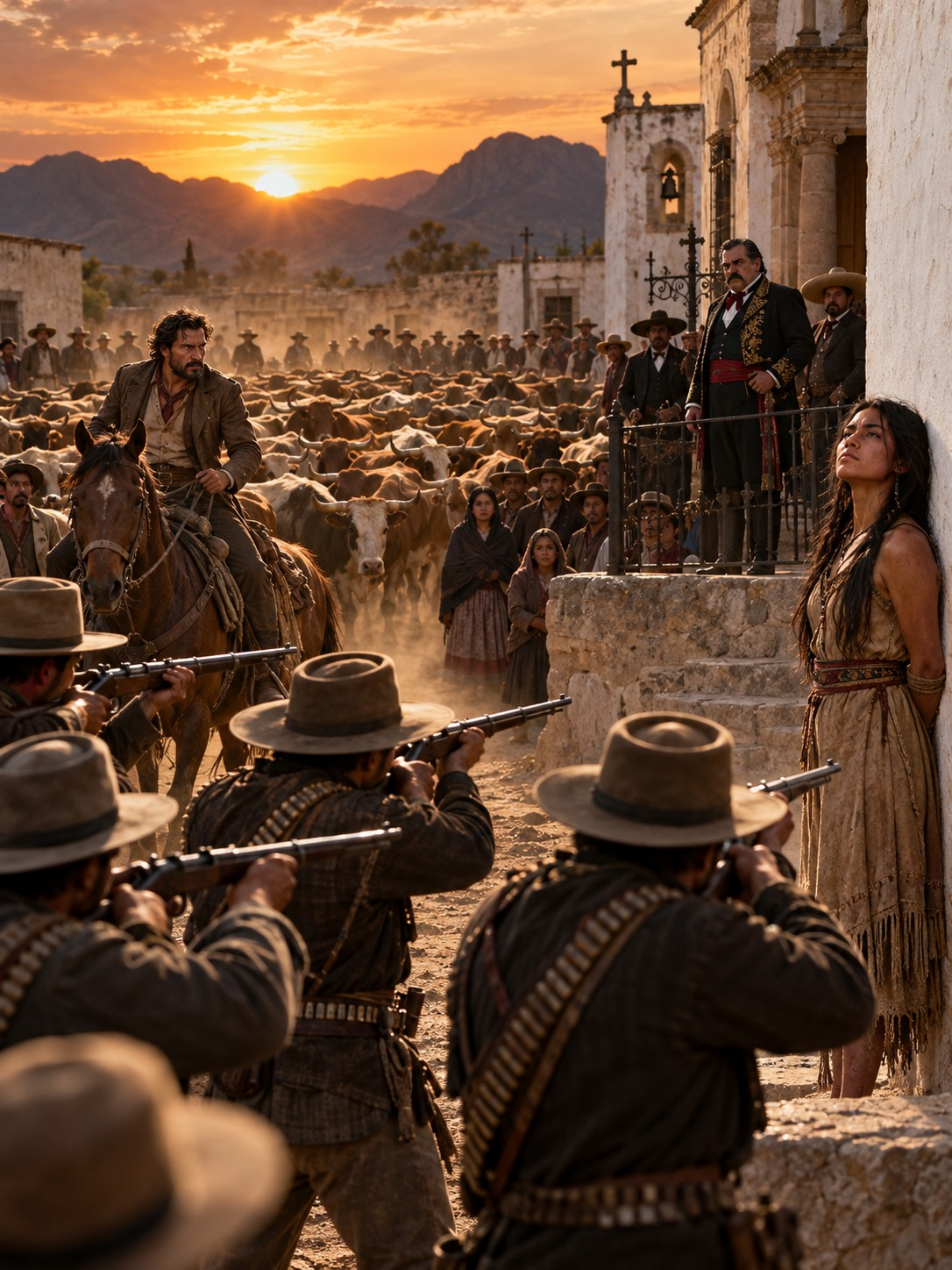
"Your father wasn't the hero you thought he was," Commander Ciro Lomas said, holding the bloodstained cloth beneath Andrés Leiva's face.
Andrés stared at the familiar initials stitched into its corner.
M.L.
Mateo Leiva.
His father.
The man who had died with nothing but a broken saddle, three pesos, and a reputation for keeping his word.
For fourteen years, Andrés had believed he knew every important detail of his father's life.
Now a man he despised was holding something that suggested otherwise.
"Where did you get that?" Andrés demanded.
Ciro smiled without warmth.
"Interesting. You recognize it."
"Answer me."
"Careful, rancher. You just purchased one woman's freedom. Don't make me regret allowing you to keep yours."
They stood in the narrow passage beside San Lorenzo's chapel. Behind them, the square was slowly emptying. Cattle shifted inside the communal enclosure, their hooves scraping against the hard earth.
The chapel bell had stopped ringing.
The sun was nearly gone.
Andrés could still see Tayén standing near Tomás Arbizu at the entrance to the passage.
She was watching them.
Ciro noticed his glance.
"Your new friend should learn when to mind her own affairs."
"She has a name."
"I know her name."
Something in the commander's voice made Andrés turn sharply.
"Then you know she didn't steal those cattle."
Ciro's expression remained unchanged.
"I know she was fortunate enough to find a fool willing to pay for her freedom."
He folded the bloodstained cloth and returned it to the wooden box.
Andrés reached for it.
Ciro moved the box away.
"Not so fast."
"That belonged to my father."
"Perhaps."
"What does that mean?"
"It means ownership can become complicated when a man is dead."
Andrés took a step forward.
Ciro's right hand dropped toward his revolver.
The movement was small.
Deliberate.
A reminder.
Andrés stopped.
He had survived enough years on the frontier to recognize a man hoping for an excuse to shoot.
Ciro tilted his head.
"Your father ever tell you about Los Sauces?"
Andrés felt his stomach tighten.
"Not much."
"Strange. He was there."
"I know."
"Did he tell you why?"
Andrés said nothing.
Ciro studied his face.
Then he gave a quiet laugh.
"No. I can see he didn't."
"What are you accusing him of?"
"Nothing. Dead men don't stand trial."
"Then say what you came to say."
Ciro leaned closer.
"Your father made a decision fourteen years ago. A decision that protected you. If I were you, I'd be grateful instead of digging around in things better left buried."
Andrés remembered his father returning home one night in 1872.
He had been a young man then, twenty-five years old, working beside Mateo on a struggling patch of land.
His father had arrived after midnight.
His shirt was torn.
His hands were trembling.
There had been blood on his sleeve.
When Andrés asked what happened, Mateo had answered with only three words.
"Go to bed."
The next morning, his father burned a bundle of papers behind the stable.
Andrés had watched from the kitchen window.
He had never asked why.
Now he wondered whether those papers had come from Los Sauces.
"Was my father involved in what happened to those families?" Andrés asked.
Ciro's smile vanished.
For a moment, he looked almost surprised.
Then he recovered.
"That depends on what you think happened."
"I saw soldiers riding into the valley."
"Soldiers followed orders."
"I heard gunfire."
"An unfortunate necessity in dangerous territory."
"I saw women and children running."
Ciro's eyes narrowed.
"You saw more than you should have."
The words hung between them.
Andrés felt his pulse quicken.
Ciro had not denied it.
He had not even asked whether Andrés was telling the truth.
He had simply acknowledged that the young rancher had witnessed something.
"You remember me," Andrés said.
Ciro looked toward the darkening square.
"Your father was a difficult man to forget."
"And me?"
The commander returned his gaze.
"You were a boy who didn't understand when to keep his mouth shut."
"I was twenty-five."
"Then you were old enough to know better."
A voice interrupted them.
"Let him go."
Tayén stood at the passage entrance.
She had Andrés's green jacket draped over her shoulders. The sleeves hung beyond her wrists, concealing the marks left by the rope.
Ciro turned.
"I don't recall inviting you."
"You didn't."
"Then leave."
She remained where she was.
Andrés noticed that her attention was fixed on the wooden box.
Not on Ciro's revolver.
Not on the bloodstained cloth.
On the box itself.
"Where did you find that?" she asked.
Ciro looked down at it.
"Why?"
"Because I've seen one like it."
Andrés turned toward her.
Ciro's fingers tightened around the lid.
"You're mistaken."
Tayén shook her head.
"No."
For several seconds, the commander said nothing.
Then he stepped toward her.
"Listen carefully. Your freedom was purchased, not earned. I suggest you take it and disappear before the chief changes his mind."
Tayén did not retreat.
"You cannot change the terms of a bargain after accepting payment."
Ciro stopped inches from her.
"You think the law protects you?"
"I think you are afraid of what I recognize."
Andrés saw the commander's jaw tighten.
The expression lasted only a heartbeat.
But it was enough.
Ciro looked toward the square, where several townspeople were still watching.
He lowered his voice.
"Both of you get out of San Lorenzo. Tonight."
Andrés stepped beside Tayén.
"We'll leave when we're ready."
"Then don't say I failed to warn you."
Ciro closed the box.
He turned away.
But before disappearing into the chapel's rear courtyard, he looked back at Andrés.
"Ask yourself something, Leiva."
Andrés waited.
"Why would a man as poor as your father possess something worth killing for?"
Then he was gone.
Tomás Arbizu was waiting beside Andrés's horse.
His spectacles had slipped down his nose, and he kept glancing toward the communal enclosure.
"Please tell me you didn't threaten the commander."
"He threatened us."
"That's worse."
Andrés took the reins.
Tomás looked at Tayén.
"Are you hurt?"
"I'll live."
"That's not quite the same thing."
"No," she admitted. "It isn't."
Tomás reached into his satchel and produced a small parcel wrapped in paper.
"Bread. Cheese. A little dried meat."
Andrés frowned.
"What's this?"
"Dinner."
"I didn't ask—"
"I know. That's why I brought it."
For the first time that evening, Tayén's expression softened.
"Thank you."
Tomás nodded awkwardly.
Then he leaned toward Andrés.
"There's something else."
"What?"
"After the cattle were counted, I saw Sergeant Jacinto speaking with Eusebio."
"And?"
"Jacinto looked frightened."
"He's one of Ciro's men."
"Exactly. I've known that man for twenty years. I've seen him drunk, angry, and half dead from fever. I've never seen him frightened of a conversation."
"What were they discussing?"
"I couldn't hear everything."
"Tomás."
The merchant hesitated.
"I heard the word 'brands.' Then Eusebio said, 'Not until tomorrow.'"
Andrés looked toward the enclosure.
His cattle were packed tightly behind the wooden fence.
Two armed guards stood at the main gate.
Another watched from the chapel steps.
"Why would they be discussing my brands?"
Tomás shook his head.
"I don't know. But I don't like it."
Andrés considered the situation.
He had surrendered his cattle under a public agreement.
The animals now belonged to the political chief.
Whatever Eusebio intended to do with them, Andrés had no legal claim remaining.
But the commander had possessed a list containing the Leiva brand before the herd arrived.
That was different.
That suggested preparation.
"Did you keep the transfer record?" Andrés asked.
Tomás patted his satchel.
"Every number. Every witness. Every brand."
"Make another copy."
"Why?"
"Because if one disappears, we'll need the other."
Tomás stared at him.
Then he nodded.
"I'll do it tonight."
Andrés mounted his horse.
He offered Tayén his hand.
She hesitated before accepting.
He helped her into the saddle behind him.
As they turned toward the eastern road, a voice called from the crowd.
"Leiva!"
An elderly rancher approached.
His name was Rafael Ortega.
He had once worked alongside Andrés's father.
Rafael removed his hat.
"Your father would have been proud today."
Andrés felt an unexpected ache.
"Thank you."
Rafael glanced at Tayén.
Then he lowered his voice.
"But there's something you should know."
Andrés waited.
"Your father once tried to help an Apache family near Los Sauces."
Tayén straightened.
"What family?"
Rafael looked uncomfortable.
"I don't remember their names."
"Try," Andrés said.
The old rancher rubbed his forehead.
"There was a woman. Two children. Maybe three. Your father brought them food after the soldiers came through."
"What happened to them?"
Rafael shook his head.
"I never found out."
Tayén's fingers tightened against the saddle.
"Was one of the children a girl?"
Rafael looked at her.
"Yes."
"How old?"
"Perhaps eight or nine."
Tayén became very still.
Andrés turned slightly.
"Tayén?"
She did not answer.
Rafael seemed suddenly eager to leave.
"I shouldn't have said anything."
"Wait," Andrés told him. "Did my father help them escape?"
The old man glanced toward the chapel.
Fear crossed his face.
"Your father was a decent man, Andrés. Remember that."
Then he put on his hat and hurried away.
Andrés watched him disappear.
He had received two completely different descriptions of his father within minutes.
Ciro suggested Mateo had participated in a crime.
Rafael claimed he had helped the victims.
Both men seemed to know something.
Neither was willing to explain.
Andrés turned his horse toward the eastern road.
Behind him, Tayén whispered, "We need to talk about Los Sauces."
He nodded.
"At the ranch."
"No."
Her voice was suddenly firm.
"Before we reach it."
"Why?"
She looked back toward the chapel.
"Because if Ciro knows who I am, your ranch may already be dangerous."
They stopped beside a dry creek bed less than a mile outside San Lorenzo.
The last sunlight had disappeared behind the mountains.
Andrés tied his horse to a mesquite tree and helped Tayén dismount.
She immediately stepped away from him.
Not rudely.
But with the instinctive caution of someone who had learned that gratitude could become another form of obligation.
Andrés noticed.
"You don't owe me anything," he said.
She looked at him.
"I know."
"Then why do you look as if you're waiting for me to ask?"
"Because most men who make sacrifices expect payment eventually."
He considered that.
"Fair enough."
She sat on a flat stone.
Andrés opened the food parcel.
He divided the bread and cheese, then handed her half.
She accepted it.
For several minutes, they ate in silence.
The desert grew cold around them.
Finally, Tayén spoke.
"At Los Sauces, my mother had a wooden box."
Andrés looked up.
"Like Ciro's?"
"Very much like it."
"What was inside?"
"Three arrows."
He waited.
"Each had red feathers," she continued. "But they were not made by my family."
"Then why did your mother keep them?"
"Because she said they proved something."
"What?"
Tayén looked toward the mountains.
"That the men who attacked our people had prepared their lies before the attack."
Andrés felt the words settle heavily in his chest.
He remembered the bundles of arrows.
The soldiers carrying them.
The way Ciro had laughed when another man asked why they needed Apache weapons.
At the time, Andrés had not understood.
Now he was beginning to.
"The arrows were planted," he said.
Tayén nodded.
"That is what my mother believed."
"And the three arrows?"
"She separated them."
"Why?"
"So no single person could destroy all the evidence."
Andrés leaned forward.
"Where are they now?"
Tayén looked at him for a long moment.
"I know where one was kept."
"And the others?"
"One disappeared after the attack at Los Sauces. Another was taken years later."
"By whom?"
"I don't know."
Andrés remembered Ciro's wooden box.
The bloodstained cloth.
The feathers protruding beneath the lid.
"Could he have one?"
"Yes."
"Could he have all three?"
Tayén shook her head.
"No."
"How can you be certain?"
She hesitated.
"Because my mother made sure the third arrow would never fall into their hands."
Andrés waited for her to continue.
But Tayén lowered her gaze.
He understood that she was not ready.
He also understood that forcing her would make him no different from the men who had tried to break her in the square.
So he changed the question.
"Was your family at Los Sauces?"
She nodded.
"Yes."
"Were you there?"
"Yes."
Andrés felt his throat tighten.
"How old were you?"
"Eighteen."
He stared at her.
For some reason, he had imagined her as the little girl Rafael described.
But Tayén had been eighteen in 1872.
Old enough to remember everything.
Old enough to understand the violence.
Old enough to carry its consequences for fourteen years.
"What happened?" he asked quietly.
She took a long breath.
"Soldiers arrived before sunrise. They said cattle had been stolen. They said our families were hiding the thieves."
Andrés closed his eyes.
He remembered hearing those accusations.
The same words.
The same certainty.
The same absence of evidence.
"They demanded our weapons," Tayén continued. "The men surrendered them because there were children nearby."
"And then?"
"They ordered everyone into the open."
Her voice remained steady.
But Andrés noticed her hands.
She had clasped them tightly together.
"My father asked to speak with the commander. He wanted to know who had accused us."
Andrés knew the answer before she said it.
"Ciro."
Tayén nodded.
"He was younger then. But I remember his face."
"What did he do?"
"He struck my father."
Andrés looked down.
"Then he ordered the soldiers to search our homes."
She paused.
"They found arrows."
"Red feathers?"
"Yes."
Andrés felt sick.
"They said those arrows proved we had attacked a ranch. But my mother knew they were false."
"How?"
"Because the shafts were cut from pinewood that did not grow near our settlement. And the bindings were made with a technique she had seen used by soldiers."
Andrés remembered the fine saw marks.
The same details Tayén had noticed in the square.
"Did your mother tell them?"
"She tried."
"What happened?"
Tayén looked away.
Andrés waited.
After a long silence, she answered.
"They took her."
The words were almost inaudible.
Andrés felt a wave of shame.
He remembered the shouting.
The running.
The gunfire.
He remembered himself hiding behind a wall.
And now he was sitting across from someone who had lived through the horror he had witnessed from a distance.
"I'm sorry," he said.
Tayén looked at him.
"For what?"
"For not helping."
"You were there?"
"Near the valley."
Her eyes sharpened.
"What did you see?"
"Enough."
"That isn't an answer."
Andrés lowered his head.
"I saw soldiers carrying bundles of arrows before they entered the settlement."
Tayén stopped moving.
"I saw Ciro with them," Andrés continued. "I heard gunfire afterward. I saw families running."
"And you said nothing?"
The question was quiet.
That made it worse.
"No."
"Why?"
Andrés swallowed.
"Because I was afraid."
Tayén looked at him for a long time.
He expected anger.
Perhaps contempt.
He would have accepted either.
Instead, she asked, "Did your father know?"
"Yes."
"Did he tell you to stay silent?"
"No."
"Then why did you?"
Andrés stared at his hands.
"I thought speaking would get us both killed."
Tayén looked toward the dark hills.
"Perhaps it would have."
He raised his eyes.
"But?"
"But silence did not save everyone else."
The words struck him harder than any accusation.
He nodded.
"You're right."
Tayén watched him.
"You cannot change what happened fourteen years ago."
"I know."
"But you can decide what you do now."
Andrés thought of the eighty cattle.
The chapel.
The rifles.
The moment he had stepped into the square.
"I intend to."
She studied him.
Then she asked a question he had not expected.
"Did your father ever wear a blue scarf?"
Andrés blinked.
"What?"
"A dark blue scarf. With white stitching."
His heart began to pound.
"Yes."
Tayén's face changed.
"He wore it often?"
"Every winter."
"And after Los Sauces?"
Andrés tried to remember.
He saw his father standing beside the stable.
The torn shirt.
The blood on his sleeve.
The scarf missing from his neck.
"No," Andrés whispered.
Tayén closed her eyes.
"What is it?" he asked.
She opened them again.
"I remember a man wearing that scarf."
Andrés leaned forward.
"Where?"
"At Los Sauces."
"My father?"
"I didn't know his name."
"What did he do?"
Tayén looked directly at him.
"He helped my younger sister escape."
For a moment, Andrés could not speak.
He had spent fourteen years believing his father was a man who had failed to intervene.
Now Tayén was telling him something different.
"Your sister survived?"
Tayén's expression darkened.
"I don't know."
"What happened to her?"
"She disappeared during the fighting. My mother told me a rancher had taken her toward the northern trail."
Andrés felt the memory of his father's return growing clearer.
The torn shirt.
The blood.
The burned papers.
The strange silence.
"Did you ever find her?"
"No."
"What's her name?"
Tayén looked down.
"Isela."
Andrés repeated it quietly.
"Isela."
The name felt unfamiliar.
Yet something about it stirred a distant memory.
A little girl.
A frightened face.
A voice asking for water.
He could almost see her.
Then the image disappeared.
Andrés stood abruptly.
"We need to go."
Tayén looked up.
"Why?"
"Because my father kept a trunk beneath the floorboards of our old house."
"What kind of trunk?"
"I never opened it."
"Why not?"
"He told me it contained things that belonged to the past."
Tayén rose.
"And you believed him?"
"Until tonight."
The Leiva ranch lay several miles east of San Lorenzo.
It was modest compared with the estates controlled by Don Eusebio and his allies.
A small adobe house stood beside a stable and a weathered wooden corral.
Beyond it stretched open grazing land.
For twelve years, the property had been filled with the sounds of cattle.
Tonight, it was silent.
Andrés noticed the silence immediately.
He had always believed the sound of his herd was ordinary.
Something he would hear every morning for the rest of his life.
Now the empty pasture seemed to accuse him.
Tayén noticed his expression.
"Do you regret it?"
He looked at her.
"The cattle?"
"Yes."
Andrés considered lying.
Instead, he answered honestly.
"Part of me does."
She nodded.
"I understand."
"I worked twelve years for them."
"I know."
"And tomorrow morning, I'll wake up with nothing to feed."
"You still have your land."
"And a mountain of debts."
Tayén looked toward the empty corral.
"Then I will help you rebuild."
Andrés shook his head.
"You don't owe me that."
"I didn't say I owed you."
He looked at her.
She met his eyes.
"I said I would help."
For the first time that night, something warm moved through his exhaustion.
"Thank you."
She nodded once.
They entered the house.
Andrés lit two oil lamps.
The rooms were simple.
A wooden table.
Two chairs.
A stone fireplace.
A narrow kitchen.
A shelf holding several books and an old family Bible.
Above the fireplace hung a small portrait of Mateo Leiva.
Tayén approached it.
She studied the face.
Then she stepped closer.
Andrés watched her.
"Do you recognize him?"
She did not answer immediately.
Finally, she said, "I think so."
His chest tightened.
"From Los Sauces?"
"Perhaps."
Andrés moved toward the kitchen.
"I'll make coffee."
Tayén turned.
"First, the trunk."
He hesitated.
Then nodded.
"First, the trunk."
They entered the small bedroom that had once belonged to his father.
Andrés had preserved it almost exactly as Mateo left it.
The bed.
The wooden chest.
The old boots beneath the window.
The faded blanket folded at the foot of the mattress.
He knelt beside the bed and pulled back the rug.
Beneath it lay three loose floorboards.
He fetched a small iron tool from the kitchen and carefully lifted the first board.
Dust rose into the lamplight.
The second board came free.
Then the third.
Beneath them was a narrow compartment.
And inside it sat a wooden trunk.
Andrés stared.
He had not seen it in years.
The brass lock was dark with age.
Tayén knelt beside him.
"Can you open it?"
Andrés examined the lock.
"My father kept a key on a chain."
"Where is it?"
Andrés touched his chest.
He wore the chain beneath his shirt.
He had worn it since Mateo's death.
He pulled it free.
A small brass key hung beside a plain silver cross.
For twelve years, he had believed the key belonged to an old storage cabinet.
He had never found the cabinet.
Now he understood why.
He inserted the key.
It turned.
The lock opened with a soft click.
Andrés lifted the lid.
Inside lay a folded wool blanket.
A small leather pouch.
Several yellowed documents.
And a child's wooden toy horse.
Tayén reached toward the toy.
Then stopped.
Her breathing changed.
Andrés noticed.
"What is it?"
She picked up the horse carefully.
It was crudely carved, with one broken ear and a tiny red mark on its back.
Tayén turned it over.
Her fingers trembled.
"I know this."
Andrés stared at her.
"How?"
"My father made it."
The room seemed to grow smaller.
Andrés looked from the toy to Tayén.
"Are you certain?"
She nodded.
"He carved it for my sister."
"Isela?"
"Yes."
Andrés felt his heart pounding.
He reached for the documents.
The first was a faded receipt.
The second was a map of the northern mountain trails.
The third was a letter.
Its edges were worn.
The handwriting belonged to Mateo.
Andrés unfolded it.
The first line read:
If anything happens to me, the truth about Los Sauces must not die with me.
Andrés stopped breathing.
Tayén leaned closer.
He continued reading.
I did what I could, but I was too late to save them all. The soldiers were not searching for stolen cattle. They were searching for something the Apache families had discovered.
Andrés looked at Tayén.
She stared at the letter.
He read further.
The commander knew the arrows were false. The political chief knew as well. But neither man could allow the truth to reach Chihuahua City.
Tayén pressed a hand against her mouth.
Andrés felt anger rising through his exhaustion.
His father had known.
Not merely suspected.
Known.
He had carried that knowledge for years.
And somehow, he had never told his son.
The next paragraph was shorter.
I managed to save one child. I entrusted her to someone I believed would protect her. I pray I was right.
Andrés's hands began to shake.
Tayén leaned forward.
"Read the name."
He looked down.
The ink had faded.
He moved the letter closer to the lamp.
There was a name.
But before he could make it out, a sudden sound came from outside.
A horse.
Then another.
Andrés froze.
Tayén heard it too.
They exchanged a glance.
He quickly folded the letter and placed it inside his shirt.
Then he extinguished the lamp.
The bedroom fell into darkness.
Outside, someone dismounted.
A boot struck the porch.
Andrés reached for the old shotgun hanging beside the door.
Tayén caught his arm.
"Wait."
He looked at her.
She listened.
Another sound followed.
A metallic click.
Someone was testing the front-door latch.
Andrés moved silently toward the window.
Through a narrow gap in the shutters, he saw three mounted men.
Their faces were hidden beneath wide-brimmed hats.
One held a lantern.
Another carried a rifle.
The third was examining the ranch gate.
Andrés recognized the dark slate-blue jacket worn by one of them.
Rural guards.
Ciro's men.
His blood turned cold.
They had followed him home.
He looked toward Tayén.
She had already moved away from the window.
Her expression was completely controlled.
"How many?" she whispered.
"Three."
"Armed?"
"Yes."
"Then don't let them know we're here."
Andrés nodded.
They stood motionless.
Outside, a man spoke.
"Check the stable."
Another answered.
"Commander said the papers were inside the house."
Andrés felt his stomach drop.
The papers.
They knew about the trunk.
Tayén looked toward the bedroom.
Then toward the rear door.
"We need to hide the letter."
Andrés reached inside his shirt.
But before he could remove it, the front door shook.
Someone struck it with a heavy object.
Once.
Twice.
A voice shouted from outside.
"Leiva! Open the door!"
Andrés tightened his grip on the shotgun.
Tayén stepped beside him.
She did not tremble.
She did not retreat.
She looked at the door and whispered, "Don't give them what they came for."
The third blow splintered the wood.
Andrés raised the shotgun.
Then a second voice came from the darkness outside.
A voice he recognized.
Tomás Arbizu.
"Andrés! Don't shoot! It's me!"
Andrés froze.
Tomás sounded terrified.
"Open the door! Quickly!"
Andrés looked at Tayén.
She shook her head.
Something was wrong.
Very wrong.
Tomás spoke again.
"They know about the trunk!"
Andrés moved toward the door.
But before he reached it, Tomás shouted one final warning.
"Andrés, listen to me! The cattle are gone!"
The words struck like a hammer.
Andrés stopped.
Outside, Tomás began pounding on the broken door.
"Every one of them! All eighty! The communal enclosure is empty!"
Andrés felt the room tilt.
Then Tomás said something even worse.
"And Eusebio has already signed the order for Tayén's execution!"
Tayén stepped toward the door.
Andrés caught her arm.
"Wait."
A fourth horse approached outside.
Its rider stopped beside the porch.
Heavy boots struck the ground.
The three guards fell silent.
Then a familiar voice spoke from the darkness.
Commander Ciro Lomas.
"Open the door, Leiva."
Andrés slowly raised his shotgun.
Ciro continued.
"I have a warrant for the woman."
A pause.
"And an arrest order for you."
Andrés looked toward Tayén.
She stood perfectly still.
Ciro's voice grew colder.
"Unless, of course, you'd rather tell me what you found beneath your father's floorboards."
The door handle began to turn.
Then it stopped.
Someone outside slid a key into the lock.
Andrés stared at it.
The key turned smoothly.
Whoever stood on the other side had known how to enter his father's house all along.
The lock clicked.
The door opened an inch.
And from the darkness, a woman's voice whispered:
"Andrés, don't trust Tomás. I know who took your cattle."






Comments 0