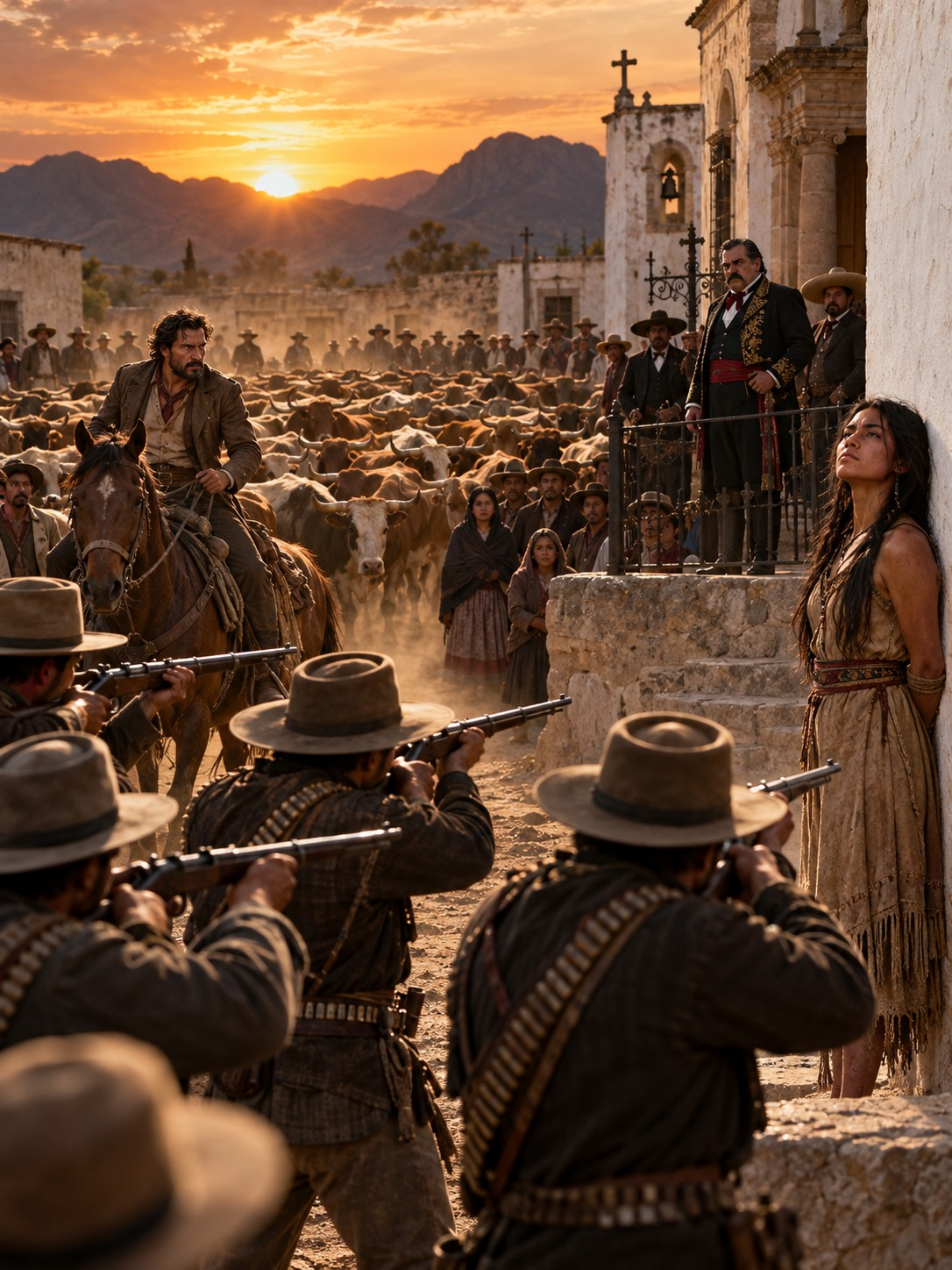
"Open this door, Leiva, or I'll have your house torn apart!" Don Eusebio Garza shouted from the porch.
Andrés stood beside the kitchen table, holding his father's unfinished letter.
The final sentence had been written in darker ink, almost as though Mateo Leiva had returned to the page after believing his confession was complete.
If Don Eusebio ever discovers that Isela is actually the child who witnessed his secret meeting at Los Sauces, he will kill her before she can speak.
Andrés read the words twice.
Then he looked at Lucía Valdés.
"What meeting?"
Lucía's face had lost all color.
Outside, Eusebio struck the door with his walking stick.
"Leiva!"
Tayén stepped toward Andrés.
"What does the letter say about my sister?"
He handed it to her.
She read the sentence.
Her fingers tightened around the paper.
For fourteen years, she had wondered whether Isela had survived the attack at Los Sauces.
Now she knew her sister had survived long enough to become a threat to the most powerful man in San Lorenzo.
And that knowledge frightened her more than the rifles that had been aimed at her chest.
"She was there," Tayén whispered.
Lucía nodded.
"Yes."
"She saw something."
"Something Eusebio has spent fourteen years trying to erase."
Another blow struck the front door.
The damaged wood cracked.
Andrés reached for his shotgun.
Lucía caught his wrist.
"Don't shoot."
"He intends to arrest us."
"He intends something worse."
Tayén folded the letter carefully.
"Then we make him speak."
Andrés looked at her.
"How?"
She turned toward the front door.
"By asking the one question he cannot answer without revealing what he knows."
Before Andrés could stop her, she walked into the narrow entrance hall.
"Don Eusebio," she called.
The pounding stopped.
A brief silence followed.
Then the political chief answered.
"So the prisoner finally remembers how to obey."
Tayén remained perfectly calm.
"You accused me of stealing eighty cattle."
"And you have now stolen another eighty."
"Then tell the people where the first herd came from."
Silence.
Andrés watched the door.
Outside, a horse snorted.
A guard shifted his boots against the porch.
Eusebio answered at last.
"Open this door."
"Where did those cattle come from?"
"That is government business."
"Then why did your commander manufacture Apache arrows to blame my family?"
The silence became absolute.
Andrés glanced at Lucía.
She was staring at Tayén with an expression that mixed fear and admiration.
Eusebio spoke again.
This time, his voice was quieter.
"Who told you about the arrows?"
Tayén looked toward Andrés.
Neither moved.
Then she answered.
"My mother."
A sharp sound came from outside.
Something metallic striking the porch railing.
Andrés imagined Eusebio turning toward Ciro.
He imagined the commander realizing that the woman he had nearly executed knew more than he had believed.
"Your mother is dead," Eusebio said.
Tayén's expression did not change.
"That doesn't mean she was wrong."
A long pause followed.
Then Eusebio laughed.
But the sound was different now.
Forced.
Thin.
"You are making dangerous accusations, woman."
"Then let a judge examine the arrows."
"I am the authority here."
"That is what frightens you."
Andrés heard Ciro's voice.
"Chief, we should leave."
Eusebio snapped, "Be quiet."
Lucía leaned toward Andrés.
"He knows."
Andrés nodded.
Eusebio had not asked whether the arrows were false.
He had asked who told Tayén.
That distinction mattered.
A man innocent of the conspiracy would have denied the accusation.
Eusebio had instead tried to discover how much she knew.
Outside, the political chief took a slow breath.
"Leiva, I am giving you one final opportunity. Surrender the woman, and I may reconsider the charges against you."
Andrés stepped beside Tayén.
"You already accepted my cattle in exchange for her freedom."
"Those cattle were stolen."
"From your own guarded enclosure."
"By conspirators."
"Then arrest your guards."
A murmur came from outside.
Several of Eusebio's men had heard.
Andrés continued.
"Your commander was seen moving the herd north after sunset."
Ciro shouted, "That's a lie!"
"Then explain why you had a list of my cattle brands before I brought them into town."
No answer.
Andrés felt his confidence strengthen.
He had spent most of his life avoiding powerful men.
Now he was beginning to understand something his father had tried to teach him.
Authority was not the same as truth.
And fear was not the same as respect.
Eusebio struck the porch once with his walking stick.
"At sunrise, you will both appear before me in the town square."
"And if we refuse?"
"Then you will be brought there in chains."
The political chief paused.
"Your father made the mistake of challenging me once, Leiva. I suggest you remember how his life ended."
Andrés felt the words like a knife.
His father had died years after Los Sauces.
Poor.
Exhausted.
Broken by work.
But until that moment, Andrés had never considered whether his father's decline had been entirely natural.
"What did you do to him?" Andrés demanded.
Eusebio did not answer.
Instead, he called to his guards.
"Keep the house surrounded until dawn."
Boots moved across the porch.
Horses shifted.
A moment later, Andrés heard the political chief and Commander Ciro riding away.
But two guards remained.
And the threat hanging over the ranch had only grown darker.
Lucía waited until the hoofbeats faded before speaking.
"You must leave this house before sunrise."
Andrés looked at her.
"How?"
"There's an irrigation ditch behind the stable. It runs beneath the old fence."
"I know the ditch."
"The guards don't."
Tayén shook her head.
"Not yet."
Lucía turned.
"What?"
"We need to understand the arrows."
"We don't have time."
"Then tell us quickly."
Tayén placed the recovered arrow fragment on the kitchen table.
Two red feathers lay against the worn pinewood shaft.
The binding was dark and brittle.
Andrés moved the lamp closer.
For the first time, he examined the arrow as carefully as Tayén had.
The wood was unusually straight.
Its surface had been smoothed with a metal tool.
Beneath the feather binding were several tiny saw marks.
Not random scratches.
Not damage caused by use.
They appeared deliberate.
"These marks," Andrés said. "I remember them."
Tayén looked at him.
"From Los Sauces?"
He nodded.
"Ciro was working on arrows outside a military supply wagon. I thought he was repairing them."
Lucía lowered herself into a chair.
"He wasn't repairing anything."
Andrés turned toward her.
"Then what was he doing?"
"Preparing evidence."
The words settled over the room.
Tayén looked down at the arrow.
"My mother said the same thing."
Lucía nodded.
"She was right."
Andrés leaned forward.
"Tell us everything."
The older woman looked toward the shuttered window.
Then she began.
"Fourteen years ago, Don Eusebio was not yet the political chief of San Lorenzo. He was an ambitious landowner with powerful friends and more debts than anyone knew."
Andrés frowned.
"Debts?"
"Large ones. He had borrowed money to purchase grazing rights, horses, and military supplies. He expected to become wealthy through government contracts."
"What happened?"
"He discovered that several families living near Los Sauces possessed documents that could destroy his plans."
Tayén's eyes narrowed.
"What documents?"
Lucía hesitated.
"Land records."
Andrés stared at her.
"Land records?"
"Yes. Original agreements recognizing certain Apache families' rights to travel, graze animals, and occupy territory near the mountain springs."
Tayén leaned forward.
"My father kept papers wrapped in leather."
Lucía looked at her.
"Then he may have been one of the men Eusebio feared."
Andrés felt the conspiracy expanding.
The stolen cattle were not the beginning.
They were part of something much older.
"Eusebio wanted the land," he said.
Lucía nodded.
"And he needed those families removed."
"So he accused them of stealing cattle."
"Yes."
"And Ciro manufactured arrows to support the accusation."
Lucía looked at the fragment on the table.
"Exactly."
Tayén's face remained controlled.
But Andrés noticed the way she pressed her fingertips against the wood.
"My father told the soldiers we had stolen nothing," she said.
Lucía lowered her eyes.
"I know."
"He offered to show them our animals. Our stores. Everything."
"I know."
"They refused."
Lucía closed her eyes.
"Because the search was never about cattle."
The room fell silent.
Andrés thought of the six rifles aimed at Tayén in the town square.
The false accusation.
The public execution.
The impossible bargain.
Fourteen years later, Eusebio and Ciro were using the same method.
Only this time, Andrés had interrupted them.
"Why three arrows?" he asked.
Lucía looked up.
"What?"
"Tayén's mother kept three. My father's map marks three locations. The recovered evidence uses the same workmanship."
The older woman hesitated.
Then she reached toward the arrow.
"Because the three arrows were made from the same batch."
Tayén leaned closer.
"How do you know?"
Lucía looked at her.
"Because I watched Ciro make them."
Andrés froze.
"You were there?"
Lucía nodded.
"I worked in Eusebio's household before he became political chief. I prepared meals, cleaned rooms, and carried messages. Men like him rarely noticed servants."
She gave a bitter smile.
"That made me useful."
"What did you see?" Andrés asked.
"Three arrows were placed on a table in Eusebio's office. Ciro had made them to resemble Apache weapons. But they weren't intended for battle."
Tayén stared at her.
"Then what were they for?"
"To be discovered."
Lucía touched the first feather.
"One would be left near a stolen herd."
She touched the second.
"Another would be placed near the settlement."
Then she looked at the broken shaft.
"And the third would be used to connect the supposed thieves to an attack on a government patrol."
Andrés felt sick.
Three arrows.
Three pieces of false evidence.
One manufactured story.
A story that justified the destruction of innocent families.
"What happened to the third arrow?" he asked.
Lucía's expression changed.
"That is what Eusebio has been trying to discover for fourteen years."
Tayén leaned forward.
"My mother had it."
Lucía nodded slowly.
"I suspected as much."
"She kept it because it proved the accusation was false."
"Yes."
"But why would one arrow prove that?"
Lucía looked at Andrés.
"Because the third arrow was different."
Andrés frowned.
"Different how?"
"It carried a mark that Ciro did not know was visible."
Tayén picked up the fragment.
"The saw marks?"
"No."
Lucía shook her head.
"Something beneath the arrowhead."
Andrés examined the broken wood.
The arrowhead had been removed long ago.
"What kind of mark?"
Lucía hesitated.
"An official supply stamp."
Andrés stared at her.
"A government stamp?"
"Yes."
Tayén's eyes widened.
"Then the arrow was made from military supplies."
Lucía nodded.
"And if the third arrow still exists, it can prove that the evidence used against the families at Los Sauces was manufactured by men working under Eusebio's authority."
Andrés looked toward his father's trunk.
Three locations.
Three arrows.
Three people who had protected the truth.
He began to understand why Mateo had hidden the map.
Why Lucía had disappeared from San Lorenzo for years.
Why Ciro had reacted so violently when Tayén mentioned the arrows.
The evidence was not merely embarrassing.
It threatened the foundation of Eusebio's power.
A sudden knock came from the back door.
All three froze.
Andrés reached for the shotgun.
"Who's there?"
A quiet voice answered.
"Tomás."
Andrés looked at Tayén.
She moved toward the window.
Through a narrow gap, she saw the merchant crouching beside the rear wall.
He was breathing heavily.
His coat was torn.
And he was carrying a small leather satchel.
Andrés opened the door just enough to let him inside.
Tomás stumbled forward.
"Close it."
Andrés obeyed.
"What happened?"
The merchant leaned against the wall.
"Ciro searched my shop."
Lucía stood.
"Did he find the records?"
Tomás shook his head.
"No."
"Where are they?"
He held up the satchel.
"Here."
Andrés took it.
Inside were several folded documents.
The original cattle transfer.
A copy of the brands.
A list of eighty animals recorded before Andrés had arrived in town.
And another document bearing an official government seal.
Andrés unfolded it.
His eyes widened.
"What is this?"
Tomás swallowed.
"A livestock transport authorization."
"For whom?"
"Commander Ciro Lomas."
Andrés read the document.
It authorized the movement of eighty government-owned cattle through San Lorenzo.
The destination was listed as a military supply station near Chihuahua City.
But the date was wrong.
The authorization had been issued before the first theft.
And the route had been changed by hand.
The new destination was written in dark ink.
Cañada de los Sabinos.
Andrés looked up.
"The abandoned lime kiln."
Tomás nodded.
"I found the document hidden inside Ciro's ledger."
Tayén stepped closer.
"Why would he keep it?"
"Because he needed proof of authorization if another officer questioned the movement."
Andrés examined the signature.
It belonged to Don Eusebio.
He felt a sudden surge of hope.
"This proves they moved the cattle."
Lucía shook her head.
"Not enough."
Andrés frowned.
"Why not?"
"Because Eusebio can claim the transport was legitimate."
"Even after accusing Tayén?"
"He can say the theft happened later."
Tomás nodded reluctantly.
"She's right."
Andrés looked at the documents.
"Then we need the cattle."
Tayén met his eyes.
"All one hundred and sixty."
The number hung between them.
Eighty from the original theft.
Eighty from Andrés's sacrifice.
If they could find both herds together, bearing their original brands, the conspiracy would become much harder to deny.
But the old kiln was guarded territory.
And Ciro already knew Andrés was suspicious.
"We can't simply ride there," Tomás said.
"No," Andrés agreed.
Lucía looked toward the window.
"There's another way."
Everyone turned.
She hesitated.
"Years ago, I traveled with Eusebio's supply wagons. The old lime kiln has a second entrance."
Andrés frowned.
"Where?"
"Through a dry ravine behind the northern ridge."
Tayén looked at her.
"Can you find it?"
Lucía nodded.
"But the passage is narrow. Horses cannot enter."
"Then we'll walk," Andrés said.
Tomás stared at him.
"You're planning to investigate the kiln tonight?"
Andrés looked toward the dark window.
"Before sunrise."
"With guards outside?"
"We'll use the irrigation ditch."
Tomás shook his head.
"This is madness."
Andrés turned toward him.
"Then stay here."
The merchant looked at the papers in his hands.
He thought of his daughter.
Of the medicine he could barely afford.
Of the ten pesos he had accepted from Ciro.
Then he looked at Andrés.
"No."
Andrés frowned.
"What?"
"I'm coming."
"Tomás—"
"I helped prepare the records that made this possible. I didn't know what they were planning, but I should have asked."
He swallowed.
"I won't make that mistake again."
Andrés studied him.
For the first time that night, he saw something stronger than fear in his old friend's face.
Resolve.
"All right," Andrés said.
Lucía looked toward Tayén.
"And you?"
Tayén picked up the broken arrow.
"I have been waiting fourteen years to learn why my family was destroyed."
She wrapped the fragment carefully.
"I'm coming."
They waited until the guards changed positions.
One moved toward the stable.
The other walked around the front of the house.
Andrés extinguished the lamps.
Then he lifted the narrow floorboard beside the kitchen wall.
Beneath it was an old drainage opening.
His father had built it years earlier to carry floodwater away from the house.
The passage was barely wide enough for a person to crawl through.
Andrés had used it as a child.
He had forgotten it existed.
Now it might save their lives.
He went first.
Tayén followed.
Then Lucía.
Tomás came last, carrying the satchel.
The passage smelled of damp earth.
Loose stones scraped against their clothing.
Above them, a guard's boots crossed the wooden porch.
Everyone stopped breathing.
The footsteps paused.
Then moved away.
Andrés crawled forward.
After several yards, the passage opened into the irrigation ditch.
They emerged behind a line of mesquite trees.
The ranch house stood dark in the distance.
The guards remained unaware.
For a moment, Andrés looked back.
He thought of his father.
Of the empty corral.
Of the land he had spent twelve years trying to preserve.
He wondered whether he would ever return.
Tayén touched his arm.
"We should go."
He nodded.
They moved north beneath the stars.
The mountains rose ahead of them.
And somewhere beyond the dark ridges, one hundred and sixty stolen cattle might be waiting.
The journey took nearly three hours.
They avoided the main road.
Lucía guided them through dry creek beds and narrow ravines.
Tomás struggled to keep pace.
Andrés carried the shotgun.
Tayén moved quietly, watching the ground.
At one point, she stopped beside a patch of disturbed earth.
Andrés approached.
"What is it?"
"Hoofprints."
He knelt.
Several large cattle tracks crossed the trail.
The marks were fresh.
"How many?" he asked.
"Too many to count."
Andrés touched the dirt.
Still loose.
Still undisturbed by wind.
"They passed recently."
Tayén nodded.
"Last night."
Tomás looked toward the ridge.
"Then this is the route."
Lucía pointed ahead.
"The kiln is beyond that hill."
Andrés felt his heart quicken.
They were close.
But as they climbed, Tayén stopped again.
She crouched beside a small stone.
Something lay half-buried in the dirt.
A red feather.
Andrés stared.
Tayén picked it up carefully.
She examined the shaft attached to it.
Fine saw marks.
The same binding.
The same workmanship.
Another manufactured Apache arrow.
But this one had something different.
A small brass ring beneath the feathers.
Tayén turned it.
Three tiny marks had been scratched into the metal.
Andrés recognized the pattern.
Three.
Two.
One.
The same marks on his father's map.
The same marks on the silver button.
He looked at Tayén.
"Someone is leaving these deliberately."
She nodded.
"Or someone is trying to lead us somewhere."
Tomás looked frightened.
"Then perhaps we should turn back."
Andrés examined the ridge.
A faint orange glow appeared beyond it.
Firelight.
Someone was awake at the kiln.
Lucía lowered her voice.
"We're almost there."
They moved carefully toward the crest.
Andrés reached the top first.
He dropped to one knee.
Then he stared.
Below them lay the abandoned lime kiln.
Its ruined stone walls formed a rough enclosure.
Several lanterns burned near the entrance.
Armed men stood beside the gates.
And inside the enclosure—
cattle.
Dozens.
Hundreds of horns rose above the stone walls.
Andrés felt his breath catch.
He counted quickly.
Twenty.
Forty.
Sixty.
The animals shifted, revealing more behind them.
He recognized a black cow with a white patch on her neck.
Then a spotted heifer.
Then a large brown steer with a crooked horn.
His animals.
His entire herd.
Alive.
And beside them stood another herd.
Different brands.
Different markings.
Eighty additional cattle.
One hundred and sixty animals.
Exactly as they suspected.
Andrés gripped the shotgun.
"We found them."
Tayén crouched beside him.
Her eyes moved across the enclosure.
Then she pointed toward a small building beside the kiln.
"Look."
Andrés followed her finger.
Through an open window, he saw a worktable.
Pinewood shafts.
Red feathers.
Leather bindings.
Small metal tools.
Everything needed to manufacture false evidence.
And standing beside the table was Commander Ciro Lomas.
He was speaking to another man.
A man whose face remained hidden in shadow.
Andrés leaned forward.
He wanted to see who it was.
Then the stranger moved into the lantern light.
Lucía gasped.
Andrés turned.
"What?"
She was trembling.
"That man."
"Who is he?"
Lucía shook her head.
"No."
Tayén looked at her.
"Lucía?"
The older woman pressed a hand against her mouth.
"He was supposed to be dead."
Andrés looked back toward the building.
The stranger removed his hat.
A deep scar crossed his forehead.
His hair was white.
And around his neck hung a dark blue scarf with white stitching.
Andrés felt the world stop.
He knew that scarf.
He had seen it in his father's trunk.
He had seen it in the old portrait above the fireplace.
He had watched his father wear it every winter.
But the man standing beside Ciro was not Mateo Leiva.
He was someone Andrés had never seen before.
Someone wearing his father's scarf.
Then the stranger turned toward the window.
Andrés saw his face clearly.
Lucía grabbed his arm.
"Don't move."
He stared at her.
"Who is he?"
Her lips trembled.
"He's the man who gave the order at Los Sauces."
Andrés felt his blood turn cold.
"Who?"
Lucía looked toward the lantern-lit building.
Then she whispered:
"He's the man your father tried to expose."
Before Andrés could ask another question, the stranger reached into his coat.
He removed a folded document.
Ciro leaned closer.
The stranger opened it beneath the lantern.
Andrés could see the official seal.
The signature.
The date.
April 1872.
Fourteen years earlier.
Then the stranger turned the document over.
On the back was a name.
A name Andrés recognized.
A name that should not have been connected to the massacre.
He leaned forward, desperate to read it.
But before he could, Tayén caught his wrist.
Her eyes were fixed on the opposite side of the enclosure.
Someone was approaching through the darkness.
A woman.
Young.
Wearing a dark shawl.
She walked toward the kiln with her hands raised.
One of the guards stepped aside.
The woman lowered her hood.
Tayén stopped breathing.
Andrés looked at her.
"Tayén?"
She could barely speak.
Her eyes filled with tears.
Then she whispered:
"Isela."
The woman below turned toward the ridge.
For one impossible moment, the sisters looked directly at each other across fourteen years of separation.
Then Ciro stepped behind Isela.
He raised his revolver.
And the stranger in the blue scarf said:
"Bring her inside. Her sister will come for her before sunrise."






Comments 0