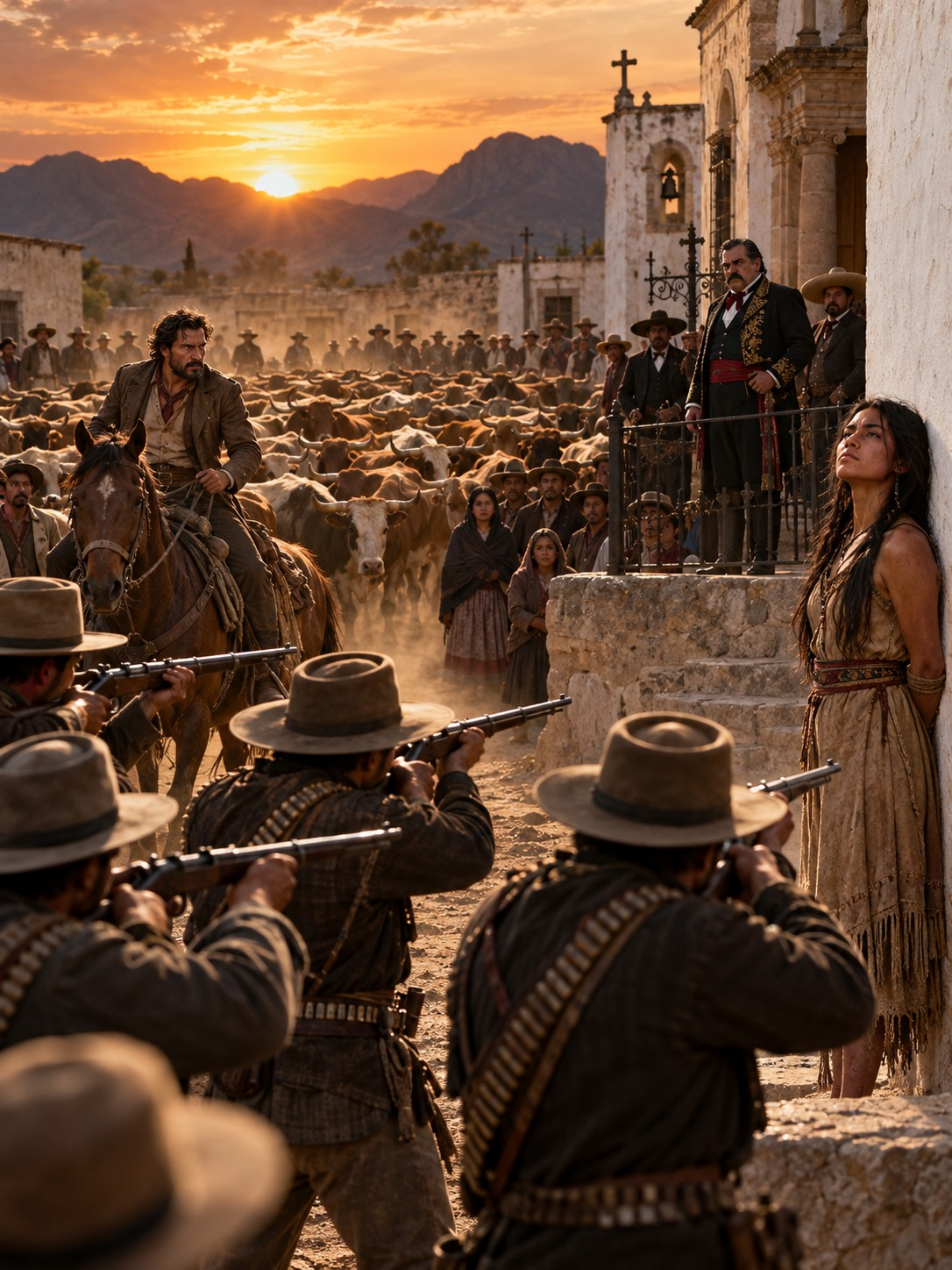
The man reaching for his gun was Tomás Arbizu.
Andrés Leiva recognized the movement before he understood what it meant.
His oldest friend stood beside the chapel steps, one hand beneath his coat, his face drained of color.
For three days, Tomás had helped him search for the stolen cattle.
He had copied the records.
Warned him about Ciro.
Risked his life to free the herd.
And now, with the entire town watching, he was reaching for a revolver.
"Tomás," Andrés said quietly. "Don't."
Tomás froze.
Above them, Commander Ciro Lomas laughed from the bell tower.
"There he is! The faithful friend!"
Andrés looked down at the envelope Tayén held.
On its back, in Mateo Leiva's handwriting, were four words:
For Tomás Arbizu—when ready.
The name struck Andrés like a blow.
Tomás had been a boy when Los Sauces happened. Seventeen years old, working as a clerk in Eusebio Garza's office.
Andrés had known him since childhood.
They had ridden together.
Worked together.
Buried friends together.
When Mateo died, Tomás had stood beside Andrés at the grave.
Now the truth seemed to be tearing through every memory.
"Tell me," Andrés said.
Tomás swallowed.
His hand remained beneath his coat.
"Not here."
"Tell me now."
From the tower, Ciro shouted, "Ask him who delivered your father's complaint to Salcedo!"
Andrés felt his chest tighten.
Tomás closed his eyes.
The answer was already on his face.
"You?" Andrés whispered.
Tomás nodded.
"Yes."
The square fell silent.
Andrés stared at him.
"My father trusted you."
"I know."
"He asked you to carry his complaint?"
Tomás's voice broke.
"Yes."
"And you gave it to the man who murdered him."
Tomás looked toward the ground.
"I didn't know what Salcedo would do."
Andrés stepped closer.
"But you knew he wanted the complaint stopped."
Tomás said nothing.
That silence hurt more than any confession.
Then Ciro shouted again.
"Enough talking! The arrow, Leiva! Or the inspector dies!"
Above the square, Inspector Esteban Rojas stood at the edge of the bell tower with a rope around his neck.
One end was tied to a wooden beam.
Ciro held a rifle against his back.
The townspeople stared upward.
Nobody moved.
Andrés looked at Tomás.
"Take your hand out of your coat."
Slowly, Tomás obeyed.
He was not holding a revolver.
He held a small leather pouch.
Andrés frowned.
Tomás opened it.
Inside lay an old silver pocket watch.
Mateo Leiva's watch.
Andrés recognized the engraved initials.
M.L.
His father had carried it for as long as Andrés could remember.
It had disappeared shortly before his death.
"Where did you get that?"
Tomás's eyes filled with tears.
"Your father gave it to me."
"When?"
"The night he learned what I'd done."
Andrés stared.
Tomás continued.
"He came to my father's house. He knew I'd delivered the complaint to Eusebio instead of the territorial judge."
"Why?"
"Because Eusebio threatened my family. My father owed him money. He said he'd take our house and have my father imprisoned."
Andrés felt anger rising.
"So you betrayed Mateo."
"Yes."
Tomás did not attempt to soften the word.
"I was seventeen. I was frightened. And I made the worst decision of my life."
Andrés looked at the watch.
"Why did he give you that?"
Tomás opened its back cover.
A tiny folded paper rested inside.
"Because he knew I was ashamed. He told me to keep it until I was brave enough to tell the truth."
Andrés took the watch.
His fingers trembled as he unfolded the paper.
It contained only two sentences.
Tomás, fear made you betray me. Do not let it make you betray yourself for the rest of your life.
Beneath the words was Mateo's signature.
Andrés stared at the message.
For fourteen years, his father had known.
He had known who delivered the complaint to his enemies.
Yet he had not condemned a frightened boy to death.
He had given him a chance to become better.
Andrés looked up.
Tomás was crying openly.
"I should have told you."
"Yes," Andrés said.
"I tried to make it right."
"I know."
"But it wasn't enough."
Andrés folded the note.
"No. It wasn't."
Tomás lowered his head.
Andrés continued.
"But you can still help us finish this."
Tomás looked up.
"How?"
Andrés glanced toward the tower.
"By telling the truth in front of everyone."
Ciro fired into the air.
The crowd screamed.
"THE ARROW!"
Andrés raised the wooden box.
"All right!"
Tayén caught his wrist.
"Andrés."
He looked at her.
Her expression was steady, but he could see the fear in her eyes.
"Trust me," he whispered.
She studied him.
Then slowly released his arm.
Andrés stepped toward the chapel.
"Let the inspector come down. Then you get the arrow."
Ciro laughed.
"You think I'm stupid?"
"I think you want to leave this town alive."
The commander stopped laughing.
Andrés continued.
"Look around."
Ciro glanced down.
The square was filled with townspeople.
Ranchers.
Merchants.
Families.
Territorial deputies.
Men who had once obeyed Eusebio without question.
Now they stood together, watching the commander hold a wounded inspector hostage.
Andrés raised his voice.
"You have nowhere to run."
Ciro's expression twisted.
"Salcedo will protect me!"
A voice answered from below.
"No, Commander."
Captain Gabriel Montalvo stepped forward.
Behind him stood Colonel Ignacio Salcedo, his hands bound.
Montalvo looked up.
"Salcedo is under arrest."
Ciro stared.
Then he shouted, "You can't arrest a colonel!"
Montalvo's voice remained steady.
"I already have."
The crowd murmured.
Ciro looked toward Don Eusebio Garza.
The political chief stood near the chapel steps, guarded by two deputies.
His face was gray.
For the first time in twenty years, he had no orders left to give.
Andrés looked toward Nicolás Serrano.
The deputy stood near the chapel's side entrance.
Andrés gave him the smallest nod.
Nicolás disappeared into the shadows.
Ciro did not notice.
His attention remained fixed on the arrow.
"Bring it up!" he shouted.
Andrés nodded.
"Then release the inspector."
"Come alone!"
"Fine."
He started toward the chapel door.
Tayén watched him go.
Then she turned toward Tomás.
"Where does the old stairway meet the bell chamber?"
Tomás blinked.
"What?"
"The stairway behind the sacristy."
He hesitated.
"There's a narrow service door near the upper landing."
"Can it be opened from inside?"
"Yes."
Tayén looked toward Lucía.
"Stay with Isela."
Lucía nodded.
Tayén took a rifle from one of Montalvo's soldiers.
Then she followed Nicolás into the chapel.
Andrés climbed the tower stairs slowly.
The wooden box rested in his left hand.
His right hand remained empty.
Above him, Ciro shouted.
"Faster!"
Andrés continued climbing.
He could hear Inspector Rojas breathing heavily.
The rope creaked against the beam.
At the final landing, Andrés stopped.
Ciro stood near the open bell chamber.
Rojas was positioned beside the railing, the noose still around his neck.
The commander aimed his rifle at Andrés.
"Put the box down."
Andrés obeyed.
Ciro looked toward it.
"Open it."
Andrés lifted the lid.
Inside lay the third red-feathered arrow.
Its official military stamp caught the afternoon light.
The leather strip bearing the original payment authorizations had already been removed and secured with the inspector's records.
But Ciro did not know that.
His eyes fixed on the arrow.
"Bring it here."
Andrés picked it up.
"Let him go."
Ciro smiled.
"You still believe promises matter?"
Andrés looked toward Rojas.
The inspector's face was pale.
But his eyes were alert.
"Not yours," Andrés said.
Ciro's smile vanished.
He stepped closer.
"Give it to me."
Andrés held out the arrow.
Ciro reached.
Then a voice spoke from behind the service door.
"Commander."
Ciro turned.
Deputy Nicolás Serrano stood in the doorway, rifle raised.
"Drop your weapon."
Ciro spun.
His rifle swung toward Nicolás.
Andrés moved.
He seized the barrel and drove it upward.
The gun fired.
The bullet struck the bell.
A deafening metallic crash filled the chamber.
Ciro shouted.
Andrés slammed him against the wall.
The rifle fell.
Nicolás rushed forward.
Ciro grabbed Andrés by the collar.
The two men staggered toward the railing.
Below them, the square opened like a stone pit.
Ciro's face twisted with hatred.
"You ruined everything!"
Andrés held his wrist.
"No."
Ciro drove his shoulder into him.
Andrés struck the railing.
The wood cracked.
For one terrible moment, both men teetered above the square.
Then Tayén appeared behind Ciro.
She caught his coat and pulled him backward with all her strength.
Nicolás seized his arm.
Together, they dragged the commander onto the floor.
Ciro struggled.
But the deputy pinned him down and bound his wrists.
Andrés collapsed against the wall, breathing hard.
Tayén knelt beside him.
"Are you hurt?"
He shook his head.
"Not badly."
She looked at him.
"That was a terrible plan."
He managed a faint smile.
"It worked."
"Barely."
Nicolás removed the rope from Rojas's neck.
The inspector sank onto a wooden bench.
For several seconds, nobody spoke.
Then Rojas looked toward Andrés.
"Mr. Leiva."
Andrés turned.
"Yes?"
The inspector gave a tired smile.
"Next time, I would prefer a plan that doesn't involve a bell."
Andrés laughed.
It was a small sound.
Exhausted.
Almost disbelieving.
But it was the first genuine laugh he had managed in days.
By sunset, the men responsible for Los Sauces were in custody.
Colonel Ignacio Salcedo.
Don Eusebio Garza.
Commander Ciro Lomas.
Baltasar Varela.
All four stood under guard inside the stone barracks beside the chapel.
No one was allowed to question them privately.
No one was permitted to remove documents from the evidence room.
And no orders issued under Salcedo's authority would be honored until reviewed by the territorial court.
Inspector Rojas dictated the first formal charges.
Unlawful killings.
Conspiracy.
Theft of government property.
Falsification of military records.
Fraudulent land transfers.
Attempted murder.
Witness intimidation.
And the murder of Mateo Leiva.
Jacinto Alvarez signed his sworn statement.
Captain Montalvo signed his.
Lucía signed hers.
Tayén and Isela gave separate accounts of what they had witnessed at Los Sauces.
Rafael Ortega confirmed Mateo's efforts to expose the crime.
Tomás Arbizu confessed to delivering the original complaint to Eusebio.
He did not ask for forgiveness.
He asked only that his statement be included.
Andrés stood beside him when he signed.
Afterward, Tomás looked at his old friend.
"Do you think you'll ever forgive me?"
Andrés considered the question.
"I don't know."
Tomás nodded.
"I understand."
Andrés looked toward the signed confession.
"But I won't pretend you haven't tried to make things right."
Tomás's eyes filled with tears.
"Thank you."
Andrés rested a hand briefly on his shoulder.
Their friendship had been wounded.
Perhaps it would never return to what it had been.
But the truth was finally between them.
And that was better than another fourteen years of silence.
Six weeks later, the territorial court convened in Chihuahua City.
The hearings lasted eleven days.
Andrés traveled there with Tayén, Isela, Lucía, Jacinto, Rafael, Tomás, and Captain Montalvo.
Inspector Rojas presented the recovered cattle records.
The court examined the military supply stamp on the third arrow.
Treasury clerks authenticated the signatures on the leather payment record.
Surveyors compared the fraudulent land transfers against the original Apache land documents.
The records matched.
The payments matched.
The dates matched.
And the testimony of the surviving witnesses established what had happened at Los Sauces.
Colonel Salcedo had ordered the attack.
Eusebio had arranged the seizure of the land.
Ciro had manufactured evidence to justify the killings.
Baltasar had distributed the payments and helped silence witnesses.
Mateo Leiva had attempted to expose them.
And when his complaint was intercepted, Salcedo had personally shot him.
The wound had eventually killed him.
The court found the four men guilty of the principal charges against them.
Their property was seized to satisfy restitution orders.
Their official authority was revoked.
And they were sentenced to imprisonment under territorial law.
Ciro's attempt to murder Inspector Rojas brought an additional sentence.
Baltasar's role in the attacks on witnesses was established through the testimony of Jacinto and the captured corporal, Felipe Aranda.
Aranda admitted his betrayal and identified the threats made against his younger brother.
The court considered his cooperation.
His brother was released from military custody.
Captain Montalvo also testified about his own failure to report the massacre.
He accepted responsibility for his silence and surrendered his commission pending review.
The court acknowledged that his later actions had saved witnesses and preserved evidence, but did not erase his earlier misconduct.
Montalvo accepted the decision.
He told Andrés afterward, "Your father deserved better from me."
Andrés nodded.
"Yes."
The captain looked down.
"I know."
Andrés studied him.
"Then live in a way that proves you've learned."
Montalvo raised his eyes.
"I will."
The ruling concerning the land took longer.
The original records showed that the Apache families at Los Sauces had held recognized rights to the springs, grazing routes, and settlement grounds before the fraudulent transfers.
The court annulled the transfers made through Eusebio's land company.
It ordered compensation for the surviving families and directed that their recognized rights be restored through the territorial land office.
For Tayén and Isela, the ruling meant more than money.
It meant their mother had not been a thief.
Their father had not been a criminal.
Their families had not deserved what happened.
The accusation that had followed them for fourteen years was formally withdrawn.
On the day the decision was announced, Isela began crying before the clerk finished reading.
Tayén held her hand.
Andrés stood beside them.
When the clerk called their mother's name, Tayén closed her eyes.
For a moment, she seemed to be listening to a voice only she could hear.
Then she whispered, "We did it, Mother."
Andrés looked away to give the sisters privacy.
His own eyes were wet.
The eighty government cattle were returned to the supply administration.
Andrés's eighty cattle were restored to him.
The court ruled that his original surrender had been obtained through unlawful coercion and fraud.
He was entitled to the herd.
The land office also awarded compensation for the damage to his ranch and the loss of income caused by Eusebio's actions.
Andrés accepted the cattle.
But he declined a larger personal reward offered for helping expose the conspiracy.
Instead, he asked that the money be placed in a fund for families displaced from Los Sauces.
The inspector looked at him in surprise.
"Are you certain?"
Andrés nodded.
"I have my ranch."
Rojas looked toward Tayén and Isela.
"And the women?"
"They have their land back."
The inspector smiled.
"Your father would have liked that."
Andrés looked toward the mountains beyond the courthouse.
"I hope so."
When they returned to San Lorenzo, the town looked different.
Not because the buildings had changed.
The chapel still stood in the square.
The blacksmith's shop still rang with hammer blows.
The market still opened before sunrise.
But people no longer lowered their voices when they spoke about Eusebio.
The political office had been placed under temporary administration until new local leadership could be selected.
The town's records were being examined.
Families came forward with old complaints.
Some sought compensation.
Others simply wanted their names cleared.
Rafael Ortega became one of the men helping review the disputed land claims.
Tomás returned to his shop.
He continued caring for Elena, whose health had improved after she received proper treatment, and Miguel rarely let his father out of sight.
Lucía moved into a small house near the chapel.
She planted flowers outside the door.
For the first time in fourteen years, she no longer slept with a packed bag beside her bed.
Jacinto remained in San Lorenzo long enough to testify in the remaining proceedings.
Then he returned to his wife and daughter.
Before leaving, he visited Andrés at the ranch.
The two men stood beside the corral.
Jacinto removed his hat.
"I owe your father my life."
Andrés looked toward the herd.
"He would have said you owed him nothing."
Jacinto smiled sadly.
"That's exactly what he said."
They shook hands.
Andrés watched him ride away.
Another piece of Mateo's unfinished work had finally found its ending.
The first rain of the new season arrived on a quiet evening.
Andrés stood beneath the ranch porch, watching the clouds move across the mountains.
The cattle grazed beyond the fence.
Reina stood near the water trough.
The old house smelled of fresh bread.
Inside, Tayén and Isela were preparing supper.
Lucía had come to visit.
Rafael was expected before dark.
Andrés looked toward the kitchen window.
He could hear laughter.
Real laughter.
The kind that had been absent from the house for years.
He thought of the night Tayén first arrived.
The rain.
The empty ranch.
The armed guards.
The fear that had followed them from San Lorenzo.
He had believed that surrendering eighty cattle might cost him everything.
Instead, it had forced him to confront the truth he had spent fourteen years avoiding.
And it had brought people into his life he could no longer imagine losing.
The screen door opened.
Tayén stepped onto the porch.
She wore a simple cream blouse and a dark skirt.
Her auburn braid rested against her shoulder.
"You're missing supper," she said.
Andrés smiled.
"I was watching the rain."
She stood beside him.
For a while, they listened to it fall.
Then she said, "Isela wants to rebuild the house near the springs."
Andrés nodded.
"The one your family lived in?"
"Yes."
"Will you help her?"
"Of course."
He looked at her.
"And you?"
Tayén hesitated.
"What about me?"
"Where do you want to live?"
She looked toward the mountains.
Then toward the ranch.
"I don't know."
Andrés felt his heart tighten.
He had expected the answer.
Her family had land to reclaim.
A home to rebuild.
A life stolen from them fourteen years earlier.
He had no right to ask her to remain.
So he said, "Whatever you choose, I'll help."
Tayén turned toward him.
"Even if I leave?"
He nodded.
"Even then."
She studied his face.
"Andrés."
"Yes?"
"Do you want me to leave?"
He looked at her.
"No."
The answer came without hesitation.
Tayén's expression softened.
"Then why haven't you asked me to stay?"
Andrés gave a small, helpless smile.
"Because I wanted you to be free to choose."
She stepped closer.
"I am free."
He nodded.
"I know."
"And I choose to stay."
For a moment, Andrés could not speak.
Tayén smiled.
"At least, if there's room."
He laughed softly.
"There's room."
She reached for his hand.
He held it.
Then she looked toward the kitchen.
"Isela will visit often."
"Good."
"Lucía too."
"Of course."
"And I intend to help rebuild the settlement near the springs."
"I'll help."
Tayén studied him.
"You keep saying that."
Andrés smiled.
"I mean it."
She leaned against him.
For a long moment, they stood together beneath the porch roof, watching the rain.
Then Andrés turned toward her.
"Tayén."
She looked up.
"Yes?"
He swallowed.
"I don't know what the future will look like."
"Neither do I."
"But I'd like to find out with you."
Her eyes filled with tears.
She smiled.
"So would I."
Andrés kissed her.
Gently.
Without hurry.
There were no rifles.
No threats.
No bargains.
Only the rain, the mountains, and two people who had survived enough darkness to recognize the value of an ordinary evening.
The following spring, a small gathering took place beside the restored chapel.
There were no grand decorations.
No wealthy guests.
No political speeches.
Only friends, neighbors, and family.
Rafael wore his best coat.
Tomás stood near the back with Elena and Miguel.
Lucía held a small bouquet of wildflowers.
Isela stood beside Tayén.
Andrés waited beneath the chapel arch.
He wore a clean white shirt, dark trousers, and the silver pocket watch that had belonged to his father.
When Tayén approached, he smiled.
She smiled back.
They exchanged simple promises.
To stand beside one another.
To speak the truth.
To offer kindness without demanding obedience.
And to build a life neither fear nor violence could govern.
When the ceremony ended, Isela embraced her sister.
Lucía cried.
Rafael laughed and declared that Andrés had finally made a sensible decision.
Tomás approached quietly.
He offered Andrés his hand.
Andrés looked at it.
Then took it.
Their friendship would never be innocent again.
But it had survived the truth.
And that mattered.
That evening, Andrés and Tayén returned to the ranch.
The sun was setting over the mountains.
The cattle moved slowly across the pasture.
Reina stood near the fence, chewing peacefully.
Andrés rested his arms on the top rail.
Tayén joined him.
"Eighty cattle," she said.
He smiled.
"What about them?"
"You gave them all away for a woman you didn't know."
Andrés looked at her.
"I knew enough."
She raised an eyebrow.
"Did you?"
He nodded.
"I knew you were innocent."
"And?"
He considered the question.
Then smiled.
"And I knew I couldn't live with myself if I walked away."
Tayén looked toward the herd.
"Do you regret it?"
Andrés shook his head.
"Not for a moment."
She slipped her hand into his.
They stood together as the last sunlight touched the pasture.
Beyond the mountains, the springs of Los Sauces flowed again through land restored to the families who had survived.
In San Lorenzo, the chapel bell rang for evening prayers.
And inside the ranch house, Mateo Leiva's wooden horse rested on a shelf beside his silver watch.
Not hidden beneath floorboards.
Not locked inside a trunk.
But displayed where anyone could see it.
A reminder of a man who had risked everything to protect a child.
A reminder that his courage had not been wasted.
And a reminder that the truth, though buried for fourteen years, had finally reached the light.
Andrés looked toward Tayén.
"Come inside?"
She smiled.
"Yes."
Together, they walked toward the house.
The door stood open.
Warm light spilled across the porch.
Supper waited inside.
And for the first time in many years, Andrés Leiva had everything he truly needed.
Not because he owned eighty cattle.
Not because he had defeated powerful men.
But because the people he loved were safe, the innocent had been vindicated, and the home he had nearly lost was filled with life again.
He closed the door gently behind them.






Comments 0