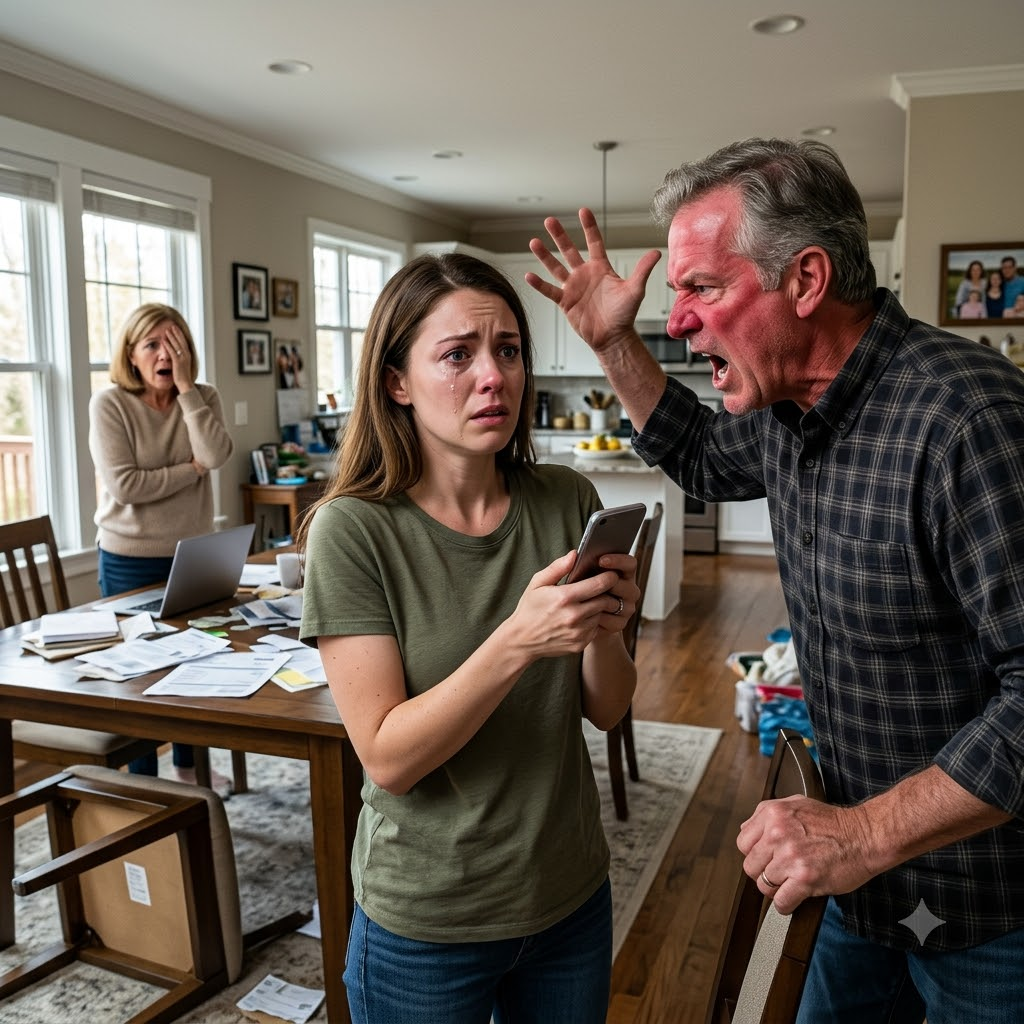
I read the attorney's email again.
Then I read it a third time.
"Our office represents Richard Parker regarding an outstanding financial obligation for which you may be legally responsible."
My name appeared beneath the greeting.
My full name.
Lauren Parker.
For several seconds, I couldn't move.
The email contained a scanned copy of a home-equity credit agreement. It was the same document my mother had photographed, except this version included additional pages.
The first two signatures belonged to my parents.
The third belonged to me.
Or at least, someone had made it look like mine.
I enlarged the image.
The signature was close enough to be convincing. The first letter of my name curved in the same direction. The final stroke extended beneath the surname, just as mine usually did.
But there was one problem.
I had never signed it.
I had never visited the lender with my father.
I had never agreed to guarantee a home-equity line of credit.
And I had never authorized anyone to use my identity for a financial obligation.
I scrolled farther down.
The agreement contained a paragraph describing the responsibilities of an additional party.
The language was complicated, but the meaning was clear enough.
The person identified beneath the borrowers could potentially be held responsible under the terms of the agreement.
My father had spent two years telling me his pension was delayed.
During those same two years, I had been paying his mortgage.
Now I was looking at a document that appeared to connect me to a $94,000 debt.
I closed the email.
Then I opened it again.
Perhaps I had misunderstood something.
Perhaps the document was an informational copy.
Perhaps my name appeared because I had once helped my parents with a payment.
But the signature was there.
And the attorney's letter was addressed directly to me.
I called my mother.
She answered almost immediately.
"Lauren?"
"Mom, I received the attorney's email."
There was a long silence.
Then she whispered:
"What did he send you?"
"A copy of the home-equity agreement."
"Oh, sweetheart."
"Mom, my signature is on it."
I heard her take a shaky breath.
"I know."
I stood up.
"What do you mean, you know?"
"I saw it."
"Did you know my name was on that agreement?"
"No. I only found out today."
I walked toward the window.
"Mom, when was this signed?"
"I don't know exactly. The date was several years ago."
"Did Dad tell you I was involved?"
"No."
"Then how did my signature get there?"
She started crying.
"I don't know, Lauren."
I closed my eyes.
I wanted to believe her.
I wanted to believe that she had discovered the same shocking information I had.
But there was something else I needed to know.
"Mom, did you ever see me sign any papers for the house?"
"No."
"Did I ever go to the bank with Dad?"
"Not that I remember."
"Then why did you sign your part?"
She hesitated.
"Your father said we were opening a home improvement credit line. He told me it would help us manage some repairs."
"Did he explain the amount?"
"He said we wouldn't need to use much."
"Did he explain that it could remain outstanding?"
"He said it was temporary."
I sat down.
The word temporary was beginning to sound familiar.
Temporary pension delays.
Temporary mortgage assistance.
Temporary financial difficulties.
Everything in my parents' lives seemed to have become temporary at some point.
Except the bills.
Those had continued.
"Mom, did Dad tell you the account was closed?"
"Yes."
"When?"
"About two years ago."
I looked at the date on the agreement.
That was around the same time he had begun telling me his pension payments were delayed.
"Did he show you proof?"
"No."
"Did you ask?"
"I trusted him."
Her voice broke.
I didn't blame her for that.
I had trusted him, too.
For years.
"Mom, I need you to send me every page of that agreement. Not just the statement. Everything."
"I can do that."
"And don't sign anything else."
"I won't."
I paused.
"Have you spoken to Dad about my signature?"
"Yes."
"What did he say?"
She became quiet.
Then she whispered:
"He said you knew about it."
My chest tightened.
"What?"
"He said you had agreed to help when the account was opened."
"That's impossible."
"I told him you never mentioned it."
"What did he say?"
"He told me I was remembering things incorrectly."
I looked at the attorney's email again.
My father had not only used my name.
He was now telling my mother that I had known about the agreement.
I felt a wave of anger rise.
But beneath it was something more serious.
Fear.
Not fear of my father.
Fear of the consequences of a document that might have been created without my knowledge.
"Mom, I'm going to get legal advice."
She began crying again.
"Please don't let this destroy our family."
I looked at the signature.
"Mom, I didn't create this situation."
"I know."
"I didn't borrow that money."
"I know."
"And I didn't tell Dad to put my name on anything."
"I believe you."
Those three words meant more than I expected.
For the first time since this started, someone in my family had clearly acknowledged that I might be telling the truth.
We ended the call.
I spent the next hour researching how to respond to a disputed financial agreement.
I knew enough about contracts to understand that a signature mattered.
I also knew that an attorney's letter wasn't the same thing as a court judgment.
I wasn't going to panic.
I wasn't going to admit responsibility.
And I wasn't going to sign anything simply because my father wanted me to.
The following morning, I contacted an independent attorney in Charlotte who handled consumer financial disputes.
Her name was Emily Brooks.
Her office scheduled a consultation for that afternoon.
I sent her the attorney's letter, the agreement, and the email from the financial services company.
I also included the payment records showing the money I had sent my parents.
When I arrived at her office, Emily greeted me with a professional smile.
She looked to be in her early forties, with shoulder-length blonde hair and a calm manner.
"Lauren Parker?"
"Yes."
"I'm Emily. Come on in."
Her office was quiet and organized.
There were bookshelves along one wall and a large desk near the window.
I placed my folder on the table.
"Thank you for seeing me."
"Of course. I've reviewed the documents you sent."
She opened the folder.
"Let's start with the agreement."
She examined the first page, then the signature page.
"Did you sign this?"
"No."
"Did you authorize your father to sign on your behalf?"
"No."
"Did you attend the signing appointment?"
"No."
She nodded and made a note.
"Did you receive any money from this credit line?"
"Not that I'm aware of."
"Did you make any payments toward the balance?"
I thought for a moment.
"I've paid my parents' mortgage for almost two years. But I don't know whether any of that money was applied to this account."
Emily looked at me.
"That's an important distinction. Paying your parents' mortgage does not automatically establish that you agreed to be responsible for a separate home-equity debt."
I felt a little relief.
"Then what should I do?"
"First, don't sign anything from your father's attorney. Don't acknowledge the debt as yours. Don't agree to a payment plan. We need to establish how your name and signature appeared on this document."
She turned the agreement toward me.
"Do you recognize the handwriting?"
"No."
"Does it look similar to your signature?"
"Yes. That's what worries me."
Emily studied the page.
"We'll preserve the original copy you've received. We'll also request the lender's complete records, including the application, identification documents, signing records, and any verification used when the account was opened."
I nodded.
"What if someone forged my signature?"
"Then that is a serious issue. But we won't jump to a conclusion until we have the underlying records."
She explained that the lender's records might show where the agreement was signed, what identification was presented, and whether there were any electronic verification records.
She also advised me to obtain my credit reports and review any accounts or inquiries I didn't recognize.
I agreed.
Before I left, she looked at the attorney's letter again.
"There's something else."
"What?"
"The letter gives you five business days to respond. I don't want you contacting your father's attorney directly until we've reviewed the demand and decided how to respond."
"Okay."
"One more question. Did your father tell you why he sent this?"
"He said I had until Friday to apologize."
Emily raised an eyebrow.
"Apologize for what?"
"For refusing to co-sign a business loan for my younger brother."
She looked at the letter.
Then she looked back at me.
"So, after you refused to guarantee a new loan, your father sent you a document suggesting you might already be responsible for an older debt?"
I nodded.
"That's how it happened."
Emily leaned back.
"That timing is certainly worth documenting."
I left her office feeling more organized than I had when I arrived.
For the first time, I had someone helping me separate facts from accusations.
I wasn't going to solve everything in one afternoon.
But I no longer felt that I had to face it alone.
At 4:12 p.m., I received a call from my mother.
I answered while walking toward my car.
"Hi, Mom."
"Lauren, I found the envelope."
My steps stopped.
"What envelope?"
"The one with your name on it. The one I showed you in the photograph."
"Where is it?"
"Your father put it in his office drawer."
"Did you open it?"
"No. But I saw him take something out of it."
"What?"
"A letter."
I gripped my phone.
"Did you read it?"
"Only part of it. He was standing near the desk, and I couldn't get close enough."
"What did it say?"
She took a breath.
"It mentioned a retirement distribution."
I closed my eyes.
"Mom, I need you to be careful."
"I know."
"He knows you've been looking through the papers."
"Yes."
"Then don't confront him."
She lowered her voice.
"Lauren, I think he's afraid you'll find out what happened to the pension."
I looked across the parking lot.
That was exactly what I had been thinking.
"Can you get a copy of the retirement statement?"
"I'll try."
We ended the call.
I drove home.
That evening, I sat at my dining table and opened the spreadsheet I had created.
I added another section.
UNAUTHORIZED FINANCIAL DOCUMENTS.
Underneath, I listed the home-equity agreement, the attorney's letter, and the proposed business loan application.
Then I added a note about the retirement distribution my mother had discovered.
I didn't know whether the documents were connected.
But I wasn't going to assume they were unrelated.
At 7:20 p.m., Tyler called.
I answered because I wanted to know whether he had heard anything from the lender.
"Hello?"
"Finally."
"What do you need, Tyler?"
"Dad says you're talking to a lawyer."
"Yes."
He made a frustrated noise.
"Seriously? You're taking this that far?"
"I received a legal demand involving a financial agreement I never signed."
"You're exaggerating."
"I'm reading the documents."
"Dad said you knew about the house account."
"He's wrong."
Tyler sighed.
"Why can't you just talk to him?"
"I did. He told me to contact his lawyer."
"That was just because he was angry."
"Then he can correct it."
Tyler became quiet.
After a moment, he said:
"Look, Dad is under a lot of pressure."
I leaned back.
"Why?"
"Because the bank is asking questions about the business loan."
"That's not my responsibility."
"He thought you were going to help."
"I never agreed."
"You're making him look bad."
I closed my eyes.
"Tyler, did you know my name was on the home-equity agreement?"
Silence.
It lasted several seconds.
Then he said:
"I don't know what you're talking about."
"Your father has a document with my signature."
"I haven't seen it."
"Did Dad ever tell you I was responsible for the house credit line?"
Tyler sighed.
"Why are you asking me this?"
"Because I want to know what you knew."
He became defensive.
"I didn't have anything to do with that."
I believed he might not have been directly involved.
But there was something about his voice that made me hesitate.
"Okay," I said.
He seemed surprised.
"Okay?"
"Yes. If you didn't know, you didn't know."
He exhaled.
"Finally. Someone is being reasonable."
I didn't respond.
Then he added:
"By the way, Dad says you should still apologize before Friday."
I looked at the clock.
"Good night, Tyler."
I hung up.
The following morning, Emily sent me an update.
She had drafted a formal response disputing the alleged obligation and requesting that the lender preserve all original records.
She also recommended that I communicate only through the appropriate legal channels while the matter was being investigated.
I reviewed the letter.
It did not accuse my father of a crime.
It did not make assumptions about how the signature had appeared.
It simply stated that I disputed the document and had not knowingly authorized the agreement.
I approved it.
Emily sent the response.
For the first time, I felt that the situation was moving in a direction I could manage.
But my father wasn't finished.
At 11:06 a.m., he sent me a text.
Richard: Your lawyer has no idea what our family agreed to.
I stared at it.
Then another message arrived.
Richard: You need to stop before you make a mistake you can't undo.
I forwarded both messages to Emily.
She replied that I should preserve them and avoid responding emotionally.
I followed her advice.
At lunchtime, my mother called.
This time, she sounded frightened.
"Lauren, I found the retirement statement."
I stepped into an empty conference room.
"What does it say?"
"I don't understand all of it."
"Can you read the date?"
"Yes. It was issued more than a year ago."
"And the amount?"
She paused.
Then she whispered:
"Thirty-eight thousand dollars."
I gripped the edge of the table.
"Thirty-eight thousand?"
"That's what it says."
"Does it show where the money went?"
"There's a transfer reference."
"To which account?"
She was quiet.
Then she said something that made my stomach drop.
"Tyler's name appears on the transfer record."
I closed my eyes.
"Mom, are you sure?"
"Yes."
I could hear papers moving.
She continued.
"There's a bank account number, and your father wrote something beside it."
"What?"
She took a shaky breath.
"Business startup."
I stared at the wall.
My father had told us his pension was delayed.
He had asked me to help pay the mortgage.
He had insisted that Tyler needed my financial support.
And now my mother had found a retirement statement showing a $38,000 distribution connected to Tyler.
I wanted to ask a hundred questions.
But one mattered more than the others.
"Mom, did Dad tell you he gave Tyler that money?"
"No."
"Did Tyler tell you?"
"No."
"Then why is the transfer record in his name?"
"I don't know, Lauren."
Her voice broke.
"I think your father used his retirement money to help Tyler."
I slowly sat down.
That might explain some of the financial pressure.
It might explain why the mortgage had become difficult.
It might explain why my father was so desperate for me to co-sign another loan.
But it raised another question.
If Tyler had already received $38,000 from Dad's retirement funds, why did he need another $75,000?
Before I could ask, my mother spoke again.
"Lauren, there's something else."
"What?"
"I found a second statement."
I waited.
"It shows another transfer."
"How much?"
She whispered the number.
"Fifty-six thousand dollars."
I stopped breathing for a moment.
"Where did it go?"
"I can't tell yet. The account information is on the next page."
"Can you photograph it?"
"I can."
I heard a door close in the background.
Then my mother suddenly stopped talking.
"Mom?"
Nothing.
"Mom, are you there?"
I heard her whisper something.
Then another voice answered.
My father's voice.
"What are you doing with those papers?"
My mother gasped.
The call went silent.
A few seconds later, my phone vibrated.
A new photograph appeared.
It showed the second retirement statement.
The amount was $56,000.
And in the recipient section, beneath the account number, was a name I never expected to see.
Lauren Parker.






Comments 0