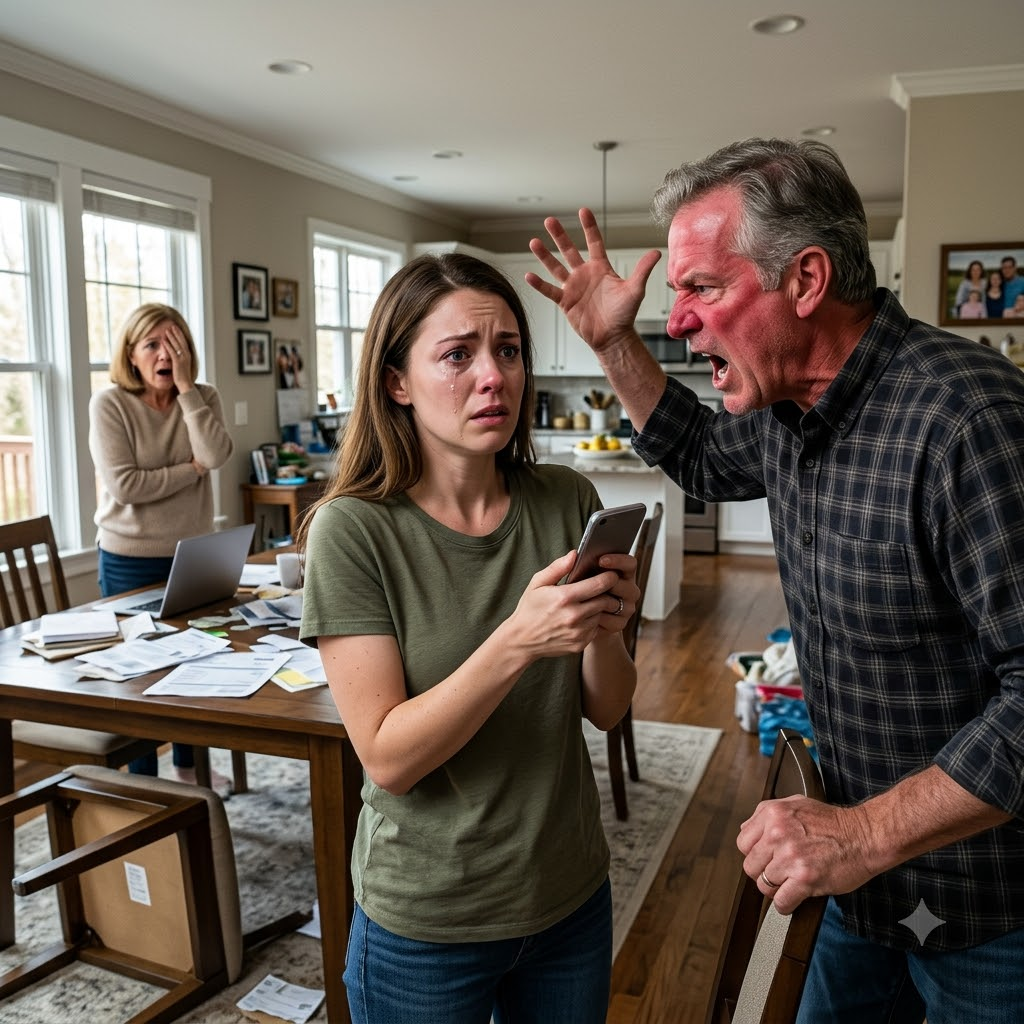
"Lauren was never supposed to see that page."
My father's voice came through my mother's phone, followed by the sound of something being placed forcefully on a table.
I stood in my kitchen, holding my phone against my ear.
"Mom?"
There was no answer.
"Mom, are you still there?"
I heard my father again.
"Give me the notebook, Margaret."
Then the call disconnected.
I stared at the screen.
For several seconds, I couldn't decide whether to call back or contact Emily.
I chose Emily.
She answered quickly.
"Lauren?"
"My mother found a notebook with my father's financial records. It contains several transfers, including the $56,000 retirement distribution and the $94,000 home-equity balance."
"Did she send you photographs?"
"Yes."
"Do you still have them?"
"Absolutely."
"Forward everything to me. Don't confront your father tonight."
I opened the photograph again.
The page was written in Richard Parker's familiar block lettering.
There were columns for amounts, dates, recipients, and repayment responsibilities.
My name appeared beside the $56,000 retirement transfer.
Tyler's name appeared beside the $38,000 distribution.
The $75,000 cashier's check was listed separately.
And beneath all three entries was the remaining $94,000 balance.
I looked at the final handwritten sentence.
Once Lauren signs the new loan, all outstanding family obligations will be consolidated.
I read it again.
Then I forwarded the image.
Emily called back less than five minutes later.
"Lauren, I want you to preserve this exactly as you received it."
"Does it mean my father considers me responsible for the money?"
"It appears that way, but the notebook itself doesn't establish legal liability. It does, however, raise important questions about how he calculated these amounts and why he connected them to your name."
I looked at the page.
"Why would he need me to sign another loan if he already believes I owe him?"
"That's something we need to investigate."
I rubbed my forehead.
"Could the new loan be connected to Tyler's business?"
"Possibly. But let's not assume. We need the actual application and supporting documents."
I agreed.
Emily asked me to send the complete photograph, including the surrounding pages if my mother had taken any.
I explained that my father had interrupted the call.
"Don't ask your mother to retrieve anything if doing so could put her under pressure," Emily said. "We'll work with what we already have."
I thanked her.
After ending the call, I opened the spreadsheet I had been maintaining.
I added a new heading.
RICHARD PARKER'S PERSONAL FINANCIAL LEDGER.
Under it, I recorded the amounts from the notebook.
$56,000.
$38,000.
$75,000.
$94,000.
Then I added the dates.
The first three appeared to involve retirement distributions and money intended for Tyler.
The final amount matched the home-equity balance.
But there was one detail I couldn't explain.
Why had my father placed all those transactions into a single ledger of family repayment responsibilities?
I wasn't a business partner.
I wasn't a borrower.
I wasn't the person who had requested the retirement distribution.
I hadn't received the money.
And I hadn't signed the credit agreement.
Yet my name was attached to almost everything.
At 9:35 p.m., my mother sent me a message.
Mom: I'm okay. Your father has the notebook now.
I immediately called her.
She answered quietly.
"Are you alone?"
"Yes. He's in the living room."
"What happened?"
"He took the notebook."
"Did he say anything?"
"He said I shouldn't have been looking through his private papers."
I closed my eyes.
"Mom, are you all right?"
"I'm fine."
"Did you manage to photograph the other pages?"
"Only two."
"That's enough for now."
She sighed.
"Lauren, I don't know what to believe anymore."
I softened my voice.
"Mom, neither of us has all the answers yet."
"Your father says the money was used to protect the family."
"Then he needs to explain where it went."
"He says you agreed to take responsibility."
"I didn't."
"I know."
She sounded tired.
Then she asked:
"Do you remember the summer we all went to the lake?"
I was surprised by the question.
"Yes."
"Your father keeps talking about that year."
I thought for a moment.
It had been several years earlier.
My parents had rented a small lake house for a family weekend. Tyler had spent most of the trip talking about starting a business.
Dad had been enthusiastic.
He had talked about investing in Tyler's future.
I had been happy for them.
I remembered taking photographs, cooking dinner, and sitting outside with my mother after everyone else had gone to bed.
"What about it?" I asked.
"Your father says that was when the family agreed to help Tyler."
I frowned.
"Mom, nobody agreed to anything financial that weekend."
"That's what I thought."
"Did Dad say otherwise?"
"He says you promised to support Tyler if he needed help."
I almost laughed.
"Mom, I gave Tyler a loan because he asked me. That was separate."
"I know."
"That doesn't mean I agreed to guarantee a business loan or take responsibility for Dad's debts."
She sighed.
"I wish I had asked more questions."
I looked down at the notebook photograph.
"Mom, I wish I had, too."
We ended the call.
The following morning, I arrived at work earlier than usual.
I had barely opened my laptop when an email appeared from Emily.
She had reviewed the financial ledger and wanted to discuss one particular entry.
I called her.
"Good morning."
"Good morning, Lauren. I've been looking at the dates in your father's notebook."
"What did you find?"
"The $56,000 transfer appears to have occurred around the same period as the disputed account authorization."
"Yes."
"The $38,000 distribution and the $75,000 cashier's check also appear to fall within the same broader financial period."
I nodded.
"Does that matter?"
"It may help us establish a sequence of transactions. I also want to know whether the home-equity line was used to repay or replace any of those funds."
I looked at the $94,000 figure.
"Could that be why my father connected everything?"
"Possibly. We need to see the actual account statements."
Emily explained that the ledger might represent my father's personal understanding of the family's financial obligations.
But it didn't prove that I had agreed to assume those obligations.
She reminded me that a handwritten record couldn't replace a valid agreement or establish my consent.
I felt a little relief.
Then she asked something unexpected.
"Lauren, did you ever receive money from your parents that you might have forgotten about?"
I thought carefully.
"No."
"Any large transfers?"
"No."
"Any checks?"
"No."
"Any accounts opened for you when you were younger?"
I hesitated.
"My parents opened a savings account for me when I was a teenager. But I withdrew the money for college."
"Do you remember which bank?"
I told her.
She asked me to locate any old records I might have.
I agreed.
After the call, I searched through my digital files.
I found an old college financial aid folder.
Inside was a scanned statement from the savings account my parents had opened when I was seventeen.
The account had been closed shortly after I graduated.
I downloaded the statement.
There was nothing unusual about it.
The balance was modest.
The closing transaction was recorded.
I had withdrawn the money for tuition and textbooks.
But the statement included an account reference that I hadn't seen in years.
I forwarded it to Emily.
She replied that it was worth keeping because it helped establish my financial history.
At 11:20 a.m., Tyler called.
I considered ignoring him.
Then I remembered his name on the authorization request.
I answered.
"What?"
"Nice to hear from you, too."
"I'm working, Tyler."
"This won't take long."
I waited.
He sighed.
"Dad says you're refusing to cooperate."
"That's correct."
"He's trying to settle everything."
"By sending me documents I never signed?"
"You're making it sound worse than it is."
I closed my office door.
"Tyler, I want you to answer one question."
"What?"
"Why did you request to be added as an authorized contact on the home-equity account?"
He became quiet.
Then he said:
"Dad needed help."
"With what?"
"His finances."
"Why did you need access to an account with my name on it?"
"Because he said you were involved."
"I wasn't."
"That's not what he told me."
I stared at the desk.
"What exactly did he tell you?"
Tyler sighed.
"He said you were part of the family arrangement."
"What arrangement?"
"The money."
"What money?"
"All of it."
I felt my stomach tighten.
"Tyler, I need you to be specific."
He became irritated.
"Why are you doing this?"
"Because my name appears on a $56,000 transfer I never received."
He didn't answer.
"And my signature appears on a home-equity agreement I never signed."
Silence.
Then he said:
"Look, I didn't create those documents."
"Did you submit them?"
"I helped Dad with paperwork."
"Did you know the signature wasn't mine?"
He didn't respond.
I waited.
Finally, he said:
"I thought you knew what he was doing."
My chest tightened.
"Why would you think that?"
"Because Dad said you agreed to help."
I closed my eyes.
"Did you ever speak to me about any of this?"
"No."
"Then why did you believe him?"
"Because he's our father."
I almost laughed.
That was exactly the reason I had believed him, too.
But trust wasn't permission.
And being related didn't make an unauthorized financial transaction acceptable.
"Tyler, did you receive the money from the $56,000 account?"
He immediately became defensive.
"I told you I didn't."
"Then who did?"
"I don't know."
"Did you have access to it?"
He was silent.
I repeated the question.
"Tyler, did you have access to the account?"
Finally, he said:
"I helped Dad move some money around."
I stood up.
"How much?"
"I don't remember."
"Was it the fifty-six thousand?"
"Some of it."
My heart began beating faster.
"What do you mean, some of it?"
"Lauren, I have to go."
"Tyler, wait."
He hung up.
I stared at the phone.
I had finally received an answer.
Not a complete one.
But enough to understand that my brother had been involved in moving money through an account bearing my name.
I immediately wrote down everything he had said.
Then I forwarded the notes to Emily.
At 12:45 p.m., she called.
"Lauren, did Tyler actually say he moved money from the account?"
"Yes."
"Did he specify whether he was acting on your behalf?"
"No."
"Did he say who gave him access?"
"He said he was helping Dad."
Emily paused.
"That's important. Please preserve the call details and write down the exact wording as closely as possible."
I agreed.
She explained that we would need independent records to determine what had happened.
Then she said something that made me stop.
"Lauren, I also think you should consider whether your brother had access to any of your personal information beyond the driver's license."
I thought about the years when Tyler had visited my apartment.
He had occasionally used my laptop to print documents.
He had once helped me move furniture.
He knew my birthday.
He knew my old address.
But I had never given him access to my banking passwords.
"Not that I remember."
"All right. Review your email and device security, just to be safe."
I followed her advice.
I changed my email password.
I enabled additional verification.
I checked my account activity.
Nothing unusual appeared.
But I still felt unsettled.
At 3:15 p.m., my mother sent another message.
Mom: Dad says he wants to talk to you about the new loan.
I replied:
Me: I'm not discussing any new loan until the old documents are investigated.
She responded:
Mom: He says this is the only way to save the house.
I stared at the message.
There it was again.
The house.
My father had repeatedly used the possibility of losing it to pressure me.
But I had begun to understand that the house was connected to much more than the monthly mortgage.
There was the $94,000 home-equity balance.
There were the retirement distributions.
There was Tyler's business funding.
And there was the disputed agreement carrying my signature.
I called Emily.
She advised me not to agree to any refinancing, consolidation, or guarantee without complete documentation and independent legal review.
I thanked her.
Then I sent my mother a short message.
Me: Please don't sign anything new. We need independent advice first.
At 5:40 p.m., I received an email from the institution handling the disputed account.
The subject line read:
Identity Verification — Additional Documentation Required.
I opened it.
The institution had reviewed my initial complaint.
They requested additional information to determine whether the account had been opened with my authorization.
They also confirmed that the account-opening date was three years earlier.
That was the same period when I had sent my father a copy of my driver's license.
I read the message twice.
Then I noticed an attachment.
It contained a partial account history.
I opened it.
The first page showed the original deposit.
$56,000.
The second page showed several withdrawals.
One transfer was made to an account ending in 4821.
Another was made to an account ending in 7736.
A third transaction showed a cashier's check.
I stared at the amounts.
They added up to nearly the entire balance.
The money had not remained in the account.
It had been moved.
I forwarded the document to Emily.
She called me almost immediately.
"Lauren, don't contact the institution again until we review this together."
"Okay."
"I want to identify the receiving accounts and determine who controlled them."
I looked at the transaction history.
"Can the bank tell us?"
"We'll request the information through the proper channels."
I nodded.
Then I noticed something.
The final transaction had a description that appeared to reference a mortgage payment.
The date matched one of the months when I had sent my father $860.
I looked at the amount.
$18,500.
I felt my stomach drop.
"Emily?"
"Yes?"
"I think part of this money may have gone toward the house."
She asked me to send the page.
I did.
We reviewed the details together.
The transaction description was incomplete, so we couldn't establish exactly where the money went.
But the reference number appeared to be connected to a mortgage servicing institution.
I searched my email for that institution's name.
It was the same lender that handled my parents' mortgage.
I sat very still.
My father had apparently transferred retirement money into an account bearing my name.
Some of that money had then been moved elsewhere.
And one transaction appeared connected to the same mortgage I had been paying every month.
If the bank confirmed that connection, I would finally understand why my father had kept the account secret.
But I needed more than an assumption.
I needed the actual payment records.
At 7:10 p.m., my mother called.
Her voice sounded different.
"Lauren, your father wants to tell you something."
I was standing in my kitchen.
"What?"
"He says he has proof that you knew about the account."
I closed my eyes.
"Proof of what?"
"That you agreed to the arrangement."
I felt my jaw tighten.
"What proof?"
She hesitated.
"He found an old document."
"What document?"
"I don't know. He says it has your signature."
I looked at the photograph of the disputed authorization.
"Mom, I've already told you I never signed those papers."
"I know."
"Then what does he have?"
She lowered her voice.
"He says you signed something at the bank three years ago."
I gripped the counter.
"That's impossible."
"That's what I told him."
"What did he say?"
"He said the document proves everything."
I remained silent.
Then my mother whispered:
"Lauren, he says you were there when the $56,000 account was opened."
My heart began beating faster.
I had never visited that bank.
I had never opened that account.
I had never received the money.
But my father was now claiming he had proof that I had been there.
"Mom, did you see the document?"
"No."
"Did he show you?"
"Not yet."
I took a slow breath.
"Please don't let him destroy it."
"I won't."
A few seconds passed.
Then she said:
"Lauren, he just brought it into the room."
I heard a chair move.
Then my father's voice.
"Margaret, give me the phone."
My mother whispered:
"He's here."
The call remained connected.
I heard my father take a breath.
Then he spoke directly to me.
"Lauren, I have the original document with your signature."
I froze.
He continued.
"And tomorrow, I'm taking it to the bank."
There was a pause.
Then he said:
"Because this time, I want them to hear the truth from the person who actually signed it."






Comments 0