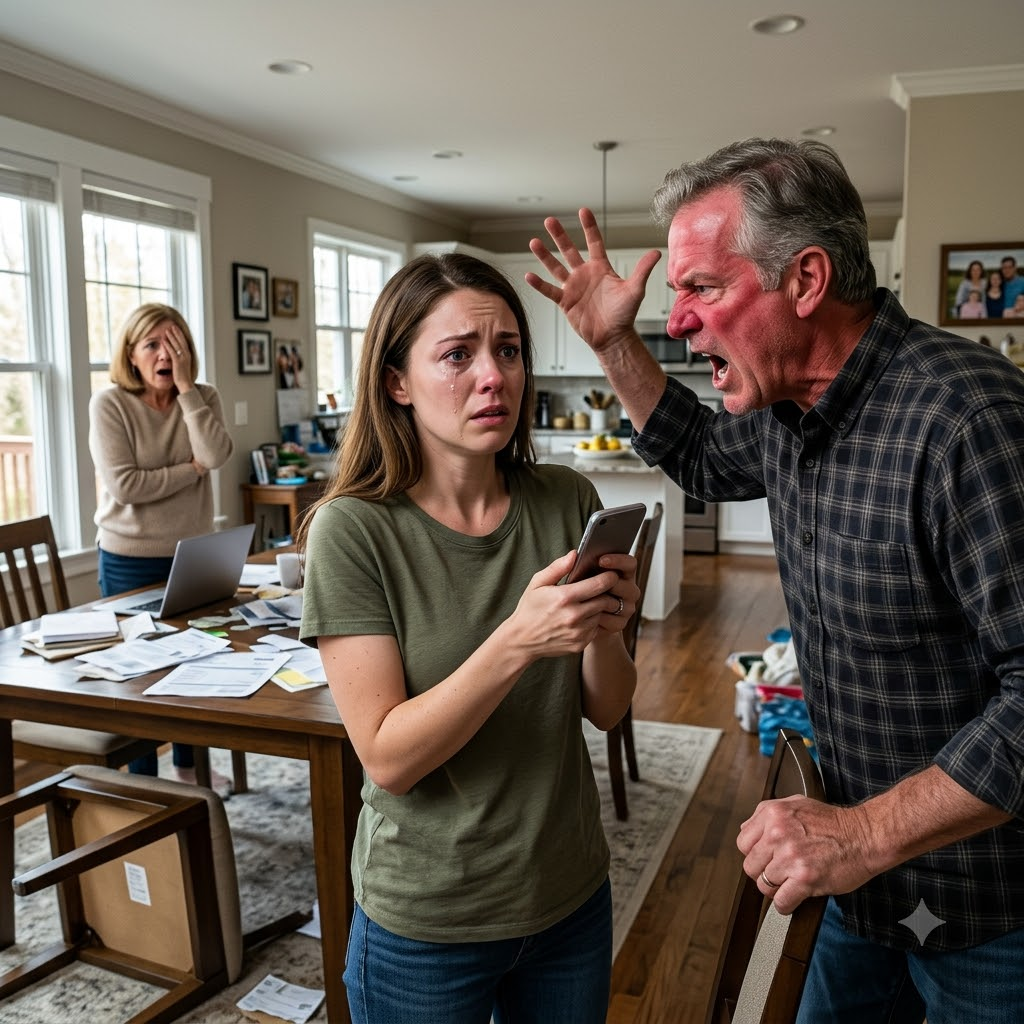
The word ACCEPTED was still glowing on my laptop screen when Emily Brooks called me.
"Lauren, don't panic. I've reviewed the notice you sent."
I stood beside my dining table, unable to look away from the document.
"My father transferred my apartment into his name."
"That's what the filing appears to indicate. But an accepted recording does not necessarily establish that the underlying transfer was legally valid. We need to challenge it immediately."
"My mother signed as a witness."
"I saw that."
I closed my eyes.
"Emily, did she know what she was signing?"
"We'll need to establish that. For now, preserve the notice, the original filing information, and every document connected to the transfer."
I looked at the date.
Several months earlier.
My father had submitted a document claiming ownership of a property he had never purchased, never paid for, and never legally owned.
My apartment.
The place I had worked years to afford.
The place I had believed was safe.
I forwarded the notice to Emily.
Within an hour, she had begun coordinating the necessary legal steps to challenge the transfer, notify the relevant property authorities, and prevent any further transaction involving my apartment while the dispute was pending.
She also asked me to prepare every genuine signature sample I could find.
I gathered my original closing documents, employment records, apartment purchase agreement, and mortgage statements.
Then I called my mother.
She answered through tears.
"Lauren, I'm so sorry."
"Mom, where is Dad?"
"He's in his office."
"Are you safe?"
"Yes."
"Did you sign the property transfer?"
She began crying harder.
"He told me it was a family authorization."
"What did you think it meant?"
"He said he needed me to confirm that you had agreed to let him manage the property temporarily."
I closed my eyes.
"Mom, did you understand that the document transferred ownership?"
"No. He told me it was temporary."
"Did you read the entire document?"
"I tried, but he kept saying there was nothing to worry about."
I took a breath.
"Did you actually see me sign it?"
"No."
"Did you tell anyone that you witnessed me signing it?"
She was silent.
Then she whispered:
"Your father told me what to write."
I felt sick.
"Mom, that's important. You need to tell the truth about what happened."
"I will."
"Please don't sign anything else."
"I won't."
We ended the call.
I forwarded her account of the conversation to Emily.
That afternoon, Emily arranged for my mother to receive independent legal guidance. She explained that my mother's position needed to be assessed separately from mine, especially because she might have signed documents without understanding their purpose.
I didn't want my mother to suffer unnecessarily.
But I couldn't allow another person to decide what happened to my home.
For once, I had to protect myself.
The following morning, Emily and I began addressing the property transfer formally.
We obtained the recorded document and examined the signature pages.
The transfer contained several serious inconsistencies.
The signature attributed to me did not match the genuine signatures on my original closing documents.
The witness declaration claimed that I had personally approved the transaction.
I had not.
And the notarial information required further verification.
Emily submitted the dispute and supporting evidence through the appropriate channels.
She also requested preservation of the original submission records.
My father's attempt to transfer ownership had now become part of a formal investigation.
For the first time, I wasn't simply reacting to another demand from him.
I was building a case based on facts.
Three days later, Tyler called.
I almost ignored him.
But I answered.
"Lauren?"
"What?"
"I need to talk to you."
"About the property transfer?"
"Yes. And everything else."
I sat down.
"Go ahead."
He took a long breath.
"Dad is furious."
"That isn't my problem."
"I know."
Silence followed.
Then he said:
"I saw the documents."
"What documents?"
"The original ones. The ones Dad kept in the desk."
I closed my eyes.
"What did you find?"
Tyler hesitated.
"There was a folder for the retirement account, another for the house, and one with your apartment information."
"Did you see the original signature form?"
"Yes."
"What was it?"
"It was the insurance form you sent Dad years ago."
I remembered the final page.
The wording about financial verification and household administration.
Tyler continued.
"Dad had copied your signature from that form onto other documents."
My stomach tightened.
"Did you see him do it?"
"I saw copies. Some were already signed."
"Who prepared them?"
He was quiet.
Then he answered.
"Dad."
I looked at the window.
"Tyler, why did you help him?"
He sighed.
"Because I was in trouble."
"What kind of trouble?"
"The business wasn't making enough money. I had loans, credit cards, equipment payments. Dad kept saying he could fix everything if we consolidated the debts."
"Using my identity."
"Yes."
I waited.
Tyler continued.
"He told me the retirement account was temporary. He said you would eventually agree to help once everything was explained."
"And the $125,000 loan?"
"He wanted to use it to pay off the business debts and some of his personal obligations."
"What about my apartment?"
"He said it was worth enough to secure the loan."
I felt a wave of anger.
"Did you know he was trying to transfer ownership?"
"No. I swear I didn't know about that until yesterday."
I didn't immediately believe him.
But I listened.
He continued.
"Dad said the property paperwork was only to make the loan easier. I didn't know he was trying to put the apartment in his name."
"Did you submit the loan documents?"
"Yes."
"Did you submit my identification?"
"Yes."
"Did you sign anything pretending to be me?"
He became silent.
Then he whispered:
"I signed the witness section on one of the business documents."
I closed my eyes.
"Tyler."
"I know."
"Did you tell the lender that I was there?"
"I signed what Dad told me to sign."
I felt tears gathering, but I didn't let them fall.
"Do you understand what you've done?"
"Yes."
"Do you understand that I could have lost my apartment?"
"I do."
He began crying.
"I thought it would all work out."
I stared at the table.
"You never asked whether I could afford to lose everything."
He didn't respond.
Finally, he said:
"I'm going to tell the truth."
I didn't forgive him that day.
But I told him to speak with his own attorney and preserve every document.
That evening, Emily called.
"Lauren, Tyler has contacted us through his attorney."
"What did he say?"
"He intends to cooperate with the investigation and provide information about the documents he helped prepare."
I sat down.
"Does that help?"
"It may. We still need independent evidence, but his cooperation could help establish the sequence of events."
I thanked her.
Then I asked about the retirement account.
Emily explained that the financial institution had expanded its review after receiving the additional documents.
The original application, identity verification records, disputed signature, and transaction history were all being examined.
There was also a separate review involving the home-equity agreement.
My father had maintained that I was responsible for the $94,000 balance.
But the documents supporting that claim were now disputed.
I asked whether the bank could continue treating me as responsible.
Emily explained that the matter would depend on the investigation and applicable legal procedures.
She was careful not to promise an immediate outcome.
But she assured me that the disputed liability was being challenged with substantial supporting evidence.
For the first time in months, I slept through the night.
The following week, my mother came to Charlotte.
She arrived with a small suitcase and a folder.
When I opened my apartment door, she looked older than I remembered.
Her eyes were red.
She hugged me without saying anything.
I held her for a long moment.
Then she handed me the folder.
"I brought everything I could find."
Inside were copies of financial statements, correspondence, and several documents from my father's desk.
One page caught my attention immediately.
It was a handwritten breakdown of the retirement money.
The total distribution was approximately $120,000.
The entries showed that the money had been divided among several destinations.
Some went toward existing debts.
Some went toward Tyler's business.
Some went toward the home-equity balance.
And another amount was marked:
Personal obligations — Richard.
My father had not been waiting for a delayed pension.
He had received a retirement distribution.
He had used it to cover debts he hadn't disclosed to my mother.
Then he had opened an account using my identity and treated the transactions as though I had accepted responsibility.
I looked at the final page.
There was a note in my father's handwriting.
Lauren's monthly support should cover the household shortfall until refinancing is complete.
I felt my throat tighten.
The $1,900 mortgage payment.
The $860 monthly transfer.
The electricity.
The insurance.
My money had not been helping my parents recover from a temporary problem.
It had been part of a financial plan my father had created without my knowledge.
I showed the page to my mother.
She began crying.
"He told me you wanted to help."
I took her hand.
"I wanted to help you. I never agreed to any of this."
She nodded.
"I know that now."
For the next several weeks, the investigation continued.
The financial institution confirmed that the retirement account had been opened using identification presented by Tyler.
The recorded verification process did not establish that I had personally attended the branch.
The telephone number and address on the application were inconsistent with my actual contact information.
The home-equity agreement also contained disputed documentation.
The lender placed the account under review and stopped treating my alleged authorization as established fact while the investigation proceeded.
The commercial lender formally suspended Tyler's business loan application.
The $125,000 loan was never funded.
The attempted property transfer was challenged, and the supporting documents were examined.
My genuine closing records, employment documents, and original signatures contradicted the claims made in the disputed paperwork.
My father's attorney eventually contacted Emily.
Richard was prepared to discuss a resolution.
At first, I refused to meet him.
Then Emily explained that a properly documented settlement might help resolve the financial disputes and protect my interests.
I agreed to one meeting.
It took place in a conference room at Emily's office.
My father arrived wearing his usual white shirt and dark trousers.
He looked tired.
Tyler came separately with his own attorney.
My mother sat beside me.
For several minutes, nobody spoke.
Then Richard looked at me.
"Lauren."
I nodded.
"Richard."
His expression tightened at the use of his first name.
He opened a folder.
"I want to settle this."
I looked at Emily.
She nodded slightly.
"Then let's discuss the documents."
My father sighed.
"I made mistakes."
I waited.
He continued.
"I was trying to protect the family."
I looked directly at him.
"By using my identity?"
He rubbed his forehead.
"I thought everything would be temporary."
"You opened an account in my name."
"I was going to explain."
"You used my retirement account information."
"I needed help."
"You submitted a loan application using my apartment as collateral."
He looked down.
"I didn't think it would go that far."
I remained silent.
Then I asked:
"Did you ever consider what would happen if the loan went wrong?"
He didn't answer.
"Did you think about whether I could afford to lose my home?"
He stared at the table.
Finally, he said:
"I thought you'd help."
I felt a strange calm settle over me.
"That's the problem, Dad. You thought my help belonged to you."
My mother began crying quietly.
Tyler looked down.
Richard said nothing.
Emily placed the proposed resolution documents on the table.
The agreement addressed the disputed financial obligations, required the withdrawal of the unauthorized loan applications, and established a process for correcting the property records and resolving the disputed account claims.
It also required the parties to cooperate with the relevant financial reviews.
My father initially objected to several provisions.
But after reviewing the supporting records, his attorney advised him to consider the proposed terms carefully.
The discussions took several meetings.
There were no dramatic speeches.
No sudden apologies.
Just documents, dates, signatures, and difficult decisions.
Eventually, Richard agreed to the terms required to resolve the property dispute and withdraw his claims over my apartment.
The transfer was formally corrected through the appropriate legal process.
The property records were restored to reflect my ownership.
The disputed $125,000 loan application was withdrawn.
The commercial lender confirmed that I was not an approved guarantor and that no loan had been funded.
The home-equity and retirement account matters continued through their separate review processes.
My father's claim that I owed him $94,000 was not supported by a valid agreement establishing my responsibility.
My financial obligations were assessed independently, and the disputed liability was not transferred to me.
The $56,000 account was also addressed through the institution's review.
The bank identified the unauthorized activity and worked through the appropriate procedures to correct its records.
Tyler provided information about the documents he had helped prepare.
He admitted that he had used my identification without obtaining my permission.
His cooperation did not erase what he had done.
But it helped establish the truth.
Richard eventually accepted responsibility for the financial arrangements he had created.
He also agreed to stop contacting lenders or institutions using my information.
The family financial support I had been providing remained discontinued.
I did not restart the $1,900 mortgage payment.
I did not resume the $860 transfer.
I did not pay their electricity or insurance bills.
Those decisions were no longer negotiable.
My mother received independent financial advice and began reviewing the household finances herself.
She discovered that the situation was more complicated than Richard had admitted.
But she also discovered that she had options.
She could decide what to pay.
She could ask questions.
She could refuse to sign documents she didn't understand.
And she could build a financial plan that did not depend on my income.
Several months later, I invited her to dinner at my apartment.
She stood in the kitchen, looking at the framed photograph of the day I received my keys.
"You look so happy here," she said.
"I was."
She touched the frame.
"Your father should never have tried to take this from you."
I looked at her.
"He didn't get to keep it."
She nodded.
Then she smiled sadly.
"I am proud of you, Lauren."
I hugged her.
This time, there were no documents waiting for me to sign.
No financial emergency.
No demand for money.
Just my mother and me.
Tyler sent me a letter several weeks later.
He apologized for using my identification and for helping Dad prepare the applications.
He admitted that he had been ashamed of his failed business and had allowed Dad to convince him that I would eventually accept responsibility for the money.
He didn't ask me for another loan.
He didn't ask me to rescue him.
He simply acknowledged what he had done.
I replied with a short message.
I told him that I hoped he would rebuild his life honestly, but trust would take time.
I didn't promise that everything would return to normal.
And I didn't need to.
As for Richard, our relationship changed permanently.
He eventually sent an apology.
It was brief.
He admitted that he had made decisions involving my identity and finances without my consent.
He acknowledged that his actions had hurt me.
I read the message.
Then I put my phone down.
I didn't need his apology to validate what had happened.
I already had the truth.
And I had my independence.
A year after the first disownment text, I sat at my dining table with a cup of coffee.
My mortgage statement was beside me.
The ownership records were correct.
My credit reports had been reviewed and corrected where necessary.
The disputed applications were no longer hanging over my future.
I opened my banking account.
There were no automatic transfers to my father's checking account.
No $1,900 mortgage payment.
No surprise family expenses.
My salary belonged to me.
My home belonged to me.
My future belonged to me.
My mother called that afternoon.
She told me she had started working with a financial adviser and had created a household budget she could understand.
She was learning how to manage her own accounts.
She sounded lighter than she had in years.
Before hanging up, she said:
"Thank you for helping me find the truth."
I smiled.
"Mom, you helped yourself by finally asking questions."
After the call, I walked to my living room window.
Charlotte was busy below me.
Cars moved along the street.
People hurried toward their appointments.
Life continued.
I thought about the message my father had sent.
You're no longer my child. If you have anything to say, contact my lawyer.
At the time, I had replied with one word.
Okay.
He had expected that word to make me frightened.
He had expected me to apologize.
He had expected me to come back with another payment, another signature, and another promise.
Instead, I had finally stopped confusing financial responsibility with love.
I hadn't abandoned my family.
I had simply refused to let them use my future as collateral for their mistakes.
I looked around my apartment.
The place was quiet.
My name was on the deed.
My keys were in my hand.
And for the first time in years, there was nothing in my life that I needed to pay for just to be considered someone's daughter.
I took a sip of coffee and smiled.
Not because everything had been easy.
Not because my family had returned to the way it once was.
But because I had finally built a life in which love did not require me to surrender everything I owned.
And that was more than enough.






Comments 0