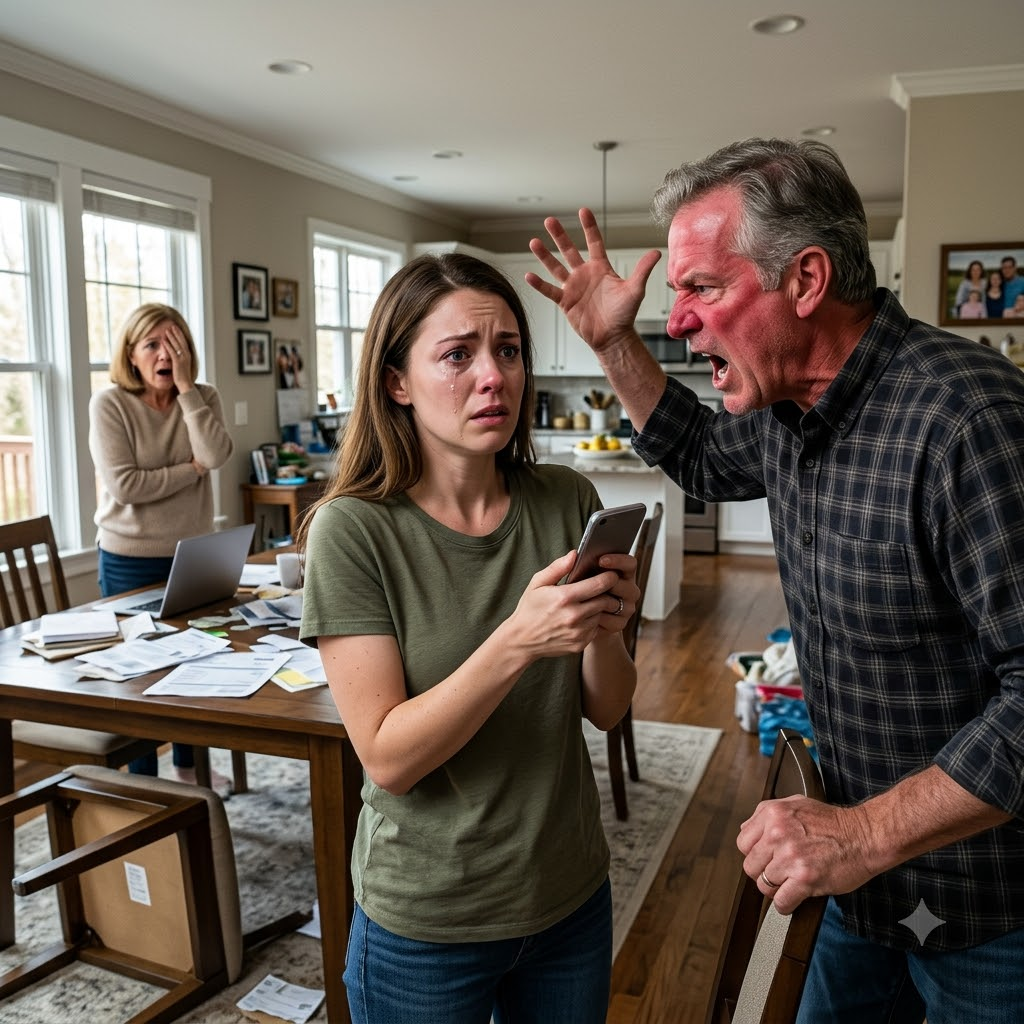
"I have the original document with your signature."
My father's words echoed in my head long after the call ended.
"And tomorrow, I'm taking it to the bank."
I stood in my kitchen, staring at my phone.
I had never opened the account.
I had never received the $56,000.
I had never signed an authorization allowing my father to manage money in my name.
Yet Richard Parker was preparing to present a document that supposedly proved otherwise.
I immediately called Emily Brooks.
She answered before the second ring.
"Lauren?"
"My father says he has the original document with my signature."
"Which document?"
"The one connected to the retirement account. He says he's taking it to the bank tomorrow."
Emily became quiet.
"Did he tell you where he obtained it?"
"No."
"Did he describe what it contains?"
"He claims it proves I was present when the account was opened."
"Have you ever been to that bank?"
"Never."
"All right. Don't contact him about the document. If he presents it, we need to obtain a copy and examine how it was created."
I walked toward the dining table.
"Emily, what if the original actually has my signature?"
"An original document doesn't automatically establish that the signature is genuine or that you understood or authorized the transaction. We need to examine the circumstances surrounding its execution."
I took a slow breath.
"So what happens tomorrow?"
"If your father contacts the institution, they should follow their verification procedures. I've already sent a dispute notice. I'll also contact the institution to advise them that you challenge the authorization."
"Thank you."
"Lauren, I want you to remember something. You don't have to prove your innocence by signing something new or agreeing to a repayment arrangement."
I nodded.
"Understood."
After ending the call, I opened my email.
I searched for the financial institution's name.
There was the original complaint.
There was the confirmation that the account had been opened three years earlier.
And there was the partial transaction history.
I downloaded everything again.
Then I checked my calendar.
Three years earlier, on the date my father claimed I had visited the bank, I had been in Charlotte.
I remembered that week.
I had been working on a major office renovation project. My manager had required the entire team to attend an in-person planning session.
I searched my old work calendar.
There it was.
A meeting scheduled from 8:30 a.m. until 4:00 p.m.
The bank account had supposedly been opened at 10:15 a.m.
I stared at the dates.
If the bank's timestamp was accurate, I couldn't have been at both places.
I opened my work email and found a message from my manager confirming attendance.
Then I found the meeting minutes.
My name appeared in the attendance list.
I saved both documents.
They weren't proof that someone had forged my signature.
But they could help establish where I had been.
At 10:30 p.m., my mother sent me a message.
Mom: Your father is very angry. He says you are trying to ruin him.
I replied:
Me: I'm asking for the truth. That's all.
She answered:
Mom: He says you signed the documents willingly.
I stared at the screen.
Me: Mom, I was at work that day. I have records.
She didn't reply.
I placed my phone on the table.
I wasn't going to spend another night defending myself against accusations.
The following morning, Emily called at 8:15.
"Good morning. I've contacted the institution."
"What did they say?"
"They confirmed receipt of your dispute. They've also noted that any original authorization connected to the account must be preserved."
"Will they give us a copy?"
"We've requested it."
I opened my laptop.
"Emily, I found something."
I forwarded the work calendar and meeting records.
She reviewed them while we spoke.
"This is useful," she said. "Keep the original emails, not just screenshots. We may need the metadata and full message history."
"Of course."
She asked me to send the meeting invitation and the confirmation from my manager.
I did.
Then she said:
"Your father may believe that presenting an original document will settle the matter. It won't. The institution still needs to establish whether the account was opened properly and whether you authorized the transaction."
I felt slightly calmer.
At 9:05 a.m., my father called.
I considered letting it go to voicemail.
Then I answered.
"Hello, Dad."
"Good. You're awake."
"I'm working."
"I'll be at the bank in an hour."
"Okay."
"I expect you to come."
I frowned.
"Why?"
"Because this concerns you."
"I've already disputed the account."
"That's exactly why you need to be there."
I leaned back.
"Dad, I have legal representation."
He laughed.
"You're making this more complicated than it needs to be."
"Then explain the document."
"I'll show you when we get there."
"Why can't you send me a copy?"
"Because it's an original."
"Take a photograph."
"No."
I looked at the calendar.
"Then my attorney can request it."
His voice became sharper.
"Your attorney doesn't need to be involved in every family matter."
"This isn't a family matter anymore. It's a financial account in my name."
He sighed.
"You always were stubborn."
I didn't respond.
Then he said:
"Your mother is coming, too."
"Why?"
"Because she witnessed everything."
My stomach tightened.
"What did she witness?"
He paused.
"She was there."
I stared at the wall.
My mother had never told me she was present when the account was opened.
If she had been there, why had she said she knew nothing about the transfer?
"Dad, I'll speak to my attorney."
He became angry.
"You have until Friday to fix this. After that, I won't protect you."
"Protect me from what?"
He ended the call.
I immediately forwarded the message summary to Emily.
She responded that I should not attend an unplanned meeting without legal guidance.
I agreed.
At 10:40 a.m., my mother called.
Her voice sounded nervous.
"Lauren, your father is leaving."
"Where is he going?"
"To the bank."
I closed my office door.
"Are you going with him?"
"He wants me to."
"Mom, did you really witness me signing the account documents?"
There was silence.
Then she whispered:
"No."
I closed my eyes.
"Then why is Dad saying you were there?"
"I don't know."
"Mom, please tell me the truth. Were you ever at that bank with him?"
"Yes."
"When?"
"Several years ago."
"Was I there?"
"No."
I sat down.
"Then what happened?"
She took a breath.
"Your father asked me to go with him. He said he needed help with some retirement paperwork. I waited in the lobby while he spoke to someone."
"Did you see him open an account?"
"No."
"Did he mention my name?"
"Not that I remember."
I looked at my work calendar.
"Mom, did you sign anything?"
She hesitated.
"Yes."
My stomach tightened.
"What did you sign?"
"I don't know. Your father told me it was a confirmation."
"What kind of confirmation?"
"He said it was related to the family account."
I closed my eyes.
"Mom, did you read it?"
"No."
I felt a wave of frustration.
"Why not?"
She began crying.
"Because I trusted him."
I softened my voice.
"I understand. But we need to know what you signed."
"I know."
"Do you have a copy?"
"No."
"Did Dad give you one?"
"No."
I took a breath.
"Please don't sign anything else."
"I won't."
Before ending the call, she said:
"Lauren, I think your father is afraid of something."
"What?"
"I don't know. But last night he kept asking whether you had contacted the retirement company."
I wrote that down.
We ended the call.
At 11:25 a.m., Emily sent me an email.
The financial institution had acknowledged her request for the original account-opening file.
They had also confirmed that the account was under additional review because of my identity dispute.
I felt a little relief.
Then my phone rang again.
It was Tyler.
I answered.
"What?"
"Why are you getting lawyers involved?"
I almost laughed.
"Because someone opened an account in my name."
"Dad says you were there."
"He is wrong."
"Mom says she remembers something."
I sat up.
"What does she remember?"
"I don't know. Dad said she witnessed the paperwork."
"She told me she didn't."
Tyler became quiet.
Then he said:
"Look, maybe she forgot."
I stared at the desk.
"Tyler, did you see the original document?"
"Yes."
My heart began beating faster.
"When?"
"Last night."
"What does it show?"
"Your signature."
"Does it show me signing?"
"I don't know."
"Then how do you know it's my signature?"
He sighed.
"Because it looks like yours."
I closed my eyes.
"Tyler, did you help Dad prepare it?"
"No."
"Did you help him open the account?"
Silence.
I repeated the question.
"Did you?"
Finally, he said:
"I helped him with some of the paperwork."
"What paperwork?"
"Bank forms."
"Which bank?"
"The same one."
I gripped the phone.
"Did you see my identification?"
He didn't answer.
"Tyler?"
"Look, I have to go."
"Wait. Did you submit the documents?"
He hung up.
I sat still.
Then I wrote down everything he had said.
My brother had now admitted helping Dad with bank paperwork connected to the disputed account.
I forwarded the information to Emily.
At 1:00 p.m., I received a call from the financial institution.
A representative introduced herself as Melissa from the account review department.
She explained that the institution had received my dispute and was reviewing the original records.
"Ms. Parker, we need to verify some information with you."
"Of course."
She asked whether I had opened the account.
"No."
"Did you attend the branch on the date listed?"
"No."
"Did you authorize Richard Parker or Tyler Parker to open or operate an account on your behalf?"
"No."
"Did you receive any funds from the account?"
"No."
She made several notes.
Then she asked:
"Do you recognize the address listed on the application?"
I gave her the address I had already seen.
"No. I've never lived there."
"Do you recognize the telephone number?"
I looked at the document.
It wasn't mine.
"No."
She paused.
"Thank you. We have noted those answers."
I asked whether she could tell me who had submitted the application.
She explained that she couldn't disclose all the information while the review was ongoing.
Then she said something unexpected.
"Ms. Parker, there is one additional item in the original file that may be relevant to your dispute."
My heartbeat quickened.
"What item?"
"A verification record."
"What kind?"
"A branch appointment confirmation."
I sat forward.
"Does it show who attended?"
"I can't confirm that yet."
"Can you tell me the date?"
She gave me the date.
It matched the day my father claimed I had been present.
I told her I had work records proving I was elsewhere.
She asked me to provide them through the official dispute channel.
I agreed.
Before ending the call, she added:
"There is also a recorded verification note associated with the account opening."
I froze.
"A recorded note?"
"Yes. It appears to be an internal verification record. Our review team will examine it."
"Can I hear it?"
"That will depend on the outcome of the review and the applicable procedures."
I thanked her.
Then I immediately called Emily.
She listened carefully.
"A recorded verification note could be important," she said. "We should formally request it."
I agreed.
At 2:30 p.m., Emily submitted the request.
The rest of the afternoon passed slowly.
I tried to work.
I answered emails.
I attended a project meeting.
But I couldn't stop thinking about the recording.
If it contained a conversation with someone claiming to be me, it could help establish what had happened.
If it contained my father's explanation, it might reveal who had provided the information.
And if it contained Tyler's voice, it could explain why his name appeared on the authorization request.
At 5:45 p.m., I drove home.
My mother called while I was stopped at a traffic light.
"Lauren?"
"Hi, Mom."
"Your father came back."
"What happened at the bank?"
"He showed them the document."
I gripped the steering wheel.
"What did they say?"
"They said they needed to review it."
I exhaled.
"Did they accept it?"
"I don't think so."
"Why?"
She paused.
"Because the woman asked Dad why the telephone number on the application belonged to Tyler."
I stared straight ahead.
"What?"
"She said the number didn't match yours."
I felt my heartbeat quicken.
"Mom, did Dad answer?"
"He said you had changed your number."
I closed my eyes.
That was false.
I had used the same personal phone number for years.
"Did they ask about the address?"
"Yes."
"What did Dad say?"
"He said you had temporarily used that address."
I almost laughed.
I had never lived there.
"Mom, did they ask you anything?"
She hesitated.
"Yes."
"What?"
"They asked whether I had seen you sign the document."
I gripped the phone.
"What did you say?"
"I told them I hadn't."
I closed my eyes.
For the first time, my mother had contradicted my father in front of someone outside the family.
"What happened after that?"
"Your father became angry."
"At you?"
"Yes."
I softened my voice.
"Mom, you did the right thing."
She began crying.
"I should have done it sooner."
I didn't answer immediately.
Then I said:
"We'll figure this out."
We ended the call.
At 7:18 p.m., I received an email from Emily.
The subject line read:
Update: Financial Institution Review.
I opened it.
The bank had confirmed receipt of the additional documents.
It had also located the original verification record.
Emily wrote that the institution was willing to provide a copy after completing the necessary review.
I read the message twice.
Then another email arrived.
This one came directly from the institution.
It contained an attachment.
The filename was:
ACCOUNT_OPENING_VERIFICATION_AUDIO_TRANSCRIPT.pdf
I opened it.
The first page contained the account number and the date.
The second page contained the verification questions.
The third page contained the recorded responses.
I scrolled slowly.
Then I reached the final section.
There was a question asking the applicant to confirm the identity of the person opening the account.
The response was recorded in quotation marks.
I read the first sentence.
Then the second.
My hands went cold.
The person who had opened the account had not claimed to be Lauren Parker.
The person had claimed to be acting with Lauren's permission.
And beneath that statement, the verification notes contained a name.
Richard Parker.
But the next line was even more disturbing.
It identified the person who had physically presented my identification documents.
I read the name.
Then I read it again.
It wasn't my father.
It wasn't my mother.
It was someone I had trusted with my home, my family, and my personal information for years.
Tyler Parker.






Comments 0