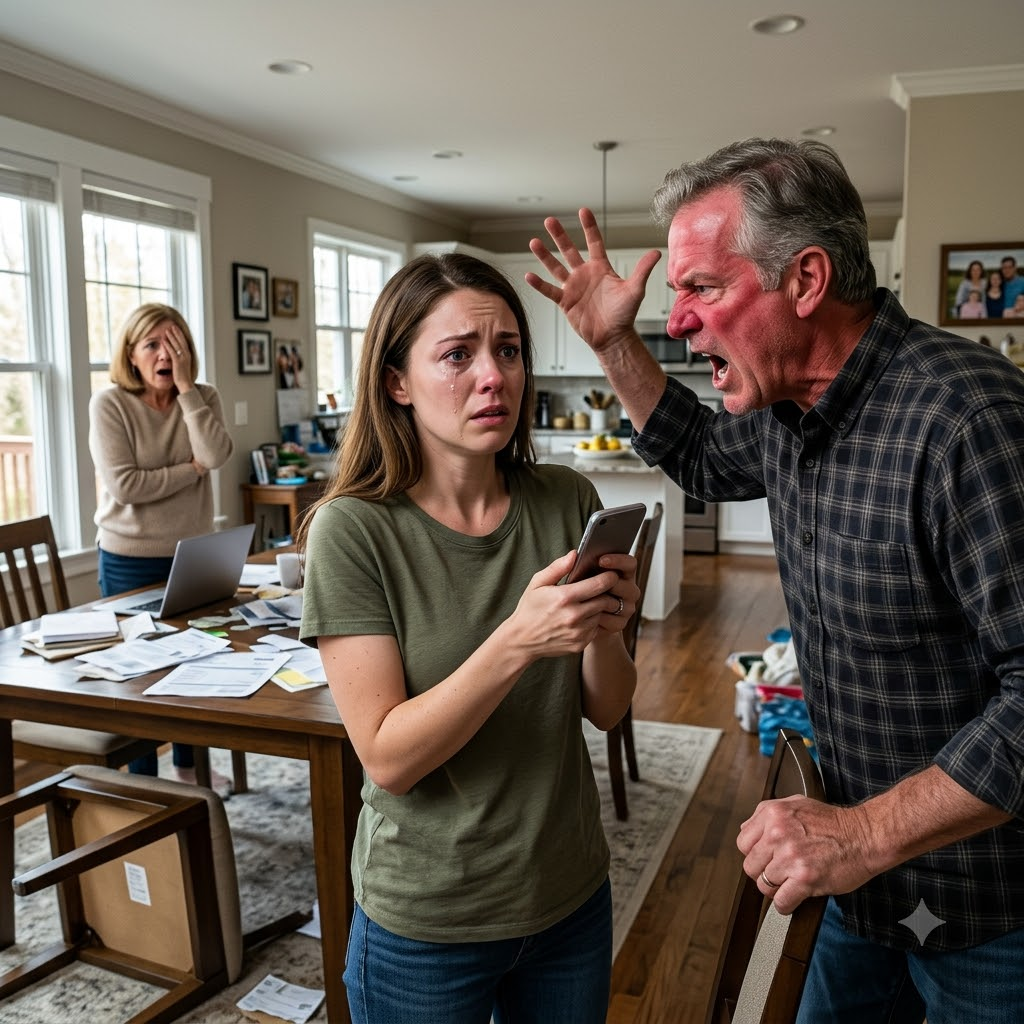
I stared at the photograph my mother had just sent me.
The retirement statement showed a distribution of $56,000.
Beneath the amount was a recipient name.
Lauren Parker.
For several seconds, I couldn't hear anything around me.
My father had told me his pension was delayed.
He had asked me to cover his mortgage.
He had accepted nearly $3,200 from me every month.
And now I was looking at a document suggesting that $56,000 from his retirement account had been transferred into an account bearing my name.
I enlarged the photograph.
There was a reference number, a transaction date, and a partial account number.
I recognized the date immediately.
It was from the previous year.
That month, my father had called me twice because he supposedly couldn't cover the household expenses.
I remembered sending him the usual $860.
I remembered paying the mortgage.
I remembered my mother thanking me for helping them get through another difficult month.
Yet this document suggested that something significant had happened with Richard's retirement funds around the same time.
I called my mother.
She answered in a whisper.
"Lauren, I only had a few seconds."
"Mom, where did you find that statement?"
"In the folder behind the insurance papers."
"Did you see the account number?"
"Only part of it."
"Was the account in my name?"
She hesitated.
"The statement lists you as the recipient."
I took a slow breath.
"Did you ever give Dad permission to transfer money into an account for me?"
"No."
"Did I ever tell you I received fifty-six thousand dollars?"
"No, sweetheart."
I looked at the document again.
"Then I need to find out where that money went."
My mother started crying.
"I don't understand any of this."
"Neither do I. But we're going to get the records."
"Your father says the money was used for family expenses."
I stopped.
"What family expenses?"
"He didn't explain."
"Did he say I received it?"
"He said it was handled through an account you knew about."
I felt my stomach tighten.
"Mom, I never received fifty-six thousand dollars."
"I believe you."
Those words gave me a little strength.
I asked her to photograph the entire statement, including the pages showing the account details and transaction references.
She agreed.
Before we ended the call, I heard a noise in the background.
My mother lowered her voice.
"Lauren, I think he's coming downstairs."
"Okay. Don't argue with him. Just keep the documents safe."
"I will."
The call ended.
I sat at my dining table and opened my laptop.
I had already spoken to Emily Brooks, the attorney I had hired to help me dispute the home-equity agreement.
Now I needed to tell her about the retirement transfer.
I forwarded the photograph and explained what my mother had found.
Emily replied within twenty minutes.
She asked me not to make assumptions about the transfer until we could obtain the original financial records.
She also recommended that I contact my bank and review every account connected to my personal information.
I followed her advice.
I checked my primary checking account.
My savings account.
My retirement account.
My credit card statements.
Nothing showed a deposit of $56,000.
I searched my email for the amount.
Nothing.
I searched for the retirement company.
Still nothing.
I had never received a notification about the transaction.
There was no record of a large deposit.
No transfer confirmation.
No tax document.
No communication from my father's retirement administrator.
I called Emily.
"Could this have been deposited into an account that I don't know about?" I asked.
"It's possible that your information was used in connection with an account you didn't authorize," she explained. "But we need to identify the institution and obtain the actual records before reaching a conclusion."
"What should I do first?"
"Request your credit reports and review all accounts and inquiries. Also, ask your mother to preserve the original statements. Don't let anyone alter or destroy them."
I agreed.
She continued.
"And Lauren, I want you to keep your communication with your father factual. Don't accuse him of fraud in a text message. Let the documents speak for themselves."
I thanked her.
After the call, I opened my banking application again.
I searched the previous year's transactions.
There was the $860 transfer.
There was the mortgage payment.
There were the utility bills.
Every month, I had sent money because Richard told me his retirement income had not arrived.
The possibility that he had already received money made those memories feel different.
I wasn't simply helping my parents.
I might have been financing a situation that someone had deliberately concealed from me.
At 10:15 the following morning, I received a call from my mother.
"Lauren, I found another page."
I stopped typing.
"What page?"
"The account information. I took a photograph."
"Can you send it?"
She did.
I opened the image.
The statement showed a financial institution I didn't recognize.
The recipient account was listed under a name that included my first and last name.
But the address was different from mine.
It showed an address in Charlotte that I had never lived at.
I zoomed in.
The address belonged to a commercial office building.
I copied it into my notes.
Then I noticed another detail.
The account had been opened several months before the $56,000 transfer.
I called Emily immediately.
She examined the photograph.
"Do you recognize this institution?" she asked.
"No."
"Have you ever opened an account there?"
"Never."
"Then we'll request information through the appropriate channels."
She reminded me that a name appearing on a statement did not, by itself, prove that I had opened or controlled the account.
I understood.
But I also understood that someone had used my personal information.
I contacted the institution's public customer service number.
I explained that I had received a financial document showing an account associated with my name and an address I did not recognize.
The representative asked for the reference number.
After a brief hold, she returned.
"Ms. Parker, I can confirm that there is a record matching the information you provided, but I can't discuss account details until your identity is independently verified."
"That's understandable," I replied. "I did not open this account, and I don't recognize the address."
She transferred me to the department responsible for identity-related disputes.
The second representative took notes and gave me a case number.
She explained that I would need to submit a written dispute and provide identification.
I agreed.
Before ending the call, I asked whether the account was still active.
"I can't confirm that without completing verification," she said.
I thanked her and wrote down the case number.
At lunchtime, I went through my personal records.
I found my old tax returns.
My employment documents.
My mortgage application from when I bought my apartment.
I had never used the unfamiliar address.
I had never listed it as a mailing address.
I had never authorized my father to open anything in my name.
I scanned the relevant records and sent them to Emily.
She responded that we were building a useful timeline.
Then she asked me a question.
"Lauren, did your father ever have access to your personal documents?"
I thought about it.
"Possibly. Years ago, when I was helping him with insurance paperwork, I sent him a copy of my driver's license."
"Do you remember when?"
"About three years ago."
"Did you send it directly?"
"Yes. He said the insurance company needed to verify a family member's information."
"Do you still have that email?"
I searched my inbox.
It took several minutes.
Then I found it.
The subject line was simple.
Insurance Information.
I opened the attachment.
It contained a scan of my driver's license.
The address was correct at the time.
The photograph was clear.
And beneath the image was a message from my father.
Richard: Thanks, sweetheart. I'll take care of the paperwork.
I stared at the screen.
Three years earlier, I hadn't thought twice about sending him that document.
He was my father.
Why wouldn't I trust him?
Now I wondered whether that innocent exchange had been connected to the account my mother had discovered.
I forwarded the email to Emily.
She asked me to preserve the original message and not delete the attachment.
I saved another copy.
Then I called my mother.
"Mom, do you remember Dad asking for my driver's license?"
She thought for a moment.
"Yes. He said it was for the insurance."
"Did he ever mention opening a bank account?"
"No."
"Did he tell you he had transferred retirement money into an account connected to me?"
"No."
I closed my eyes.
"Okay."
She sounded upset.
"Lauren, I need to tell you something."
"What?"
"Your father says the fifty-six thousand dollars was never yours."
I frowned.
"What does that mean?"
"He says the account was only temporary."
"Temporary for what?"
"He wouldn't explain."
I leaned forward.
"Mom, if the account was temporary, why was my name on it?"
She began crying again.
"I asked him that."
"What did he say?"
"He told me not to worry about it."
I shook my head.
"Mom, that's not an explanation."
"I know."
For a moment, neither of us spoke.
Then she said:
"Your father also mentioned Tyler."
My stomach tightened.
"What about him?"
"He said the money was connected to Tyler's business."
I looked at the $56,000 statement.
"Did Dad say Tyler received it?"
"He said Tyler was involved."
I closed my eyes.
This was becoming more complicated with every conversation.
The $38,000 retirement distribution appeared connected to Tyler.
The $56,000 transfer appeared under my name.
The home-equity credit line carried my signature.
And my father had been telling everyone that his pension was delayed.
I needed the actual records.
Not another explanation from Richard.
Not another accusation.
The documents.
That afternoon, Emily sent me a draft request for the financial institution's records.
She explained that the request would need to follow the proper procedures and that the institution might require additional identity verification.
I signed the necessary authorization.
Then I placed the documents in a folder.
At 5:40 p.m., I received a message from Tyler.
Tyler: Dad says you contacted the bank.
I didn't respond.
Another message appeared.
Tyler: You need to stop digging into things that don't concern you.
I stared at the screen.
I typed:
Me: My name appears on an account I never opened. It concerns me.
He replied immediately.
Tyler: You don't understand the arrangement.
I sat still.
That was the second time someone in my family had used the word arrangement.
First my father.
Now Tyler.
I typed:
Me: What arrangement?
The typing indicator appeared.
Then disappeared.
A few seconds later, another message came through.
Tyler: Call Dad.
I didn't.
Instead, I forwarded the exchange to Emily.
She advised me to keep the messages.
At 7:15 p.m., my mother called.
She was crying before I even said hello.
"Lauren, I found the folder."
"What folder?"
"The one with the original retirement documents."
"Where was it?"
"In the bottom drawer of your father's desk."
"Did you open it?"
"Yes."
I stood up.
"Mom, what's inside?"
"Statements. Letters. A copy of the home-equity agreement."
"Anything else?"
She hesitated.
"There's a letter from the freight company."
My heart began beating faster.
"About Dad's pension?"
"Yes."
"What does it say?"
"I haven't read the whole thing, but it has a date."
"What date?"
She told me.
It was more than a year before my father had first asked me for mortgage assistance.
I sat down.
"Mom, is it an approval letter?"
"I think so."
"What does the heading say?"
She read it slowly.
"Retirement Benefits Distribution Confirmation."
I closed my eyes.
"Keep reading."
Her voice trembled.
"It says the distribution was processed."
I waited.
Then she gave me the amount.
It was not a delayed payment.
It was not a pending benefit.
It was a completed distribution.
My father had received the money.
And the date was months before he had told me the pension was delayed.
I asked my mother to photograph every page.
She agreed.
Then I heard her move something.
"What is that?" I asked.
She sounded confused.
"There's another envelope inside the folder."
"What's written on it?"
She paused.
Then she whispered:
"It's addressed to Tyler."
I gripped the phone.
"Open it."
There was a rustling sound.
A few seconds passed.
Then she spoke again.
"Lauren, this isn't just a retirement statement."
"What is it?"
"It's a copy of a cashier's check."
"How much?"
My mother took a shaky breath.
"Seventy-five thousand dollars."
I went completely still.
The exact amount Tyler had recently asked me to guarantee.
But the check was dated months earlier.
And beneath the amount, in the recipient section, was Tyler's full name.
My mother turned the page.
Then she read the handwritten note attached to it.
"Business loan repayment."
I stared at the wall.
Tyler had already received a substantial amount of money from our father's retirement funds.
Yet he had returned to ask for another $75,000.
I wanted to understand why.
Before I could ask my mother another question, I heard her gasp.
"Lauren..."
"What?"
She sounded as though she had just seen something terrible.
"There is another document beneath the check."
"What document?"
"A bank transfer authorization."
"Whose name is on it?"
She didn't answer immediately.
Then she whispered:
"Your father's signature is here."
I waited.
"And yours is underneath it."






Comments 0