My father shoved my canvas duffel bag through the farmhouse doorway.
"Get out, Hannah! You're not my responsibility anymore!"
When Walter Miller later found me stranded behind his feed store, he noticed the old brass key hanging from my mother's necklace.
Three tiny numbers had been scratched into its back.
He recognized them immediately.
And suddenly, he stopped asking whether I had somewhere to sleep.
I was nineteen years old when my father threw me out of the only home I had ever known.
It happened three hours after my mother's funeral.
I still had black funeral clothes on. My shoes were muddy from the cemetery, and my mother's perfume lingered faintly on the sleeve of the coat I had borrowed from her closet that morning.
I had barely finished washing the coffee cups from the funeral gathering when my father announced that I needed to leave.
At first, I thought I had misunderstood him.
He stood beside the kitchen counter with his arms crossed. His name was Robert Whitaker, and he had spent most of my childhood believing that speaking louder automatically made him right.
Behind him stood Diane, his second wife.
She had been married to my father for less than a year, although she had lived in our farmhouse for several months before my mother died.
Diane was wearing a dark green sweater and a pair of expensive earrings.
And on her left hand was my mother's wedding ring.
I stared at it.
I couldn't seem to look anywhere else.
My mother had worn that ring for twenty-six years. It was a simple gold band with a small diamond that caught the sunlight whenever she reached across the kitchen table to hand me a cup of coffee.
I remembered her fingers turning the ring while she thought.
I remembered her taking it off before kneading bread.
I remembered her telling me that it was the one thing she had owned that had never been bought with money.
Now it was on Diane's finger.
"Take that off," I said.
Diane glanced down.
Then she smiled.
"Your father gave it to me."
I looked at him.
"She was buried this morning."
My father sighed as if I were inconveniencing him.
"Hannah, don't start."
"I asked her to take it off."
"And I told you to stop."
His voice had the familiar warning in it.
For most of my life, that warning had been enough to make me step backward.
My mother had been different.
She never shouted at him. She never tried to win arguments by making herself louder. She simply looked at him until he ran out of things to say.
I had learned that silence could be stronger than anger.
But that afternoon, standing in the kitchen where my mother had taught me how to make biscuits, I discovered that silence could also be painful.
Diane walked over to the refrigerator and opened it.
"We've discussed this," she said casually. "Your father and I need a fresh start."
I looked at the refrigerator.
My mother's handwritten shopping list was still attached to the door with a small magnet shaped like a sunflower.
Milk.
Eggs.
Flour.
Coffee.
The ordinary words seemed impossible to read.
"Where am I supposed to go?" I asked.
My father shrugged.
"You're nineteen."
That was his entire answer.
I waited for something else.
A suggestion.
A little money.
A temporary arrangement.
Anything that might have indicated he understood what he was doing.
Instead, he walked toward the hallway and returned carrying my old canvas duffel bag.
He had already packed it.
I recognized the bag immediately. My mother had bought it for me when I was sixteen and had taken me on a school trip to Rapid City.
It was heavy.
My winter clothes were stuffed inside without being folded.
A pair of boots stuck out of the zipper.
My toothbrush was tucked into the outside pocket.
He had packed my entire life into one bag.
"Where are my photographs?" I asked.
"What photographs?"
"The ones from my room."
"There's no reason to take everything."
I stared at him.
My childhood photographs were still hanging in the hallway. There was one of my mother holding me beside the old windmill, another of us standing beside the pickup truck, and one of my grandfather teaching me how to repair a fence.
"Those are mine."
"The house belongs to me."
The words landed harder than I expected.
I looked toward the kitchen window.
Outside, the old pickup sat beside the driveway. It was a 1998 Ford F-150 that my mother had loved more than most people loved their new vehicles.
Its blue paint had faded.
The passenger door had a dent.
The heater worked only when it felt like working.
But it still ran.
And it was the only vehicle I could use.
My father followed my gaze.
"You can take the truck," he said. "But don't come back expecting anything else."
I almost laughed.
Not because anything was funny.
Because I couldn't believe that a man could bury his wife in the morning and throw her daughter away before dinner.
Diane approached me.
She lowered her voice.
"Your father has done enough for you. It's time you learned how the world works."
I looked at her hand again.
The ring.
My mother's ring.
"Did she give that to you?"
Diane's smile disappeared for a moment.
Then she lifted her chin.
"Robert decided I should have it."
"That isn't what I asked."
My father stepped between us.
"That's enough."
I picked up my duffel bag.
It was heavier than I expected.
My hands were trembling, but I kept my face still.
I wasn't going to give either of them the satisfaction of watching me beg.
At the doorway, Diane spoke again.
"You're going to regret making this difficult."
I stopped.
I looked back at her.
"No," I said quietly. "I'm going to remember it."
Then I walked outside.
The wind hit me immediately.
It was November in western South Dakota, and the temperature had already begun falling.
A storm warning flashed across the television through the living room window.
I could see the red banner from where I stood.
WINTER WEATHER ALERT.
HEAVY SNOW EXPECTED.
DANGEROUS WIND CHILLS.
I loaded the duffel bag into the truck.
My father stood in the doorway.
He didn't offer me a blanket.
He didn't ask where I planned to sleep.
He didn't even come outside.
I climbed into the driver's seat and turned the key.
The starter clicked.
Nothing happened.
I tried again.
Another click.
"Come on, sweetheart," I whispered.
My mother used to say that old trucks responded better to encouragement than threats.
I patted the dashboard.
"Please."
The engine finally caught.
I sat there for several seconds, listening to it rumble.
Then I looked toward the farmhouse.
My father was still standing in the doorway.
Diane had appeared behind him.
She lifted her hand.
For one foolish second, I thought she might wave.
Instead, she adjusted my mother's wedding ring.
I turned away.
The truck rolled down the driveway.
I watched the farmhouse disappear in the rearview mirror.
The porch light remained on.
It was the same light my mother had always left burning when she knew I would be coming home after dark.
That small yellow glow followed me for almost a mile.
Then the road curved.
And I never saw it again that night.
I had forty-three dollars in my wallet.
I counted it twice while driving.
Two twenty-dollar bills.
Three one-dollar bills.
That was everything.
I had no job, no apartment, no savings account, and no relatives I could call without worrying that they would report back to my father.
My mother's funeral had brought several people into town, but most had returned to their own homes by the afternoon.
My aunt lived in Sioux Falls.
My mother's cousin lived near Rapid City.
Neither had offered me a place to stay.
I couldn't blame them entirely.
My father had spent years presenting himself as a respectable rancher who always did what was best for his family.
People believed him.
They had no reason to imagine that he would throw his daughter out on the day they buried his wife.
I drove toward Red Willow.
The nearest town was small enough that everyone knew whose truck was parked outside the grocery store.
The nearest Walmart was more than fifty miles away.
The nearest neighbor to our ranch lived several miles down a gravel road.
I knew the land.
I knew how quickly a clear sky could turn dangerous.
I knew that the prairie wind could push a person off balance.
And I knew that the approaching storm was not something I could simply wait out in an unlocked truck.
The temperature dropped as the sun disappeared.
My heater blew cold air.
I pulled my mother's scarf from the duffel bag and wrapped it around my neck.
It smelled faintly of laundry soap.
I pressed my face into it for a moment.
Then I forced myself to look at the road.
I couldn't afford to break down.
Not tonight.
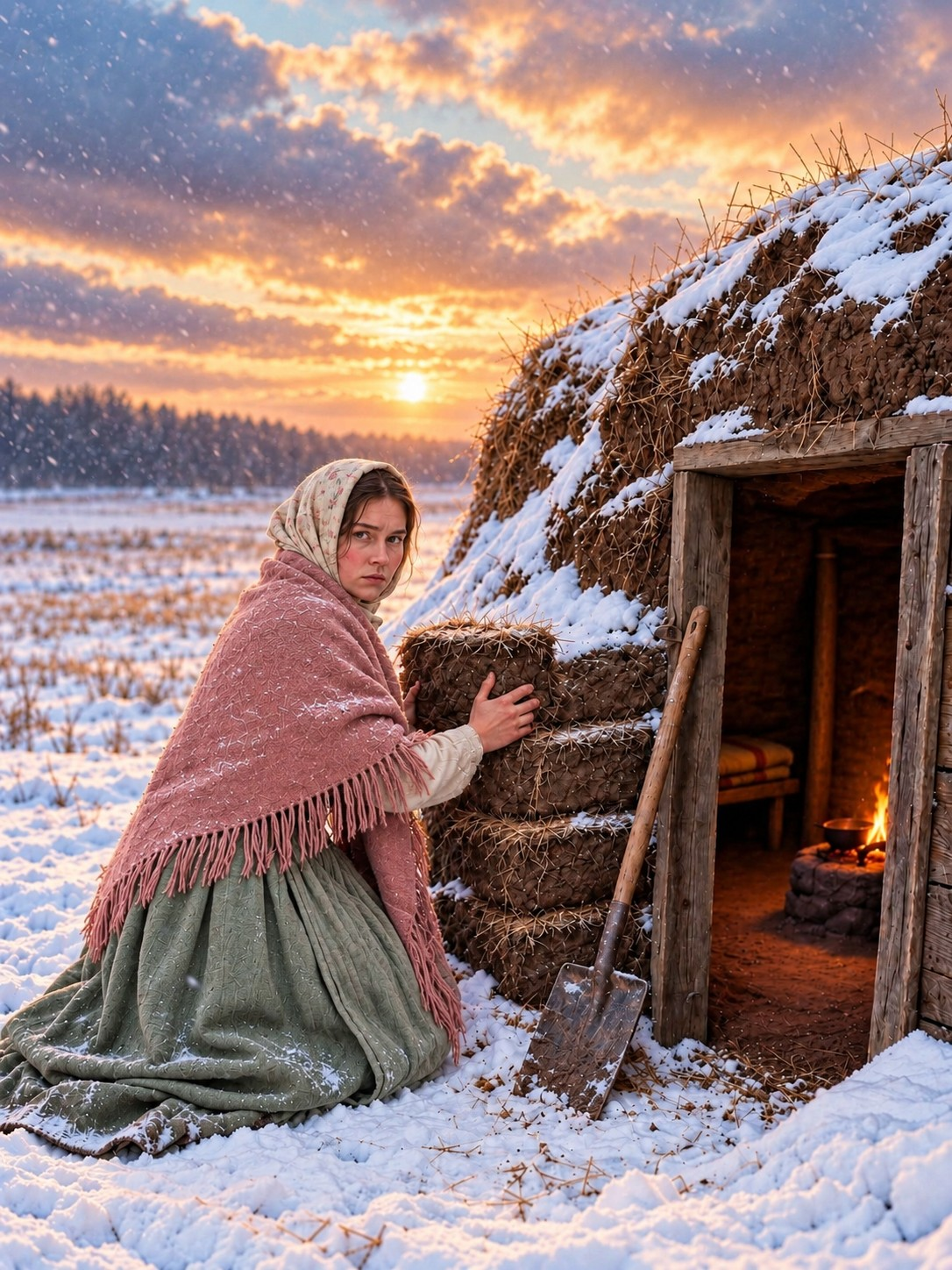
Seven miles southwest of the ranch sat forty acres of neglected pasture.
My grandfather had left the land to me when I turned eighteen.
The deed was recorded in my name.
My father had never considered it valuable.
There was no house, no barn, no electricity, and no running water.
The old windmill had collapsed years earlier.
The gravel track was barely usable after heavy rain.
Diane once called it a mosquito farm.
My father called it worthless.
I remembered those words now.
Worthless.
I repeated them under my breath.
Then I remembered something else.
My grandfather had shown me the property lines when he transferred the deed.
He had walked with me across the grass, pointing toward a shallow natural depression in the ground.
"This part stays sheltered," he had said. "Even when the wind comes hard from the north."
He had also shown me where the ground rose slightly, where the soil drained better, and where old prairie grass grew thick enough to protect the earth beneath it.
At the time, I hadn't understood why he was explaining those things.
I had thought he was simply telling me about land I would probably never use.
Now I wondered whether he had known something I didn't.
I glanced at the fuel gauge.
Almost empty.
I needed to reach town.
I needed food.
And I needed somewhere to spend the night.
I had forty acres.
But I didn't have a roof.
Not yet.
By the time I reached Red Willow, the temperature had fallen to seventeen degrees.
I pulled into the gravel lot behind Miller's Feed and Supply.
The store was nearly closed.
A single light remained on above the loading entrance.
Walter Miller was locking the back door when he saw my truck.
He was sixty-eight years old, a widower, and one of the few people who had known my mother since they were teenagers.
He had sold us fencing supplies, animal feed, and tools for as long as I could remember.
He had also attended the funeral that morning.
I lowered the window.
"Hi, Walter."
He looked at me.
Then he looked at the duffel bag on the passenger seat.
His expression changed.
"Hannah?"
"Hi."
He walked closer.
"What are you doing out here?"
I tried to answer casually.
"Just driving around."
He glanced at the sky.
Then at my clothes.
Then at the truck.
"Where's your father?"
I looked down at the steering wheel.
"At home."
Walter didn't speak immediately.
He had the kind of face that rarely revealed what he was thinking.
His gray eyebrows pulled together.
"Did something happen?"
I shook my head.
It was a small movement.
But he understood.
He opened the passenger door and looked at the bag.
"How long have you been driving?"
"Not long."
"Have you eaten?"
I wanted to say yes.
I wanted to tell him everything was fine.
Instead, my stomach answered for me.
Walter sighed.
"Turn that truck off."
"I still need to go somewhere."
"Where?"
I looked at him.
I couldn't say it.
I had nowhere to go.
Walter waited.
Then he reached into his coat pocket and pulled out a set of keys.
"Come inside," he said. "I'll make you something hot."
I hesitated.
"I don't want to bother you."
"Hannah, I've known you since you were in diapers. If you think you're bothering me, you've forgotten how many times your mother brought me food when I was sick."
My throat tightened.
I looked away.
He stepped back to let me out.
I grabbed my duffel bag.
Walter noticed the old brass key hanging from the chain around my neck.
It had belonged to my mother.
I had found it in the pocket of her winter coat that afternoon.
She had worn it for years, but I had never asked what it opened.
Walter stared at it for several seconds.
"Where did you get that?"
"My mom's coat."
He reached toward it, then stopped himself.
"May I see?"
I lifted the chain.
He turned the key carefully between his fingers.
On the back were three tiny numbers.
417.
Walter's face changed.
Not dramatically.
He simply stopped moving.
His eyes shifted from the key to my face.
"Where did your mother get this?"
"I don't know. She never told me."
He looked toward the road.
Then back at the key.
"Hannah, did your father see this?"
I shook my head.
"Why?"
Walter didn't answer.
He returned the key to me and opened the store's back entrance.
"Come inside."
Something in his voice had changed.
It was no longer the voice of an old man offering a hungry girl a warm meal.
It was the voice of someone who had suddenly realized that a problem he thought was buried might still be alive.
I followed him inside.
He locked the door behind us.
Then he walked to his office.
"Sit down," he said.
I lowered myself into the chair.
He switched on the small desk lamp and opened an old metal filing cabinet.
For several moments, he searched through folders.
Then he pulled out a yellowed envelope.
My mother's name was written across the front.
ELIZABETH WHITAKER.
I stared at it.
Walter placed the envelope on the desk.
"I was hoping I would never have to give you this."
My hands went cold.
"What is it?"
He looked at me.
"Something your mother asked me to keep safe."
Before I could ask another question, the telephone on his desk rang.
Walter glanced at the caller ID.
His expression hardened.
He answered.
"Hello?"
A man's voice came through the receiver.
Even from across the room, I recognized it.
My father.
Walter listened without speaking.
Then his eyes moved toward me.
"Yes," he said slowly. "She's here."
I felt my stomach tighten.
Walter looked down at the envelope.
My father's voice grew louder.
Then Walter said something that made my blood run cold.
"No, Robert. She isn't going back with you tonight."
He hung up.
For several seconds, neither of us moved.
Then Walter turned the envelope over.
There was another name written on the back.
My grandfather's.
And beneath it, in my mother's handwriting, were six words:
Only give this to Hannah when necessary.
Walter pushed the envelope toward me.
"Your mother knew this day might come."
I reached for it.
But before my fingers touched the paper, Walter placed his hand over mine.
"There's something you need to understand first."
He looked directly into my eyes.
"Your father didn't just throw you out of that farmhouse, Hannah."
He paused.
"He may have been trying to keep you away from something."
Then someone knocked three times on the store's locked back door.
Walter went completely still.
Because neither of us was expecting another visitor.
And the person outside had just called my name.
Lưu ý: Bộ truyện được thiết kế thành 12 chương, mỗi chương khoảng 2.000 từ tiếng Anh. Tổng độ dài tương đương khoảng 24.000 từ, vượt quá giới hạn của một lần trả lời. Tôi sẽ giữ nguyên cốt truyện, nhân vật, mốc sự kiện và các cliffhanger đã thiết lập; phần tiếp theo sẽ bắt đầu trực tiếp từ Chapter 2, không kể lại Chapter 1.






Comments 0