The knocking came again.
Three sharp blows against the locked back door.
"Hannah!"
I recognized the voice immediately.
My father.
Walter Miller stood behind his desk, holding the yellowed envelope in one hand. His expression had changed completely. The friendly old man who had offered me a warm meal was gone. In his place stood someone who seemed to be listening for something beyond the sound of the wind.
"Stay here," he whispered.
I stood up.
"That's my father."
"I know."
"Why is he here?"
Walter glanced at the envelope.
"That's what I'm trying to find out."
Another knock.
"Hannah, open this door!"
My father sounded angry.
Not worried.
Not frightened.
Angry.
I had spent nineteen years learning the difference.
Walter walked toward the back entrance but stopped several feet away.
"Robert, what are you doing here?"
"Move away from the door, Walter."
"I asked you a question."
"That's a family matter."
Walter gave a short, humorless laugh.
"Funny. I thought family mattered when Elizabeth was alive."
There was silence.
Then my father's voice dropped.
"Don't bring my wife into this."
I felt something tighten inside my chest.
My wife.
He had said it so easily.
As if my mother were still somewhere in the farmhouse, waiting for him to come home.
As if he hadn't buried her that morning.
As if he hadn't placed her wedding ring on another woman's finger before the flowers at her grave had even begun to wilt.
Walter looked back at me.
"Did you tell him you were coming here?"
"No."
"Did you tell anyone about the key?"
"No."
He nodded slowly.
Then he opened the small office door and gestured for me to step inside.
"Take your bag."
I grabbed the duffel.
"What about you?"
"I'll handle Robert."
I hesitated.
Walter lowered his voice.
"Listen to me, Hannah. Whatever happens tonight, don't hand that key to anyone. Not your father. Not Diane. Not even me unless you understand exactly why."
I touched the brass key hanging from my necklace.
"What's so important about it?"
Walter looked toward the envelope.
"Your mother wanted you to know when the time was right."
"Know what?"
He didn't answer.
Instead, he opened the office door.
I stepped into the narrow storage room behind it.
The room smelled of cardboard, motor oil, and old wooden shelving. Walter moved a stack of feed catalogs and pointed toward a small chair.
"Stay here."
He closed the door almost completely.
Through the narrow opening, I could see part of his office.
My father's voice came again.
"I know she's inside."
Walter didn't move.
"Then you should have thought about that before you put her out in the cold."
"She needs to come home."
I almost laughed.
Home.
The word sounded ridiculous coming from him.
"I thought you wanted her gone," Walter replied.
"That's none of your business."
"You're right. It isn't. But she's nineteen years old, she's just buried her mother, and it's below freezing outside. That makes it my business."
My father said something too quietly for me to understand.
Walter's face tightened.
Then the door opened.
I couldn't see who entered.
I heard footsteps.
A familiar female voice followed.
Diane.
"Robert, we need to leave."
My father ignored her.
"Hannah!"
I closed my eyes.
He was still calling me as if I were a child who had wandered into the wrong room.
I wanted to step out.
I wanted to ask him why he had packed my belongings before the funeral flowers had even been removed.
I wanted to ask whether he had ever loved my mother.
But I stayed where I was.
Walter moved closer to the doorway.
"She isn't coming with you."
My father lowered his voice.
"You don't understand what she's carrying."
The words made my eyes open.
What I was carrying?
My duffel bag contained two sweaters, three pairs of socks, a pair of jeans, a toothbrush, and a photograph of my mother.
I had no money beyond forty-three dollars.
I owned nothing worth stealing.
Except the land.
The thought came so suddenly that I nearly stood up.
The forty acres.
My grandfather's property.
I remembered the deed in my mother's desk. I remembered the day my grandfather had placed it in my hands.
My father had called it a useless inheritance.
But the deed had my name on it.
And I had never given him permission to sell it.
Walter spoke again.
"Robert, go home."
There was a long pause.
Then my father said something that made the room feel colder.
"If she opens that envelope, you'll regret getting involved."
The footsteps moved toward the entrance.
A moment later, the back door slammed.
I heard Diane's voice outside.
"Are you sure she has it?"
My father answered.
"Not yet."
The truck engine started.
Then the sound faded into the night.
Walter waited nearly a full minute before opening the storage-room door.
I stepped out.
"What did he mean?"
Walter rubbed his forehead.
"I was hoping you wouldn't hear that."
"Did he come here because of the key?"
Walter looked at me.
"I think he came because he believes your mother left you something."
I stared at the envelope.
"What did she leave me?"
He picked it up.
"That's what we're going to find out."
Walter made coffee.
I didn't drink it immediately.
My hands were still cold, even though the little heater in his office was running.
He placed a plate of scrambled eggs and toast in front of me.
"Eat first."
"I'm not hungry."
"That wasn't a question."
It was the first time anyone had spoken to me with the kind of authority that didn't feel cruel.
I picked up the fork.
The eggs were warm.
I took a bite.
Then another.
Only after several minutes did I realize how hungry I was.
Walter sat opposite me.
He opened the yellowed envelope carefully.
Inside was a folded letter, a small photograph, and a document with an official county stamp.
The handwriting on the letter was unmistakable.
My mother's.
I recognized the way she crossed her capital H's and pressed too hard on the final letters of certain words.
I reached for it.
Walter handed it to me.
"Honey," it began.
My throat tightened.
I read the first line again.
Then I continued.
If you're reading this, something has happened that I hoped you would never have to face.
I don't know when this letter will reach you. I only know that there may come a day when you need to understand why your grandfather insisted on putting the forty acres in your name.
I stopped.
I looked at Walter.
"She knew?"
He nodded.
"Your mother asked me to keep this envelope several months ago."
"Why didn't she give it to me herself?"
Walter looked down at the table.
"She wanted to. But she was worried about how your father would react."
I continued reading.
Your grandfather loved that piece of land. He never considered it worthless. He believed it had possibilities that other people couldn't see.
He also believed that land should belong to the person who would protect it, not simply the person who could make the most money from it.
I turned the page.
There was another paragraph.
Don't let anyone convince you that the property is no good simply because it doesn't look like much. The shallow draw, the old grass, and the northern rise are important. Your grandfather showed me things about that land that I never fully understood.
I looked up.
"What things?"
Walter pointed toward the photograph.
"Maybe that will help."
It showed my grandfather standing beside the old windmill.
He was younger than I remembered him, perhaps in his early fifties.
Beside him stood my mother.
She was smiling.
Both were holding a wooden measuring rod.
I turned the photograph over.
There was writing on the back.
North draw. Second marker. Never dig after heavy rain.
I frowned.
"What's the second marker?"
Walter leaned closer.
"Your grandfather used to mark the property with old fence posts."
"I remember the posts."
"Most of them are still there."
"Why would he write that?"
Walter didn't answer.
He picked up the stamped document.
It was a copy of the original deed.
My name appeared in the ownership section.
HANNAH ELIZABETH WHITAKER.
My grandfather had transferred the property to me shortly before his death.
I remembered the day.
I had been eighteen.
He had taken me to the county office, signed the papers, and handed me a folder.
My father had been furious when he found out.
He told my grandfather that I was too young to understand land ownership.
Grandfather had simply replied, "She's old enough to understand what's hers."
At the time, I thought it was just another argument between two stubborn men.
Now I wondered whether it had been something much more serious.
"Did my father know about this letter?" I asked.
Walter shook his head.
"I don't believe so."
"Then why is he looking for it?"
Walter folded his hands.
"Because your mother asked me to keep something else."
He reached into the bottom of the envelope.
There was a smaller piece of paper.
On it were three numbers.
417.
The same numbers scratched into my mother's key.
Walter placed the key beside the paper.
For several seconds, he stared at them.
Then he stood.
"Come with me."
"Where?"
"To the storage room."
He walked to a tall cabinet behind his desk and unlocked the bottom drawer.
Inside were several old metal boxes, each covered with dust.
He pulled out the smallest one.
It had a brass lock.
I looked at my necklace.
"Is that what the key opens?"
"I don't know."
He held out his hand.
I removed the chain and passed him the key.
It fitted.
The lock clicked.
Walter lifted the lid.
Inside was a folded county map, an old envelope, and a small notebook.
The notebook belonged to my grandfather.
I recognized his handwriting immediately.
Walter opened the map.
The forty acres were marked in faded blue ink.
A red circle had been drawn around the shallow depression near the northern boundary.
Beside it were two words.
SHELTER SITE.
I leaned forward.
"What's that supposed to mean?"
Walter traced the red circle.
"Your grandfather spent a lot of time studying this property."
"Why?"
"Because the prairie can be dangerous. He believed there were places on that land where a person could build something protected from the worst of the winter winds."
I looked at the photograph again.
My mother had been standing beside him with a measuring rod.
"An underground shelter?"
Walter hesitated.
"Possibly."
I remembered my grandfather showing me the shallow draw.
He had explained how the land rose on one side and dipped on the other.
He had pointed out the thick prairie grass.
At the time, I thought he was teaching me about drainage.
Maybe he had been teaching me something else.
"Did he build one?"
Walter shook his head.
"Not that I know of."
"Then why mark it?"
"Your grandfather was a careful man. He liked planning for things before he needed them."
I looked at the map.
The red circle was close to the old gravel track.
Not far from the collapsed windmill.
It was a place I could reach with the pickup.
But I didn't understand how any of it explained my father's behavior.
Walter seemed to read my expression.
"There's something else."
He removed the notebook from the box.
Several pages contained measurements and sketches.
There were drawings of a low wooden entrance, a sloping roof, and a series of protective layers.
The handwriting became increasingly difficult to read toward the end.
Then I noticed something written in the margin.
Robert must never control the property.
I felt my stomach drop.
"Why would Grandfather write that?"
Walter closed the notebook.
"I don't know."
"Was my father trying to take the land?"
Walter didn't answer immediately.
Then he said, "A few months ago, Robert came into my store asking about the value of undeveloped pasture in this area."
I looked at him.
"Why?"
"He said he was considering selling some property."
"But the forty acres aren't his."
"Exactly."
I stared at the deed.
My father had spent years calling the land worthless.
He had never asked about it again after my grandfather transferred it to me.
Until now.
"Did you tell him anything?"
"I told him I couldn't discuss property I didn't own."
Walter pushed the notebook toward me.
"Your grandfather knew something. Your mother knew something. And now your father seems very interested in keeping you away from it."
I felt the room grow smaller.
Outside, the wind rattled the metal siding.
I looked at the clock.
It was nearly eight.
I had no place to sleep.
I had no proper food supplies.
And the weather warning on the television had become more serious.
Walter noticed me looking toward the window.
"How much time do you think we have before the storm reaches us?" I asked.
He glanced at the forecast.
"Not much."
"Can I get to the property tonight?"
"Absolutely not."
"I have to."
"Hannah, you can barely keep warm sitting in this office. You're not driving across an unlit gravel track in a truck with a failing heater."
"But I can't stay here."
Walter shook his head.
"You can stay in the spare room above the store."
I looked down.
"I don't want charity."
He sighed.
"Then don't call it charity. Call it repayment."
"For what?"
"Your mother once spent three nights looking after my wife when she was dying. She never asked for anything. Let me do one small thing for her daughter."
I couldn't answer.
He placed another piece of toast on my plate.
"Tomorrow, we'll go to your property together. We'll see what's there. We'll figure out what you need."
I nodded.
For the first time that evening, I felt as though I might actually sleep.
The spare room above Miller's Feed and Supply was small.
It had a narrow bed, a wooden dresser, and a window overlooking the gravel lot.
Walter brought up two blankets and an old electric heater.
He also gave me a grocery bag containing canned soup, crackers, bottled water, and a flashlight.
"Keep these close."
"Thank you."
He stood at the doorway.
"Hannah?"
"Yes?"
"Don't tell anyone about the box."
I nodded.
"Especially your father?"
"Especially Robert."
He left.
I locked the door.
Then I sat on the edge of the bed and took out the photograph of my mother.
I held it against my chest.
For a long time, I didn't move.
I wanted to hear her voice.
I wanted her to tell me that everything would be all right.
I wanted to go downstairs and find her sitting in Walter's office, laughing about something insignificant.
But there was no way to bring her back.
I wiped my face with the sleeve of my coat.
Then I looked at the notebook.
I had brought it upstairs without telling Walter.
I opened it again.
Most of the pages contained measurements, rough drawings, and notes about the property.
My grandfather had written about the direction of winter winds, the natural slope of the land, and the way snow accumulated around the northern rise.
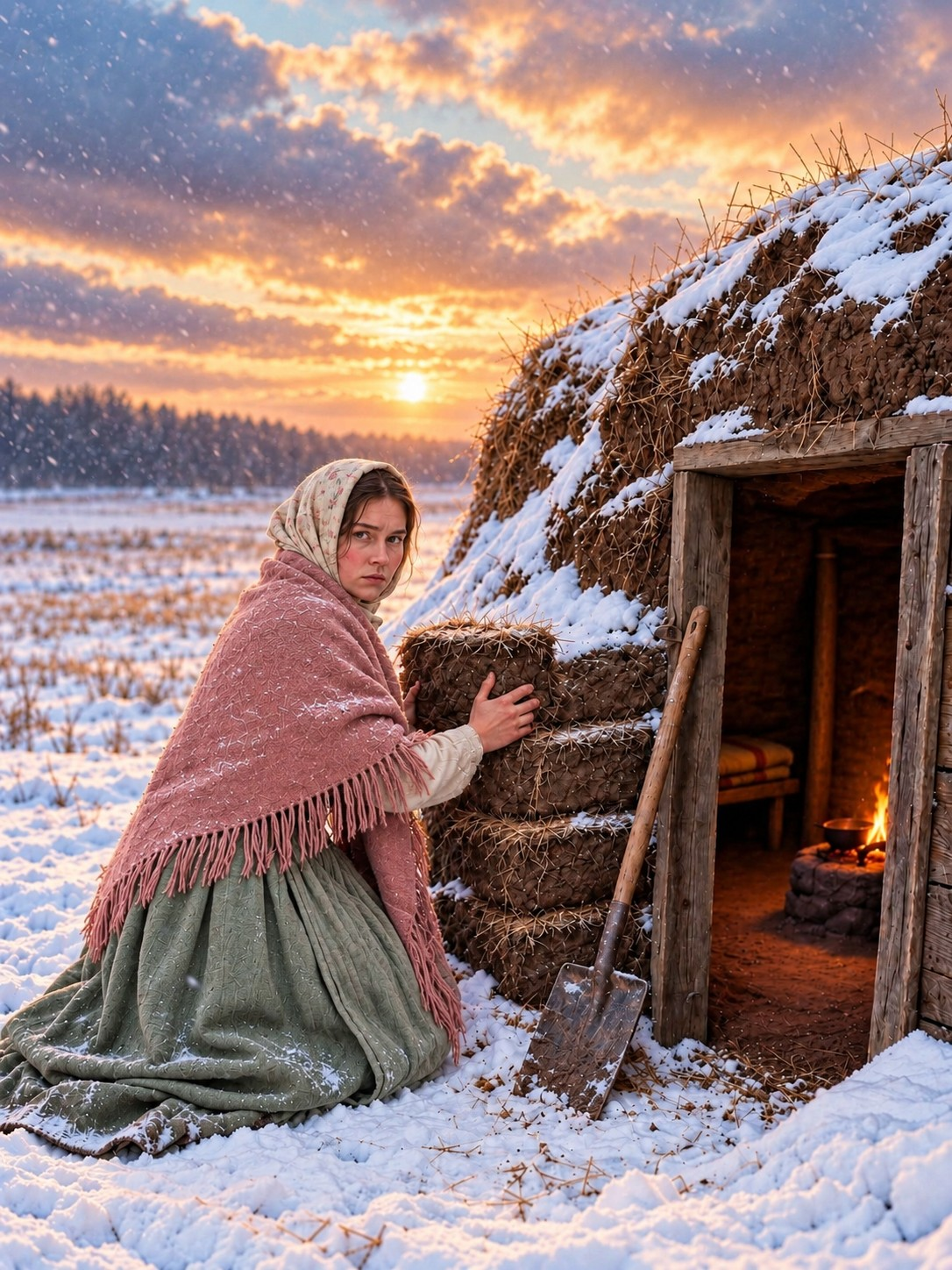
One page had a drawing of a rectangular structure.
It was partly underground.
The roof appeared to be made from timber, branches, earth, and tightly packed grass.
Beside it was a list.
Hay bales.
Wooden supports.
Canvas.
Dry straw.
A shovel.
Water containers.
I read the list twice.
Then I turned another page.
A sentence had been underlined.
The ground will protect what the wind cannot reach.
I stared at it.
An underground shelter.
A place protected from the prairie wind.
A place where someone could survive if the farmhouse doors were locked against them.
My grandfather had planned for a possibility I had never considered.
I closed the notebook.
Then I heard a vehicle enter the gravel lot below.
I moved toward the window.
A dark pickup had parked beside my mother's old Ford.
The driver stepped out.
Even from above, I recognized the shape of his shoulders.
My father.
He walked toward the store's rear entrance.
But he wasn't alone.
A second person emerged from the passenger side.
Diane.
She looked up at the building.
Then she pointed toward my window.
I stepped back immediately.
The telephone on the dresser began ringing.
I stared at it.
Walter had told me the room was private.
I hadn't given anyone the number.
The ringing continued.
I finally picked up.
"Hello?"
There was a pause.
Then my father's voice came through.
"Hannah, listen carefully. I know Walter has given you something that belonged to your mother."
My fingers tightened around the receiver.
"How do you know?"
He ignored the question.
"Bring it downstairs."
"I'm not coming down."
"Hannah, this isn't a game."
"I know."
His voice became colder.
"That property isn't what you think it is."
I looked at my grandfather's notebook.
"What does that mean?"
He took a breath.
Then he said something I never expected.
"Your grandfather didn't leave you those forty acres because he wanted you to own land."
I stopped breathing.
"Then why did he leave them to me?"
For several seconds, he said nothing.
Then I heard Diane whisper something in the background.
My father covered the receiver, but not before I caught two words.
"Tell her."
He returned to the phone.
"Because there's something buried out there, Hannah."
My hand went numb.
"What?"
He lowered his voice.
"Something your mother should never have shown you."
The line went silent.
Then, from downstairs, I heard Walter shout my name.
I rushed to the window.
My father was standing beside his truck.
Walter had stepped outside to confront him.
But Diane wasn't looking at Walter.
She was looking directly at the upstairs window.
And in her hand was a photograph of my grandfather standing beside the old windmill.
She raised it toward the glass.
Then she turned it over.
Even from the second floor, I could see the red circle marked on its back.
The exact same circle as the one on my grandfather's map.
And beneath it was a handwritten message.
417 IS NOT THE ONLY KEY.
I stepped away from the window.
Someone had just knocked on my bedroom door.
Three times.
Then a familiar female voice whispered from the other side.
"Hannah, it's Diane. Your mother left something else here, and I think you need to see it before your father finds out."
I stared at the locked door.
Because Diane was supposed to be downstairs.
And the voice outside my room had just spoken again.
"Open the door, sweetheart."
It sounded exactly like my mother.






Comments 0