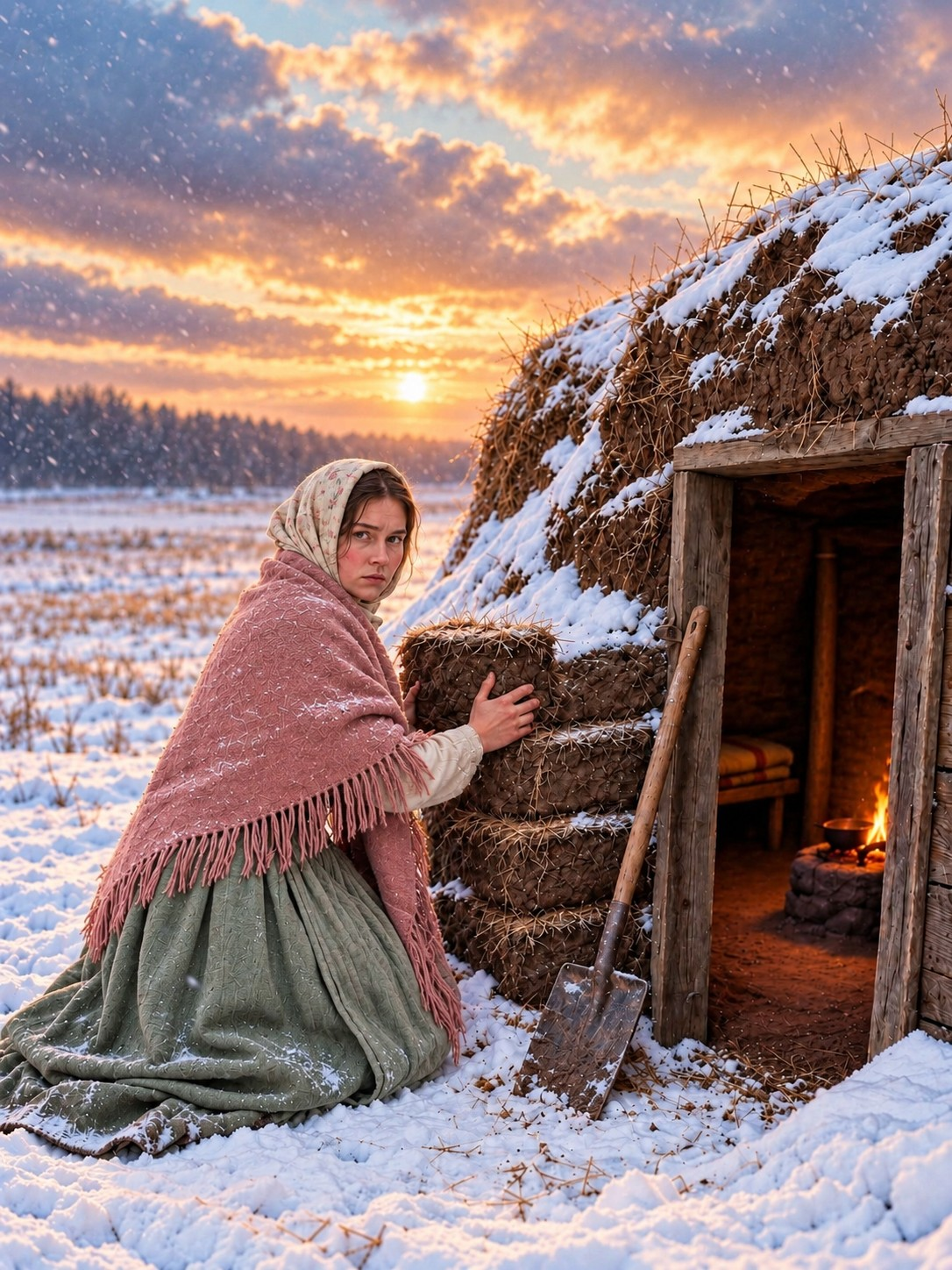
"THE SECOND CABINET MUST NEVER BE OPENED!"
My father's voice echoed across the frozen prairie.
For several seconds, nobody moved.
Walter stood beside the underground entrance, holding the legal document Diane had brought. Maggie was behind him, clutching the folder of papers recovered from the shelter.
I stood between them and my father.
The small brass key was still in my hand.
I looked at Robert Whitaker.
For nineteen years, I had believed that his anger came from disappointment. I thought he had wanted a son, or a more obedient daughter, or simply a family that never questioned him.
But the expression on his face was something different.
He wasn't angry because I had disobeyed him.
He was frightened because I had discovered something.
"Why?" I asked.
My father stared at the key.
"Give it to me."
"No."
"Hannah, I'm not asking again."
"You've already taken my home. You've taken my mother's ring. You've spent the last two days trying to control what I do with land that belongs to me."
I stepped closer.
"You're not taking this."
His face reddened.
"You have no idea what your grandfather put in there."
"Then tell me."
He opened his mouth.
Nothing came out.
Diane looked toward the road.
Walter noticed.
"Robert, you need to leave."
My father ignored him.
He pointed toward the underground entrance.
"That place isn't safe. The structure is old. The supports could collapse. You could be buried alive down there."
Walter folded the document.
"That's a reasonable concern. We inspected the supports, and we're going to have them professionally assessed before anyone uses the shelter."
My father gave him a bitter look.
"You're pretending to care about her safety?"
"I care about whether she survives the winter."
"Then send her home."
Walter shook his head.
"She doesn't have a home at your farmhouse anymore."
The silence that followed was uncomfortable.
My father looked at me.
For a moment, I thought he might say something about my mother.
He didn't.
Instead, he turned toward the truck.
"Come on, Diane."
She remained beside the open passenger door.
"Robert, what about the documents?"
"Leave them."
"But—"
"I said leave them."
He climbed into the driver's seat.
Diane hesitated.
Then she placed the folder on the hood of the truck.
Before getting inside, she looked at me.
"You don't understand what your mother was involved in."
I held her gaze.
"Then maybe you should tell me."
Diane's expression hardened.
"Some truths don't make people stronger, Hannah."
She got into the truck.
The engine started.
My father drove away without looking back.
I watched the vehicle disappear behind the low rise.
Then I turned toward Walter.
"What was in the second cabinet?"
He looked down at the small brass key.
"Something important enough that your father is willing to risk a winter storm to stop you from opening it."
"That doesn't answer my question."
"No," he said. "It doesn't."
Maggie picked up the abandoned folder.
"We should get inside the store before the weather gets worse."
Walter nodded.
He looked at the sky.
The first snowflakes had begun falling.
And they were much larger than the ones we had seen the night before.
We returned to Miller's Feed and Supply shortly before three.
Walter placed the documents in his office safe.
Maggie made coffee.
I sat at the small table with my grandfather's notebook open in front of me.
I couldn't stop thinking about the second cabinet.
Whatever was inside it had frightened my father more than the prospect of me being left alone in the winter.
I wanted to open it immediately.
But Walter refused.
"We need to secure the shelter first."
"What if the documents are important?"
"They'll still be there tomorrow."
"What if my father comes back?"
"Then we'll deal with him."
I shook my head.
"You don't know what he's capable of."
Walter stopped pouring coffee.
For several seconds, he studied me.
Then he sat opposite me.
"You're right. I don't know everything about Robert."
He looked toward Maggie.
"But I know your mother. And I know your grandfather. Neither of them would have spent years preparing that shelter without a good reason."
Maggie placed a cup in front of me.
"Your grandfather believed the prairie could be survived if a person respected it."
I looked at her.
"Did he ever tell you what was inside the cabinet?"
"No."
"Did my mother?"
She shook her head.
"She told me that if you ever needed to use the shelter, I should help you find it. She never explained the second cabinet."
I leaned back.
"Everyone knew something except me."
Maggie looked uncomfortable.
"Your mother wanted you to grow up without carrying her worries."
I stared at the coffee.
"She could have trusted me."
"She did trust you."
"Then why didn't she tell me?"
Maggie reached across the table.
"Because she was trying to give you a childhood, Hannah. Not because she thought you were weak."
I looked away.
I knew she was probably right.
But knowing that didn't make the silence easier to accept.
Walter stood.
"All right. We have work to do."
He brought out the list of supplies.
"We need enough food, water, blankets, and basic equipment for twelve days. We also need to inspect the shelter's ventilation and drainage. No shortcuts."
I looked at the list.
The number twelve seemed impossibly large.
Twelve days alone beneath the prairie.
Twelve days without knowing whether the roads would be open.
Twelve days without electricity or running water.
And possibly twelve days without seeing another human being.
"Can we really prepare in time?" I asked.
Walter checked his watch.
"If we start now."
The next several hours passed quickly.
Walter called a local building inspector he trusted and arranged for an urgent inspection of the underground structure. The man agreed to come the following morning, weather permitting.
Maggie helped me calculate how much food we would need.
We counted cans, measured rice and dried beans, and separated supplies into waterproof containers.
Walter showed me how to inspect the batteries in the old lanterns.
He also found a compact first-aid kit in the storage room.
"Your mother insisted we keep one of these behind the counter," he said.
I smiled faintly.
"She was always prepared."
"More prepared than most people."
He handed me the kit.
Inside were bandages, antiseptic wipes, gauze, medical tape, and a small thermometer.
I checked each item.
Some supplies had expired.
Walter noticed.
"We'll replace those."
I wrote them down.
Then we moved to the back storage area.
There were several bundles of heavy canvas, rope, wooden stakes, and insulation.
Walter also found an old manual about constructing temporary winter shelters.
I opened it.
The drawings reminded me of my grandfather's notebook.
"Can we use these?"
"Some of them. But we won't improvise anything that affects the structural supports."
I nodded.
I didn't want to build something that would collapse on top of me.
The shelter needed to be safe before it could become a home.
By five o'clock, the temperature had dropped again.
The snow was falling steadily.
Walter looked outside.
"We need to move the truck closer to the loading entrance."
I followed him.
The old Ford was parked beside the building.
He checked the tires, examined the battery, and listened to the engine.
"She needs attention."
"Can you fix it?"
"Some of it."
He opened the hood.
I held the flashlight.
For nearly an hour, he checked connections and tightened loose fittings.
Finally, he closed the hood.
"That should help. But I wouldn't take it onto an icy highway unless absolutely necessary."
I nodded.
"Thank you."
He wiped his hands.
"Your mother would have been happy to see you taking care of that old truck."
I looked at the driver's seat.
There was a small scratch on the steering wheel where my mother had once dropped a screwdriver.
I remembered her laughing about it.
For a moment, the memory was so clear that I almost expected to hear her calling me from inside the store.
Then the wind struck the building.
The moment passed.
That evening, Walter showed me the property map again.
He spread it across his office desk.
The northern draw was marked in red.
The first entrance was marked with a small square.
The second chamber appeared as a rectangle behind it.
But the western passage remained unexplained.
I traced the line with my finger.
"Where does this go?"
Walter leaned closer.
"Possibly toward the old windmill."
"Could there be another entrance?"
"Maybe."
Maggie entered carrying three mugs of coffee.
She looked at the map.
Then she pointed toward the western boundary.
"Elizabeth once told me there was a natural spring somewhere near that side of the property."
Walter frowned.
"I thought that spring dried up years ago."
"She said your grandfather had found a way to collect water there."
I sat up.
"Would it still work?"
"Hard to say," Walter replied.
He examined the drainage marks.
"If the water source is still accessible, it could be useful. But we need to test it. We can't assume it's safe to drink."
I looked at the map.
A reliable water source would make a tremendous difference.
The shelter had shelves.
It had a protected entrance.
It had space for blankets and supplies.
But without enough water, twelve days would become much more difficult.
"Could we get to the spring before the storm?"
Walter looked toward the window.
"Not tonight."
"Tomorrow?"
"If the inspector finishes early and the road remains passable."
I nodded.
I was beginning to understand how much work lay ahead.
The shelter was not a finished home.
It was a project.
A difficult, dangerous, unfinished project.
But it was mine.
And for the first time, I had something I could work toward without asking my father for permission.
At eight that evening, Maggie offered to drive me to the farmhouse.
I looked at her.
"Why?"
"Your mother's personal things."
I shook my head.
"I don't want to go back there."
"I understand."
"I don't want to see Diane wearing her clothes or touching her things."
Maggie nodded.
"Then we won't go inside."
She opened her purse and removed a small folded note.
"Elizabeth asked me to collect something from the old mailbox if I ever had to help you."
I unfolded it.
There was an address written across the top.
It was the farmhouse.
Below it were three words.
MAILBOX. BOTTOM PANEL.
I looked at Maggie.
"What did she put there?"
"I don't know."
"Then why didn't you collect it before?"
"Because your mother told me to wait until you needed it."
I considered the note.
My father had already taken almost everything from me.
But perhaps there were still things he didn't know about.
I put the note into my coat pocket.
"We can go."
Walter immediately objected.
"Not in this weather."
"It isn't far."
"That's not the point."
Maggie agreed with him.
"We'll wait until morning. If the road is safe, I'll take you."
I didn't argue.
I was learning that determination and recklessness were not the same thing.
The next morning, I woke before sunrise.
The snow had stopped briefly.
The sky was dark gray, but the wind had eased.
Walter was already downstairs.
He had arranged for the building inspector to meet us at the property at nine.
Maggie had packed breakfast sandwiches.
I ate mine standing beside the counter.
"Did you sleep?" Walter asked.
"Some."
"That's better than nothing."
He handed me a pair of thick work gloves.
"These are yours."
I looked at them.
They were brown leather, with wool lining.
"Thank you."
"Your mother used to complain that you never wore gloves."
I laughed softly.
"She was right."
Walter smiled.
Then he became serious.
"Today we need to establish whether the shelter is safe enough to repair. If the inspector says the supports are compromised, we stop."
I nodded.
"Understood."
"And no entering the second chamber until we know the structure is stable."
I looked at him.
"Even if the cabinet contains something important?"
"Especially then."
I sighed.
"All right."
Maggie handed me a thermos.
It was the one my mother had given Walter.
"Take this. You'll need something warm."
I held it carefully.
For a moment, I felt as though my mother had found another way to look after me.
The building inspector arrived at nine fifteen.
His name was Daniel Price.
He was in his early fifties, broad-shouldered, with a gray beard and a weathered face.
He carried a tool bag and a clipboard.
Walter introduced us.
Daniel shook my hand.
"So you're Hannah."
"Yes."
"Your grandfather was a clever man."
"You knew him?"
"I inspected some of his work years ago."
He looked toward the northern draw.
"He always liked doing things his own way."
We walked to the shelter.
Daniel examined the entrance, the wooden supports, and the drainage channel.
He spent almost forty minutes checking the structure.
Then he asked us to wait outside while he inspected the interior.
Walter went with him.
I remained near the entrance with Maggie.
The wind began picking up again.
I looked toward the western side of the property.
Something dark was visible near the old windmill.
At first, I thought it was a fence post.
Then I saw it move.
I narrowed my eyes.
A person.
Someone was standing near the windmill.
I turned toward Maggie.
"Do you see that?"
She followed my gaze.
Her face changed.
"Stay here."
She walked toward the truck.
I watched the figure.
It seemed to be examining something on the ground.
Then it disappeared behind the windmill.
I started walking in that direction.
Maggie turned sharply.
"Hannah!"
I stopped.
"Someone's out there."
"I know."
"Who is it?"
She didn't answer.
Instead, she took out her phone.
She called Walter.
He emerged from the shelter a moment later.
"What's wrong?"
I pointed toward the windmill.
"There was someone there."
Walter looked across the field.
The figure was gone.
Daniel climbed out behind him.
"What's happening?"
"Someone may be on the property," Walter said.
Daniel looked toward the road.
"Could be a neighbor."
"Not likely," Walter replied.
We stood in silence.
Then Walter noticed something.
A fresh set of tire tracks crossed the frozen grass.
They led from the western boundary toward the windmill.
The tracks were too narrow to belong to my mother's Ford.
Walter crouched beside them.
"Someone came through here recently."
I looked toward the windmill.
"Could it have been my father?"
"Maybe."
Maggie examined the tracks.
"These are different."
Walter looked up.
"Different how?"
"Robert's truck has a wider rear tire."
I felt a chill.
"Then who was here?"
Nobody answered.
Daniel finished his inspection shortly before eleven.
He returned to the entrance with his clipboard.
"The main chamber is structurally sound enough for careful restoration," he said. "Some supports need replacing, and the upper entrance needs better protection from water."
I felt my chest loosen.
"What about the second chamber?"
"That area needs additional inspection. I wouldn't recommend storing heavy materials there yet."
Walter nodded.
"Can we work on the main room?"
"Yes, provided you replace the damaged timber and don't block the ventilation."
Daniel pointed toward the drainage channel.
"You'll also need to keep this clear. If snowmelt or rainwater collects here, it could create serious problems."
I wrote everything down.
Then he examined the entrance from outside.
"Your grandfather understood the terrain. The shelter is positioned well. But don't mistake a good location for a finished structure."
"I won't."
He gave me a small smile.
"Good. You're going to need patience."
After Daniel left, Walter helped me unload the first supplies.
We carried the blankets, food containers, and tools inside.
I arranged the items on the shelves.
The canned food went on the lower level.
Dry supplies went into sealed containers.
The first-aid kit remained near the entrance.
Walter checked the ventilation again.
Then he looked at the sky.
"We have less time than I hoped."
I stepped outside.
The clouds were moving quickly now.
The wind had changed direction.
Snow began drifting across the northern rise.
Maggie looked toward the road.
"We should leave soon."
I nodded.
But before we returned to the truck, I walked toward the windmill.
I wanted to see the tire tracks.
The ground was disturbed near the base.
There were fresh marks around the old metal supports.
Then I noticed a small piece of paper caught beneath a broken wooden board.
I pulled it free.
It was damp.
The writing was almost illegible.
But I could make out one sentence.
THE WATER IS STILL RUNNING.
I turned the paper over.
There was another line.
DON'T LET ROBERT FIND THE WESTERN ENTRANCE.
I looked toward Walter.
He was standing beside the shelter.
I held up the paper.
He walked toward me.
"Where did you find that?"
"Here."
He read it.
His expression became serious.
Maggie came closer.
"What's wrong?"
Walter handed her the paper.
She read the message.
Then she looked toward the western boundary.
"Your mother wrote that."
I stared at her.
"How do you know?"
"Because I recognize her handwriting."
I looked at the tire tracks again.
Someone had been searching for the western entrance.
And now I understood why my father had been so desperate to keep me away from the shelter.
We returned to Miller's Feed and Supply shortly after noon.
The weather had deteriorated rapidly.
Snow covered the gravel road in patches.
Walter parked behind the building.
He helped me carry the remaining supplies inside.
Then he turned on the television.
The local weather reporter stood in front of a map of the region.
A wide band of winter weather was moving toward western South Dakota.
The forecast had become much worse.
Heavy snowfall was expected to begin overnight.
Strong winds could create dangerous whiteout conditions.
Road closures were likely.
The reporter warned residents to avoid unnecessary travel and prepare for extended isolation.
Walter lowered the volume.
"Twelve days," I whispered.
"Possibly."
I looked toward the shelves.
The supplies were not enough yet.
We needed more water.
More insulation.
More fuel.
And a reliable way to keep the shelter warm without creating a ventilation hazard.
I opened my notebook.
I began writing a list.
Walter stood beside me.
"You're thinking like your mother."
I looked up.
"What do you mean?"
"She never wasted time worrying about what she couldn't control. She made a list and started working."
I smiled faintly.
"She did that."
Walter pointed toward the map.
"Tomorrow morning, if the road allows it, we'll check the western water route. After that, we finish securing the entrance."
I nodded.
Then I looked at the old brass key.
I still hadn't opened the second cabinet.
I wanted to know what my grandfather had hidden.
I wanted to understand why my mother had been afraid.
And I wanted to know what my father believed was so dangerous that he would rather leave me homeless than let me discover it.
I placed the key inside my coat.
For now, the shelter came first.
At six that evening, the first emergency warning arrived on Walter's phone.
A message from the county emergency management office advised residents to prepare for possible isolation.
Walter read it twice.
Then he looked at me.
"We may have to move everything tonight."
I glanced toward the truck.
"What about the road tomorrow?"
"That's the problem. We can't count on it."
Maggie began packing the remaining supplies.
Walter checked the batteries.
I filled several containers with drinking water.
We worked without speaking much.
The store was warm.
The lights were bright.
The smell of coffee and cardboard felt strangely comforting.
But outside, the prairie was disappearing.
Snow covered the parked vehicles.
The wind rattled the metal signs.
By seven, the temperature had dropped again.
Walter locked the front door.
"That's enough for tonight."
I looked at the supplies.
"We still haven't found the water source."
"We'll work on it tomorrow if conditions allow."
"And the second cabinet?"
He gave me a tired look.
"Still there."
I nodded.
He was right.
The cabinet wasn't going anywhere.
I carried my duffel bag upstairs.
Before entering the spare room, I looked back toward the office.
Walter was standing beside the map.
Maggie was speaking quietly to him.
Neither noticed me watching.
Then I heard Maggie say something.
"Elizabeth told me there was one more person who knew about the western entrance."
Walter shook his head.
"Who?"
Maggie hesitated.
Then she answered.
"Someone who was supposed to be dead."
I stopped.
Walter looked toward the staircase.
Our eyes met.
For several seconds, he didn't speak.
Then he closed the office door.
I stood in the hallway, holding my mother's old coat.
Outside, the blizzard began.
And downstairs, Walter had just discovered that someone from my grandfather's past might still be alive.
At 8:43 p.m., the lights went out.
The entire store plunged into darkness.
I heard Walter moving downstairs.
Then his voice came through the stairwell.
"Stay where you are!"
I reached for my flashlight.
The beam flickered once before turning on.
I opened the bedroom door.
Walter stood at the bottom of the stairs.
Maggie was beside him.
Both were looking toward the front entrance.
A loud metallic crash came from outside.
Then another.
Someone was trying to force the door.
Walter grabbed a heavy flashlight.
"Who's there?"
No answer.
The handle moved.
Then a voice came through the storm.
"Mr. Miller!"
Walter froze.
The voice continued.
"Open the door! It's about Elizabeth!"
Maggie covered her mouth.
I looked at her.
"Who is it?"
She didn't answer.
The person outside struck the door again.
"Please! I have something Hannah needs to see!"
Walter slowly approached the entrance.
He looked through the narrow window.
Then he stepped backward.
His face had turned completely white.
I moved closer.
"Who is it?"
Walter turned toward me.
His lips trembled.
Then he whispered the one name nobody had expected to hear again.
"Your grandfather."
And the man outside was holding his original death certificate.






Comments 0