"Because Hannah still doesn't know what was written on the original birth record."
Daniel's voice came through the phone.
My mother stood in the middle of the farmhouse kitchen, holding the device against her ear.
My grandfather was beside her.
The sheriff had one hand resting on his belt.
I stood near the dining table, trying to understand why a man who had spent nineteen years hiding from the truth still believed he could control my life.
My mother finally answered.
"Then tell her."
Daniel laughed.
"You don't understand, Elizabeth. There are things she shouldn't know."
I stepped forward.
"You're wrong."
The laughter stopped.
I took the phone from my mother's hand.
"This is Hannah. If you have something to say about my birth, say it to me."
There was a long silence.
Then Daniel spoke.
"You've been told that Robert is your father."
"Yes."
"Have you seen the original birth record?"
"I've seen the laboratory report."
"That's not the same thing."
I looked at Michael, the sheriff.
He gave me a small nod.
I continued.
"What are you trying to tell me?"
Daniel's voice became colder.
"Your mother changed your birth record before you were born. She wanted Robert to be your legal father. She believed it would protect you."
I looked at my mother.
She didn't deny it.
Daniel continued.
"But the original document contains another name."
"Whose?"
"Mine."
I closed my eyes briefly.
"So you're claiming you're my biological father?"
"No. I'm telling you that I was listed as your father on the original hospital paperwork."
I frowned.
"Those aren't the same thing."
For the first time, Daniel said nothing.
I continued.
"My mother told me Robert was my biological father. The laboratory report confirmed it. So what exactly are you trying to prove?"
His voice sharpened.
"That I was supposed to have a place in your life."
I almost laughed.
"You had nineteen years."
"I was prevented from seeing you."
"By whom?"
"Your mother."
I looked at Elizabeth.
She stepped closer.
"Daniel, stop."
He ignored her.
"She made me believe I had no right to my own daughter."
My mother took the phone.
"You had no right to threaten her. You had no right to manipulate Robert. And you had no right to come into my home and frighten a child."
Daniel's voice rose.
"I never wanted to hurt Hannah."
"But you did."
Silence.
Then my mother said something I would remember for the rest of my life.
"You didn't lose your place in her life because of a piece of paper. You lost it because of the choices you made."
She ended the call.
For several seconds, nobody moved.
Then Deputy Collins took the phone.
"That conversation was recorded."
My mother looked at him.
"Good."
I looked at the laboratory report again.
Robert was my biological father.
Daniel had been listed on an earlier document because of the circumstances surrounding my birth, but he had never been my biological parent.
The mystery had finally become clear.
And for the first time, Daniel's words no longer frightened me.
The sheriff arranged for officers to search the maintenance shed.
We accompanied them.
The snow had begun to settle, leaving the prairie almost completely silent.
The shed stood near the western boundary of my forty acres.
Its wooden walls were weathered.
One corner of the roof had partially collapsed.
Walter held the flashlight while Michael examined the lock.
It was old.
But it hadn't been forced.
My mother stood beside me.
"Your grandfather built this shed," she explained.
"Why did you hide the recording here?"
"Because nobody thought it was important."
She gave a small, sad smile.
"Sometimes the safest place is the one everyone ignores."
Michael opened the door.
Inside were several old tools, a rusted toolbox, and a stack of wooden boards.
He moved the boards aside.
Behind them was a small metal compartment.
My mother reached into her coat.
She removed a key.
I recognized it.
It was the same style as the one my grandfather had used for the underground cabinet.
She inserted it.
The lock turned.
Inside was a waterproof case.
Walter opened it carefully.
There were three items.
A small digital recorder.
A sealed envelope.
And a document bearing my mother's signature.
My grandfather took the document.
His eyes widened.
"Elizabeth."
She looked at him.
"What?"
He handed it to her.
She read the first paragraph.
Then she covered her mouth.
It was a statement she had written before the night of the farmhouse incident.
It explained the entire arrangement between Robert and Daniel.
The payments.
The false development proposal.
The unauthorized transfer of water rights.
And the pressure placed on my mother to sign documents she had never approved.
But the most important part was at the bottom.
The forty acres had been transferred to me legally when I turned eighteen.
The transfer was unconditional.
No creditor.
No family member.
No business partner.
Nobody could claim ownership simply because they had once helped maintain the land.
I looked at my grandfather.
"So the property really is mine?"
He smiled.
"It always was."
I looked toward the prairie.
Forty acres.
My forty acres.
The place my father had called worthless.
The place my stepmother had mocked.
The place my mother had spent years preparing for me.
I felt tears forming.
But this time they weren't tears of fear.
They were relief.
The recorder contained the original conversation from the night my mother was injured.
The sheriff listened to it with us.
There were no dramatic confessions.
No exaggerated speeches.
Just the voices of people who believed they could get away with something because they had kept it hidden for too long.
Robert admitted that he had arranged the meeting.
Daniel demanded the documents.
My mother refused.
Michael's voice appeared later, confirming that he had arrived and attempted to stop the confrontation.
Then came the sound of a struggle.
The recording continued.
My mother spoke clearly.
"If anything happens to me, the property belongs to Hannah. The documents are in the western chamber. The original agreement is invalid. Robert knows that."
Then Robert answered.
"Elizabeth, please. Don't make this worse."
My mother replied:
"You already made it worse when you decided our daughter was something you could trade."
The recording ended shortly afterward.
The sheriff looked at Robert.
"You'll need to explain your involvement."
My father nodded.
"I understand."
For once, he didn't argue.
He didn't blame the weather.
He didn't blame my mother.
He didn't blame me.
He simply sat there.
The investigation took several weeks.
The original documents were examined.
The financial records were verified.
The recording was authenticated.
Daniel was located in a motel outside Rapid City.
He was arrested after officers connected him to the fraudulent land agreement and the assault investigation.
He denied responsibility at first.
But the evidence was too extensive.
Michael provided a detailed statement about his involvement.
He also admitted that he had concealed his identity for years.
His cooperation helped investigators establish the sequence of events surrounding my mother's disappearance and the false funeral arrangements.
Sarah's testimony confirmed what had happened afterward.
She admitted that she had made decisions out of fear.
She also admitted that she had allowed me to believe my mother was dead.
She apologized.
Not once.
Many times.
And I eventually understood that her fear had been real, even if her choices had hurt me.
I didn't forgive everyone immediately.
But I stopped carrying their secrets as if they were my responsibility.
My father asked to speak with me before he left for his formal interview.
We met in the farmhouse kitchen.
The same kitchen where everything had begun.
He looked tired.
His shirt was wrinkled.
His bandaged hand rested on the table.
I stood near the counter.
"What do you want?"
He looked at the floor.
"To apologize."
I didn't answer.
He continued.
"I know I don't deserve forgiveness."
"You're right."
He nodded.
"I know."
For several seconds, neither of us spoke.
Then he said:
"I loved your mother."
I looked at him.
"Then why did you let her suffer?"
He swallowed.
"Because I became selfish. I thought I could fix everything with money. I thought Daniel would leave us alone if I cooperated."
"And when that didn't work?"
"I became afraid."
I shook my head.
"You were afraid, so you threw me out."
He closed his eyes.
"Yes."
I looked at the man who had raised me.
The man who had taught me to drive.
The man who had once carried me on his shoulders during the county fair.
I remembered those things.
I also remembered the forty-three dollars.
The locked door.
The wedding ring.
Both memories were true.
"I can't pretend that never happened," I said.
"I know."
"And I won't return to the farmhouse."
He nodded.
"I understand."
I took a breath.
"But I don't want to spend the rest of my life hating you."
He looked up.
For the first time, I saw tears in his eyes.
"I don't expect you to forgive me."
"Then don't ask me to."
He nodded.
We didn't hug.
We didn't suddenly become a happy family.
But when he left the kitchen, I no longer felt the need to chase after him and demand that he understand what he had done.
Some relationships could not be repaired simply because someone finally admitted they were broken.
And that was something I had to accept.
Diane was found two days later.
She had taken shelter in an abandoned equipment building several miles from the western boundary.
She was cold, dehydrated, and frightened.
Walter's neighbor discovered her while checking livestock.
She was taken to the hospital.
When I visited her, she looked much smaller than I remembered.
The expensive coat was gone.
So was the confidence she had worn like jewelry.
My mother's wedding ring was no longer on her finger.
It sat inside a small evidence envelope on the hospital table.
Diane looked at me.
"I suppose you've come to see me suffer."
"No."
"Then why?"
I looked at the ring.
"Because it belonged to my mother."
Diane looked down.
"Your father gave it to me."
"I know."
"He told me it was his to give."
I didn't answer.
She began crying.
"I didn't know how much trouble he was in. I thought he was protecting our future."
I looked at her.
"You knew he was throwing me out."
She nodded.
"Yes."
"You watched him do it."
"I did."
"Why?"
She wiped her eyes.
"Because I wanted the house to myself. I wanted your father to choose me. I thought you were the only thing standing between us and a new life."
I stared at her.
My mother had been dead.
I had been nineteen.
And Diane had still thought of me as competition.
She pushed the evidence envelope toward me.
"I shouldn't have taken the ring."
I picked it up.
"You're right."
She lowered her head.
I didn't forgive her either.
But I accepted the ring.
It belonged with my mother's things.
And that was where it would stay.
The legal investigation continued into spring.
Robert's involvement in the financial arrangement was established.
Daniel faced charges connected to the assault, fraudulent dealings, and intimidation.
Michael's role was also examined.
He cooperated fully with investigators and eventually returned to using his real name.
He was no longer Deputy Collins.
He was simply Michael, my mother's brother.
My aunt Sarah recovered from her injuries.
She moved into a small house near Red Willow.
At first, I visited her only occasionally.
Our relationship was awkward.
There were too many unanswered questions.
But she never pressured me.
She listened.
She apologized.
And slowly, we began building something that hadn't existed before.
One afternoon, she brought me a box.
Inside were photographs of my mother.
Some showed her as a teenager.
Others showed her working in the farmhouse garden.
There were pictures of her standing beside my grandfather's old truck.
And there was one photograph I had never seen.
My mother was holding me as a newborn.
She was smiling.
On the back, she had written:
My Hannah. My greatest reason to keep going.
I held the photograph for a long time.
Then I placed it beside the wooden bird.
By April, the snow began to melt.
The prairie emerged slowly.
First the fence posts.
Then the gravel track.
Then the patches of brown grass.
The forty acres looked almost exactly as they had when I first drove there after leaving the farmhouse.
Except now I understood what my mother had seen.
The land wasn't worthless.
It had a natural spring.
A sheltered depression.
A strong underground structure.
And enough space to build a home without asking anyone's permission.
My grandfather helped me inspect the property.
Walter brought tools.
Maggie helped organize supplies.
Sarah prepared meals for everyone.
Even Michael came by on weekends to repair the old windmill.
We began restoring the shelter.
The original design was practical.
The entrance was reinforced.
The drainage system was improved.
The ventilation was repaired.
We added emergency lighting and proper insulation.
I decided that the shelter would remain a place of safety.
Not a secret prison.
Not a hiding place.
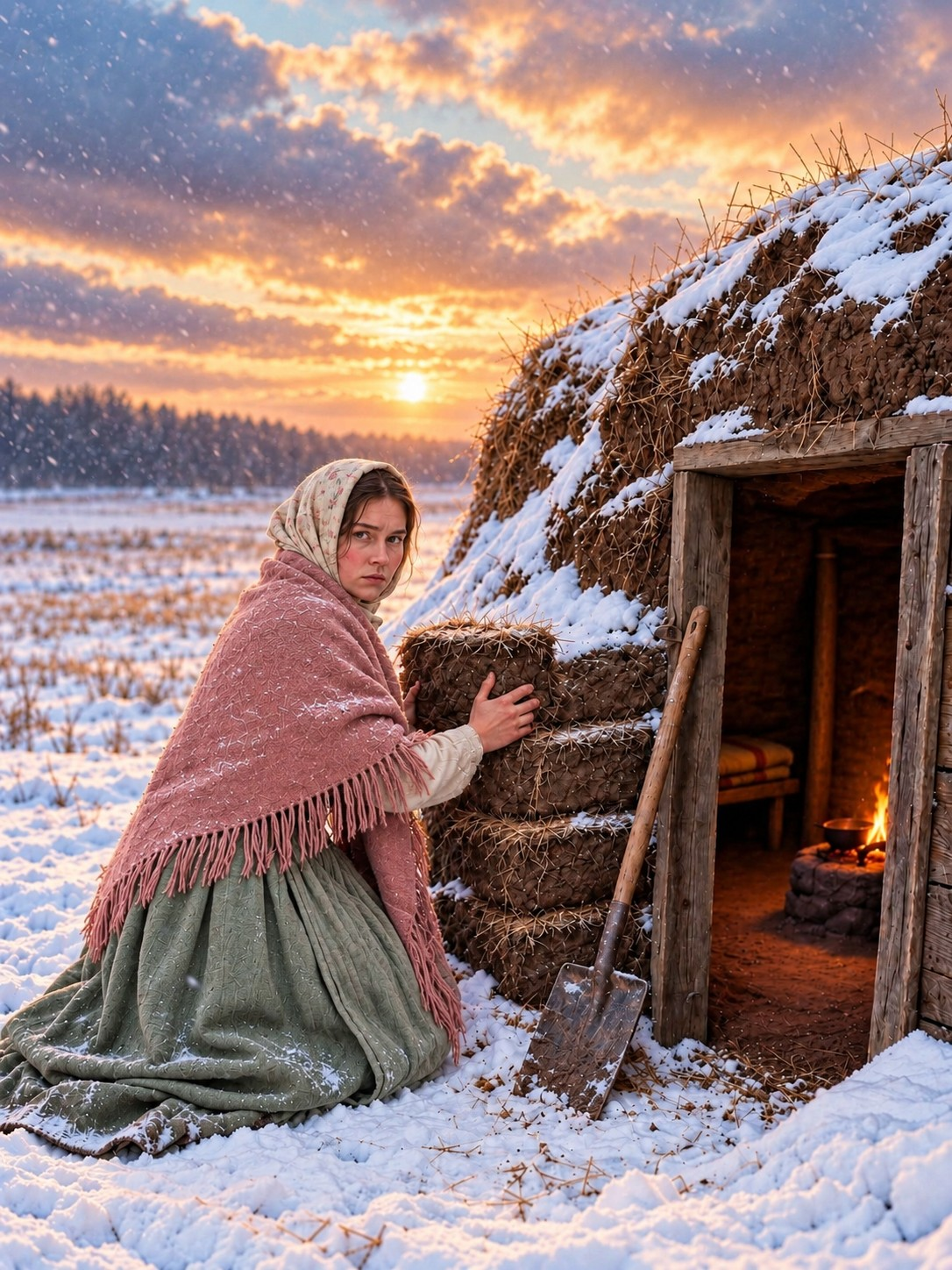
A home that could protect people during the kind of winters that had nearly destroyed my life.
My grandfather watched me working one afternoon.
He leaned against the doorway.
"Your mother would be proud."
I wiped my forehead.
"I hope so."
He smiled.
"She already was."
I looked toward the prairie.
For the first time, the land felt peaceful.
In June, I made a decision.
I would build a small home above the shelter.
Nothing extravagant.
A practical house with a kitchen, two bedrooms, a wood-burning stove, and wide windows overlooking the prairie.
I wanted a place where I could cook without worrying about who might kick over the table.
A place where the doors could remain unlocked because nobody inside was afraid.
I used part of the money my grandfather had set aside for the property improvements.
I worked with local contractors.
I learned how to read construction plans.
I helped install shelves.
I painted the kitchen cabinets.
I planted flowers near the entrance.
The first time I turned the key in the finished front door, I stood quietly for several minutes.
The house smelled of fresh wood and paint.
Sunlight crossed the kitchen floor.
A small wooden bird sat on the windowsill.
My mother's bird.
I touched its repaired wing.
Then I heard someone calling from outside.
"Hannah!"
My grandfather stood near the porch.
He was holding a paper bag.
"I brought something."
I smiled.
"What?"
"Your mother's bread recipe."
I opened the door.
He handed me the bag.
Inside was a handwritten recipe card.
The paper was old.
The edges were worn.
But the writing was unmistakable.
My mother's.
At the bottom she had written:
Always make enough for one more person than you expect.
I looked at my grandfather.
He smiled.
"She used to say that every winter."
I nodded.
"Then we'll need a bigger table."
He laughed.
My mother moved into the house that autumn.
Not immediately.
We needed time.
She had to rebuild her health.
I had to learn how to live with the fact that someone I had mourned for nineteen years was suddenly part of my everyday life.
There were difficult conversations.
There were nights when I woke from dreams about the funeral.
Sometimes I looked at her and remembered the years she had missed.
Sometimes she looked at me and began crying because she had missed my childhood.
We didn't pretend those years could be returned.
But we began making new memories.
She taught me to bake bread again.
I taught her how to use a smartphone.
We planted a small vegetable garden.
We repaired the old windmill together.
One evening, while we were preparing dinner, she stood beside the kitchen counter and watched me knead dough.
"You still do that the same way," she said.
I smiled.
"You taught me."
She reached over and brushed flour from my cheek.
"I missed this."
I looked at her.
"So did I."
She took my hand.
"I'm sorry, Hannah."
I nodded.
"I know."
"I should have found a way to tell you."
"Yes."
She lowered her eyes.
"I can't give you those years back."
I squeezed her hand.
"No. But you can be here now."
She began crying.
I hugged her.
And for the first time, I felt that I wasn't holding on to a memory.
I was holding my mother.
The following winter, the first major snowstorm arrived.
The weather service warned that temperatures would fall below zero.
Strong winds were expected across western South Dakota.
I stood beside the kitchen window, watching the first snowflakes cross the yard.
My mother was making soup.
My grandfather was checking the generator.
Walter had brought extra firewood.
Sarah was arranging blankets in the emergency room beneath the house.
Everyone had a job.
Nobody was frightened.
The shelter was ready.
The house was warm.
And the doors were open.
That evening, we sat around the dining table.
There were six bowls of soup.
Fresh bread.
Butter.
And a small candle in the center.
My mother raised her glass.
"To family."
My grandfather smiled.
"To second chances."
Sarah added:
"To telling the truth."
Walter lifted his cup.
"And to surviving another South Dakota winter."
Everyone laughed.
I looked around the table.
My mother.
My grandfather.
My aunt.
The people who had helped me when I had nowhere to go.
For the first time, I understood what home was supposed to feel like.
It wasn't a building.
It wasn't a family name.
It wasn't a piece of paper proving who belonged to whom.
It was the people who stayed.
The people who told the truth.
The people who made room for you when the world tried to push you out.
A year after my father threw me out, I returned to the old farmhouse.
Not to move back.
Not to reclaim the kitchen.
I went because the property had been sold as part of the financial settlement.
The new owners had asked whether I wanted anything from the house before the renovations began.
I took three things.
My mother's old recipe book.
A small photograph from the hallway.
And the wooden chair where she used to sit while teaching me to mend clothes.
I didn't take the wedding ring.
That belonged with her.
I didn't take the old dining table.
It had been replaced long before.
I simply stood in the empty kitchen for a moment.
I remembered the night my father had locked the door.
I remembered the cold.
The forty-three dollars.
The truck that barely started.
I remembered believing I had lost everything.
Then I looked at the photograph in my hands.
My mother was smiling.
I understood that I hadn't lost everything that night.
I had lost a house.
But I had found the courage to build a home.
When I stepped outside, my father was standing near his truck.
He looked older.
He didn't approach me.
He simply nodded.
I nodded back.
It wasn't forgiveness.
Not completely.
But it was peace.
I climbed into my own vehicle and drove west.
Toward the forty acres.
Toward the house I had built.
Toward the people waiting for dinner.
That evening, my mother and I sat on the porch.
The prairie stretched beneath a wide orange sunset.
The wind moved gently through the grass.
She held a cup of tea.
I held the old recipe book.
"Do you ever think about that night?" she asked.
"Sometimes."
"Does it still hurt?"
I considered the question.
"Yes."
She looked down.
"I'm sorry."
I reached over and held her hand.
"But it doesn't decide what happens next."
She looked at me.
I smiled.
Then I rested my head against her shoulder.
Inside the house, my grandfather was laughing at something Walter had said.
Sarah was setting the table.
The kitchen smelled of fresh bread.
The storm shelter beneath our feet was ready for another winter.
And for the first time in my life, I knew that nobody could take this place away from me.
Not my father.
Not Daniel.
Not the people who had tried to rewrite my story.
I was nineteen when I walked out of the farmhouse with forty-three dollars and nowhere to go.
I had believed that losing my home meant losing my future.
I was wrong.
The land my father called worthless became the place where I found my strength.
The secret my mother had carried became the truth that finally set us free.
And the girl who had once stood outside a locked door eventually built a home where nobody had to beg to be loved.
I looked at my mother.
She kissed my forehead.
"Good night, little sparrow."
I smiled.
"Good night, Mom."
And when the first snow began falling across the prairie, I knew exactly where I belonged.






Comments 0