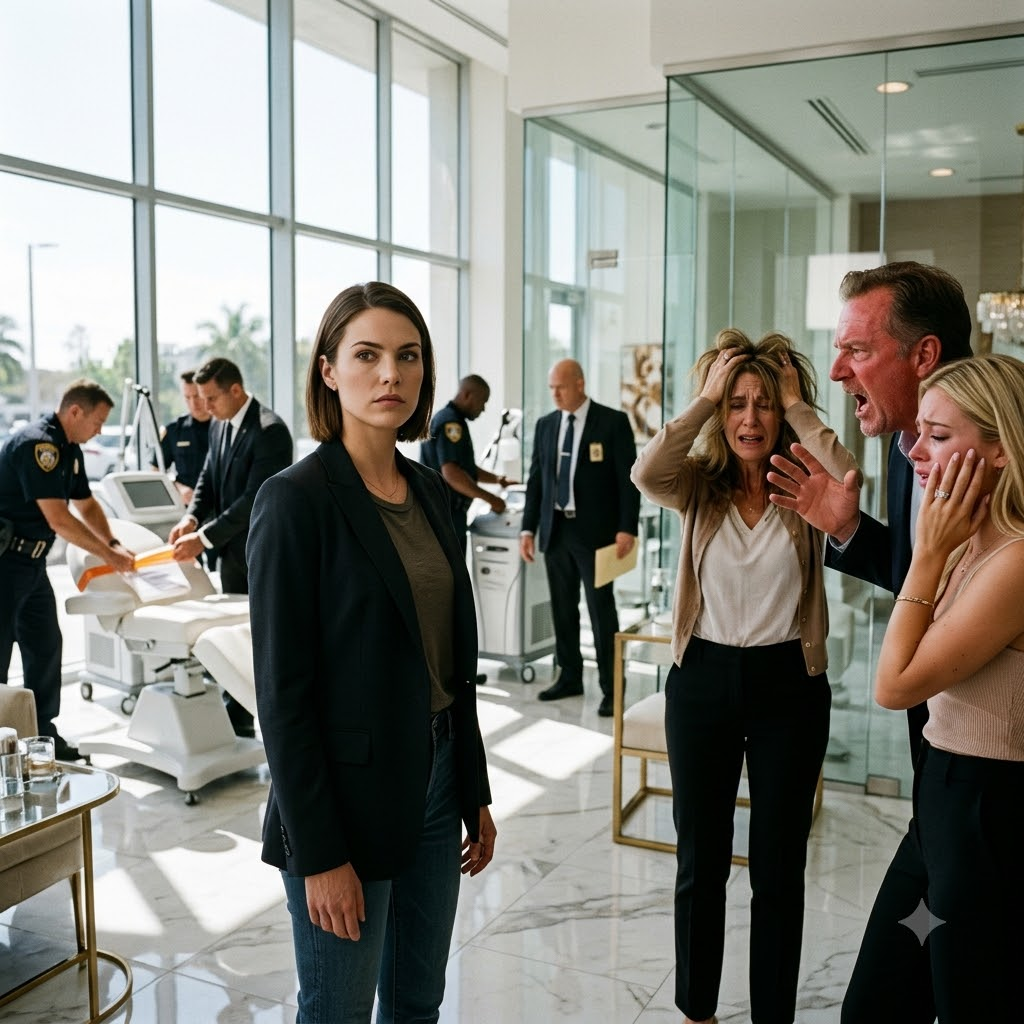
"Fallon! Don't open that door!" Boon whispered, grabbing my wrist as three sharp knocks echoed through my apartment.
I stood frozen, my phone still pressed against my ear.
Seconds earlier, a woman claiming to be Eleanor Whitcomb had told me something that threatened to destroy everything I believed about my grandmother's death.
"Your grandmother didn't die the way they told you."
Then the call had ended.
Now someone was standing outside my apartment at four in the morning.
And I had no idea whether the person on the other side had come to help me—or make sure I never learned the truth.
Another knock.
Three quick taps.
A pause.
Then two more.
Boon slowly moved toward the kitchen and reached for the heavy flashlight he'd brought from his truck.
I shook my head.
"Don't."
He looked at me.
"I'm not opening it."
"Then what are you doing?"
"Making sure whoever's out there knows we're awake."
I stared at him.
The man was seventy-three years old. He had arthritis in both hands, a bad knee, and a habit of complaining whenever he had to climb more than one flight of stairs.
Yet he was standing between me and the front door without hesitation.
My own father had spent the previous evening demanding that I surrender my inheritance.
Boon, who owed me nothing, was willing to protect it.
That realization hurt more than I expected.
"Who is it?" I called.
Silence.
Then a man's voice answered.
"Building maintenance."
I frowned.
At four in the morning?
"What do you want?"
"There's a reported water leak on your floor, ma'am. We need to check the plumbing."
I looked toward my kitchen sink.
No leak.
No running water.
Nothing.
"Which apartment reported it?"
A pause.
"Downstairs."
"Which unit?"
Another pause.
"Ma'am, we just need to inspect the pipes."
Boon leaned close.
"Ask for his name."
"What's your name?" I called.
The man hesitated.
"Mike."
"Mike what?"
No answer.
I felt my stomach tighten.
I had lived in this building for seven years.
The maintenance supervisor's name was Carlos.
His assistant was named Ben.
Neither sounded like the man outside.
I stepped backward.
"I'm calling the landlord."
The voice immediately hardened.
"Ma'am, if there's water damage, you'll be responsible."
"Then my landlord can explain that to me."
Silence.
A moment later, footsteps moved away from the door.
I waited until I heard the stairwell door close.
Then I exhaled.
Boon didn't relax.
"Call the police."
"Again?"
"Yes."
I looked at the clock.
4:07 a.m.
In less than twelve hours, my life had become a nightmare of threatening calls, suspicious documents, break-ins, and strangers pretending to be maintenance workers.
I dialed 911.
While I spoke to the dispatcher, Boon checked the peephole.
The hallway was empty.
But when he stepped away, his expression was grim.
"What?" I whispered.
He pointed toward the door.
"Someone covered the hallway camera."
My blood turned cold.
"How do you know?"
"There's black tape over the lens."
I stared at him.
The camera belonged to the building.
It was mounted above the elevator, facing the hallway.
I'd seen it every day for years.
Someone had deliberately blocked it.
Someone who didn't want to be recorded standing outside my apartment.
The dispatcher instructed me to remain inside and avoid confronting anyone.
I gave her the details.
Then I sat at the kitchen table and stared at Grandma's black notebook.
The little book looked harmless.
Cracked leather.
Yellowed pages.
A faded elastic band.
But inside it were enough names, dates, and unexplained transactions to make my entire family panic.
And somewhere among those pages was the reason a woman declared dead twenty years earlier had just called me.
I opened the notebook again.
Boon sat across from me.
"Fallon, you need to rest."
I shook my head.
"I can't."
"You're exhausted."
"Grandma might have been murdered."
The words came out before I could stop them.
Boon went still.
For several seconds, neither of us spoke.
Then he said quietly, "We don't know that."
I looked at him.
"Eleanor said Grandma didn't die the way they told me."
"That could mean several things."
"Like what?"
He hesitated.
"Medical negligence. A mistake in her records. Someone withholding information."
"Or someone killed her."
His face tightened.
"Possibly. But we cannot jump to conclusions."
I hated that he was right.
Because conclusions were all I wanted.
I wanted one clear answer.
One name.
One reason.
Something I could hold in my hands and say, This is what happened.
Instead, I had fragments.
A hidden compartment.
A missing woman.
A forged-looking signature.
A foreclosure that didn't make sense.
And a photograph of my father standing beside Eleanor Whitcomb the previous day.
I looked at that photograph again.
The timestamp was unmistakable.
Yesterday.
My father had seen Eleanor.
He knew she was alive.
And he had never mentioned her to me.
"Why would Dad hide her?" I whispered.
Boon rubbed his forehead.
"I don't know."
"But you knew her."
"Twenty years ago."
"What was she like?"
He looked toward the window.
"Eleanor was careful. Brilliant with numbers. She could remember an account balance after seeing it once."
"Was she close to Grandma?"
"Very."
"Then why did Grandma never talk about her?"
Boon sighed.
"Sometimes people stop mentioning someone because the memory hurts too much."
I thought about that.
Grandma had kept photographs of people she'd lost.
Her parents.
Her husband.
Old friends.
She spoke about them often.
But Eleanor had disappeared from every story.
As though someone had erased her.
I turned another page of the notebook.
Near the back, I found a folded sheet tucked between two entries.
It was smaller than the others.
The paper had been creased so many times that the edges were beginning to split.
I carefully unfolded it.
There were only three lines.
If Eleanor returns, ask about the blue ledger.
If Richard denies knowing her, do not believe him.
If anything happens to me, Fallon must find the original medical records.
I stared at the last sentence.
My chest tightened.
"Original medical records?"
Boon leaned forward.
I handed him the paper.
He read it.
Then read it again.
"Margaret wrote this?"
"That's her handwriting."
He looked up.
"Do you have copies of her hospital records?"
"Some."
"Which ones?"
"Discharge summaries. Medication lists. Appointment notes."
"What about the final hospitalization?"
I swallowed.
Grandma had spent the last six days of her life at St. Catherine's Medical Center.
She'd been admitted after developing severe weakness and difficulty breathing.
The doctors had told me her condition was deteriorating.
Her heart was failing.
Her kidneys were struggling.
She was eighty-four years old.
And she had been bedridden for years.
I'd accepted that her body was finally giving up.
Because that was what the doctors said.
Because that was what my mother said.
Because sometimes death comes slowly enough that everyone mistakes it for something inevitable.
But now I remembered something.
Something I'd pushed aside.
On the evening before Grandma died, I'd arrived at the hospital after closing my shop.
My mother was standing outside her room.
She looked irritated.
"You're late."
"I had a client fitting."
"Your grandmother's been asking for you."
I hurried inside.
Grandma was awake.
Her eyes followed me.
She tried to speak.
But her voice was weak.
I leaned close.
"What is it, Grandma?"
Her fingers tightened around mine.
"Don't..."
I moved closer.
"Don't what?"
Her lips trembled.
"Don't let..."
Then she began coughing.
A nurse entered.
The moment passed.
Later that night, Grandma became less responsive.
By morning, she was gone.
At the time, I'd believed she was trying to tell me not to worry.
Now I wasn't sure.
I pressed my hands against my face.
"Boon, I need those records."
He nodded.
"Then we'll get them."
The police arrived shortly before five.
Two officers inspected the hallway.
They confirmed that someone had placed tape over the security camera.
The building manager, awakened by their call, said no maintenance work had been scheduled.
He also confirmed that neither employee had visited the building overnight.
The officers documented the incident.
They removed the tape.
And they advised me to stay somewhere else temporarily.
I didn't argue.
By then, I was too frightened to pretend everything was normal.
Boon suggested his house.
He lived in a quiet neighborhood west of the city.
But I shook my head.
"If someone followed me here, they could follow me there."
"Then where?"
I looked at my phone.
Charles Whitmore.
He'd asked me to come to his office at eight.
It was nearly five.
Three hours.
I could survive three hours.
"I want to go straight to the attorney."
Boon studied me.
Then nodded.
"All right."
We packed quickly.
The documents went into my locked metal file box.
The notebook and brass key stayed in my handbag.
I took my laptop, phone charger, and a change of clothes.
Then I stood beside my bed for a moment.
Grandma's photograph was still on the nightstand.
I picked it up.
Her smile looked gentle.
Almost amused.
I remembered her saying, The strongest stitches are the ones nobody sees.
I slipped the photograph into my bag.
"You're coming with me," I whispered.
At 6:12 a.m., we pulled into a twenty-four-hour diner near the attorney's office.
Boon insisted I eat.
I ordered scrambled eggs and toast.
I managed three bites.
He drank coffee.
Neither of us said much.
Then my phone rang.
Mom.
I stared at the screen.
Boon looked up.
"Don't answer."
I hesitated.
Then I pressed the button and put the call on speaker.
"Fallon?"
Her voice was sweet.
Too sweet.
"Mom."
"Darling, where are you?"
I looked at Boon.
"Why?"
"Your father and I are worried."
"About what?"
"Elodie said you were acting strangely yesterday."
I almost laughed.
"Strangely?"
"She said you refused a very generous offer and became aggressive."
"She came to my shop and screamed at me."
"That's not what she told us."
"Of course it isn't."
My mother sighed.
"Fallon, must you always turn everything into a fight?"
I looked down at my untouched breakfast.
"Mom, did you know Eleanor Whitcomb?"
Silence.
Complete silence.
Then my mother asked, "Who?"
I watched Boon's expression change.
"Eleanor Whitcomb."
"I don't know anyone by that name."
"Are you sure?"
"Of course I'm sure."
"She was Grandma's friend."
A pause.
"Your grandmother had many friends."
"She disappeared twenty years ago."
My mother's breathing became audible.
"Fallon, where did you hear that name?"
I felt a chill.
"Why?"
"Answer me."
"Why does it matter?"
Her voice sharpened.
"Because I need to know what you've been doing."
I leaned back.
"What have I been doing?"
"Digging into things that don't concern you."
I stared at the phone.
"Grandma's finances concern me."
"Not anymore. She's dead."
The words hit me like a slap.
I looked at Boon.
He closed his eyes.
My mother continued.
"Your grandmother made her choices. The estate is being handled. You need to stop interfering."
I swallowed.
"Did you know Eleanor was alive?"
A sharp breath.
Then Mom laughed.
"Fallon, that's ridiculous."
"Is it?"
"That woman died years ago."
"Then why was Dad photographed with her yesterday?"
Silence.
The kind of silence that answers a question more clearly than words.
Then I heard movement.
A muffled voice.
My father's.
"What did she say?"
My mother whispered something I couldn't hear.
Then Dad took the phone.
"Fallon."
His voice was hard.
"Where are you?"
I looked at Boon.
He shook his head.
I stayed silent.
"Fallon, answer me."
"Why were you with Eleanor Whitcomb?"
He didn't respond.
"Dad?"
"Who sent you that photograph?"
My heart hammered.
"You admit it's real?"
"Who sent it?"
"Why does it matter?"
"Because you're being manipulated."
"By whom?"
"People who want to hurt this family."
I almost laughed.
"This family?"
"Don't start."
I looked at Grandma's notebook.
At the handwritten warning.
If Richard denies knowing her, do not believe him.
"Dad, did you take money from Grandma?"
His voice became dangerously quiet.
"Be very careful what you accuse me of."
"Did you?"
"I spent my entire life providing for this family."
"That isn't an answer."
"Your grandmother was confused."
"She wasn't confused."
"You don't know what she was involved in."
I felt my stomach tighten.
"Then tell me."
A pause.
Then he said, "Bring me the documents."
I stared at the phone.
"What?"
"Whatever you found in that machine. Bring it to me."
"Why?"
"Because you don't understand what you're holding."
I looked at Boon.
He was watching me with narrowed eyes.
"Then explain it."
My father exhaled.
"Fallon, your grandmother made enemies."
"Who?"
"People you don't want to know."
"Like Eleanor?"
Silence.
Then he said something that made my blood run cold.
"Eleanor Whitcomb should have stayed dead."
The call ended.
I sat motionless.
Boon stared at the phone.
Neither of us spoke for several seconds.
Then he said, "We need to tell Whitmore exactly what your father said."
I nodded.
But inside, something had changed.
My father hadn't denied knowing Eleanor.
He hadn't denied the photograph.
And he hadn't denied that Grandma's documents mattered.
He'd demanded them.
That was enough to tell me he was afraid.
And I had never seen my father afraid of anything.
Charles Whitmore was waiting when we arrived at his office.
He looked as though he hadn't slept.
His tie was slightly crooked.
His eyes were red.
He ushered us into a private conference room and locked the door.
I noticed.
So did Boon.
Whitmore sat across from us.
"First, are you safe?"
"For now."
"Good."
He opened a leather folder.
"Margaret anticipated that certain people might try to recover the machine."
I stared at him.
"Then why didn't you warn me yesterday?"
His expression tightened.
"Because she gave me specific instructions about when to disclose certain information."
"People broke into my shop."
"I know."
"Someone came to my apartment."
"I know."
I leaned forward.
"Then stop speaking like this is a routine legal matter."
Whitmore looked at me.
For the first time, his professional expression cracked.
"You're right."
He removed his glasses.
"I'm sorry."
The apology surprised me.
He continued.
"Your grandmother believed that revealing everything too early would put you in danger. She wanted you to receive the machine, discover the compartment, and contact me once you understood that the contents were important."
I stared at him.
"She planned all of this?"
"Not every event. But she anticipated the possibility of resistance."
"From my family?"
"Yes."
I felt a sharp ache in my chest.
Grandma had known.
She'd known they would fight me.
She'd known they would try to take the machine.
And she'd still left it to me.
Whitmore slid a document across the table.
It was a copy of a trust agreement.
The title read:
THE MARGARET BELLAMY FAMILY PROPERTY TRUST
I looked at the date.
It had been established nearly twenty years earlier.
"What is this?"
"A trust your grandmother created after her husband's death."
"Why?"
"To protect certain assets from creditors and unauthorized transfers."
I frowned.
"Which assets?"
Whitmore turned a page.
"Her residence. Certain investment accounts. And a minority ownership interest in a commercial property holding company."
My heart began pounding.
"North Shore Holdings?"
He looked at me sharply.
"You found that name?"
"Yes."
He nodded slowly.
"Then Margaret's records survived."
Boon leaned forward.
"What happened to the trust?"
Whitmore's expression darkened.
"That is the central problem."
He placed another document beside the first.
"Several years ago, amendments were filed that appeared to transfer control of certain trust assets."
"To whom?" I asked.
Whitmore looked directly at me.
"Your mother."
I felt cold.
"Karen?"
"Yes."
"And Dad?"
"Your father was connected to some of the subsequent transactions."
I stared at the pages.
"Did Grandma approve the amendments?"
"She disputed them."
My throat tightened.
"Then why weren't they reversed?"
"Because the signatures and supporting documents appeared facially valid. Challenging them required evidence, and Margaret's health was deteriorating."
I looked down.
The forged-looking signature.
The power of attorney.
The bank transfers.
It was beginning to fit together.
Not completely.
But enough to make me sick.
"Did Mom steal Grandma's house?"
Whitmore chose his words carefully.
"There is evidence suggesting that your grandmother's property interests were transferred or encumbered without her informed authorization."
I stared at him.
"That's lawyer language."
"Yes."
"Tell me what it means."
He paused.
"It means someone may have used documents bearing your grandmother's name to obtain money or control property she did not intend to surrender."
I closed my eyes.
Grandma's house.
The lilac bushes.
The kitchen table.
The little porch where she'd taught me to shell peas.
All of it.
Potentially taken.
Not lost.
Taken.
I opened my eyes.
"And the foreclosure?"
Whitmore leaned forward.
"The foreclosure proceeding involved a debt secured by property interests that may have been improperly transferred."
"Can it be reversed?"
"Possibly. But that depends on the records, the parties involved, and the court's findings."
I swallowed.
"What about the deed?"
He looked at me.
"Which deed?"
"The one Grandma hid."
His expression changed.
"May I see it?"
I opened the file box.
Removed the documents.
Placed them on the table.
Whitmore examined the top pages.
Then he reached the property deed.
He went very still.
Boon noticed.
"What is it?"
Whitmore adjusted his glasses.
"This is a copy of the original conveyance."
"Is that important?" I asked.
"Very."
He turned the page.
Then another.
His expression became increasingly serious.
"Margaret kept more than I realized."
I leaned forward.
"What does that mean?"
He looked up.
"It means we may have evidence of a chain of transactions that was deliberately concealed."
My stomach tightened.
"By my parents?"
"Possibly."
He looked at the notebook.
"May I?"
I nodded.
He opened it.
Read several entries.
Then stopped.
His eyes widened slightly.
"Where did you find this?"
"Inside the machine."
He looked at Boon.
"Did you know she kept a ledger?"
"No."
Whitmore turned another page.
Then whispered, "Margaret, you clever woman."
I stared at him.
"What?"
He pointed to a series of handwritten numbers.
"These are not ordinary notes."
"What are they?"
"References to transaction records."
He looked up.
"She created a cross-index."
I frowned.
"A what?"
"A way to connect dates, amounts, and documents. If someone destroyed one set of records, she could reconstruct the sequence from another."
I looked at Grandma's handwriting.
The tiny numbers.
The red circles.
The dates.
She had been building a map.
A map of what had happened to her money.
Her house.
Her life.
Whitmore turned to the back of the notebook.
Then stopped.
His face changed.
"What?" I asked.
He stared at the page.
"November seventeenth."
I felt my pulse quicken.
"The key has that date."
He looked up sharply.
"You found the key?"
I placed it on the table.
The small brass key caught the light.
Whitmore stared at it for several seconds.
Then he leaned back.
"She actually kept it."
Boon frowned.
"Kept what?"
Whitmore looked at us.
"Access to the original records."
My heart hammered.
"Where?"
He hesitated.
Then said, "A private records facility outside Chicago."
I stared at him.
"Locker 214?"
He nodded.
"Yes."
I felt a surge of hope.
For the first time since Grandma's death, there was something concrete.
A place.
A key.
A destination.
Not just threats and secrets.
I leaned forward.
"Then let's go."
Whitmore shook his head.
"Not yet."
My hope collapsed.
"Why?"
"Because the facility requires two forms of authorization."
I frowned.
"What kind?"
"The physical key and a release document signed by the designated custodian."
"Who is the custodian?"
Whitmore looked at the trust agreement.
Then at me.
"Eleanor Whitcomb."
The room went silent.
I stared at him.
"The woman who's supposed to be dead?"
"Yes."
I swallowed.
"She's alive."
Whitmore froze.
"What?"
"She called me last night."
His face drained of color.
I told him about the photograph.
The hospital bed.
My father.
The timestamp.
The phone call.
Eleanor's warning.
And the sudden disconnection.
Whitmore listened without moving.
When I finished, he slowly stood.
"Fallon, I need you to show me that photograph."
I handed him my phone.
He studied it.
Then enlarged the image.
His expression changed.
Not surprise.
Recognition.
He looked at the elderly woman.
Then at the man beside her.
My father.
Then he whispered, "Richard found her."
Boon stood.
"What does that mean?"
Whitmore didn't answer.
He was staring at the photograph.
I felt my chest tighten.
"Mr. Whitmore?"
He looked at me.
"Your grandmother spent years trying to locate Eleanor."
"Why?"
"Because Eleanor was the only person who could verify the original ownership records."
I frowned.
"Ownership of what?"
Whitmore slowly lowered the phone.
"Your grandmother's house was only one part of the property arrangement."
I stared at him.
"What else?"
He hesitated.
Then said, "The commercial property where your sister operates her spa."
My breath caught.
"Élan Aesthetics?"
He nodded.
"The building is connected to the same holding company."
I felt dizzy.
Elodie's spa.
Grandma's house.
North Shore Holdings.
The trust.
The money.
Everything was connected.
I looked at the documents.
Then at Whitmore.
"Are you saying Grandma owned the spa building?"
"She held an interest in the company that owned it."
I swallowed.
"How much?"
He hesitated.
"That is one of the questions Eleanor can answer."
I leaned back.
My sister had spent years boasting about her luxury business.
My mother had mocked my small alterations shop.
My father had told me I lacked ambition.
And now I was sitting in an attorney's office learning that their financial success might have been built on assets taken from the woman I'd spent ten years caring for.
I felt anger rise.
Slow.
Cold.
Controlled.
Not the kind that made me want to scream.
The kind that made me want every document.
Every signature.
Every transaction.
Every lie.
I looked at Whitmore.
"Then we find Eleanor."
He nodded.
"Yes."
Boon looked uneasy.
"Richard already knows where she is."
Whitmore's expression darkened.
"That's what worries me."
At 10:43 a.m., Whitmore arranged for a private investigator he trusted to review the photograph and the address from the anonymous message.
He also contacted a colleague experienced in financial litigation.
I signed an authorization allowing them to review Grandma's records on my behalf.
This time, I read every word.
Every page.
Every line.
Whitmore waited patiently.
When I finished, he nodded.
"Your grandmother would approve."
My throat tightened.
"She taught me to be careful with stitches."
He smiled faintly.
"Apparently, she wanted you to be careful with signatures too."
For the first time that morning, I almost smiled.
Then my phone vibrated.
A message from Elodie.
Mom says you're meeting with lawyers.
I stared at it.
A second message appeared.
You have no idea what you're doing.
Then a third.
If you ruin my business, I'll make sure you lose yours.
I showed Whitmore.
He photographed the messages.
"Preserve these."
I nodded.
Then another message arrived.
This one contained a photograph.
My workshop.
Taken from inside.
The damaged Singer machine stood near the workbench.
Someone had placed a white envelope on top of the cabinet.
Beneath the photograph were five words.
You missed something in the drawer.
I stared.
The police had secured the shop.
Boon had locked the door.
No one should have been inside.
Yet someone had entered again.
And left an envelope.
I looked at Whitmore.
"Someone's at my shop."
He stood immediately.
"Do not go there alone."
I showed him the photograph.
He studied it.
Then frowned.
"Fallon, enlarge the envelope."
I did.
There was handwriting on the front.
Three words.
For My Girl.
My breath stopped.
Grandma.
That was what she called me.
My girl.
I stared at the screen.
Whitmore looked at Boon.
"Did Margaret leave any other instructions about the machine?"
Boon shook his head.
"Not that she told me."
I felt my pulse racing.
Another envelope.
Another message.
Another piece of Grandma's plan.
But this one hadn't been inside the hidden compartment.
Someone had placed it there after the break-in.
Which meant someone else might be following Grandma's instructions.
Or someone was using her handwriting to lure me back.
I looked at Whitmore.
"I need to know what's inside."
He nodded slowly.
"Then we'll have the police check the premises first."
I reached for my handbag.
The brass key was still inside.
The notebook.
The photograph.
Grandma's final letter.
Everything she'd left me was beginning to form a pattern.
But one question remained.
Why had Eleanor warned me about Grandma's death?
I looked at Whitmore.
"Before we go, there's something else."
He turned.
"What?"
"Eleanor said Grandma didn't die the way they told me."
His expression changed.
He sat down slowly.
"What exactly did she say?"
I repeated the words.
He stared at me.
Then opened a drawer and removed a sealed envelope.
It was marked with Grandma's name.
And beneath it, in red ink, were the words:
TO BE OPENED ONLY IF THE CAUSE OF DEATH IS QUESTIONED.
My heart stopped.
Whitmore placed the envelope on the desk.
His hands were trembling.
"Margaret gave me this three weeks before she died."
I stared at him.
"What is it?"
He swallowed.
"A written statement concerning her medical treatment."
Boon stepped closer.
Whitmore looked at me.
"Fallon, your grandmother believed someone was interfering with her medication."
The room went silent.
I felt the blood drain from my face.
"Who?"
Whitmore looked down at the envelope.
Then back at me.
"She named someone."
My hands began shaking.
"Tell me."
He broke the seal.
Pulled out a folded sheet.
Unfolded it.
His eyes moved across the page.
Then he stopped.
His expression changed completely.
"That's impossible," he whispered.
I stood.
"What?"
He looked at me.
"Fallon, this statement isn't what I expected."
I reached for the paper.
He hesitated.
Then slowly turned it toward me.
At the top was Grandma's handwriting.
Below it was a list of medications.
Dates.
Dosages.
And one final sentence.
I leaned closer.
The words were written in trembling black ink.
If I die suddenly, the person responsible will be—
Before I could finish reading, Whitmore's office phone rang.
He looked at the caller ID.
His face went white.
"Who is it?" I whispered.
He didn't answer.
The phone rang again.
Then he pressed the speaker button.
A woman's voice filled the room.
Weak.
Breathless.
Terrified.
"Charles, it's Eleanor."
Whitmore stood so quickly his chair rolled backward.
"Eleanor?"
"Richard knows where I am."
My heart hammered.
"Where are you?" Whitmore demanded.
A pause.
Then Eleanor whispered, "I'm at the old house."
I stared at the phone.
Grandma's house.
The one supposedly lost to foreclosure.
Whitmore grabbed a pen.
"Eleanor, listen carefully. Don't move. I'm sending help."
But Eleanor wasn't listening.
She was crying.
"Charles, Margaret left something in the basement."
My breath caught.
"What?" I whispered.
Eleanor heard me.
"Fallon?"
I stepped closer.
"I'm here."
Her voice broke.
"Your grandmother knew they'd come for the machine."
I gripped the desk.
"Who?"
"Your parents."
I felt sick.
Eleanor continued.
"But the machine wasn't the only hiding place."
Whitmore looked at me.
Boon went still.
Eleanor's breathing became ragged.
"Fallon, there's a second ledger. The original one. It's beneath the basement stairs."
My heart pounded.
"What's in it?"
A long silence.
Then she whispered, "The truth about the money."
I closed my eyes.
"And Grandma?"
Eleanor began crying harder.
"The truth about her death too."
I felt my knees weaken.
"Who hurt her?"
Eleanor tried to answer.
But another voice interrupted.
A man's voice.
Cold.
Familiar.
My father.
"Eleanor, put the phone down."
I froze.
Whitmore shouted, "Richard, don't touch her!"
There was a struggle.
A sharp cry.
Then something crashed.
The line remained open.
For several seconds, we heard only movement.
Then my father's voice came through the speaker.
"Fallon?"
I couldn't breathe.
"Dad?"
He spoke slowly.
Almost gently.
"Sweetheart, I need you to listen very carefully."
I stared at the phone.
"Where's Eleanor?"
He ignored the question.
"Your grandmother left you something she never should have kept."
My fingers tightened around the desk.
"Where is she?"
A pause.
Then he said, "If you want to know what really happened to Margaret, come to the house."
Whitmore shook his head violently.
"Don't agree."
I looked at him.
My father continued.
"Come alone. Bring the key."
I felt cold.
"The key?"
"Locker 214."
Boon grabbed my arm.
Whitmore reached for his phone.
And then my father said something that made every person in the room go completely still.
"Fallon, there's one more thing you need to know."
I stared at the speaker.
"What?"
His voice dropped to a whisper.
"Your grandmother wasn't the first woman in this family we had to silence."
Then the line went dead.
At that exact moment, someone knocked on Whitmore's private office door.
Three times.
A pause.
Then two more.
The same pattern I'd heard outside my apartment.
Whitmore slowly turned toward the door.
"Who is it?"
A woman answered.
Her voice was calm.
Familiar.
And unmistakable.
"Charles, open up. It's Karen Bellamy."
I looked at Boon.
His face had gone pale.
Because my mother wasn't supposed to know we were there.
And she wasn't alone.
Through the frosted glass, I could see three silhouettes.
My mother's voice came again.
"Fallon, sweetheart, I know you're inside."
The door handle began to turn.
And someone on the other side inserted a key into the lock.






Comments 0