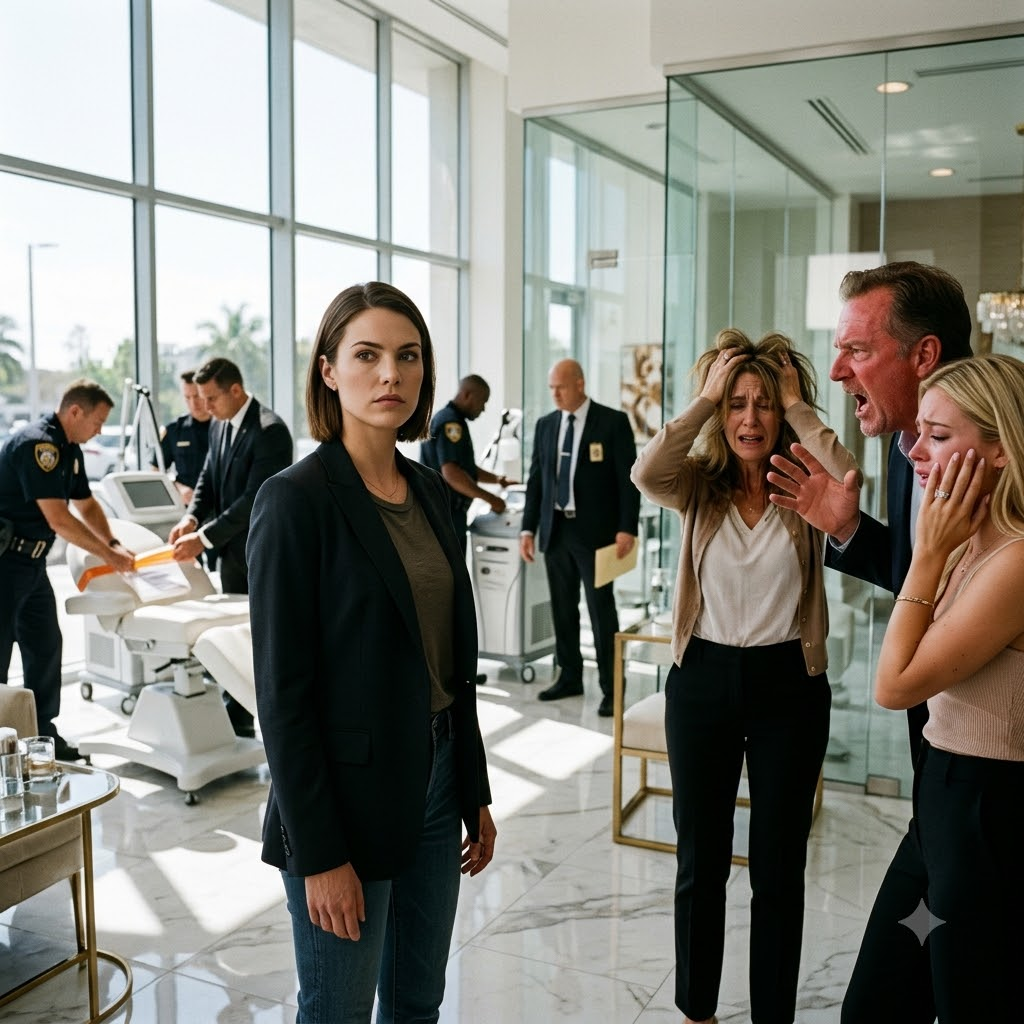
"Don't open that door!" Boon shouted as the key scraped inside Charles Whitmore's office lock.
I stood beside the attorney's desk, staring at the three shadows behind the frosted glass.
My mother was outside.
Two people stood with her.
And someone had a key to a private office that Charles Whitmore had locked less than an hour earlier.
"Charles!" my mother called. "I know Fallon is in there. Open the door before this gets any more embarrassing."
Whitmore's expression hardened.
"Karen, you have no appointment. Leave immediately."
The key turned again.
But the lock didn't release.
Whitmore had engaged a second security bolt when we'd entered.
I hadn't noticed it until now.
My mother's voice sharpened.
"Don't be ridiculous. I'm Margaret's daughter."
"That doesn't give you permission to enter my office."
"I have every right to know what you're discussing with my child."
I felt something cold settle inside me.
My child.
She hadn't called me that when I spent ten years changing Grandma's bedding.
She hadn't called me that when I worked fourteen-hour days to keep my business alive.
She hadn't called me that when Elodie received three hundred thousand dollars and I inherited a rusted sewing machine.
But now that I possessed documents she desperately wanted, I was suddenly her child again.
Whitmore reached for his desk phone.
"Karen, I'm calling building security."
A man's voice spoke from the hallway.
"There's no need for that."
I recognized the voice.
Martin Vale.
My father's longtime business associate.
I hadn't seen him in years, but I remembered his expensive watches and the way he always smiled without showing his teeth.
He used to attend family dinners when I was younger.
Grandma never liked him.
Whenever he visited, she would quietly leave the room.
I had assumed she found him arrogant.
Now I wondered whether she'd known something about him.
Whitmore's face changed.
"Martin?"
"Charles," the man replied pleasantly. "Let's not make this unpleasant."
Boon stepped closer to me.
"Who's Martin Vale?" he whispered.
"Someone who worked with Dad."
Boon's jaw tightened.
Whitmore spoke again.
"Mr. Vale, you are not authorized to access this office."
Martin laughed softly.
"Come on, Charles. We've known each other for twenty years."
"Then you should know better than to attempt entry."
My mother struck the door.
"Fallon! Stop hiding behind that lawyer!"
I looked at Whitmore.
He nodded toward the phone on the desk.
I understood.
I pressed the button for the building's security desk.
A man answered.
"Security."
"This is Charles Whitmore's office," I said. "Three people are attempting to enter a locked private conference room without permission."
Whitmore took the receiver.
He identified himself and requested immediate assistance.
Outside, the voices stopped.
For several seconds, there was silence.
Then my mother spoke.
Her tone had changed completely.
"Fallon, sweetheart, please. We just need to talk."
I closed my eyes.
That voice.
The soft, wounded voice she used whenever she wanted to make me feel guilty.
I had spent my entire life responding to it.
When I was twelve, she'd used it after forgetting my school recital.
When I was seventeen, she'd used it after giving Elodie the money she'd promised for my college expenses.
When I was thirty, she'd used it after refusing to help with Grandma's care.
Every time, I had forgiven her.
Every time, I had told myself she didn't mean to hurt me.
But I was thirty-eight now.
And I had finally learned that some people didn't need forgiveness.
They needed boundaries.
"Mom," I said, keeping my voice steady, "go home."
A pause.
Then she whispered, "You don't understand what you're doing."
"Then tell me the truth."
Silence.
"Tell me why Grandma's house was mortgaged. Tell me why her money went into Elodie's spa. Tell me why you wanted that sewing machine so badly."
I heard someone moving outside.
Then Martin spoke.
"Karen, don't answer that."
My stomach tightened.
Whitmore's expression darkened.
I continued.
"Tell me why Dad was photographed with Eleanor Whitcomb yesterday."
My mother gasped.
A small sound.
But unmistakable.
Then she said something I would remember for the rest of my life.
"That woman should have stayed buried."
The hallway went silent.
I stared at the door.
Boon looked at Whitmore.
Whitmore slowly reached for his phone and activated the recording function on his office security system.
"Karen," he said carefully, "what woman are you referring to?"
My mother didn't answer.
Instead, Martin spoke.
"Charles, I strongly suggest you stop this conversation."
Whitmore's voice became cold.
"And I strongly suggest you leave my office."
Footsteps approached.
A new voice called from the hallway.
"Building security. Everyone step away from the door."
My mother protested.
Martin said something I couldn't hear.
Then the shadows moved.
A moment later, the hallway fell quiet.
Whitmore waited until security confirmed that the visitors had been escorted to the elevator.
Only then did he unlock the door.
I stood motionless.
My hands were trembling.
Boon touched my shoulder.
"Fallon?"
I looked at him.
"My mother knew Eleanor."
He nodded.
"Yes."
"She knew Eleanor was alive."
"Possibly."
I shook my head.
"No. She said that woman should have stayed buried."
Whitmore closed the door again.
His expression was grim.
"That statement is troubling, but we need to be careful about what we conclude from it."
I turned toward him.
"Careful?"
"Yes."
"Mr. Whitmore, someone broke into my shop. Someone followed me home. My father threatened me. And my mother just tried to force her way into your office."
"I know."
"Then why does everyone keep telling me to be careful?"
He looked at me for a long moment.
"Because whoever is behind this is making mistakes. And we need those mistakes documented properly."
I stared at him.
Then slowly sat down.
He was right.
I hated it.
But he was right.
Anger wouldn't prove fraud.
Fear wouldn't restore Grandma's house.
And shouting at my parents wouldn't tell me where Eleanor was.
Evidence would.
I looked at the documents spread across the desk.
"Then let's find the evidence."
Whitmore nodded.
"That's exactly what Margaret wanted."
The first thing Whitmore did was contact the police.
He reported the attempted unauthorized entry, the statements made in the hallway, and the earlier call from Eleanor.
He also provided the information about my father apparently being at Grandma's former house.
An officer took the details and said they would be reviewed in connection with my previous reports.
I asked whether someone could check on Eleanor.
Whitmore gave the address and explained that she might be vulnerable.
The officer said the information would be passed along for a welfare check.
It wasn't the immediate rescue I wanted.
But at least someone besides us now knew where she might be.
Then Whitmore called a colleague named Rebecca Sloan.
She was a forensic accountant who specialized in tracing disputed assets.
I had never heard of forensic accounting before.
To me, accountants were people who prepared tax returns and told business owners how much money they owed.
Rebecca apparently did something very different.
She followed money people didn't want found.
Whitmore put her on speakerphone.
"Rebecca, I have an urgent matter involving a family trust, questionable property transfers, and several business entities."
"How questionable?" she asked.
Whitmore looked at me.
"Potentially criminal."
There was a pause.
"Send me the documents."
He scanned several pages.
The deed.
The mortgage records.
The wire transfers.
Grandma's handwritten transaction index.
And the photograph of Elodie's spa.
Rebecca was silent for nearly five minutes.
Then she said, "Charles, where did you get these?"
Whitmore glanced at me.
"From the beneficiary."
"Are they originals?"
"Some are copies. We are preserving the physical materials."
Another pause.
Then Rebecca asked, "Who is Elodie Bellamy?"
I felt my stomach tighten.
"My sister," I answered.
"Does she own Élan Aesthetics?"
"Yes."
"Does she own the building?"
I hesitated.
"She says she does."
Rebecca made a small sound.
"That's interesting."
Whitmore leaned forward.
"Why?"
"Because the records you've sent suggest that the operating business and the real estate are controlled through different entities."
I frowned.
"What does that mean?"
Rebecca answered patiently.
"It means your sister may own the spa business without owning the property where it operates."
I looked at Whitmore.
He nodded.
"That is consistent with what we've discussed."
Rebecca continued.
"The commercial property appears to have been held through North Shore Holdings LLC. But the ownership records contain changes that need verification."
"Changes?" I asked.
"Membership transfers. Amendments. Assignments of beneficial interests."
I rubbed my forehead.
"Can you explain that in normal language?"
"Of course."
Her voice softened.
"Imagine your grandmother owned part of a company that owned a building. Someone could try to take control of that building by changing the records showing who owned the company."
I stared at the papers.
"Without selling the building?"
"Exactly."
My heart began pounding.
"And if they used Grandma's signature without permission?"
"Then those transactions could be challenged, and depending on the evidence, there could be serious legal consequences."
I swallowed.
"How much was the building worth?"
Rebecca hesitated.
"I haven't verified its current market value. But the financing documents suggest we're dealing with a substantial commercial asset."
"More than three hundred thousand dollars?"
"Potentially much more."
I looked at the photograph of Elodie's spa.
The marble floors.
The expensive treatment rooms.
The glass walls.
My sister had spent years bragging about that building.
She'd called it her greatest achievement.
But what if it had never truly belonged to her?
What if Grandma had paid for the foundation of Elodie's success while I was being told there wasn't enough money to repair her wheelchair?
The thought made me sick.
"Rebecca," I said quietly, "there are transfers from Grandma's accounts to the spa."
"Yes. I noticed."
"Could those be legitimate?"
"Some could be. We need bank records, authorizations, and the underlying agreements."
I looked down.
"How much money are we talking about?"
She paused.
"Based only on the pages you've provided, I can identify several hundred thousand dollars in transfers requiring explanation."
My mouth went dry.
Several hundred thousand.
Grandma had spent her final years worrying about the price of her medications.
She'd apologized whenever I bought her new pajamas.
She'd insisted I reuse old towels rather than spend money on fresh ones.
And somewhere in the background, enormous sums had been moving through accounts connected to my family.
I felt tears burn behind my eyes.
Whitmore noticed.
He slid a box of tissues toward me.
I shook my head.
I wasn't going to cry.
Not yet.
Rebecca continued.
"There's another issue."
Whitmore leaned forward.
"What?"
"The dates."
I looked up.
"What about them?"
"Several transfers occurred during periods when Margaret Bellamy's medical records may show she lacked the capacity to manage complex transactions."
My heart stopped.
"She was bedridden."
"That alone doesn't establish incapacity," Rebecca said. "But it makes contemporaneous documentation especially important."
I nodded.
"She had difficulty writing."
"Then we need to compare the signatures with authenticated examples."
I remembered the smooth signature on the transfer document.
The one that looked nothing like Grandma's trembling handwriting.
"I have examples."
"Good. Preserve them."
Rebecca paused.
Then asked a question that made the room go silent.
"Fallon, did your grandmother ever authorize you to manage her financial affairs?"
"No."
"Did she ever ask you to sign documents on her behalf?"
I thought about the insurance form Mom had given me six months earlier.
My stomach tightened.
"I signed something."
Whitmore looked at me.
"What?"
"My mother said it was for insurance reimbursement."
Rebecca's voice sharpened.
"Do you have a copy?"
"No."
"Do you remember the title?"
I closed my eyes.
I could picture the paper.
White.
Several pages.
A blue logo at the top.
A signature line near the bottom.
But the title was gone from my memory.
"No."
Rebecca sighed.
"Then we need to find it."
I opened my eyes.
"Why?"
"Because if your signature appears on a document you didn't understand, we need to know exactly what authority or obligation someone claims it created."
I felt cold.
"Could Mom have used my signature to take Grandma's money?"
"I can't say that without seeing the document."
"But it's possible?"
"It's possible your signature was used in a transaction you didn't fully understand. We need the actual record before drawing conclusions."
I stared at Whitmore.
He looked deeply concerned.
I remembered Grandma's warning.
Fallon must not sign anything.
She had known.
Or feared.
That someone would use me too.
By noon, Rebecca had agreed to review the records formally.
Whitmore arranged for the documents to be copied and preserved.
He also contacted the probate court clerk to verify the status of Elodie's inheritance distribution.
I sat beside Boon while Whitmore made the calls.
For the first time, I began to understand something important.
My sister hadn't necessarily received three hundred thousand dollars yet.
She'd been told she was entitled to that amount under the will.
But the estate still had to be administered.
And if the money was tied to disputed transactions, things could become complicated.
Very complicated.
When Whitmore ended the call, I asked the question that had been bothering me.
"Why would Grandma leave Elodie three hundred thousand dollars if she knew Elodie had taken money from her?"
Whitmore folded his hands.
"That is one of the questions Margaret anticipated."
I stared at him.
"What does that mean?"
He opened a separate folder.
Inside was a handwritten letter.
Grandma's handwriting.
My heart tightened.
"Another letter?"
Whitmore nodded.
"She left several."
I looked at him.
"Why didn't she just tell me everything?"
He sighed.
"Because she was trying to create a record that would survive her."
I didn't understand.
He continued.
"Margaret knew her health was declining. She also knew that certain people might challenge anything she said."
I thought about my mother calling her confused.
Elodie claiming she didn't know what she was doing.
My father dismissing her decisions.
Whitmore looked at me.
"Your grandmother wanted her intentions documented clearly, through independent witnesses and formal legal procedures."
I swallowed.
"Can I read it?"
He handed me the letter.
The first line made my throat tighten.
My dearest Fallon,
If you are reading this, then the machine has done its job.
I pressed my lips together.
Grandma.
Even now, she sounded like herself.
I continued.
I know you must be hurt by the way I divided my estate.
I know Elodie will celebrate the money, and I know Karen will use the machine to make you feel small.
Please forgive me for allowing that moment to happen.
My eyes blurred.
She had known.
She had known exactly what my mother would say.
Exactly how Elodie would react.
And she'd allowed it.
Not because she didn't love me.
Because she was trying to accomplish something.
I kept reading.
The money promised to Elodie is not a reward for what she has done.
It is part of a larger arrangement that Charles understands.
I wanted the amount stated clearly so that the source of the funds, the claims against them, and the final distribution would all be examined through the proper legal process.
I stopped.
Looked at Whitmore.
"What does that mean?"
He leaned forward.
"Your grandmother wanted certain transactions brought into the open."
"By leaving Elodie money?"
"By making the estate administration unavoidable and requiring the relevant assets and liabilities to be accounted for."
I frowned.
"She could have left everything to charity."
"She could have. But Margaret believed there were assets that had already been improperly diverted. She wanted those claims investigated before the estate was closed."
I looked back at the letter.
I did not want you to inherit a fight you could not win.
I wanted you to inherit the truth.
A tear slipped down my cheek.
I wiped it away.
Then I read the final paragraph.
Do not confuse the amount written beside Elodie's name with the amount she will ultimately receive.
There are debts that must be accounted for.
There are signatures that must be explained.
And there is money that was never hers to touch.
I lowered the paper.
The room was silent.
Boon looked at me.
Whitmore waited.
I stared at Grandma's handwriting.
For years, my sister had treated money as proof of worth.
She believed that expensive clothes made her important.
That a luxury business made her successful.
That being favored by our parents made her better than me.
But Grandma had understood something Elodie hadn't.
Money could be counted.
Money could be traced.
And money could reveal the truth.
I looked at Whitmore.
"She knew Elodie had taken something."
He nodded slowly.
"She suspected it."
"And she wanted the records examined."
"Yes."
I looked at the letter again.
"Then we're going to finish what she started."
At 1:36 p.m., Rebecca called back.
Her voice was different.
Sharper.
More urgent.
"Charles, I found something."
Whitmore put her on speaker.
"What?"
"I've been comparing the transfer dates against the business filings."
I leaned forward.
"And?"
"There's a pattern."
Rebecca explained that several payments associated with Grandma's assets appeared to have been routed through a consulting company before reaching accounts connected to Élan Aesthetics.
The consulting company was called Vale Strategic Services.
I felt my stomach drop.
"Martin Vale?"
"That appears to be the name associated with the company," Rebecca said.
I looked at Whitmore.
The man who had tried to enter his office with my mother.
My father's longtime associate.
The man Grandma never liked.
Rebecca continued.
"Some payments were labeled as consulting fees. Others were recorded as equipment financing or property development expenses."
I frowned.
"Is that illegal?"
"Not automatically. But the amounts, timing, and related parties raise questions."
Whitmore leaned forward.
"Can you identify where the money originated?"
"Some of it appears connected to loans secured by property interests that Margaret disputed."
I felt cold.
Grandma's house.
Again.
Everything led back to that house.
Rebecca paused.
"There's another problem."
I held my breath.
"What?"
"Élan Aesthetics has been advertising treatments involving equipment that may require specific licensing and regulatory compliance."
I stared at the phone.
"What kind of equipment?"
"Advanced cosmetic treatment devices. I can't determine legality from advertisements alone, but some of the claims warrant review."
I remembered Elodie's social media posts.
The gleaming machines.
The expensive treatment rooms.
The photographs of wealthy clients.
She was always announcing new services.
New technology.
New exclusive procedures.
And whenever I asked where she found the money, she'd laugh.
"Successful people reinvest, Fallon. You wouldn't understand."
I swallowed.
"Could the equipment have been purchased with Grandma's money?"
Rebecca paused.
"Some of the financing records suggest that funds connected to the disputed transactions were used for business expansion and equipment purchases."
My stomach twisted.
I thought about Grandma lying in bed, apologizing because she needed new shoes.
I thought about Elodie posing beside a machine that cost more than my entire annual income.
I thought about Mom telling me there wasn't enough money to hire additional nursing help.
And suddenly, I wanted to scream.
Instead, I asked quietly, "Can you prove it?"
"Not yet. But I can identify the records we need."
"Then get them."
Whitmore looked at me.
Rebecca answered.
"We'll proceed through the appropriate legal channels."
I nodded.
"Good."
Because I didn't want revenge based on suspicion.
I wanted the truth.
And I wanted it documented so thoroughly that nobody could laugh it away.
At three o'clock, Whitmore received a call from the investigator he'd hired to locate Eleanor.
The investigator's name was Daniel Cross.
He spoke in a low, controlled voice.
"I checked the address."
Whitmore leaned forward.
"And?"
"The house is occupied."
My heart jumped.
"By whom?"
"That isn't clear yet."
I looked at Boon.
He was watching the phone.
Daniel continued.
"There are indications someone has been staying there recently. A vehicle registered to a company associated with Richard Bellamy was seen nearby."
My stomach tightened.
"Dad."
Whitmore asked, "Did you find Eleanor?"
"No."
My hope collapsed.
"Was she there?" I asked.
"I can't confirm that."
I closed my eyes.
Daniel continued.
"But I found something else."
Whitmore frowned.
"What?"
"A private medical transport company made a pickup from that address yesterday afternoon."
I opened my eyes.
"Medical transport?"
"Yes."
"Where did they take her?"
"That's what I'm trying to establish."
My heart hammered.
Eleanor had been photographed in a hospital bed.
Then she'd called from Grandma's old house.
Now a medical transport company had apparently moved someone from that address.
I leaned forward.
"Could Dad have moved her?"
Daniel paused.
"I don't have evidence identifying who arranged the transport."
I nodded.
I was beginning to hate those words.
I don't have evidence.
But I understood why they mattered.
Every accusation had to be supported.
Every conclusion had to be earned.
That was how we would win.
Not by shouting louder than my family.
By proving what they'd done.
Whitmore asked Daniel to continue tracing the transport.
Then he ended the call.
I looked at the clock.
Three fifteen.
It had been less than twenty-four hours since the will reading.
And already, my entire understanding of my family had collapsed.
I thought about Grandma's last hospital stay.
Her weak voice.
Her trembling hand.
The words she hadn't finished.
Don't let...
Don't let what?
Don't let Mom take the house?
Don't let Elodie get the money?
Don't let Dad find Eleanor?
Or something worse?
I looked at Whitmore.
"I need Grandma's original medical records."
He nodded.
"I've already requested the relevant records through the estate's authorized channels."
"How long?"
"That depends on the provider and the documentation required."
I felt frustrated.
"Can't we go to the hospital?"
"We can ask about the process, but we need to respect the applicable privacy and authorization requirements."
I looked down.
Every answer seemed to lead to another locked door.
Another form.
Another delay.
Then Boon spoke.
"Fallon, what about the envelope at your shop?"
I looked up.
The envelope.
For My Girl.
The one someone had placed on Grandma's damaged sewing machine.
I'd almost forgotten it.
Whitmore frowned.
"Has anyone recovered it?"
"Not yet."
He reached for his phone.
"Then we should arrange to have it collected safely."
By late afternoon, the police had confirmed that no one was inside my workshop.
An officer accompanied Boon and me while we retrieved the envelope.
The shop looked worse in daylight.
The damaged lock.
The overturned chair.
The scratches across the floor.
The broken Singer cabinet.
I stood in the doorway, staring at the wreckage.
My chest tightened.
This was where I'd built my life.
Where I'd made clothes for children who'd never had anything custom-made for them.
Where I'd stayed late to finish wedding dresses and adaptive jackets.
Where I'd learned that I could survive without my family's approval.
And now someone had invaded it because of a secret Grandma had left behind.
Boon touched my shoulder.
"We'll fix it."
I nodded.
But I wasn't sure I believed him.
The envelope was still on the machine.
White.
Unsealed.
Grandma's handwriting on the front.
For My Girl.
I put on the disposable gloves the officer offered and carefully lifted it.
Inside was a small folded note.
And a photograph.
The photograph showed Grandma standing beside a younger woman.
Both were smiling.
Behind them was a brick building.
I recognized it.
Élan Aesthetics.
But the photograph had been taken long before Elodie opened her spa.
On the back, Grandma had written:
Eleanor and me. Before they took everything.
My throat tightened.
I unfolded the note.
The handwriting was Grandma's.
But the message was different from the others.
Short.
Urgent.
Fallon, if this reaches you, someone has already discovered the first hiding place.
Do not trust the numbers in the will.
Do not trust the story about the foreclosure.
And do not believe anyone who tells you the house was sold.
I stopped breathing.
The house wasn't sold?
I looked at Boon.
He read over my shoulder.
His expression changed.
I continued.
The original deed is not where they think it is.
The key will lead you to the records.
But before you go, you must understand one thing.
The money Elodie received was never hers.
My hands trembled.
I read the sentence again.
The money Elodie received was never hers.
Boon looked at me.
"Fallon..."
I shook my head.
"Wait."
There was one more line.
Ask Charles about the account opened in your name.
I stared at the paper.
My name?
An account?
I had never opened an account connected to Grandma's estate.
I looked at Boon.
"What account?"
He shook his head.
"I don't know."
I reached for my phone.
Whitmore answered immediately.
"Fallon?"
"There's another letter."
His voice sharpened.
"What does it say?"
I read the final sentence.
There was silence.
Then Whitmore said, "Come back to my office."
My stomach tightened.
"Why?"
"Because there's something I need to show you."
"What?"
He hesitated.
"An account statement."
My heart hammered.
"Whose account?"
He answered quietly.
"Yours."
I stared at the phone.
"That's impossible."
"I understand."
"No, you don't. I never opened an account with Grandma's money."
"I know."
"Then why is there an account in my name?"
Whitmore paused.
Then said, "That's what we need to determine."
We returned to his office just before six.
Whitmore was waiting with a thick folder.
He looked exhausted.
I sat across from him.
Boon remained beside me.
Whitmore opened the folder.
"Fallon, several years ago, an account was established using your name and identifying information."
I stared at him.
"What kind of account?"
"An investment account."
My mouth went dry.
"How much money?"
He hesitated.
"At one point, the reported balance exceeded four hundred thousand dollars."
I felt dizzy.
Four hundred thousand.
In my name.
Without my knowledge.
"That's impossible."
Whitmore slid a statement toward me.
My name was printed at the top.
Fallon Bellamy.
My former address.
My date of birth.
Everything looked correct.
Except I'd never seen the account before.
I stared at the signature.
It looked like mine.
But something was wrong.
The letters were too smooth.
Too carefully formed.
I leaned closer.
Then I remembered.
The insurance form.
The one Mom had asked me to sign six months earlier.
My stomach dropped.
"Mr. Whitmore..."
He looked at me.
"What?"
"I think someone copied my signature."
Boon went still.
Whitmore studied the document.
"That possibility needs to be investigated."
I looked at the statement again.
There were withdrawals.
Transfers.
Large amounts moving out.
Some directed to North Shore Holdings.
Others to Vale Strategic Services.
And one to Élan Aesthetics.
My sister's business.
I felt sick.
"How much is left?"
Whitmore looked down.
"According to the latest statement we have, very little."
I stared at him.
"Where did it go?"
He turned the page.
A transfer record appeared.
The recipient was a company I recognized immediately.
Élan Aesthetics.
The amount was $185,000.
I stopped breathing.
My sister had received money from an account in my name.
An account I never knew existed.
I looked at Whitmore.
"Could I be responsible for this?"
His expression was serious.
"That depends on the account documents, the transactions, and whether your identity was used without authorization."
I felt my hands go numb.
My family hadn't merely ignored me.
They might have used my name.
My signature.
My identity.
To move money.
And if anything went wrong, the records could point toward me.
I looked at Boon.
His face was pale.
Then I looked back at Whitmore.
"Did Grandma know?"
He hesitated.
"She suspected your identity had been used."
I closed my eyes.
Grandma's warning.
Fallon must not sign anything.
Now I understood why.
I opened my eyes.
"Then we need to prove I didn't authorize those transactions."
Whitmore nodded.
"Yes."
I looked at the account statement.
Then at the photograph of Elodie's spa.
The business she'd bragged about.
The building she'd claimed was hers.
The equipment she'd purchased.
All of it suddenly looked different.
Not like success.
Like evidence.
My phone vibrated.
A message from Elodie.
I opened it.
Mom says you're trying to destroy everything I've built.
I stared at the words.
Then another message arrived.
You always hated me because I was successful.
I felt something cold settle inside me.
I typed a reply.
I don't hate you, Elodie.
Then I paused.
And added:
I just want to know whose money paid for your success.
I pressed send.
For several seconds, nothing happened.
Then the typing indicator appeared.
Disappeared.
Appeared again.
Finally, her reply arrived.
You have no idea what Mom made me do.
I stared at the screen.
My heart began pounding.
Before I could answer, another message appeared.
Fallon, please don't tell Dad I said that.
Then a third.
He doesn't know about the second account.
I looked up at Whitmore.
"There's another account."
His expression changed.
"What?"
I showed him the messages.
He read them.
Then slowly stood.
"Fallon, we need to preserve this conversation."
I nodded.
But before I could take a screenshot, Elodie sent one final message.
It contained a photograph.
A bank statement.
The account holder's name was partially obscured.
But the last four digits were visible.
And beneath the statement was a handwritten note.
If Fallon finds this, we're finished.
The handwriting belonged to my mother.
I stared at the photograph.
Then my phone began ringing.
Elodie.
I answered.
"Elodie?"
Her voice was shaking.
"Fallon, I need you to listen."
"What happened?"
She was crying.
Not the dramatic tears she used when she wanted attention.
Real tears.
Terrified tears.
"Mom found out I texted you."
My stomach tightened.
"Where are you?"
"At the spa."
"Are you alone?"
"No."
I heard movement.
A door closing.
Then Elodie whispered, "Fallon, the money wasn't just for the business."
I gripped the phone.
"What do you mean?"
Her breathing became ragged.
"There were payments to someone else."
"Who?"
She started crying harder.
"Someone who was supposed to keep Grandma quiet."
My blood turned cold.
"Elodie, who?"
A pause.
Then she whispered, "I found the invoices."
I stood.
"Send them to me."
"I can't."
"Why?"
"Because Mom has them."
I looked at Whitmore.
He was already reaching for his phone.
"Elodie, listen to me. Get somewhere safe."
She made a small, frightened sound.
"Fallon?"
"Yes?"
"I think Dad knows."
My heart hammered.
"Knows what?"
She whispered, "That Grandma was going to tell you everything."
Then I heard footsteps.
A man's voice.
My father's.
"Elodie. Give me the phone."
She gasped.
"Fallon, don't come here!"
The line went dead.
I stood frozen.
Whitmore looked at me.
"What happened?"
I couldn't answer.
Because another message had just arrived.
Not from Elodie.
From an unknown number.
A photograph.
My sister's spa.
The front entrance.
A black SUV parked outside.
And standing beside it was my father.
But he wasn't alone.
A woman stood next to him.
Elderly.
Silver-haired.
With a small scar above her left eyebrow.
Eleanor Whitcomb.
I stared at the screen.
Then another message appeared.
If you want the original ledger, come to the spa before midnight.
I looked at Whitmore.
He shook his head.
"Fallon, don't."
But my phone vibrated again.
This time, the message contained a video.
Only seven seconds long.
I pressed play.
The camera showed a dimly lit room.
A hospital bed.
An elderly woman lying beneath a white blanket.
Then a man's hand entered the frame.
He placed a small bottle on the bedside table.
I recognized the room.
Grandma's hospital room.
The video had been recorded the night before she died.
My heart stopped.
The man's hand moved toward the bottle.
Then a familiar voice spoke from behind the camera.
My mother's voice.
"Make sure Fallon never sees what happens next."
The video froze.
And beneath it appeared a final message.
THE REST OF THE RECORDING IS IN LOCKER 214.






Comments 0