"Play it again!" I demanded, pushing my phone across Charles Whitmore's desk.
My grandmother's hospital room appeared on the screen.
A man's hand placed a small bottle beside her bed.
Then my mother's voice came through the recording.
"Make sure Fallon never sees what happens next."
The video ended.
Seven seconds.
Seven seconds that made me question everything I'd been told about the woman who had raised me.
Whitmore watched the screen without speaking.
Boon stood beside the window, his arms folded tightly across his chest.
I looked from one man to the other.
"Tell me that's not my mother's voice."
Neither answered.
"Tell me I'm imagining it."
Whitmore removed his glasses.
"Fallon, we need to preserve the original message and have the recording authenticated."
I laughed.
It wasn't a happy sound.
"Authenticated?"
"Yes."
"My mother is talking about hiding something from me while a man handles a bottle in Grandma's hospital room."
"I understand what it suggests."
"Then why are you acting like we just found a parking ticket?"
His expression softened.
"Because if this recording is genuine, it may be important evidence. And I don't want anyone destroying its value by making accusations before investigators can examine it."
I stared at him.
He was right.
Again.
I was beginning to hate how often being right required patience.
I picked up my phone.
The unknown sender had written:
THE REST OF THE RECORDING IS IN LOCKER 214.
I looked at the brass key lying on the desk.
Small.
Ordinary.
Almost ridiculous.
How could something so insignificant hold the answers to twenty years of secrets?
Boon crossed the room.
"Fallon, listen to me."
I looked up.
"We're not going to that spa."
I frowned.
"I didn't say we were."
"You were thinking about it."
I looked away.
He sighed.
"Your father asked you to come alone. Someone else sent you a message telling you to go there before midnight. That's not a coincidence."
"What if Elodie is in danger?"
"Then we tell the police."
"What if they don't get there in time?"
Boon leaned forward.
"And what happens if you walk into a trap?"
I didn't answer.
Because the truth was, I had no idea.
My sister had spent most of her life treating me like an embarrassment.
She had mocked my business.
Belittled my sacrifices.
Accepted our parents' favoritism as though it were a natural law.
But she was still my sister.
And when I'd heard her crying on the phone, something inside me had reacted before I could stop it.
The same instinct that had made me help her with homework when she refused to study.
The same instinct that had made me drive across Chicago at midnight when her first boyfriend abandoned her at a party.
The same instinct that had made me forgive her again and again.
I wanted to protect her.
But for the first time, I understood that protecting someone didn't mean obeying every demand made in their name.
I looked at Whitmore.
"Call the police."
He nodded.
"And tell them about the video."
"I will."
"And Elodie."
"Yes."
I swallowed.
"And Eleanor."
Whitmore's expression darkened.
"Especially Eleanor."
By seven that evening, the police had received copies of the messages, the video, and the photographs.
An investigator named Detective Lena Ortiz contacted Whitmore and arranged to meet us at his office.
She arrived wearing a dark blazer, black trousers, and the expression of someone who had spent years listening to people lie.
She was in her early forties.
Her hair was pulled into a tight bun.
She carried a notebook but didn't open it immediately.
Instead, she looked at me.
"Miss Bellamy, I understand you've had a difficult couple of days."
I nodded.
"That's one way to describe it."
She pulled out a chair.
"Let's start with the recording."
I handed her my phone.
She watched the seven-second video twice.
Then she asked, "Do you recognize the man's hand?"
"No."
"Any distinctive jewelry? Scars? Tattoos?"
I thought carefully.
"No. His sleeve looked dark. That's all."
"Do you recognize the voice?"
"Yes."
"Whose?"
"My mother. Karen Bellamy."
She wrote that down.
"How certain are you?"
"Very."
"All right."
She looked at Whitmore.
"Has anyone verified when or where this was recorded?"
"Not yet."
Ortiz nodded.
"We'll need the original file if possible. A forwarded clip may not contain the metadata we need."
I looked at her.
"Can you find whoever sent it?"
"We can investigate the source."
"Will you?"
"Yes."
I studied her face.
She wasn't promising miracles.
But she wasn't dismissing me either.
That mattered.
Ortiz turned another page.
"Now, tell me about Eleanor Whitcomb."
I explained the photograph.
The phone call.
The old house.
The private medical transport.
My father's involvement.
And Eleanor's warning about Grandma's death.
Ortiz listened without interrupting.
When I finished, she asked, "Have you ever met Eleanor in person?"
"No."
"How do you know the woman on the phone was Eleanor?"
I hesitated.
"Boon recognized her in the photograph."
She looked at him.
He nodded.
"I knew her years ago."
"Could you identify her today?"
"I believe so."
"Good."
Ortiz wrote something down.
Then she looked at me.
"Miss Bellamy, there's something I need you to understand."
I braced myself.
"Your family may be involved in financial wrongdoing. There may also be threats or coercion. But the circumstances surrounding your grandmother's death are a separate question that requires medical and forensic evidence."
I nodded.
"I know."
"Do you?"
I looked down.
Then admitted, "I'm trying to."
Her expression softened slightly.
"That's enough for now."
She closed her notebook.
"We're coordinating a welfare check and reviewing the information about the transport company. I also want you to stop responding to anonymous messages."
I looked up.
"What if they send something important?"
"Preserve it. Don't engage. Forward it to us."
I nodded.
Then she said something that made my stomach tighten.
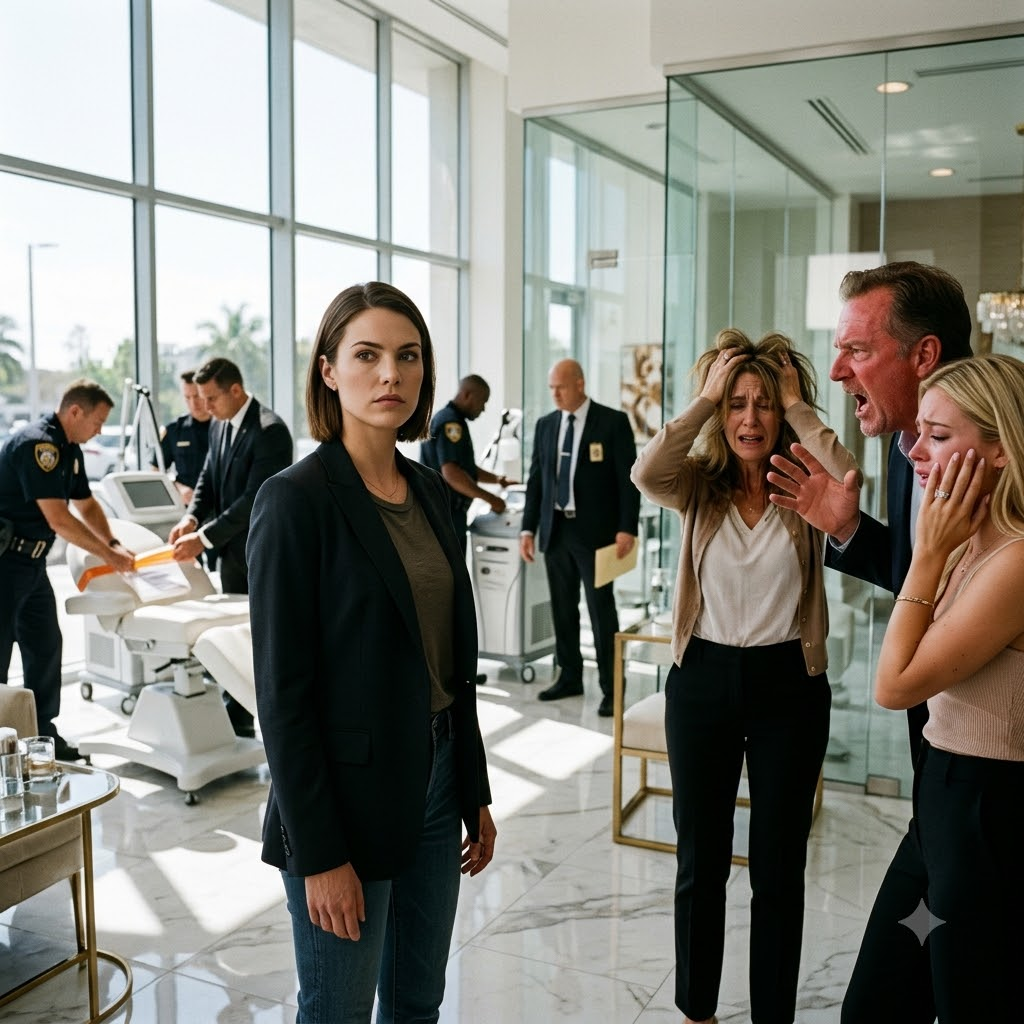
"And do not go to Élan Aesthetics tonight."
I stared at her.
"Why?"
"Because we've received information suggesting there may be a confrontation there."
My pulse quickened.
"What information?"
She hesitated.
"I can't share everything about an active investigation."
"Is my sister safe?"
"We're working to establish that."
I leaned forward.
"Detective, please."
She studied me for a moment.
Then said, "Your sister's business has been the subject of a separate regulatory inquiry."
I froze.
"What kind?"
"Questions about licensing, equipment, and certain treatment practices."
I thought about Rebecca's earlier concerns.
The expensive machines.
The advertisements.
The financing.
Everything was converging.
Ortiz continued.
"That doesn't establish criminal wrongdoing. But it means several agencies may have an interest in the records connected to that business."
I swallowed.
"And Dad?"
She didn't answer directly.
"Let us handle the immediate safety concerns."
I nodded.
But I knew one thing.
Whatever my family had been hiding, the walls were beginning to close in.
After Detective Ortiz left, Whitmore spread Grandma's documents across the conference table.
He looked at the brass key.
Then at me.
"I think it's time."
My heart jumped.
"Locker 214?"
He nodded.
"The facility is called Lakeview Private Archives. Margaret rented secure storage there through the trust."
I leaned forward.
"Can we go tonight?"
"No. The facility is closed."
I groaned.
"Of course it is."
"But I spoke with the manager. He agreed to meet us at eight tomorrow morning."
I looked at the clock.
Eight tomorrow.
Thirteen hours.
It felt impossible.
Whitmore continued.
"We'll bring the trust documents, the key, and the authorization paperwork."
"What about Eleanor?"
"That remains a problem."
I frowned.
"You said we needed her signature."
"Yes. But there may be an alternative procedure if she cannot appear."
"What kind?"
"A court-authorized release, depending on the terms of the storage agreement and the circumstances."
I sighed.
"Which could take weeks."
"Possibly."
I leaned back.
Grandma had left me a key.
A name.
A trail of documents.
But every answer seemed to require another signature.
Another legal procedure.
Another person who might already be in danger.
Boon looked at Whitmore.
"Margaret must have anticipated this."
Whitmore nodded slowly.
"She usually did."
He opened Grandma's letter again.
Read it.
Then stopped.
"What?" I asked.
He looked at the page.
"There's something here I overlooked."
I leaned forward.
He pointed to a line near the bottom.
If Eleanor cannot come, remember the second witness.
I frowned.
"Second witness?"
Whitmore stared at the words.
Then looked at Boon.
Boon's expression changed.
"What?" I asked.
Whitmore spoke slowly.
"Margaret's storage agreement required two designated witnesses when she established the archive."
"Who were they?"
"Eleanor was one."
I looked at Boon.
He was staring at the table.
Then he whispered, "I was the other."
I froze.
"You?"
He nodded.
"I signed something for Margaret years ago. She told me it was to confirm the machine's provenance and some stored family records."
Whitmore looked almost relieved.
"Then we may have what we need."
I stared at Boon.
"You never told me."
He looked ashamed.
"I didn't know what it meant."
I wanted to be angry.
But I couldn't.
Boon had spent the last twenty-four hours protecting me.
He'd stood between me and intruders.
He'd helped save Grandma's documents.
And he'd never once asked for anything in return.
I reached across the table.
Touched his hand.
"Thank you."
His eyes filled.
He looked away.
"Don't thank me yet, kid."
At nine thirty, I finally left Whitmore's office.
This time, I wasn't going home.
Detective Ortiz had recommended that I stay somewhere secure while the threats were being investigated.
Whitmore arranged a room at a small hotel under a reservation made through his office.
Boon insisted on staying nearby.
We drove separately.
Before leaving, I stopped beside Grandma's Singer machine head, which we'd brought from my apartment earlier for safekeeping.
It sat on a table in Whitmore's locked records room.
The old black metal was scratched.
The gold lettering had faded.
But I could still see the tiny mark Grandma had made near the handwheel.
A small white scratch.
I remembered asking her about it when I was eight.
She'd smiled.
"That's where I learned not to rush."
I'd laughed.
"How?"
"Because I rushed, and the machine reminded me."
I had never understood why she loved that old thing so much.
Now I did.
It wasn't just a machine.
It was a witness.
It had been there through her marriage.
Her widowhood.
Her daughter's betrayal.
Her granddaughter's childhood.
And her final years.
It had carried the evidence she couldn't safely give me while she was alive.
I touched the handwheel.
"One more day, Grandma," I whispered.
"Just one more day."
I reached the hotel shortly after ten.
The room was small but clean.
A bed.
A desk.
A television.
A window overlooking a parking lot.
I locked the door.
Checked the chain.
Then checked it again.
Boon called from his room down the hall.
"You all right?"
"Yes."
"Eat something."
"I will."
"That's what you said this morning."
I almost smiled.
"Good night, Boon."
"Good night, kid."
I set my handbag on the desk.
Then opened Grandma's notebook.
I couldn't stop thinking about the hospital video.
The bottle.
My mother's voice.
The words Eleanor had spoken.
Your grandmother didn't die the way they told you.
I turned to the entries from Grandma's final month.
Most were brief.
Medication changes.
Appointments.
Visits.
Then I found one dated eleven days before her death.
Karen brought new pills. Said doctor approved. I refused.
My stomach tightened.
The next entry was dated three days later.
Richard angry. Says I must stop asking questions.
I turned another page.
Elodie came. Wanted signature. I told her no.
I stared at the handwriting.
Grandma had been fighting.
Even while bedridden.
Even while weak.
Even while everyone around her insisted she was confused.
She'd been fighting.
I turned to the final page.
There was an entry I hadn't noticed.
The writing was faint.
Almost illegible.
Fallon knows my medicines. Fallon will notice.
My throat tightened.
I remembered the medication organizer I'd filled every Sunday.
Seven compartments.
Morning.
Afternoon.
Evening.
I knew every pill.
Every dosage.
Every change.
At least, I thought I did.
Then I remembered the last week.
Mom had insisted on taking over.
"You're exhausted, Fallon. Let me handle it."
I'd been grateful.
So grateful.
I'd spent ten years caring for Grandma while working full-time.
I was tired.
And when my mother finally offered help, I'd accepted it.
I had handed over the medication organizer.
I had trusted her.
I closed my eyes.
"Oh, Grandma."
A memory surfaced.
The night before Grandma was hospitalized, I'd visited her at home.
She'd been unusually sleepy.
Her words were slurred.
I asked whether she'd taken her evening medication.
Mom answered from the doorway.
"Of course she has."
I checked the organizer.
The compartment was empty.
I assumed everything was fine.
But now I remembered something else.
The pills looked different.
One tablet had been pale blue.
I'd never seen it before.
I opened my eyes.
My heart hammered.
I grabbed my phone.
Opened my photographs.
Scrolled backward.
I had taken pictures of Grandma's medication labels months earlier.
It was how I kept track of refills.
I found the folder.
Then I opened the last photograph I'd taken before her hospitalization.
The organizer sat on her bedside table.
Seven compartments.
The pills were visible through the plastic.
And there it was.
A pale blue tablet.
I zoomed in.
The image was blurry.
But I could make out part of an imprint.
Two letters.
Maybe a number.
I stared at it.
Then sent the photograph to Detective Ortiz with a message explaining what I remembered.
I didn't know whether it meant anything.
But for the first time, I had something more than suspicion.
I had a photograph.
At 11:18 p.m., someone knocked on my hotel room door.
My heart stopped.
Three knocks.
A pause.
Then two more.
I stared at the door.
The same pattern.
My apartment.
Whitmore's office.
Now the hotel.
I backed away.
My phone was already in my hand.
Then a familiar voice spoke.
"Fallon?"
Elodie.
I froze.
"Elodie?"
"Please open the door."
Her voice was weak.
I moved toward the peephole.
She stood alone in the hallway.
Her copper-red hair was tangled.
Her green blouse was wrinkled.
Her mascara had run down her cheeks.
She looked nothing like the polished woman who'd laughed at my inheritance.
I didn't open the door.
"How did you find me?"
She looked directly at the peephole.
"Mom told me."
My stomach tightened.
"How did Mom know?"
Elodie shook her head.
"I don't know."
I stepped backward.
That was enough.
I wasn't opening the door.
"Elodie, call the police."
She began crying.
"Fallon, please."
"Tell me what's wrong."
She looked over her shoulder.
Then whispered, "Dad hit me."
My breath caught.
I remembered the photograph from the spa.
My father standing beside Eleanor.
The black SUV.
The messages.
The video.
I swallowed.
"Are you hurt?"
She nodded.
I looked at the security chain.
Then at my phone.
"Stay there. I'm calling someone."
"No!"
Her voice rose.
"Please don't call Dad."
"I'm not calling Dad."
She pressed her forehead against the door.
"Fallon, I don't know what to do."
I closed my eyes.
For thirty-eight years, I'd been the sister who fixed things.
The sister who answered late-night calls.
The sister who forgave.
But this time, I couldn't simply open the door because she was crying.
Not when people were following me.
Not when my family had been lying for years.
I called the front desk.
Asked them to send security to my floor.
Then I called Boon.
He answered immediately.
"Fallon?"
"Elodie's outside my room."
A pause.
"I'm coming."
I waited.
Elodie kept crying.
Then she whispered something that made my stomach turn.
"Mom told me to get the key."
I froze.
"What?"
She covered her mouth.
Then shook her head.
"She said if I brought her the key, she'd make everything go away."
I stared at the door.
"Elodie, did you come here for the key?"
She began sobbing.
"I don't know anymore."
I felt something inside me break.
Not loudly.
Not dramatically.
Just a quiet realization.
My sister had come to me because she was afraid.
But she had also come because my mother had sent her.
Even now.
Even after everything.
Mom was using one daughter against the other.
I leaned against the wall.
"Elodie, listen carefully. I'm not giving you the key."
She nodded through her tears.
"I know."
"And I'm not going anywhere with you."
"I know."
"But if you're hurt, I'll help you get medical attention."
She looked up.
For the first time, she seemed genuinely surprised.
"Why?"
I stared at her.
"Because you don't deserve to be hurt."
Her face crumpled.
She covered her mouth.
Then whispered, "I don't deserve you."
I didn't answer.
Because I wasn't sure what to say.
Boon arrived with hotel security.
They escorted Elodie to a small meeting room near the lobby.
I joined them after confirming that the area was monitored and that staff were present.
Elodie sat at a table holding a paper cup of water.
Her left cheek was swollen.
There was a small bruise near her jaw.
Seeing it made my stomach twist.
I sat across from her.
"Did Dad do that?"
She nodded.
"Why?"
She stared at the table.
"Because I told him I wanted out."
"Out of what?"
She swallowed.
"The business."
I frowned.
"Elodie..."
She looked up.
"You think I knew everything."
I didn't answer.
She continued.
"I knew Mom was moving money. I knew Dad was using different companies. But they told me it was normal."
I stared at her.
"Normal?"
"Business financing. Tax planning. Asset protection."
I felt anger rise.
"Grandma couldn't afford proper nursing care."
Elodie flinched.
"I know."
"No, you don't."
She began crying again.
I leaned forward.
"While I was changing her sheets, you were buying machines worth more than my shop."
"I didn't know where all the money came from."
"But you knew some of it came from Grandma."
She looked away.
Silence.
That was answer enough.
I felt my chest tighten.
"Elodie."
She whispered, "Mom said Grandma wanted to help."
I shook my head.
"Grandma said no."
Elodie covered her face.
"I know that now."
I stared at her.
For years, I'd wanted my sister to admit what she'd done.
To acknowledge that she'd been favored.
That she'd benefited.
That she'd watched me struggle while she accepted everything.
Now she was sitting across from me, crying.
And I felt no satisfaction.
Only exhaustion.
I asked quietly, "Why did you come here?"
She lowered her hands.
"Because I found something."
My heart quickened.
"What?"
She reached into her handbag.
Pulled out a folded document.
Placed it on the table.
It was a bank transfer confirmation.
The amount was $92,000.
The recipient was a private medical services company.
I frowned.
"What is this?"
Elodie swallowed.
"Mom paid them."
"For what?"
She shook her head.
"I don't know."
I looked at the date.
Three days before Grandma died.
My blood turned cold.
"Elodie..."
She began crying again.
"I found it in the spa's accounting files."
I stared at the document.
"Why would the spa pay a medical services company connected to Grandma?"
Elodie whispered, "That's what I asked Mom."
"What did she say?"
"She told me to forget I saw it."
I looked at the amount again.
Ninety-two thousand dollars.
Three days before Grandma died.
I felt sick.
"Do you know who received the money?"
Elodie nodded.
"The company belongs to a doctor."
My heart hammered.
"Which doctor?"
She looked at me.
"Dr. Adrian Kessler."
The name meant nothing to me.
Then she added, "He worked at St. Catherine's."
I stopped breathing.
Grandma's hospital.
I looked at Boon.
His face had gone pale.
Elodie continued.
"He wasn't Grandma's regular doctor. But he had access to her records."
I stared at her.
"How do you know?"
She pulled another paper from her bag.
A printed email.
The sender was my mother.
The recipient was Dr. Kessler.
The subject line read:
PRIVATE ARRANGEMENT — MARGARET BELLAMY
I felt my hands go numb.
Elodie whispered, "I printed it before Dad took my laptop."
I looked at the email.
It contained only a few lines.
Adrian,
The situation has become urgent. Margaret is asking questions again.
We need the matter handled before Fallon discovers the account.
Payment will be processed through the usual channel.
Karen.
I stared at the words.
My mother.
My grandmother.
My name.
The account.
Everything connected.
I looked at Elodie.
"Did you read this?"
She nodded.
"That's when I told Dad I wanted out."
"And he hit you?"
She nodded again.
I closed my eyes.
Then opened them.
"Elodie, we need to give this to the police."
She looked terrified.
"Will I go to jail?"
I didn't lie.
"I don't know."
She began crying.
I reached across the table.
Touched her hand.
"But hiding it won't make it disappear."
She nodded slowly.
For the first time in our lives, we were sitting on the same side of a problem.
Not because everything was forgiven.
Not because the past had vanished.
But because the truth had finally become too dangerous to ignore.
At 1:42 a.m., Detective Ortiz arrived at the hotel.
She interviewed Elodie separately.
I waited in the lobby with Boon.
The television above the reception desk played a late-night news program.
I barely noticed it.
My thoughts kept returning to the email.
The situation has become urgent.
Margaret is asking questions again.
We need the matter handled.
What did that mean?
Had Mom arranged for someone to frighten Grandma?
To silence her?
To change her medication?
Or was there another explanation?
I wanted to believe there was.
I wanted desperately to believe my mother hadn't done something unforgivable.
But the evidence was growing.
And every new document made the possibility harder to dismiss.
Boon sat beside me.
"You need some sleep."
I shook my head.
"I can't."
He sighed.
"Your grandmother would be furious with me if I let you collapse."
I almost smiled.
"She'd tell you to stop fussing."
He chuckled softly.
"She'd tell me I was fussing while fussing twice as much herself."
I looked at him.
For a moment, I remembered Grandma alive.
Laughing.
Complaining about the price of groceries.
Insisting that I take the last piece of pie.
I swallowed.
"I miss her."
Boon's eyes filled.
"I know."
I looked down.
"I keep thinking about the last time she held my hand."
He said nothing.
"She was trying to tell me something."
Boon reached over.
Squeezed my shoulder.
"Maybe she already did."
I looked at him.
He nodded toward my handbag.
"The notebook. The machine. The key."
I swallowed.
"Maybe."
Then my phone vibrated.
A message from Whitmore.
The archive manager has agreed to an earlier appointment. Seven a.m. Be ready.
I stared at the screen.
Seven.
Less than six hours.
Locker 214.
Finally.
At 6:45 a.m., Whitmore, Boon, Detective Ortiz, and I arrived at Lakeview Private Archives.
The facility occupied a converted brick warehouse near the edge of an industrial district.
There were no signs advertising what it stored.
Only a discreet brass plaque beside the entrance.
A man in his sixties met us inside.
His name was Harold Pierce.
He wore a gray suit and carried a ring of keys.
Whitmore introduced us.
Pierce looked at Boon.
"Mr. Mercer."
Boon nodded.
"Harold."
I stared at them.
"You know each other?"
Pierce smiled faintly.
"Your grandmother was a very careful woman, Miss Bellamy."
I was beginning to realize that was the understatement of the century.
Pierce led us through a security checkpoint.
We signed documents.
Presented identification.
Whitmore showed the trust authorization.
Boon confirmed his identity as a designated witness.
Detective Ortiz explained that she was present to observe and document the process.
Pierce examined everything carefully.
Then he nodded.
"All right."
My heart began pounding.
He led us down a long hallway.
Past locked doors.
Past shelves of sealed archival boxes.
Past a security camera mounted above a steel gate.
Finally, we reached a small room.
On the far wall were numbered storage compartments.
I scanned them.
208.
209.
210.
211.
212.
213.
214.
There it was.
A narrow steel door.
A brass keyhole.
A small engraved number.
I felt my throat tighten.
Grandma had known I would come here.
She'd hidden the key.
She'd written the instructions.
She'd trusted me to find my way.
Pierce stepped aside.
"Miss Bellamy, the key."
I reached into my handbag.
My fingers closed around the brass key.
I held it for a moment.
Then stepped forward.
The metal felt cold.
I inserted it into the lock.
Turned.
A soft click.
The door opened.
Inside was a long metal storage box.
Pierce carefully slid it onto the table.
Whitmore looked at me.
"Are you ready?"
I nodded.
But my hands were trembling.
Pierce opened the box.
Inside were three items.
A sealed brown envelope.
A small external hard drive.
And a folded piece of blue fabric.
I stared at the fabric.
It was from one of Grandma's old dresses.
The blue dress she'd worn to my high school graduation.
I remembered sewing a loose button onto it the night before the ceremony.
My throat tightened.
I picked it up.
Beneath it was a handwritten note.
My girl,
If you are here, then you have already learned that the people closest to us can hide the ugliest truths.
I am sorry I could not tell you everything while I was alive.
But I needed you to have proof.
Not rumors.
Not accusations.
Proof.
I swallowed.
The final line was underlined twice.
Watch the recording before you open the envelope.
I looked at the hard drive.
Whitmore nodded.
"We'll make a forensic copy first."
Detective Ortiz agreed.
Pierce provided a secure computer in a nearby examination room.
The drive was connected through a read-only device so its contents wouldn't be altered.
A technician documented the process.
I watched every movement.
Every cable.
Every screen.
Then the technician opened the directory.
There were folders.
Bank records.
Property documents.
Medical correspondence.
And one labeled:
MARGARET — FINAL NIGHT
My heart stopped.
Whitmore looked at me.
"Fallon..."
I nodded.
"Play it."
The technician opened the file.
The screen went black.
Then Grandma's hospital room appeared.
The same room from the seven-second clip.
The same bed.
The same bedside table.
The same small bottle.
But this recording was longer.
Much longer.
The timestamp showed 11:42 p.m.
The night before Grandma died.
My mother entered the frame.
She wore a cream cardigan.
Her hair was pulled back.
She looked tired.
Angry.
Behind her stood a man in a dark jacket.
Dr. Adrian Kessler.
I recognized him from the hospital website Elodie had shown me.
My stomach twisted.
Mom approached Grandma's bed.
"Margaret, we need to talk."
Grandma opened her eyes.
Her voice was weak.
"Where's Fallon?"
"She's gone home."
"Call her."
Mom sighed.
"We've been through this."
Grandma tried to sit up.
Dr. Kessler stepped closer.
"Mrs. Bellamy, you need to rest."
Grandma looked at him.
"I didn't ask for you."
My heart hammered.
Mom leaned forward.
"You've made this very difficult."
Grandma's voice was faint.
"You took my money."
I covered my mouth.
Mom's expression changed.
"Don't start."
"You took the house."
"Mother, please."
"You used Fallon's name."
I felt tears burn behind my eyes.
Grandma knew.
She knew everything.
Mom looked toward Dr. Kessler.
Then back at Grandma.
"We can fix this if you stop making accusations."
Grandma shook her head.
"No."
Mom's voice sharpened.
"Think about Elodie."
Grandma closed her eyes.
"I did."
"She's going to lose everything."
"Then she must face what she did."
Mom stepped backward.
For a moment, she looked genuinely frightened.
Then Dr. Kessler spoke.
"Karen, we need to finish this conversation."
He reached toward the bedside table.
The small bottle appeared in his hand.
I gripped the edge of the desk.
The technician paused the video.
I turned toward him.
"Why did you stop?"
Detective Ortiz answered.
"Because we need to document the file and make sure everyone understands what we're viewing."
I stared at her.
"Please."
She studied my face.
Then nodded to the technician.
The video resumed.
Dr. Kessler placed the bottle on the table.
Mom looked at Grandma.
Her voice dropped.
"Margaret, I'm giving you one last chance."
Grandma opened her eyes.
And then she said something that made me stop breathing.
"Karen, I know about Eleanor."
My mother's face went white.
Dr. Kessler froze.
Grandma continued.
"I know Richard kept her hidden."
Mom whispered, "You don't understand."
Grandma's voice strengthened.
"I understand enough."
She reached beneath her blanket.
Pulled out a folded piece of paper.
Held it toward Mom.
"Tell Fallon the truth."
Mom stared at the paper.
Then slowly reached for it.
Grandma pulled it away.
"No."
Mom's expression hardened.
"Mother."
"Not until she knows."
I leaned closer to the screen.
The paper.
Grandma was holding something.
Something my mother wanted.
Then Dr. Kessler moved toward the bed.
The camera angle shifted slightly.
And a third voice spoke.
A woman's voice.
From somewhere near the door.
"Don't touch her."
My heart stopped.
The technician adjusted the volume.
The woman stepped into the frame.
Silver hair.
A small scar above her eyebrow.
Eleanor Whitcomb.
I stared at the screen.
Boon whispered, "Good Lord."
Eleanor stood beside Grandma's bed.
Alive.
Twenty years after her supposed death.
She looked terrified.
But determined.
Mom stepped backward.
"Eleanor?"
Eleanor ignored her.
She looked at Grandma.
"Margaret, I brought the originals."
Grandma began crying.
My chest tightened.
Eleanor reached into her handbag.
Pulled out a thick blue ledger.
Placed it on the bed.
Mom lunged forward.
Dr. Kessler grabbed her arm.
"Karen, stop."
Eleanor looked directly toward the camera.
Then said something I would never forget.
"If anything happens to Margaret, this recording goes to the police."
The room went silent.
Mom stared at her.
Then slowly smiled.
It was the coldest expression I'd ever seen on my mother's face.
"You think you're the only one who knows how to keep secrets?"
Eleanor's face changed.
"What do you mean?"
Mom looked toward the doorway.
Then said, "Richard, come in."
My blood turned cold.
My father entered the room.
He wasn't alone.
Behind him stood Martin Vale.
The man who had tried to force his way into Whitmore's office.
The man whose company had received money from Grandma's accounts.
The man Grandma had never trusted.
My father looked at Eleanor.
Then at the ledger.
His expression darkened.
"Give me the book."
Eleanor stepped backward.
"No."
Dad moved closer.
"Eleanor, don't make this difficult."
She shook her head.
"You've already taken twenty years of my life."
I stared at the screen.
Twenty years.
My father had been involved in Eleanor's disappearance.
Grandma had known.
And now they were all standing in her hospital room.
My father reached for the ledger.
Eleanor pulled it away.
Then Grandma spoke.
Her voice was weak.
But clear.
"Richard."
He turned.
She looked directly at him.
"You won't hurt another woman in this family."
My father froze.
For several seconds, no one moved.
Then he said quietly, "You should have left this alone, Margaret."
The camera shook.
Someone moved toward the bed.
A hand reached across the frame.
The image blurred.
Then the screen went black.
I gasped.
"No."
The technician checked the file.
"There are a few seconds of interruption."
I leaned forward.
"Keep playing."
The image returned.
Grandma was lying back against her pillows.
Eleanor was crying.
Mom stood near the door.
Dr. Kessler was holding the small bottle.
And my father was speaking into his phone.
I couldn't hear what he said.
Then the camera shifted again.
Dr. Kessler approached Grandma's bed.
He looked at Mom.
"Are you sure?"
My mother's face was pale.
She didn't answer.
He looked toward my father.
Dad nodded once.
I felt my stomach drop.
Dr. Kessler reached for a syringe.
Detective Ortiz leaned forward.
The technician increased the brightness.
I stared at the screen.
Grandma opened her eyes.
She looked directly toward the camera.
And whispered one word.
"Fallon."
I began crying.
I couldn't stop.
Because she had been asking for me.
She had wanted me there.
And I hadn't known.
Boon put his arm around my shoulders.
I barely felt it.
On the screen, Eleanor moved forward.
"Stop!"
Dr. Kessler turned.
Eleanor grabbed his wrist.
The syringe fell.
It struck the floor.
Mom screamed.
My father lunged toward Eleanor.
The camera tipped sideways.
For several seconds, the image showed only the ceiling.
Voices overlapped.
Footsteps.
A crash.
Then Grandma's voice.
Weak.
But unmistakable.
"Don't let them take the ledger."
The recording ended.
I stared at the black screen.
My hands were shaking.
No one spoke.
Not Whitmore.
Not Boon.
Not Detective Ortiz.
Not the technician.
Finally, I whispered, "What happened after that?"
The technician checked the file.
"That's the end of this recording."
I stared at him.
"No."
He looked uncomfortable.
"I'm sorry."
I turned toward Whitmore.
"There's more."
He nodded slowly.
"Possibly."
I looked at the sealed brown envelope.
Grandma's final instruction.
Watch the recording before you open the envelope.
I reached for it.
Detective Ortiz gently stopped me.
"Fallon, let us document it first."
I nodded.
The envelope was photographed.
The seal examined.
The exterior recorded.
Then Whitmore carefully opened it.
Inside was a letter.
And a photograph.
The photograph showed my father standing beside a younger Eleanor Whitcomb.
Between them was a little girl.
She couldn't have been more than five.
Dark hair.
A white dress.
A small silver bracelet.
I stared at the photograph.
Something about the girl's face looked familiar.
The shape of her eyes.
The curve of her mouth.
The tiny dimple in her left cheek.
I looked at Whitmore.
"Who is that?"
He didn't answer.
Instead, he unfolded Grandma's letter.
His expression changed.
He read the first paragraph.
Then stopped.
"Charles?" Boon asked.
Whitmore looked at me.
His eyes were filled with something I couldn't understand.
Pity.
Fear.
And disbelief.
"Fallon," he whispered, "there's something your grandmother wanted you to know before you saw this photograph."
My heart began pounding.
"What?"
He looked down at the letter.
Then slowly turned it toward me.
At the top, Grandma had written:
My dearest Fallon,
There is a reason your father was so desperate to keep Eleanor hidden.
There is a reason Karen never wanted you asking questions about your childhood.
And there is a reason I made sure you inherited the sewing machine.
I stared at the words.
My throat tightened.
Then I reached the next sentence.
And everything inside me went still.
The little girl in this photograph is you.
I looked at the picture again.
My father.
Eleanor.
Me.
But the photograph was dated twenty years earlier.
I would have been eighteen.
The child in the photograph was no older than five.
I frowned.
"That can't be right."
Whitmore leaned closer.
I looked at the date again.
Then I noticed something.
The photograph wasn't dated twenty years earlier.
It was dated thirty-three years earlier.
I had misread the faded ink.
Thirty-three years.
I was five.
The girl was me.
My hands began trembling.
I looked at Eleanor's face.
Then at my own.
The same eyes.
The same mouth.
The same dimple.
I felt dizzy.
"Why was I with Eleanor?"
Whitmore didn't answer.
I looked back at Grandma's letter.
There was one more paragraph.
The handwriting was shaky.
But the words were clear.
Fallon, I have loved you every day of your life.
I have watched you become the kindest woman I know.
But there is something I should have told you long ago.
I swallowed.
My heart hammered.
Then I read the final sentence.
Karen Bellamy is not your biological mother.
I stopped breathing.
The room tilted.
Boon grabbed my chair.
Whitmore reached toward me.
But I barely noticed.
Because I was staring at the photograph.
At Eleanor Whitcomb.
At the woman who had supposedly died twenty years ago.
At the woman my father had kept hidden.
And at the little girl standing between them.
Me.
Then Detective Ortiz's phone rang.
She answered.
Listened.
Her expression changed.
"What do you mean she's gone?"
I looked up.
Ortiz stood.
"Where?"
A pause.
Then she said, "Secure the scene. Don't let anyone leave."
My heart hammered.
"Detective?"
She lowered the phone.
Her face was pale.
"Fallon, officers located the medical transport vehicle."
I stood.
"And Eleanor?"
Ortiz hesitated.
"The vehicle was abandoned."
My stomach dropped.
"Where is she?"
Ortiz looked at Whitmore.
Then at me.
"There was blood inside."
I gripped the table.
Before I could speak, my phone vibrated.
An unknown number.
A photograph appeared.
Eleanor Whitcomb sat in a chair.
Her hands were bound.
Her face was bruised.
Behind her stood a man in a dark suit.
My father.
I stared at the screen.
Then a message appeared.
You opened the wrong box.
A second message followed.
If you want your real mother alive, bring the original deed to Élan Aesthetics.
My hands began shaking.
Then the final message arrived.
Midnight. Come alone.
I looked at Detective Ortiz.
She was already reaching for her radio.
But before she could speak, another photograph loaded.
This one showed a locked room.
A medical treatment chair.
Several expensive machines.
And a woman lying motionless beneath a white sheet.
Only one hand was visible.
A delicate gold bracelet hung from her wrist.
I recognized it.
Elodie's bracelet.
The one Mom had given her for her twenty-fifth birthday.
My phone rang.
Dad.
I answered without thinking.
"Where's Elodie?"
My father laughed softly.
"Fallon, sweetheart, you finally understand."
I felt my blood turn cold.
"Understand what?"
A pause.
Then he whispered, "One daughter was never supposed to survive this."
The line went dead.
And at that exact moment, the archive's emergency alarm began screaming.
The steel door behind us slammed shut.
The lights went out.
Then a man's voice came through the darkness.
"Nobody move."
A flashlight snapped on.
And someone standing beside locker 214 raised a gun.






Comments 0