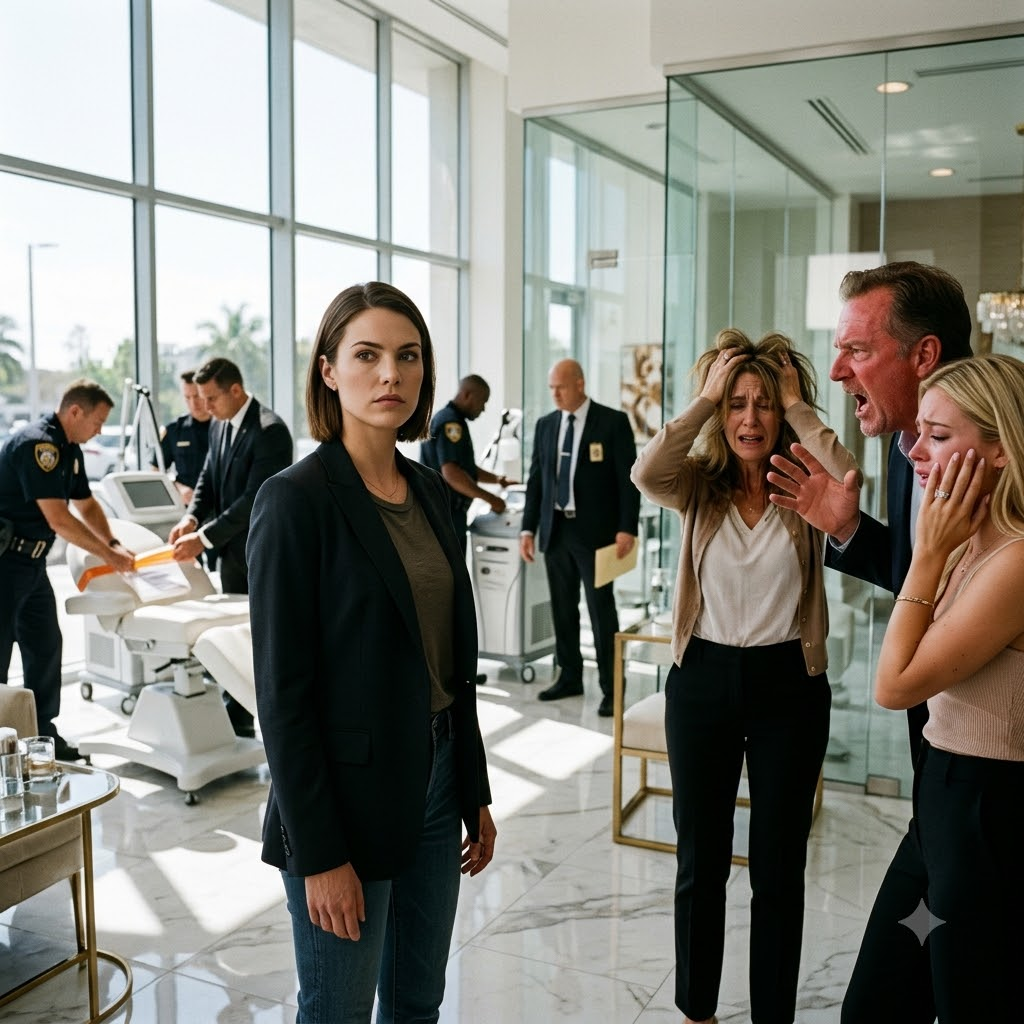
"Someone's inside!" I whispered, grabbing Boon's arm as the front door clicked open in the darkness.
Boon caught my wrist before I could reach for the light switch.
"Don't move, Fallon."
His voice was barely audible.
Across the workshop, the security alarm gave one weak electronic chirp and fell silent.
Then came footsteps.
Slow.
Deliberate.
Someone was moving through the front room.
And whoever it was had somehow unlocked a door I knew I'd secured less than an hour earlier.
I stood frozen beside my grandmother's antique Singer sewing machine, clutching my phone with one hand and the brass key we'd discovered inside its hidden compartment with the other.
On my phone screen, the legal document Charles Whitmore had emailed me remained open.
Under the heading Contingent Beneficiary was a name that had made Boon drop his coffee.
Eleanor Whitcomb.
I had never heard of her.
But Boon apparently had.
Because the moment he saw that name, his face had turned white.
And he'd whispered that Eleanor Whitcomb was supposed to be dead.
Now someone was inside my shop.
I couldn't decide which frightened me more.
The stranger moving toward us.
Or the possibility that my grandmother had spent her final years protecting a secret connected to a dead woman.
A floorboard creaked near the fitting room.
Boon leaned close to my ear.
"Back office. Now."
I shook my head.
"What about the documents?"
He looked toward the workbench.
The papers were scattered beneath the inspection lamp.
Copies of deeds.
Bank transfers.
A photograph of Elodie's medical spa.
Grandma's black notebook.
And the faded red ribbon that had held everything together.
There was no time to gather them neatly.
Boon grabbed the entire stack and shoved it beneath his jacket.
I slipped the notebook into my handbag.
Then we moved toward the back office.
I knew every inch of my workshop.
The narrow aisle between the cutting tables.
The rack of unfinished dresses.
The small storage room where I kept adaptive fasteners, specialized zippers, and expensive fabric.
I could walk through it blindfolded.
Tonight, I nearly had to.
The emergency lights had failed along with the overhead fixtures.
Only the pale glow of streetlights filtered through the front windows.
Behind us, something metallic scraped against the floor.
I stopped.
Boon pushed me forward.
"Keep going."
We reached the office.
I slipped inside.
Boon followed and closed the door without letting the latch click.
The room was barely large enough for a desk, two chairs, and a filing cabinet.
I crouched beside the desk.
Boon stood near the door, listening.
Footsteps crossed the workshop.
Then stopped.
A man's voice spoke.
"Machine's here."
My stomach dropped.
Another voice answered from farther away.
"Check the cabinet."
There were two of them.
I pressed my hand against my mouth.
The first man moved something heavy.
Metal scraped against tile.
Grandma's Singer.
They were touching it.
I felt a sudden, irrational surge of anger.
That machine had been hers for decades.
She'd taught me to sew on it.
She'd rested her hands on its worn oak cabinet while telling me stories about her childhood.
Now strangers were dragging it across my workshop like stolen furniture.
Boon touched my shoulder.
He pointed at my phone.
I understood.
I opened the emergency call screen.
My thumb trembled so badly I almost pressed the wrong number.
The dispatcher answered.
"911. What's the address of your emergency?"
I whispered my shop's address.
"Two men have broken into my business. I'm hiding in the back office."
"Are you in immediate danger?"
"Yes."
"Do they have weapons?"
"I don't know."
"Stay where you are if it's safe. Officers are being dispatched."
I lowered the phone but kept the connection open.
In the workshop, one of the men cursed.
"Empty."
A pause.
"What?"
"The compartment. Somebody already opened it."
My heart hammered.
They knew exactly where to look.
The second man spoke.
"Find the papers."
Something crashed.
A chair.
Then another sound.
Glass breaking.
I squeezed my eyes shut.
My workshop.
The business I'd built from nothing.
The only place in my life that had ever felt entirely mine.
They were tearing it apart.
Boon leaned closer.
"Fallon, listen carefully."
I looked at him.
"If they get through this door, you go out the office window."
I stared.
"It's too narrow."
"You're smaller than I am."
"I'm not leaving you."
His expression hardened.
"Don't argue with me."
I opened my mouth.
Then we heard footsteps approaching.
The office doorknob turned.
Once.
Twice.
A man's voice came through the wood.
"Miss Bellamy?"
My blood went cold.
He knew my name.
"We don't want trouble."
Boon stepped in front of me.
The man continued.
"We just need something that belongs to your family."
I stared at the door.
My mother had used almost the same words.
Family property.
As if those two words could erase a legal inheritance.
As if everything Grandma had left me automatically belonged to the people who had ignored her while she was alive.
I forced myself to speak.
"Who sent you?"
Silence.
Then the man laughed softly.
"You're making this harder than it needs to be."
"Who sent you?"
"Open the door."
"No."
The handle rattled again.
Then something struck the wood.
Hard.
I flinched.
Boon braced his shoulder against the door.
The second blow cracked the frame.
I heard the dispatcher speaking from my phone.
"Ma'am, officers are on their way. Do not confront the intruders."
Another impact shook the door.
Boon looked at me.
"Window. Now."
I moved toward the narrow window above the filing cabinet.
It opened onto the alley.
I pushed the cabinet aside and climbed onto the chair.
My hands fumbled with the latch.
Behind me, the office door splintered.
Then, from outside, came a sound so beautiful I nearly cried.
A police siren.
The men stopped.
One shouted, "Move!"
Footsteps thundered across the workshop.
The front door slammed.
An engine roared.
And suddenly, the building was silent again.
I remained perched on the chair, gripping the window frame.
Boon leaned against the damaged office door.
Neither of us spoke.
Then he let out a shaky breath.
"Well," he muttered, "Margaret certainly knew how to leave a complicated inheritance."
I almost laughed.
Instead, I started crying.
Not loudly.
Not dramatically.
Just exhausted tears I couldn't stop.
Boon crossed the room and wrapped one arm around my shoulders.
"It's all right, kid."
I shook my head.
"No, it isn't."
He didn't argue.
Because we both knew I was right.
The police arrived four minutes later.
Officer Reyes was among them.
He recognized me immediately.
"Miss Bellamy?"
I nodded.
He looked at the damaged office door.
Then at the overturned furniture.
"Are you injured?"
"No."
"Did they touch you?"
"No."
His partner moved through the workshop while another officer checked the alley.
The intruders were gone.
They had escaped before the patrol cars reached the building.
My front door showed signs of tampering around the lock.
The power had been shut off at an exterior service disconnect.
Someone had known where to find it.
Someone had known how to enter.
And someone had known about the hidden compartment beneath Grandma's sewing machine.
That last detail frightened me most.
Officer Reyes took another statement.
This time, I told him everything.
The inheritance.
The offers.
The threatening text.
The documents.
My mother's visit.
My father's strange phone call.
And the two men who had demanded the papers.
He listened carefully.
When I finished, he asked, "Do you have reason to believe your family arranged this?"
I hesitated.
"I don't have proof."
"That's important."
"I know."
He nodded.
"Tell us what you know directly. Let investigators determine the rest."
I appreciated that.
For once, someone wasn't asking me to excuse my family's behavior.
But he wasn't encouraging me to make accusations I couldn't support either.
He simply wanted facts.
I could work with facts.
Facts were better than the twisted emotional rules I'd grown up with.
The officers photographed the damage.
They collected a piece of broken lock hardware.
One checked nearby businesses for exterior security cameras.
Another asked whether my building had surveillance.
I did.
A cheap camera above the front entrance.
Unfortunately, it depended on the same power supply that had been interrupted.
But I remembered something.
"My neighbor has cameras."
Reyes looked up.
"Which neighbor?"
"The pharmacy next door. Their rear camera faces the alley."
He wrote down the information.
"We'll follow up."
I glanced at Grandma's machine.
It had been dragged several feet from the workbench.
The cabinet stood open.
The concealed panel had been torn away completely.
One of the iron treadles was bent.
Seeing it damaged hurt more than I expected.
I knelt beside it.
Ran my fingers across the oak.
"I'm sorry, Grandma," I whispered.
Boon crouched next to me.
"Wood can be repaired."
I looked at him.
"What about everything else?"
He didn't answer immediately.
Then he said, "Some things take longer."
By the time the police left, it was nearly one in the morning.
Officer Reyes advised me not to remain at the shop overnight.
He also told me to preserve the threatening messages, keep the documents secure, and contact an attorney as soon as possible.
I promised I would.
After the patrol cars disappeared, Boon locked the damaged entrance with a temporary security bar from his truck.
Then he returned to the workbench.
"Let's see what we've still got."
He removed the papers from beneath his jacket.
I retrieved Grandma's notebook from my handbag.
The brass key was still in my pocket.
Nothing important appeared to be missing.
I felt a small wave of relief.
Then I remembered the email.
Eleanor Whitcomb.
I looked at Boon.
"You never explained the name."
He went still.
For a moment, I thought he might pretend not to understand.
Then he pulled out a chair.
"Sit down, Fallon."
I didn't like the way he said it.
I sat.
Boon lowered himself into the opposite chair.
He looked suddenly older.
The wrinkles around his eyes seemed deeper.
His hands rested on the table.
"Eleanor Whitcomb was your grandmother's closest friend."
I frowned.
"Grandma never mentioned her."
"She did, years ago. You were probably too young to remember."
"Who was she?"
Boon stared at the damaged sewing machine.
"She and Margaret worked together when they were young. Eleanor was a bookkeeper. Very good with numbers. Margaret handled garment production for a small clothing manufacturer."
I leaned forward.
"Grandma worked in manufacturing?"
"Before she married your grandfather, yes. She was more than a seamstress, Fallon. She helped manage an entire production floor."
I felt a strange ache.
There were so many things I hadn't known.
I'd spent thousands of hours beside Grandma.
Yet somehow, parts of her life remained hidden from me.
Boon continued.
"Eleanor was brilliant. Quiet. Careful. The kind of woman who could look at a ledger and spot a missing dollar."
"What happened to her?"
He rubbed his forehead.
"About twenty years ago, she became involved in a dispute over property investments."
"What kind of dispute?"
"Several people had pooled money into a small real estate partnership. There were questions about missing funds and ownership records."
My stomach tightened.
"Was my father involved?"
Boon looked at me.
"Richard knew some of the people."
"That's not an answer."
"No," he admitted. "It isn't."
I waited.
He sighed.
"Your father was building his property business around that time. Eleanor believed certain records had been altered."
"By Dad?"
"She never proved that."
"But she suspected him?"
Boon looked away.
I felt cold.
"What happened next?"
"Eleanor disappeared."
I stared.
"Disappeared?"
"Her car was found near the lake. Her purse was inside. The police investigated."
"Did they find her?"
"No."
I swallowed.
"Then why did you say she was dead?"
"Because years later, a court declared her legally dead. Her family needed to settle her affairs."
I looked at the legal document on my phone.
"Then why would Grandma list her as a beneficiary?"
"That's what I don't understand."
I read the name again.
Eleanor Whitcomb.
A woman missing for two decades.
A woman who had accused people connected to my father's business of financial wrongdoing.
A woman Grandma had apparently never stopped thinking about.
"Could the document be old?" I asked.
Boon shook his head.
"Look at the execution date."
I checked.
The document had been signed only eight months before Grandma died.
My pulse quickened.
"She knew Eleanor was legally dead."
"Yes."
"Then why include her?"
Boon was silent.
I looked at the scanned page again.
Below Eleanor's name was a reference to a conditional trust provision.
The legal language was complicated.
But one phrase stood out.
Upon verification of identity and survival.
I read it aloud.
Boon's expression changed.
"Verification of survival?"
I nodded.
He leaned closer.
"Read the next line."
I did.
The provision directed the trustee to preserve certain assets until the named beneficiary's status could be independently confirmed.
I stared at the words.
"Grandma thought Eleanor might still be alive."
Boon didn't answer.
He didn't have to.
I called Charles Whitmore at 1:27 a.m.
I expected voicemail.
Instead, he answered on the second ring.
"Fallon?"
His voice sounded strained.
"Mr. Whitmore, someone broke into my shop."
A chair scraped on his end.
"Are you safe?"
"Yes. The police came."
"Was anything taken?"
"No."
"Did they get the documents?"
I froze.
"You know about the documents?"
A long pause.
Then he said, "I know Margaret left instructions concerning certain records."
"Why didn't you tell me at the will reading?"
"Because she placed conditions on when I could disclose particular information."
"Conditions?"
"Yes."
"What conditions?"
He hesitated.
"Fallon, are you alone?"
"Boon Mercer is here."
Another pause.
"Good. Margaret trusted Mr. Mercer."
I looked at Boon.
He was watching me carefully.
"Mr. Whitmore, I need answers."
"I understand."
"Then tell me why my grandmother hid financial records inside a sewing machine."
He exhaled.
"Because she believed someone had been systematically misusing her assets."
My throat tightened.
"Who?"
"She suspected members of her own family."
I closed my eyes.
Hearing it from an attorney made it real in a way my own suspicions hadn't.
Grandma had known.
Or at least feared.
She'd known while I was bathing her.
Feeding her.
Helping her dress.
While my mother complained about how expensive her care had become.
While Elodie posted photographs of her luxury spa.
While my father told everyone the family was doing its best.
Grandma had been quietly collecting evidence.
"Why didn't she report it?"
Whitmore paused.
"She attempted to challenge certain transactions. Some of the records were incomplete, and she was concerned about what might happen if she made accusations without sufficient documentation."
"She could have told me."
"She was worried about you."
I opened my eyes.
"Everyone keeps saying that."
"Because it's true."
"Then why leave me the machine?"
"Because she believed you would protect the evidence once it came into your possession."
I looked at the Singer.
Its cabinet was damaged.
Its iron frame scratched.
But the papers had survived.
"Mr. Whitmore, what happened to her house?"
Another silence.
Then he said, "The foreclosure was more complicated than your parents represented."
"Was it real?"
"There was a foreclosure proceeding."
"That isn't what I asked."
"I know."
"Did Grandma actually owe the money?"
"That is one of the central questions."
I gripped the phone.
"And the three hundred thousand dollars Elodie inherited?"
Whitmore's voice became careful.
"The will provides for that distribution. Whether the funds ultimately available for distribution are affected by claims or other proceedings is a separate matter."
I frowned.
"Are you saying she might not get it?"
"I'm saying no one should assume an announced inheritance is the same as money already transferred into a bank account."
I remembered Elodie's delighted face.
Her plans for the spa expansion.
My mother's proud smile.
For the first time, I wondered whether Grandma had understood exactly how they would react.
"Why give Elodie that much money if she suspected her?"
Whitmore took a breath.
"That is something we need to discuss in person."
"Why not now?"
"Because the documents you're holding are only part of the picture."
I looked toward Boon.
"What's the other part?"
Whitmore hesitated.
Then he asked, "Did you find a brass key?"
My fingers tightened around it.
"Yes."
"Is there a number attached?"
"214."
He went silent.
"Mr. Whitmore?"
"Do not lose that key."
"What does it open?"
"I can't explain that safely over the phone."
My frustration flared.
"Everyone keeps telling me not to do things. Nobody tells me why."
"I understand how this sounds."
"No, I don't think you do. My mother threatened me. My sister tried to buy the machine. My father knows about the hidden compartment. Two men just broke into my shop. And now you're telling me there's another secret?"
His voice softened.
"Fallon, Margaret spent the final years of her life trying to make sure you wouldn't be left defenseless."
I swallowed.
"Against whom?"
He didn't answer directly.
"Come to my office at eight tomorrow morning. Bring Boon. Bring the documents and the key."
"Will you explain everything?"
"I'll explain what I can verify."
I stared at the wall.
Then I asked the question that had been haunting me.
"Did Grandma know she was going to die?"
Whitmore was quiet for a long moment.
"She knew her health was failing."
"That's not what I mean."
"I know."
"Was she afraid someone would hurt her?"
His answer came slowly.
"She was afraid someone would hurt you."
Boon refused to let me drive home alone.
He followed my Honda in his pickup while I took the documents to my apartment.
I lived above a small grocery store in a neighborhood where the sidewalks were uneven and the streetlights sometimes flickered.
My apartment had two bedrooms.
One had been converted into a workspace.
The other contained a narrow bed, a dresser, and a photograph of Grandma on my nightstand.
She was smiling in the picture.
Her hair was pinned back.
She wore a blue cardigan I'd made for her.
I had taken the photograph on her seventy-eighth birthday.
Looking at it now, I wondered how many secrets she'd been carrying behind that smile.
Boon helped me carry the Singer's detachable machine head into the apartment.
We left the damaged cabinet secured at the shop.
He insisted that the most important documents remain with me.
I placed them inside a locked metal file box.
Then I made copies of the photographs and scanned pages on my laptop.
I saved them to an encrypted drive.
Boon watched quietly.
"Good," he said. "Keep separate copies."
I looked at him.
"Do you think they'll come after me again?"
He didn't lie.
"I think whoever sent those men is frightened."
"Of what?"
"Of whatever Margaret collected."
I looked at the brass key.
"And Eleanor Whitcomb?"
Boon's expression darkened.
"That's a different kind of fear."
I sat on the edge of my bed.
For a moment, exhaustion overwhelmed me.
I wanted to sleep.
I wanted to wake up and discover that the past twelve hours had been a nightmare.
I wanted Grandma to be alive.
I wanted my mother to be merely cruel instead of potentially criminal.
I wanted my sister's greatest offense to be selfishness.
And I wanted my father to be a man whose disappointment could still be mistaken for concern.
But the documents were real.
The broken lock was real.
The threatening message was real.
And Grandma was gone.
I looked at Boon.
"Do you think she knew what they were doing?"
He sat in the chair beside my bed.
"I think Margaret knew enough to be frightened."
"Why didn't she go to the police?"
"Maybe she tried. Maybe she didn't trust the evidence she had. Maybe she was waiting for one last piece."
I looked down.
"Or maybe she didn't want to believe her own daughter could betray her."
Boon said nothing.
That silence was answer enough.
At 3:14 a.m., I finally opened Grandma's black notebook again.
Boon had fallen asleep in the living room chair.
I sat at my kitchen table beneath a small lamp.
The notebook smelled faintly of old paper and lavender.
Grandma had always tucked dried lavender into her drawers.
She said it kept the moths away.
I turned the pages carefully.
Dates.
Amounts.
Names.
Some entries were ordinary.
Medical expenses.
House repairs.
Insurance payments.
Others were marked with small red circles.
One entry read:
Karen requested new authorization. Refused.
Another:
Richard came without calling. Asked about Eleanor.
I stopped.
Eleanor.
I turned the page.
Elodie says expansion depends on bridge financing. Karen insists I must help.
My stomach tightened.
The next entry was dated three weeks later.
Bank called about payment I did not authorize.
I stared.
Then another.
Requested copies. Karen intercepted mail.
My hands began shaking.
I remembered my mother collecting Grandma's mail.
She said it was easier to keep everything organized.
I had believed her.
Of course I had.
She was my mother.
I turned another page.
Fallon must not be told until I can protect her.
Tears blurred the words.
"Grandma," I whispered.
I pressed my fingers against the paper.
"You should have trusted me."
Then I saw a final entry.
It was written in darker ink.
The letters were uneven.
Grandma's hand had clearly been trembling.
November 17. Eleanor's proof. Locker 214.
My breath caught.
The key.
The date.
The missing woman.
I turned the page.
There was one more sentence.
If Richard learns she is alive, he will destroy everything.
I stared at it.
Read it again.
Then a third time.
Eleanor was alive.
Or Grandma believed she was.
I felt my pulse hammering in my ears.
I looked toward the living room.
Boon was still asleep.
I reached for my phone.
There was a message from an unknown number.
It had arrived at 2:58 a.m.
I opened it.
A photograph filled the screen.
My apartment building.
Taken from across the street.
The timestamp showed it had been captured less than twenty minutes earlier.
Beneath the image was a single sentence.
Your grandmother should have stopped looking.
I stood so quickly my chair fell backward.
Boon woke at the sound.
"Fallon?"
I couldn't speak.
I turned the phone toward him.
He stared at the photograph.
Then moved to the window.
He pulled the curtain aside just enough to look outside.
His expression changed.
"What?" I whispered.
He didn't answer.
He stepped away from the window.
"Get your shoes."
My heart slammed against my ribs.
"Why?"
"Now, Fallon."
I grabbed my shoes.
Then the phone vibrated again.
Another message.
This time, there was no photograph.
Only an address.
And beneath it, four words.
Ask your father about Eleanor.
I looked up.
Boon was staring at the screen.
His face had gone gray.
"That's impossible," he whispered.
"What is?"
He pointed at the address.
"That's where Eleanor Whitcomb disappeared."
I stared at the message.
Then I noticed something beneath the address.
A second photograph was loading.
Slowly.
Pixel by pixel.
First, a doorway.
Then a hospital bed.
Then the face of an elderly woman lying beneath a white blanket.
My breath stopped.
The woman had silver hair.
Deep wrinkles.
And a small scar above her left eyebrow.
Boon grabbed the edge of the table.
"Oh my God."
I looked at him.
"Is that Eleanor?"
He nodded.
But before I could speak, the image finished loading.
A second person stood beside the hospital bed.
A man in a dark suit.
His hand rested on the elderly woman's shoulder.
I recognized him immediately.
My father.
And beneath the photograph was a timestamp.
Yesterday.
I stared at the screen.
My father had been standing beside a woman declared dead twenty years earlier.
And someone wanted me to know it.
Then my phone began ringing.
The caller ID displayed a name I hadn't seen in years.
GRANDMA'S HOUSE.
I stood frozen.
That landline had supposedly been disconnected after the foreclosure.
The phone rang again.
Boon stared at me.
"Don't answer it."
But my thumb was already moving.
I pressed the green button.
For several seconds, there was only breathing.
Then a woman's voice whispered, "Fallon Bellamy?"
"Yes?"
A pause.
"Your grandmother told me you'd come looking."
My throat tightened.
"Who is this?"
The woman began to cry.
Then she said, "My name is Eleanor Whitcomb."
I gripped the table.
Behind her voice, I heard a door opening.
A man spoke.
His voice was low.
Familiar.
"Who are you talking to?"
Eleanor gasped.
Then whispered one final sentence.
"Fallon, your grandmother didn't die the way they told you."
The line went silent.
And someone knocked three times on my apartment door.






Comments 0